
Federal Reserve Holds Rates Steady as New Chair Kevin Warsh Signals Hawkish Pivot
The Federal Reserve kept its benchmark interest rate unchanged at 3.50% to 3.75%, but a sudden resurgence in inflation prompted policymakers to signal that rate hikes may be necessary before the end of the year.
By Factlen Editorial Team
- Inflation Hawks
- Prioritize price stability and support higher rates to combat the energy-driven inflation spike.
- Financial Markets
- Concerned with the repricing of assets and the impact of tighter financial conditions on corporate growth.
- The Trump Administration
- Advocates for lower borrowing costs to stimulate economic growth and reduce the burden on consumers.
What's not represented
- · Small business owners facing sustained high borrowing costs
- · Prospective homebuyers priced out by elevated mortgage rates
Why this matters
The Federal Reserve's pivot from expected rate cuts to potential rate hikes means borrowing costs for mortgages, auto loans, and credit cards will remain painfully high for the foreseeable future. This 'higher for longer' reality threatens to tighten corporate budgets and slow economic growth as the central bank prioritizes its fight against a sudden 4.2% inflation spike.
Key points
- The Federal Reserve unanimously voted to hold its benchmark interest rate steady at a range of 3.50% to 3.75%.
- New Fed Chair Kevin Warsh oversaw a drastic shortening of the policy statement, removing previous forward guidance.
- Half of the Fed's policymakers now project at least one rate hike by the end of 2026.
- U.S. inflation hit a three-year high of 4.2% in May, driven primarily by a global energy shock.
- Major financial institutions have pushed back their forecasts for the first rate cut to October 2026.
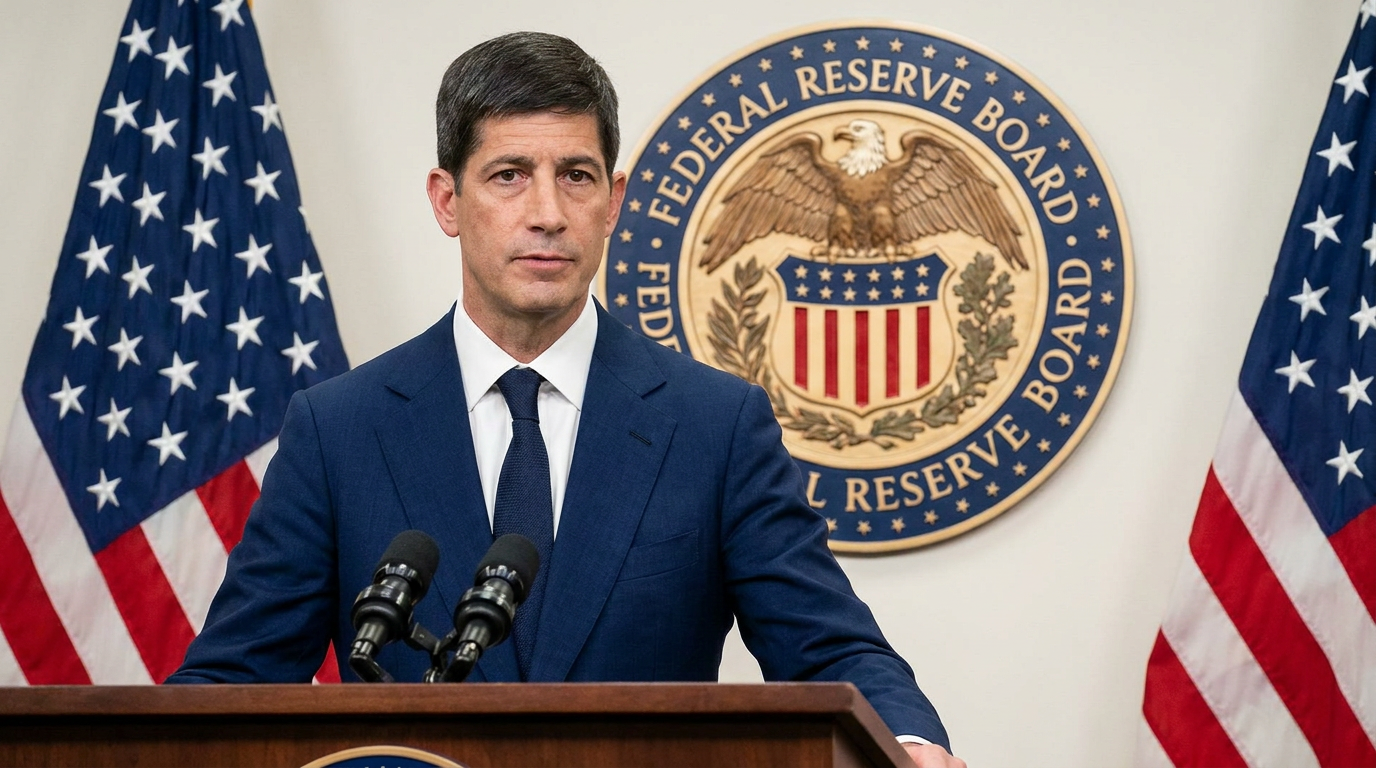
The Federal Reserve held its benchmark interest rate steady at a range of 3.50% to 3.75% on Wednesday, marking the conclusion of Kevin Warsh’s highly anticipated first meeting as chair. The unanimous 12-0 decision by the Federal Open Market Committee extends a pause on rate adjustments that has been firmly in place since the beginning of the year. While economists and financial markets widely expected the central bank to keep borrowing costs unchanged this month, the underlying message delivered by the new leadership caught Wall Street off guard. Instead of laying the groundwork for future easing, the Fed delivered a stark warning about the state of the American economy.[2][5]
Behind the steady headline rate lies a dramatic shift in the central bank's macroeconomic outlook. Facing a sudden and stubborn resurgence in consumer prices, Federal Reserve officials signaled that their next move is more likely to be a rate hike than a rate cut. This hawkish pivot represents a complete reversal of the narrative that dominated financial markets just a few months ago, when investors were confidently pricing in multiple rate reductions for the back half of the year. The realization that the 'higher for longer' era is far from over has forced a rapid recalibration of expectations across the global financial system.[2][4]
The depth of this hawkish pivot was laid bare in the Federal Reserve’s Summary of Economic Projections, commonly referred to as the 'dot plot.' This quarterly chart maps out where each policymaker expects interest rates to be in the coming years. In March, the dot plot painted a decidedly dovish picture, with 12 of the 19 participating officials projecting at least one rate cut by the end of 2026. On Wednesday, that consensus evaporated. The updated chart revealed that nine of the 18 participating policymakers now project at least one rate increase before the year is out, reflecting deep institutional concern over sticky inflation.[4][5]

Notably, the updated dot plot was missing one crucial submission. Warsh confirmed during his post-meeting press conference that he deliberately refrained from providing his own personal projection for the future path of interest rates. This highly unusual move underscores the new chairman's desire to overhaul how the Federal Reserve communicates with the public and financial markets. Warsh has been a vocal critic of the central bank's recent reliance on heavy forward guidance, arguing that it boxes policymakers into corners and creates unnecessary market volatility when economic conditions inevitably change.[2][5]
Warsh’s debut signaled a sharp, structural departure from the era of his predecessor, Jerome Powell. The committee’s post-meeting policy statement was drastically pared down, shrinking from a detailed 341 words in April to a sparse 130 words in June. This new, streamlined document stripped away previous language that had hinted at an 'easing bias' or the likelihood of further reductions in borrowing costs. Instead, it simply stated the facts of the rate decision and reaffirmed the central bank’s commitment to maintaining ample reserves in the banking system—a minimalist format highly reminiscent of the Alan Greenspan era.[2][5]
The primary catalyst for the Federal Reserve's abrupt U-turn is a stubborn and unexpected resurgence in consumer prices. U.S. inflation hit 4.2% in May—its highest level in three years—shattering hopes that the central bank had successfully guided the economy to a soft landing. This inflationary spike is being driven largely by a severe energy shock stemming from the ongoing geopolitical conflict involving Iran, which has severely disrupted global supply chains and pushed up the cost of oil, gasoline, and agricultural fertilizers.[3][8]
The primary catalyst for the Federal Reserve's abrupt U-turn is a stubborn and unexpected resurgence in consumer prices.
This energy shock has cascaded through the broader economy, accounting for roughly 40% of the recent inflationary surge and forcing the Fed to drastically revise its internal models. The central bank's updated forecasts now project that the Personal Consumption Expenditures index—the Fed's preferred inflation gauge—will end the year at an annualized 3.6%. This is a sharp upward revision from the 2.7% rate projected just three months ago. 'We've missed for five years, and we're going to fix that,' Warsh stated bluntly during his 42-minute press conference, emphasizing that the institution remains 'unanimously and unambiguously committed' to bringing inflation back down to its 2% target.[2][3]

The Federal Reserve operates under a dual mandate: it must balance the need for price stability with the goal of maximum employment. Currently, the American labor market remains remarkably robust, with employers adding a solid 172,000 positions in May. This underlying economic strength gives policymakers the confidence—and the runway—to keep borrowing costs elevated in their fight against inflation. Because businesses are still hiring and consumers are still spending, the Fed believes the economy can withstand a tighter monetary stance without immediately tipping into a recession.[2]
Financial markets reacted swiftly and negatively to the realization that relief from high interest rates is no longer imminent. The Dow Jones Industrial Average closed 500 points lower following the announcement, while the S&P 500 and the tech-heavy Nasdaq Composite both shed roughly 1%. The prospect of prolonged high rates is putting intense pressure on historically tight corporate credit spreads, raising the cost of capital for businesses that rely on floating-rate debt to fund their operations and expansion plans.[1][4]
Major financial institutions are rapidly revising their economic models in the wake of Warsh's hawkish debut. Citigroup, for example, officially pushed back its forecast for the first Federal Reserve rate cut from September to October, noting that the central bank's consensus is shifting much slower than previously anticipated. In the futures market, traders have completely abandoned their bets on summer rate cuts; instead, data from LSEG indicates that markets have now fully priced in a 25-basis-point rate hike by October.[7]
Warsh’s hawkish stance also sets the stage for a high-stakes clash with the White House. President Donald Trump, who appointed Warsh to the chairmanship earlier this year, has exerted unprecedented public pressure on the central bank to lower borrowing costs. The administration views high interest rates as an unnecessary anchor on economic growth and a significant political liability, arguing that cheaper credit is essential to stimulate capital investment and ease the financial burden on American households. Trump recently remarked that it is 'hard to believe' the Fed would consider raising rates, claiming it 'just keeps a country down.'[3][6]

By explicitly leaving the door open to rate hikes, Warsh is asserting the Federal Reserve's strict independence from political influence. During his press conference, the new chairman declined to answer whether he had spoken with the president since assuming the role, keeping the focus squarely on the macroeconomic data. This assertion of independence was praised by institutionalists and monetary hawks, who argue that bowing to political pressure would permanently damage the central bank's credibility and unmoor long-term inflation expectations.[3][6]
Looking ahead, the Federal Reserve faces a complex and highly uncertain balancing act over the summer months. Warsh has previously theorized that massive productivity gains driven by artificial intelligence could eventually help ease structural inflation, potentially justifying lower rates in the future. However, he made it clear that current economic data does not yet support cutting rates on that optimistic premise. Until the global energy shock subsides and core inflation shows consistent signs of cooling, American consumers and businesses will have to navigate a punishing landscape of elevated borrowing costs.[3][8]

How we got here
March 2026
The Fed's dot plot shows 12 of 19 officials projecting at least one rate cut by the end of the year.
May 2026
Kevin Warsh is sworn in as the new Chairman of the Federal Reserve, succeeding Jerome Powell.
May 2026
U.S. inflation hits 4.2%, a three-year high, driven by an energy shock from the Iran conflict.
June 17, 2026
Warsh leads his first FOMC meeting, holding rates steady but signaling a hawkish pivot toward potential hikes.
Viewpoints in depth
Inflation Hawks
Prioritize price stability and support higher rates to combat the energy-driven inflation spike.
This camp argues that the Federal Reserve's primary duty is to anchor inflation expectations, which have been severely tested by the recent energy shock. They support Warsh's decision to strip away forward guidance and leave the door open for rate hikes, believing that premature cuts would only reignite price pressures. For hawks, the robust labor market provides the necessary runway to keep borrowing costs elevated until the 4.2% inflation rate is decisively broken.
Financial Markets
Concerned with the repricing of assets and the impact of tighter financial conditions on corporate growth.
Investors and analysts are grappling with the reality that the 'higher for longer' era is extending further into the future. This perspective highlights the immediate consequences of the Fed's hawkish pivot: tighter corporate credit spreads, lower equity valuations, and increased borrowing costs for businesses on floating-rate debt. With major banks like Citigroup pushing their rate-cut forecasts into late 2026, markets are forced to recalibrate their growth models to account for a central bank that is no longer rushing to the rescue.
The Trump Administration
Advocates for lower borrowing costs to stimulate economic growth and reduce the burden on consumers.
The White House views high interest rates as an unnecessary anchor on the U.S. economy, arguing that they stifle capital investment and hurt everyday Americans through expensive mortgages and auto loans. From this viewpoint, the current inflation spike is a temporary supply-side issue driven by global energy markets, not a structural flaw that requires punishing domestic demand. The administration has consistently pressured the Fed to cut rates, setting up a tense dynamic with the newly appointed chair.
What we don't know
- Whether the current energy shock will subside quickly or bleed into core inflation metrics like housing and services.
- How the Trump administration will respond if the Federal Reserve officially raises interest rates ahead of the midterm elections.
- If AI-driven productivity gains will materialize fast enough to naturally cool inflation without requiring further rate hikes.
Key terms
- Federal funds rate
- The target interest rate set by the Fed at which commercial banks borrow and lend their excess reserves to each other overnight.
- Dot plot
- A chart published quarterly by the Federal Reserve showing where each policymaker expects interest rates to be in the future.
- Forward guidance
- The communication tool used by a central bank to signal its future monetary policy intentions to the public and financial markets.
- Hawkish
- A monetary policy stance that prioritizes keeping inflation low, typically by favoring higher interest rates.
- Credit spread
- The difference in yield between a U.S. Treasury bond and a corporate bond of the same maturity, reflecting the extra risk of lending to a corporation.
Frequently asked
Did the Federal Reserve raise interest rates?
No. The Fed voted unanimously to hold the benchmark interest rate steady at a range of 3.50% to 3.75%.
Why are officials talking about rate hikes again?
Inflation surged to a three-year high of 4.2% in May, driven largely by an energy shock from the conflict involving Iran. This has forced the Fed to reconsider its plans for rate cuts.
When will interest rates finally go down?
Major financial institutions like Citigroup have pushed their forecasts for the first rate cut back to October 2026, though markets are currently pricing in the possibility of a rate hike before then.
How did the stock market react?
Markets reacted negatively to the hawkish tone. The Dow Jones Industrial Average dropped 500 points, and the S&P 500 fell nearly 1% following the announcement.
Sources
Source coverage
8 outlets
3 viewpoints surfaced








[1]BloombergFinancial Markets
Hawkish Fed to Put Pressure on Historically Tight Credit Spreads
Read on Bloomberg →[2]CBS NewsInflation Hawks
Federal Reserve leaves interest rates unchanged amid resurgent inflation
Read on CBS News →[3]The Washington PostInflation Hawks
Kevin Warsh commits to tame the inflation beast
Read on The Washington Post →[4]The GuardianFinancial Markets
US stock markets drop after Federal Reserve leaves interest rates unchanged
Read on The Guardian →[5]ForbesThe Trump Administration
Fed Holds Interest Rates Unchanged In Kevin Warsh's First Meeting—But Higher Rates Are Expected
Read on Forbes →[6]Business InsiderThe Trump Administration
Wall Street reacts to Kevin Warsh's first Fed meeting
Read on Business Insider →[7]FinimizeFinancial Markets
Citi Just Pushed Back Its Fed Rate-Cut Call
Read on Finimize →[8]Northeastern Global NewsInflation Hawks
What to expect from Kevin Warsh's first meeting
Read on Northeastern Global News →

Every angle. Every day.
Get business stories with full source coverage and perspective breakdowns delivered to your inbox.