
Do LED Face Masks Actually Work? The Clinical Evidence Behind the Glow
At-home LED face masks promise to reduce wrinkles and clear acne using light therapy, but clinical data reveals that their success depends entirely on specific wavelengths and months of daily consistency.
By Factlen Editorial Team
- Clinical Dermatologists
- Medical professionals who view at-home masks as a helpful adjunct but warn against over-reliance.
- Home Beauty Tech Advocates
- Consumers and beauty editors who champion the accessibility and cumulative benefits of daily at-home treatments.
- Clinical Researchers
- Scientists focused on the precise wavelengths and power densities required to achieve photobiomodulation.
What's not represented
- · Consumers with darker skin tones (Fitzpatrick IV-VI) who may experience different heat sensitivities
- · Ophthalmologists evaluating long-term retinal safety
Why this matters
At-home LED masks cost between $150 and $500, representing a significant investment for consumers. Understanding the clinical evidence separates proven cellular benefits from marketing hype, ensuring buyers choose the right wavelengths for their specific skin concerns without wasting money.
Key points
- Red and near-infrared light stimulate collagen production and reduce fine lines without causing thermal damage.
- Blue light targets and destroys acne-causing bacteria on the skin's surface.
- At-home masks are significantly less powerful than in-clinic panels, requiring daily use to achieve results.
- Visible improvements in skin structure typically require 12 to 16 weeks of consistent treatment.
- Eye protection is essential when using masks that feature blue light channels.
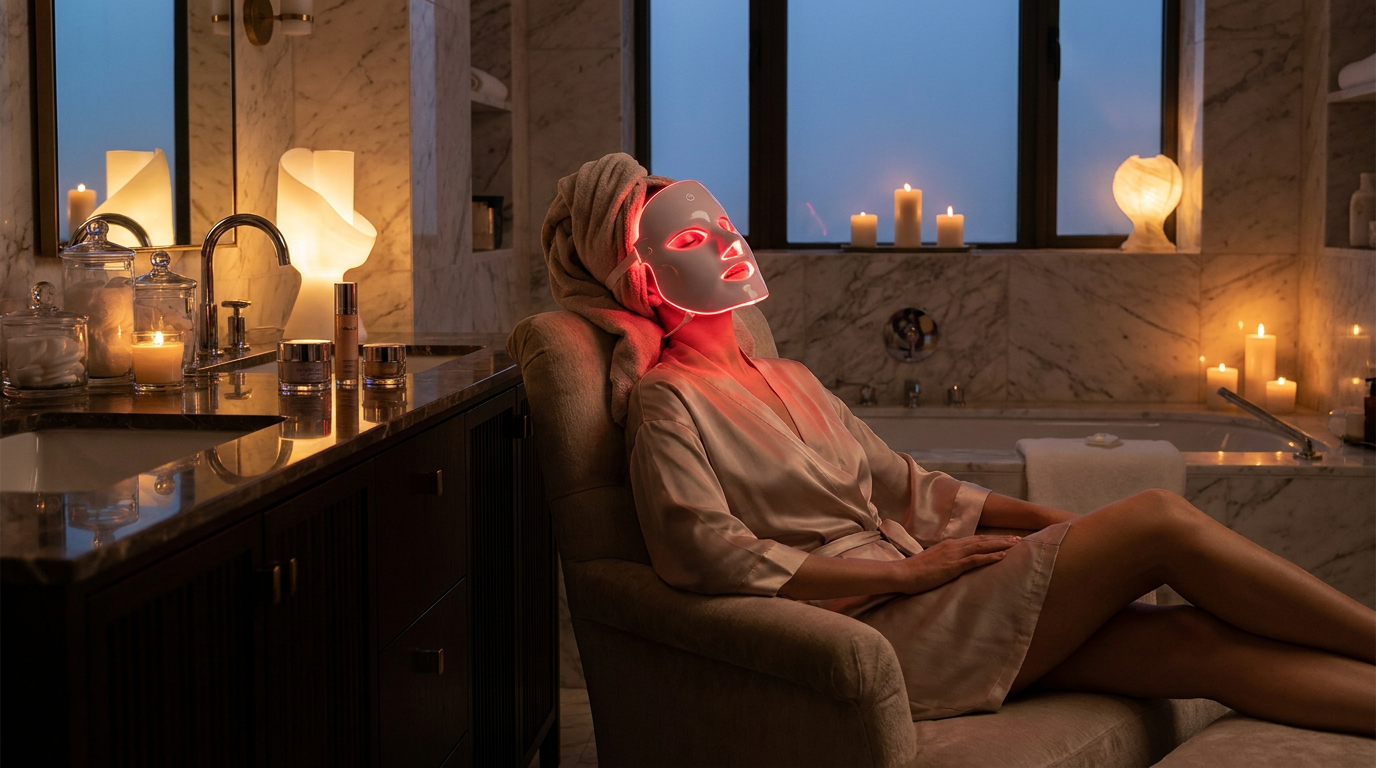
If you have scrolled through any social media platform recently, you have likely encountered the unmistakable glow of an LED face mask. Looking somewhere between a futuristic spa treatment and a Star Wars prop, these glowing contraptions have migrated from the offices of elite dermatologists directly into the nighttime routines of millions. Promising to erase fine lines, banish acne, and deliver a radiant complexion, these devices command premium prices, often ranging from $150 to well over $500. But as the market floods with knockoffs and competing claims, consumers are left asking a fundamental question: is this a genuine revolution in at-home skincare, or merely a highly photogenic placebo? The answer, buried in clinical literature and dermatological consensus, reveals that the technology is remarkably effective—provided you understand exactly what you are buying and have the patience to see it through.[7]
The science powering these glowing masks is known as photobiomodulation, a process originally studied by NASA in the 1990s to promote plant growth and accelerate wound healing in astronauts. Unlike lasers or intense pulsed light treatments that rely on controlled thermal damage to trigger the skin’s healing response, LED therapy is entirely non-invasive and generates no heat. Instead, specific wavelengths of light penetrate the skin and are absorbed by the mitochondria—the energy-producing powerhouses within our cells. This absorption stimulates the production of adenosine triphosphate, effectively giving the cells more energy to perform their natural functions. In the context of skincare, this cellular energy boost accelerates tissue repair, reduces inflammation, and most importantly, kicks collagen and elastin production into high gear.[4][5]
When evaluating the evidence for anti-aging, the clinical literature heavily favors two specific wavelengths: red light at approximately 633 nanometers and near-infrared light at 830 nanometers. Red light penetrates the outer layers of the skin to stimulate cellular turnover and improve surface texture, while the invisible near-infrared light reaches deeper into the dermis to target fibroblasts, the cells responsible for synthesizing collagen. A landmark 2018 review published in the Journal of Clinical and Aesthetic Dermatology analyzed multiple randomized controlled trials, concluding that these specific wavelengths consistently yield favorable results. Participants in these studies demonstrated measurable improvements in collagen density, a reduction in skin roughness, and a visible softening of fine lines and wrinkles without any adverse side effects.[5]

However, the clinical data also highlights a crucial caveat that marketing materials often obscure: the timeline for visible results. Photobiomodulation is a marathon, not a sprint. Because the process relies on the body’s natural collagen production cycle, changes occur at a microscopic level long before they become visible in the mirror. Clinical guidelines suggest that while some users may notice a subtle improvement in skin tone and a reduction in generalized redness within four to six weeks, significant structural changes—such as the smoothing of crow’s feet or the firming of the jawline—typically require twelve to sixteen weeks of consistent use. For consumers accustomed to the immediate, albeit temporary, plumping effects of topical serums, this required dedication can be a hurdle.[4]
Beyond anti-aging, LED masks have proven to be a formidable tool in the management of mild to moderate acne, primarily through the use of blue light. Operating at a wavelength of roughly 415 nanometers, blue light does not penetrate as deeply as its red counterpart. Instead, it remains near the surface of the skin where it specifically targets and destroys the bacteria responsible for causing breakouts. When blue light is combined with the anti-inflammatory properties of red light, the results are particularly compelling. Clinical trials have demonstrated that this dual-wavelength approach can reduce inflammatory acne lesions by up to 76 percent over a twelve-week period, offering a chemical-free alternative for sensitive, blemish-prone skin.[5][6]
Beyond anti-aging, LED masks have proven to be a formidable tool in the management of mild to moderate acne, primarily through the use of blue light.
Despite these proven mechanisms, clinical dermatologists are quick to point out the vast difference between the medical-grade LED panels used in their clinics and the battery-powered masks sold to consumers. The critical metric here is irradiance, or power density, measured in milliwatts per square centimeter. Professional in-clinic panels typically deliver an irradiance of 30 to over 100 milliwatts per square centimeter, flooding the skin with therapeutic light in a matter of minutes. In contrast, the average at-home mask outputs between 5 and 15 milliwatts per square centimeter. While the wavelengths are identical, the lower power density of home devices means they must be used much more frequently—often daily—to achieve a cumulative dose that approaches clinical efficacy.[2]

This disparity in power leads to one of the primary concerns among medical professionals: the risk of delayed treatment. Dermatologists warn that while at-home masks are excellent for maintenance and mild improvements, they are not a substitute for medical intervention in severe cases. Patients suffering from cystic acne or rapid, severe collagen loss may spend months diligently using an underpowered home device, only to see minimal results. In the case of severe acne, this delay can be particularly detrimental, as prolonged inflammation significantly increases the risk of permanent textural scarring. Experts stress that LED masks should be viewed as an adjunct to, rather than a replacement for, prescription topicals and professional care.[2]
For those ready to invest, the market is currently divided into two dominant design philosophies, each with distinct clinical advantages. The first camp utilizes flexible silicone, championed by devices like the Omnilux Contour Face. By using a pliable material that straps tightly to the head, these masks ensure that the LED diodes sit flush against the skin. This proximity minimizes light scatter and maximizes absorption, which is particularly important for the deeper-penetrating near-infrared wavelengths. These flexible models typically focus exclusively on the 633-nanometer red and 830-nanometer near-infrared spectrums, making them the preferred choice for users whose primary goal is long-term collagen stimulation and deep tissue repair.[6]
The second design philosophy features rigid plastic shells, most notably seen in the Dr. Dennis Gross SpectraLite FaceWare Pro. While these masks sit slightly further from the skin, they often compensate by offering multiple light channels within a single device. The SpectraLite, for example, incorporates both red and blue light diodes, allowing users to toggle between anti-aging treatments, acne-fighting sessions, or a combination of both. Furthermore, the rigid design often allows for higher-powered diodes that reduce the required treatment time; the Dr. Dennis Gross mask requires only a three-minute daily session, compared to the ten-minute commitment required by most flexible silicone competitors.[6]

When it comes to safety, the consensus across the medical community is overwhelmingly positive. Because LED therapy is non-ionizing, it carries zero risk of causing the DNA damage associated with ultraviolet light from the sun or tanning beds. The treatments are painless, require no downtime, and are generally safe for all skin tones. However, there are specific contraindications. Individuals with photosensitive conditions, such as lupus, or those taking medications that increase light sensitivity—including certain antibiotics and prescription retinoids—are advised to consult with a physician before beginning an LED regimen, as the concentrated light could trigger an adverse reaction.[1][3]
The most pressing safety mandate from ophthalmologists and dermatologists concerns eye protection, particularly when utilizing blue light. While red and near-infrared light are generally benign to ocular tissue, prolonged exposure to intense blue light can cause photochemical damage to the retina. Medical professionals stress that users should never look directly into the diodes of an active mask. If a device features a blue light channel, it is absolutely imperative to use the built-in eye shields or the blackout goggles provided by the manufacturer. Even with red-only masks, many experts recommend keeping the eyes closed during the treatment session to prevent unnecessary strain and ensure complete safety.[1][4]
Ultimately, the evidence confirms that at-home LED face masks are far more than a social media gimmick; they are a scientifically validated tool for skin rejuvenation. However, their success is entirely dependent on the user's commitment and expectations. They will not deliver the overnight transformation of a chemical peel or the dramatic lifting of a surgical procedure. Instead, they offer a slow, steady, and cumulative improvement in cellular health. For the consumer willing to dedicate ten minutes a day, every day, for several months, the reward is a measurable increase in collagen, a reduction in breakouts, and a genuinely healthier complexion built from the inside out.[2][3][7]
How we got here
1990s
NASA studies red and near-infrared light for plant growth and wound healing in space.
2010s
LED phototherapy becomes a staple in dermatology clinics for treating acne and aging.
2020
Flexible silicone at-home masks enter the consumer market, making daily treatments accessible.
2024
Clinical literature expands, confirming the efficacy of at-home devices when used consistently over 12+ weeks.
Viewpoints in depth
Clinical Dermatologists
Medical professionals who view at-home masks as a helpful adjunct but warn against over-reliance.
Dermatologists generally agree that the underlying science of photobiomodulation is sound. However, they emphasize a crucial distinction in power density: in-clinic LED panels deliver significantly more energy than battery-powered home masks. Their primary concern is that patients with severe acne or rapidly aging skin might delay seeking prescription treatments or professional procedures, relying instead on home devices that only offer 'modest' improvements over long periods.
Home Beauty Tech Advocates
Consumers and beauty editors who champion the accessibility of daily at-home treatments.
For skincare enthusiasts, the appeal of LED masks lies in the cumulative effect of daily use. While acknowledging that a single 10-minute home session cannot match a clinic treatment, advocates argue that the convenience of treating skin while watching TV or reading leads to higher compliance. Over a 12-week period, this consistent, low-dose exposure yields undeniable improvements in skin texture, tone, and overall radiance without the recurring costs of professional appointments.
What we don't know
- Whether decades of daily at-home LED use could have unforeseen long-term effects on facial fat pads or ocular health.
- Exactly how much product penetration is enhanced when LED masks are used directly over active skincare ingredients.
Key terms
- Photobiomodulation
- The use of specific wavelengths of light to stimulate cellular function, promote healing, and reduce inflammation.
- Irradiance
- The power density of the light emitted by a device, typically measured in milliwatts per square centimeter (mW/cm²).
- Near-Infrared (NIR) Light
- Invisible light wavelengths (typically 830-850nm) that penetrate deeper into the skin than visible red light to support tissue repair.
- Wavelength
- The distance between successive crests of a light wave, measured in nanometers (nm), which determines the light's color and how deeply it penetrates the skin.
Frequently asked
Can I use an LED mask over my skincare serums?
It is best to use LED masks on clean, dry skin. While some lightweight serums can be applied beforehand if the manufacturer specifies, heavy creams or sunscreens will block the light.
Do LED face masks cause facial fat loss?
No. The wavelengths used in at-home LED masks (red, blue, and near-infrared) do not penetrate deeply enough or generate enough heat to affect subcutaneous fat pads.
How long does it take to see results?
Clinical studies suggest that while minor improvements in skin tone may appear in 4 to 6 weeks, significant changes in collagen density and wrinkle reduction require 12 to 16 weeks of consistent use.
Is it safe to use an LED mask every day?
Yes, most FDA-cleared at-home masks are designed for daily use. However, users should strictly follow the manufacturer's recommended session time, usually between 3 and 10 minutes.
Sources
Source coverage
7 outlets
3 viewpoints surfaced







[1]Mayo ClinicClinical Researchers
Are LED face masks worth it?
Read on Mayo Clinic →[2]The IndependentClinical Dermatologists
Dermatologists warn over at-home LED face masks
Read on The Independent →[3]Global NewsClinical Dermatologists
Do LED face masks actually work? What dermatologists say
Read on Global News →[4]Boulder Medical CenterClinical Researchers
The Bottom Line on At-Home Red-Light Masks
Read on Boulder Medical Center →[5]Journal of Clinical and Aesthetic DermatologyClinical Researchers
Phototherapy with light emitting diodes: Treating a broad range of medical and aesthetic conditions in dermatology
Read on Journal of Clinical and Aesthetic Dermatology →[6]CelliaraHome Beauty Tech Advocates
Two of the most clinically-backed LED masks compared
Read on Celliara →[7]Factlen Editorial TeamHome Beauty Tech Advocates
Synthesis by Factlen editorial team
Read on Factlen Editorial Team →


Every angle. Every day.
Get shopping stories with full source coverage and perspective breakdowns delivered to your inbox.