
Decoding the Code of Points: How Modern Gymnastics Scoring Works
Elite gymnastics abandoned the Perfect 10 in 2006 in favor of an open-ended scoring system. Here is exactly how the modern D-Score and E-Score math works.
By Factlen Editorial Team
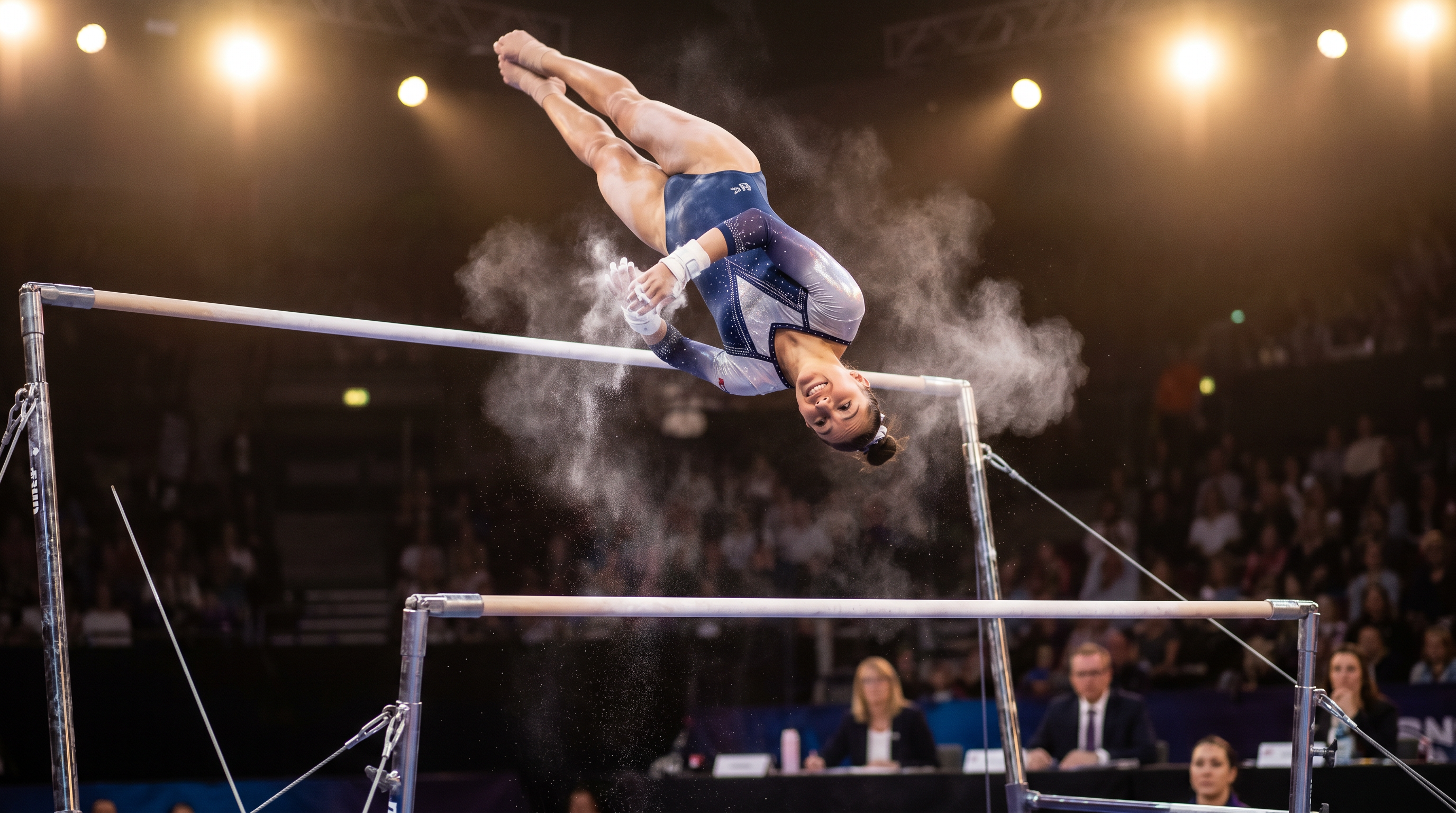
- Difficulty Innovators
- Argue that the open-ended code rightfully rewards athletes who push the boundaries of human physics and risk.
- Artistry Purists
- Believe the pursuit of high D-scores has sacrificed the fluid, dance-like artistry that once defined the sport.
- Technical Evaluators
- Focus on the mathematical objectivity the new system brings, separating athletes based on quantifiable metrics rather than subjective perfection.
What's not represented
- · Casual viewers who tune in exclusively for the Olympics and remain confused by the absence of the Perfect 10.
- · Lower-level club gymnasts who still compete under modified 10.0 systems before reaching the elite ranks.
Why this matters
Understanding the modern gymnastics scoring system transforms how you watch the sport, turning a confusing jumble of numbers into a clear, strategic battle of risk versus reward. By knowing how the math works, viewers can instantly recognize why a seemingly flawless routine might lose to one with a visible stumble.
Key points
- The Perfect 10 was abolished in elite gymnastics in 2006 to allow for infinite progression in skill difficulty.
- Modern scores combine a Difficulty Score (D-Score) with an Execution Score (E-Score).
- The D-Score has no maximum limit and is calculated by adding the values of the routine's hardest skills.
- The E-Score starts at 10.0, with judges deducting points for every form break, step, or fall.
- A final score is calculated by adding the D-Score and E-Score, then subtracting any neutral penalties.
For decades, the "Perfect 10" was the holy grail of sports. When Nadia Comaneci scored the first 10.0 at the 1976 Montreal Olympics, the scoreboard famously flashed "1.00" because it wasn't programmed to display double digits. The 10.0 became synonymous with flawless athletic achievement, cementing gymnastics as a pursuit of absolute perfection.[6]
But if you tune into the Olympics or World Championships today, you won't see a 10.0. Instead, you'll see scores like 14.833 or 15.200. For casual viewers who only watch gymnastics every four years, the math can feel baffling, leaving many to wonder why the sport abandoned its most iconic metric.[1][4]
The reality is that the Perfect 10 is dead in elite international competition, replaced by the "open-ended" Code of Points. This system, implemented in 2006, fundamentally changed the sport by splitting gymnastics scoring into two distinct halves: what you do, and how well you do it.[2][3][4][5]

The catalyst for this massive shift occurred at the 2004 Athens Olympics. A series of high-profile judging controversies—most notably involving Russian gymnast Alexei Nemov and American Paul Hamm—exposed a fatal mathematical flaw in the 10.0 system that could no longer be ignored.[6][8]
Under the old rules, a gymnast's "Start Value" was capped at 10.0. Once multiple athletes reached that maximum Start Value, judges had no mathematical way to reward a gymnast who performed a significantly more dangerous or complex routine. The sport had hit a ceiling, and athletes were being held back by the math.[1][3][8]
Enter the modern Code of Points. Today, every routine receives a Difficulty Score (D-Score) and an Execution Score (E-Score). The D-Score is open-ended, meaning it starts at zero and has no maximum limit, allowing athletes to continually push the boundaries of human capability.[2][5]
The D-Score is calculated by adding up the most difficult elements in a routine. For women, the judges count the top eight skills performed during the routine; for men, they count the top ten.[4]
Every recognized skill in gymnastics is assigned a letter value based on its complexity and risk. An "A" skill is worth 0.1 points, a "B" is 0.2, all the way up to a "J" skill—the most dangerous and complex moves in the world—which is worth a full 1.0 point.[4][5]

Every recognized skill in gymnastics is assigned a letter value based on its complexity and risk.
Gymnasts can also earn "Connection Value" by linking difficult skills together without a pause, and they receive specific points for meeting compositional requirements. When you add the top skills, the connections, and the requirements, you get the D-Score. A world-class D-Score today typically sits between 5.5 and 6.5.[1][2][4][8]
The second half of the equation is the Execution Score (E-Score). This is where the ghost of the Perfect 10 still lives. The E-Score starts at a base of 10.0, and judges deduct points for every error in form, technique, and artistry.[1][5][7]
Deductions are brutal and granular. A small step on a landing or a slight leg separation might cost 0.1 points. A large step or deep squat costs 0.3. A fall from the apparatus results in a massive 1.0 point deduction in elite competition, severely damaging medal hopes.[2][4][7]
Because the modern code is so strict, a "perfect" 10.0 E-Score is practically impossible. In today's elite landscape, an E-Score in the low-to-mid 8s is considered exceptional, and anything above a 9.0 is historically rare.[8]
To ensure fairness, a large panel of judges evaluates every routine. The D-panel calculates the difficulty, while a separate E-panel of six judges evaluates the execution independently.[7]
The highest and lowest E-scores from the panel are thrown out, and the middle four are averaged to prevent outlier bias. Finally, any "neutral deductions"—such as stepping out of bounds on the floor exercise or going over the time limit—are subtracted.[2][4][5][7]

The final equation is simple: D-Score + E-Score - Neutral Deductions = Total Score. If a gymnast has a 6.0 D-Score and an 8.5 E-Score, their final score is 14.500.[2][5]
When the FIG first proposed this system, critics feared it would ruin the sport's artistry. Purists argued that an open-ended D-Score would encourage gymnasts to "chuck" dangerous skills with poor form just to rack up difficulty points.[1][8]
How we got here
1976
Nadia Comaneci scores the first Perfect 10 at the Montreal Olympics, cementing the 10.0 as the sport's ultimate benchmark.
2004
Scoring controversies at the Athens Olympics expose the mathematical limitations of the capped 10.0 Start Value.
2006
The International Gymnastics Federation officially abolishes the Perfect 10, introducing the open-ended Code of Points.
2024
The Paris Olympics showcase the evolution of the open code, with athletes routinely scoring in the 14s and 15s through unprecedented difficulty.
Viewpoints in depth
Difficulty Innovators
Argue that the open-ended code rightfully rewards athletes who push the boundaries of human physics and risk.
For athletes and coaches pushing the sport's limits, the open-ended Code of Points is a necessary evolution. Under the old 10.0 system, a gymnast performing a safe, simple routine could tie with an athlete risking a highly complex, dangerous release move, provided both executed flawlessly. Innovators argue that removing the scoring ceiling fundamentally changed the sport's trajectory, incentivizing generational talents to invent new skills and elevate the baseline of human athletic capability. They view the complex math not as a burden, but as an accurate reflection of the sport's extreme physical demands.
Artistry Purists
Believe the pursuit of high D-scores has sacrificed the fluid, dance-like artistry that once defined the sport.
Critics of the modern scoring system often point to the loss of fluid, expressive choreography, particularly on the floor exercise and balance beam. Because the D-Score heavily rewards acrobatic difficulty and complex skill connections, purists argue that routines have become disjointed series of tumbling passes separated by brief pauses to set up the next trick. While the International Gymnastics Federation has recently introduced stricter artistry deductions to combat this trend, purists maintain that the open-ended code inherently prioritizes raw power and acrobatics over the dance and elegance that characterized the Perfect 10 era.
Technical Evaluators
Focus on the mathematical objectivity the new system brings, separating athletes based on quantifiable metrics rather than subjective perfection.
For judges and technical officials, the open-ended code solved a critical mathematical crisis. In the early 2000s, the clustering of top athletes at the 10.0 ceiling made it nearly impossible to fairly separate medalists without resorting to microscopic, highly subjective execution deductions. By splitting the score into a quantifiable difficulty baseline (D-Score) and a strict execution metric (E-Score), evaluators argue the sport is now judged much more objectively. The separation of the judging panel into D-panels and E-panels further insulates the final score from individual bias, ensuring that the athlete who wins is genuinely the one who performed the most difficult routine with the fewest errors.
What we don't know
- How high the D-Score ceiling can ultimately go as training technology and sports science continue to improve.
- Whether the International Gymnastics Federation will eventually overhaul the code again to force a stronger return to traditional dance and artistry.
Key terms
- Code of Points
- The official rulebook that defines the scoring system and skill values in international gymnastics.
- D-Score
- The Difficulty Score, an open-ended total based on the routine's hardest skills and connections.
- E-Score
- The Execution Score, starting at 10.0, from which deductions are taken for form and errors.
- Connection Value
- Bonus points awarded for linking two or more difficult skills together without a pause.
- Neutral Deduction
- Penalties taken from the final score for non-technical errors, such as stepping out of bounds.
Frequently asked
Can a gymnast still score a Perfect 10?
No, elite gymnastics uses an open-ended system where the final score is the sum of difficulty and execution, usually landing between 13.000 and 15.500.
Why do college gymnasts still get 10s?
NCAA gymnastics uses a modified version of the old Code of Points, capping the maximum score at 10.0 to emphasize execution over extreme difficulty.
What happens if a gymnast falls?
A fall results in a flat 1.0 point deduction from the Execution Score, though the gymnast still receives the difficulty value if the skill was completed.
How many judges score a routine?
A panel of judges is split into a D-panel for difficulty and an E-panel for execution, with the highest and lowest execution scores discarded.
Sources
Source coverage
8 outlets
3 viewpoints surfaced







[1]Factlen Editorial TeamDifficulty Innovators
Synthesis by Factlen editorial team
Read on Factlen Editorial Team →[2]USA GymnasticsTechnical Evaluators
Gymnastics 101: Scoring
Read on USA Gymnastics →[3]International Gymnastics FederationTechnical Evaluators
2022-2024 Code of Points - Women's Artistic Gymnastics
Read on International Gymnastics Federation →[4]Inside GymnasticsDifficulty Innovators
Gymnastics Scoring Explained: D-Score and E-Score
Read on Inside Gymnastics →[5]GK EliteTechnical Evaluators
How is Gymnastics Scored? A Complete Guide
Read on GK Elite →[6]WikipediaTechnical Evaluators
Code of Points (artistic gymnastics)
Read on Wikipedia →[7]Rockstar AcademyTechnical Evaluators
The Scoring System in Gymnastics
Read on Rockstar Academy →[8]Gymnastics Analysis via MediumArtistry Purists
The Code of Points: Why Gymnastics Scoring Changed
Read on Gymnastics Analysis via Medium →
More in sports
See all 401 stories →Women's Sports
How Women's Wrestling Became the Fastest-Growing Collegiate Sport in America
8 sources

Engine Regulations
The 2026 Formula 1 Engine Revolution: How Sustainable Fuel and a 50/50 Hybrid Split Are Changing the Sport
8 sources

MLB Milestones
Brewers' Jacob Misiorowski Throws Historic 15-Strikeout, One-Hit Shutout
7 sources

Pitching Milestone
Jacob Misiorowski Throws Historic 15-Strikeout, One-Hit Complete Game in Brewers Win
7 sources

Every angle. Every day.
Get sports stories with full source coverage and perspective breakdowns delivered to your inbox.