
How to Build a Rain Garden: A DIY Guide to Managing Stormwater and Boosting Biodiversity
Rain gardens are shallow, planted depressions that capture and filter stormwater runoff before it reaches local waterways. By mimicking natural ecosystems, these low-maintenance landscaping features solve yard drainage issues while supporting native pollinators.
By Factlen Editorial Team
- Water Quality Advocates
- Focuses on the role of rain gardens in mitigating municipal water pollution.
- Native Plant Enthusiasts
- Prioritizes the ecological benefits of restoring native flora to residential landscapes.
- Homeowners & Landscapers
- Values the practical, aesthetic, and property-enhancing aspects of the gardens.
What's not represented
- · Municipal Planners
- · HOA Boards
Why this matters
Stormwater runoff is a leading cause of water pollution in local streams and rivers. Building a rain garden allows homeowners to actively protect their local watershed while simultaneously solving yard drainage problems and creating a low-maintenance habitat for pollinators.
Key points
- Rain gardens are shallow basins designed to capture and filter stormwater runoff from roofs and driveways.
- A successful rain garden must drain completely within 24 to 48 hours to prevent mosquito breeding.
- Native plants are essential due to their deep root systems, which create channels for water infiltration.
- Proper placement requires keeping the garden at least 10 feet away from building foundations and septic systems.
Every time a heavy storm rolls through a residential neighborhood, thousands of gallons of water cascade off roofs, rush down driveways, and flood into streets. This stormwater runoff doesn't just overwhelm municipal sewer systems; it acts as a conveyor belt for lawn chemicals, motor oil, and sediment, carrying them directly into local creeks and rivers.[4][5]
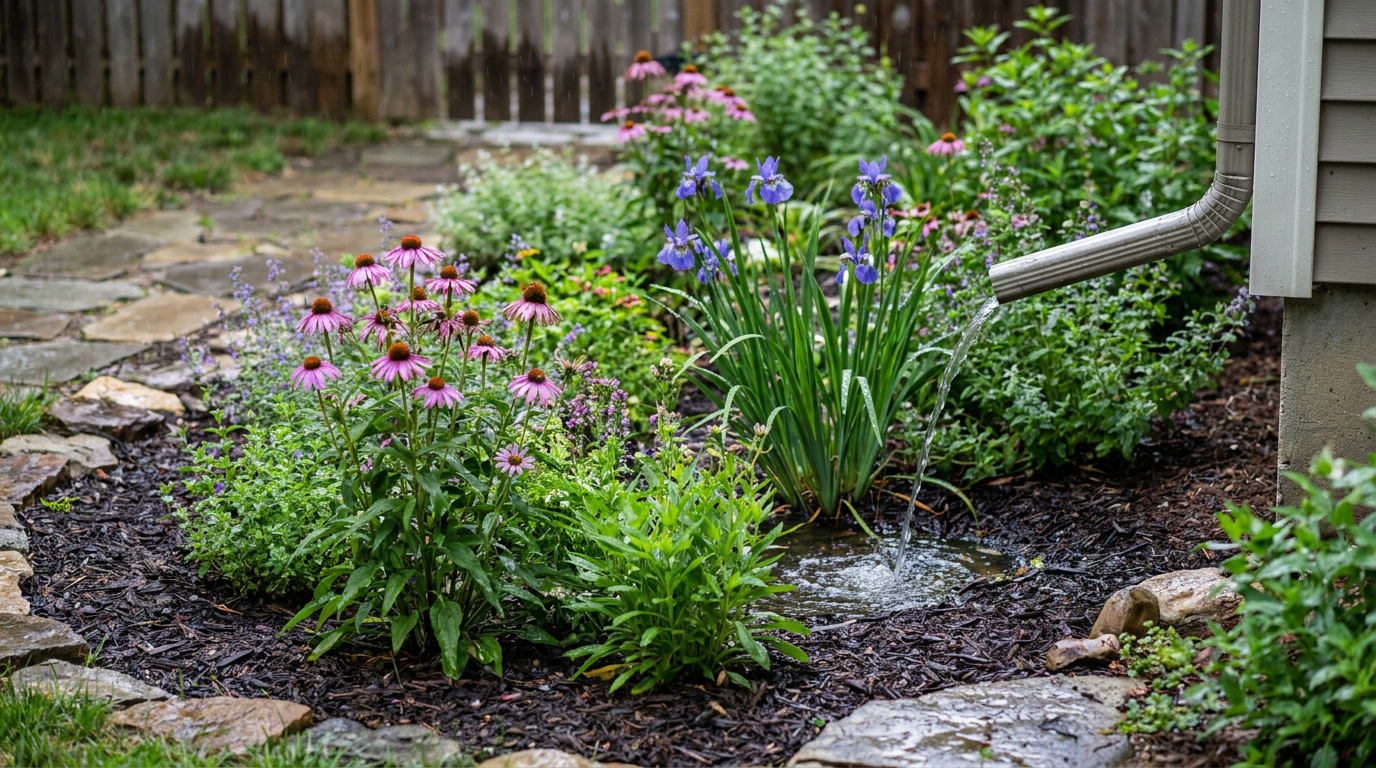
For decades, the standard landscaping approach was to usher this water off the property as quickly as possible. But a growing movement of homeowners and environmental scientists is flipping that script. Enter the rain garden: a shallow, intentionally designed depression planted with deep-rooted native species that catches runoff and allows it to slowly percolate back into the earth.[6]
"A rain garden is one of those rare landscape features that does serious work while looking beautiful doing it," notes the Factlen Editorial Team. By mimicking the natural absorption capabilities of a forest floor, a rain garden can soak up 30% more water than an equivalent patch of turf grass.[4][6]
The mechanism relies on biology and physics rather than concrete and pipes. When water pools in the basin, sediment settles out. The specialized soil matrix and the dense root systems of native plants act as a living filter, absorbing excess nutrients and allowing soil microbes to break down organic pollutants before the water recharges the underlying aquifer.[2][5]

Despite the name, a rain garden is not a pond. A properly constructed site is designed to hold a few inches of water during a storm and drain completely within 24 to 48 hours. Because mosquitoes require at least a week of standing water to breed, a functioning rain garden will never become a pest nuisance.[4][7]
Building one requires careful planning, starting with location. The site must be at least 10 feet away from any building foundation to prevent basement seepage, and it should never be placed over a septic field or directly beneath the drip line of mature trees.[2][3]
Building one requires careful planning, starting with location.
The most critical step in the process happens before a single plant is purchased: the percolation, or "perc," test. To ensure the ground can actually absorb water, homeowners must dig a hole 12 inches deep, fill it with water, and time the drainage. If the hole doesn't empty within 24 hours, the underlying soil is too compacted or clay-heavy, and the site will require extensive amendment or a different location entirely.[2][7]

Sizing the garden depends on the volume of water it needs to handle. A standard rule of thumb is to measure the square footage of the roof or driveway feeding into the garden and make the basin about 20% to 30% of that size. For a 500-square-foot roof section, a 100-square-foot garden is typically sufficient.[2]
The physical construction involves digging a broad, flat-bottomed basin usually 6 to 12 inches deep. On sloped yards, the excavated soil is repurposed to build a low, compacted mound—called a berm—on the downhill edge. This berm acts as a gentle dam, holding the runoff in the basin long enough for it to soak downward rather than spilling over the lawn.[3][6]
Soil preparation is where many DIY projects succeed or fail. If the native soil is heavy clay, experts recommend excavating deeper and replacing the base with a highly permeable "rain garden mix" consisting of roughly 50% sand, 30% compost, and 20% topsoil. This creates a sponge-like environment that encourages rapid infiltration.[2][6]

When it comes to planting, native species are non-negotiable. Unlike shallow-rooted turf grass, native wildflowers and shrubs have root systems that can plunge several feet into the earth, creating channels for water to follow. They are also uniquely adapted to the "feast or famine" water cycle of a rain garden, surviving both temporary inundation and extended summer droughts.[1][4]
The planting layout should be divided into zones. The deepest part of the basin, which stays wet the longest, is ideal for moisture-loving species like Blue Flag Iris, Cardinal Flower, or Swamp Milkweed. The sloping sides and the top of the berm, which drain quickly, are better suited for drier natives like Coneflowers, Black-eyed Susans, and native ornamental grasses.[1][6]

Maintenance is highest during the first year. Young plants require regular watering to establish their deep root systems, and the basin must be kept weed-free. A two-to-three-inch layer of undyed hardwood mulch helps suppress weeds and retain moisture, though it should be kept away from the immediate base of plant stems to prevent rot.[1][3]
Once established, a rain garden becomes a self-sustaining ecosystem. It requires no fertilizer, no mowing, and minimal supplemental watering. Beyond its hydrological benefits, it transforms a soggy yard problem into a vibrant habitat, offering a crucial waystation for native bees, butterflies, and birds.[4][5]
How we got here
Day 1
Observe yard drainage during a storm and select a location at least 10 feet from the foundation.
Day 2
Conduct a 24-hour percolation test to ensure the soil drains adequately.
Day 3
Dig the shallow basin, build the downhill berm, and amend the soil with compost and sand if necessary.
Day 4
Plant native species in groups, apply mulch, and water thoroughly to establish roots.
Viewpoints in depth
Water Quality Advocates
Focuses on the role of rain gardens in mitigating municipal water pollution.
For environmental scientists and watershed protection groups, rain gardens are decentralized infrastructure. They argue that traditional stormwater management—funneling water into storm sewers—is fundamentally flawed because it concentrates pollutants and causes downstream erosion. By capturing runoff at the source, residential rain gardens act as micro-treatment plants, utilizing soil microbes to break down hydrocarbons and filtering out heavy metals before they can reach vulnerable rivers and bays.
Native Plant Enthusiasts
Prioritizes the ecological benefits of restoring native flora to residential landscapes.
Botanists and wildlife advocates view rain gardens primarily as habitat restoration. They emphasize that modern lawns are ecological deserts. By replacing turf grass with deep-rooted native species, rain gardens provide critical foraging grounds for pollinators, birds, and beneficial insects. This camp advocates for strict adherence to locally native plant lists, arguing that the success of the garden depends on the evolutionary relationship between the local climate, the soil, and the native fauna.
Homeowners & Landscapers
Values the practical, aesthetic, and property-enhancing aspects of the gardens.
For property owners, the appeal of a rain garden is often highly practical: it solves persistent yard drainage issues. Instead of fighting a perpetually muddy spot or paying for expensive underground French drains, landscapers use rain gardens to turn a negative into a landscape feature. This perspective values low long-term maintenance, curb appeal, and the cost-effectiveness of using natural topography to manage water.
What we don't know
- Exactly how climate change and increasingly severe, concentrated rainfall events will affect the long-term sizing standards for residential rain gardens.
- The precise lifespan of a rain garden's soil filtration capacity before heavy metals and pollutants require the soil to be excavated and replaced.
Key terms
- Stormwater runoff
- Rainwater that flows over impervious surfaces like roofs and driveways, picking up pollutants instead of soaking into the ground.
- Percolation test
- A simple method to measure how quickly soil absorbs water, used to determine if a site has adequate drainage.
- Berm
- A slightly raised mound of earth built on the downhill side of a rain garden to hold water in the basin.
- Impervious surface
- Any material, such as concrete, asphalt, or roofing, that prevents water from infiltrating into the soil.
Frequently asked
Will a rain garden attract mosquitoes?
No. A properly designed rain garden drains completely within 24 to 48 hours, which is not enough time for mosquito larvae to hatch and develop.
Do I need a large yard to build a rain garden?
Not at all. Even a small rain garden of 100 square feet can effectively capture runoff from a single downspout and make a positive environmental impact.
Can I plant vegetables in my rain garden?
It is not recommended. Rain gardens filter pollutants from roof and driveway runoff, so edible plants should be kept in separate, raised beds.
Sources
Source coverage
7 outlets
3 viewpoints surfaced







[1]Washington State University ExtensionHomeowners & Landscapers
Rain Garden Basics and How to Build a Rain Garden
Read on Washington State University Extension →[2]Take Care of Texas (TCEQ)Water Quality Advocates
How to Build a Rain Garden
Read on Take Care of Texas (TCEQ) →[3]UC Master Gardener ProgramNative Plant Enthusiasts
Building a Rain Garden
Read on UC Master Gardener Program →[4]Alliance for the Chesapeake BayWater Quality Advocates
How to Plant a Rain Garden
Read on Alliance for the Chesapeake Bay →[5]New Hampshire Department of Environmental ServicesWater Quality Advocates
How to Build a Rain Garden in Your Yard
Read on New Hampshire Department of Environmental Services →[6]Factlen Editorial TeamHomeowners & Landscapers
Synthesis by Factlen editorial team
Read on Factlen Editorial Team →[7]Missouri Botanical GardenNative Plant Enthusiasts
Design and Build a Rain Garden
Read on Missouri Botanical Garden →
More in home
See all 33 stories →Home Electrification
The Economics and Mechanics of the Zero-Emission Home Retrofit
6 sources

Appliance Tech
How Induction Cooking Works: The Science and Stakes Behind the Kitchen Transition
8 sources

Neuroaesthetics
The Science of the 'Sensory Sanctuary': How Interior Design Literally Rewires Your Brain
6 sources

Neuroaesthetics
The Science of a Happy Home: How Neuroaesthetics is Rewiring Interior Design
7 sources

Every angle. Every day.
Get home stories with full source coverage and perspective breakdowns delivered to your inbox.