
DOJ Approves $111 Billion Paramount-Warner Bros. Merger, Reshaping Media Landscape
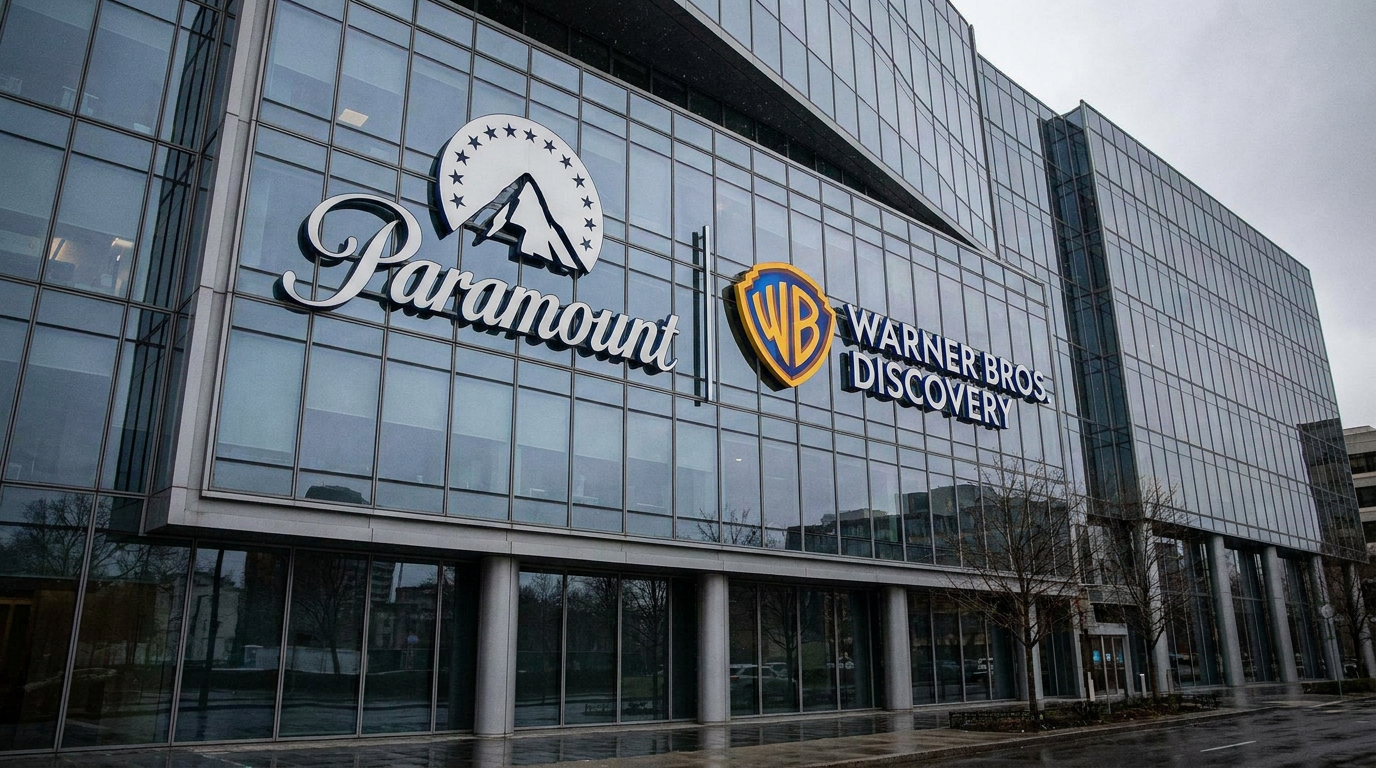
The Justice Department has cleared Paramount Skydance's acquisition of Warner Bros. Discovery, removing a major federal hurdle for the mega-merger. The deal, which combines CNN and CBS News, now faces state-level lawsuits and international scrutiny.
By Factlen Editorial Team
- Merger Proponents & Regulators
- Argue the deal creates a necessary competitor to tech giants and will not harm consumers.
- Media Watchdogs & Critics
- Warn of unprecedented media consolidation, political influence over newsrooms, and job losses.
- Archivists & Historians
- Concerned about the privatization and potential restriction of historic news footage from CNN and CBS.
What's not represented
- · Independent filmmakers who rely on studio distribution deals
- · Rank-and-file union employees at CBS and CNN facing potential layoffs
Why this matters
This merger fundamentally alters the American media ecosystem by placing major film studios, streaming platforms, and two of the nation's largest news networks (CNN and CBS News) under a single corporate owner. The consolidation will likely lead to streaming service changes, significant industry job cuts, and potential shifts in national news coverage.
Key points
- The U.S. Justice Department approved Paramount Skydance's $111 billion acquisition of Warner Bros. Discovery.
- Regulators concluded the deal will not harm competition in streaming, linear television, or theatrical releases.
- The merger places major news networks CNN and CBS News under common ownership.
- Critics and Democratic lawmakers argue the approval was politically motivated by the Trump administration.
- The deal still faces potential lawsuits from state attorneys general in California and New York.
- European regulators are investigating $24 billion in Middle Eastern sovereign wealth funding backing the merger.
The U.S. Department of Justice has officially cleared Paramount Skydance's $111 billion acquisition of Warner Bros. Discovery, removing the largest federal hurdle to a transaction that will fundamentally reshape the American media landscape. Following an eight-month antitrust investigation, regulators concluded on Friday that the mega-merger would not harm competition or consumers in the streaming, linear television, or theatrical film markets.[1][2][3][8]
The approval paves the way for David Ellison—the billionaire son of Oracle founder and prominent Donald Trump ally Larry Ellison—to unite a sprawling portfolio of legacy assets under a single corporate umbrella. The combined entity will house Paramount Pictures and Warner Bros., streaming platforms HBO Max and Paramount+, and cable giants including TNT and MTV. Most consequentially for the political landscape, the deal places two of the nation's most influential news organizations, CBS News and CNN, under common ownership.[1][3][4][5][7][9]
In its official rationale, the Justice Department's Antitrust Division stated that its review of over two million documents indicated the merger would actually increase competition. Regulators argued that combining the two companies' streaming services would create a more robust alternative capable of challenging deep-pocketed tech giants like Netflix, Amazon, and Disney. David Ellison has also pledged to release a combined 30 films annually with a guaranteed 45-day exclusive theatrical window, alleviating some concerns about reduced studio output.[1][2][8][9]

However, the federal green light has ignited fierce backlash from media watchdogs and Democratic lawmakers, who accuse the Trump administration's Justice Department of rubber-stamping the deal for political reasons. Critics point to the Ellison family's close ties to the president, who has frequently criticized CNN's coverage and publicly praised the prospect of new ownership. Senator Elizabeth Warren condemned the approval, characterizing it as a handover of the American media ecosystem to "Trump-aligned billionaires."[1][4][5][7][9]
Critics point to the Ellison family's close ties to the president, who has frequently criticized CNN's coverage and publicly praised the prospect of new ownership.
Concerns over editorial independence have been amplified by recent leadership changes. Paramount's decision to hire conservative commentator Bari Weiss to oversee CBS News has been widely interpreted by industry observers as a move to appease the administration and signal a rightward shift. Journalists within both CNN and CBS News have expressed deep anxiety over potential editorial interference, as well as the looming threat of severe job cuts stemming from the $6 billion in "synergies" promised to investors.[1][7][9]

Beyond the immediate political and economic fallout, historians and documentary filmmakers are sounding the alarm over the privatization of the networks' vast video archives. The Archival Producers Alliance warns that placing the historical libraries of both CNN and CBS News under a single corporate entity risks restricting public and journalistic access to decades of raw footage and original reporting. They argue that corporate cost-cutting or political pressure could lead to exorbitant licensing fees or outright censorship of historically significant material.[6]
Despite the Justice Department's clearance, the merger is not yet a finalized reality. State-level pushback is mounting, with California Attorney General Rob Bonta and his New York counterpart reportedly preparing their own antitrust lawsuits to block the consolidation. To succeed, state prosecutors will face the steep legal burden of convincing a judge that federal regulators fundamentally erred in their extensive review.[3][5]

The transaction also faces intense international scrutiny. The United Kingdom's Competition and Markets Authority recently launched an inquiry to determine if the deal will substantially lessen competition, with a preliminary decision due in August. Meanwhile, the European Commission is investigating the complex financing behind the merger, specifically focusing on $24 billion in backing from sovereign wealth funds in Saudi Arabia, the United Arab Emirates, and Qatar.[1]
As the legal and regulatory battles shift to state courts and European capitals, the broader entertainment industry is bracing for a seismic contraction. If finalized, the Paramount-Warner Bros. Discovery merger will mark the end of an era for Hollywood's legacy studios, consolidating unprecedented cultural and informational power into a single, highly scrutinized conglomerate.[3][7]
How we got here
Oct 2025
Warner Bros. Discovery board places the company up for auction to maximize shareholder value.
Dec 2025
Netflix reaches an initial $82.7 billion agreement to acquire WBD, sparking industry concern over theatrical releases.
Feb 2026
Paramount Skydance outbids Netflix, reaching a definitive $111 billion all-cash agreement with WBD.
Apr 2026
WBD shareholders officially vote to approve the sale to Paramount Skydance.
Jun 2026
The U.S. Justice Department clears the merger, though state and international reviews remain pending.
Viewpoints in depth
Regulators & Proponents
The view that consolidation is necessary to compete with tech giants.
The Justice Department and corporate executives argue that the legacy media industry is in a fight for survival against massive technology companies like Netflix, Amazon, and Apple. From this perspective, merging Paramount and Warner Bros. Discovery is the only way to create a streaming platform with enough scale and content to remain viable. Proponents emphasize that the deal will not reduce output, pointing to commitments to maintain robust theatrical release schedules.
Media Watchdogs & Critics
The view that the merger threatens journalistic independence and consumer choice.
Consumer advocates and Democratic lawmakers view the merger as a dangerous consolidation of informational power. They argue that placing CNN and CBS News under the control of David Ellison—whose family has close ties to the Trump administration—poses a severe threat to editorial independence. Furthermore, critics warn that the $6 billion in promised 'synergies' will inevitably lead to mass layoffs, reduced local news coverage, and higher subscription prices for consumers.
Archivists & Historians
The view that corporate consolidation threatens the preservation of historical records.
Documentary filmmakers and archival producers are raising alarms about the privatization of the nation's visual history. CNN and CBS News hold some of the most comprehensive video libraries of modern American history. Archivists fear that merging these repositories under a single, cost-cutting corporate entity could result in the destruction of raw footage, restricted public access, or exorbitant licensing fees that would make historical documentary production financially unfeasible.
What we don't know
- Whether state attorneys general in California and New York will successfully secure an injunction to block the merger.
- How the UK and European regulators will rule on the transaction, particularly regarding the $24 billion in Middle Eastern sovereign wealth funding.
- The exact timeline for the phase-out of Paramount+ and the resulting pricing structure for the combined streaming service.
- How the merger will ultimately impact the editorial direction and staffing levels at CNN and CBS News.
Key terms
- Antitrust Division
- A branch of the U.S. Department of Justice responsible for enforcing laws against monopolies and anti-competitive business practices.
- Linear television
- Traditional broadcast and cable television programming that is watched as it airs on a set schedule, rather than streamed on demand.
- Sovereign wealth fund
- A state-owned investment fund that invests in real and financial assets globally, often funded by a country's surplus reserves.
- Synergies
- A corporate term for the financial benefits and cost savings achieved by combining two companies, often resulting in job cuts and consolidated operations.
Frequently asked
Will this merger affect my streaming subscriptions?
Yes. Paramount+ is expected to be phased out, with its programming library migrating to a combined HBO Max platform.
Why are politicians criticizing the deal?
Critics argue the merger consolidates too much media power and places CNN and CBS News under the control of billionaires with close ties to the Trump administration.
Is the merger officially finalized?
No. While the federal government approved it, the deal still faces potential lawsuits from state attorneys general and ongoing antitrust investigations in the UK and Europe.
Sources
Source coverage
9 outlets
3 viewpoints surfaced









[1]The GuardianMedia Watchdogs & Critics
US justice department approves $111bn merger of Paramount and Warner Bros Discovery
Read on The Guardian →[2]Fox BusinessMerger Proponents & Regulators
DOJ clears Paramount-Warner Bros merger after 8-month antitrust probe, says deal could boost competition
Read on Fox Business →[3]Los Angeles TimesMedia Watchdogs & Critics
Justice Dept. approves Paramount's acquisition of Warner Bros.
Read on Los Angeles Times →[4]ForbesMerger Proponents & Regulators
Paramount's $111 Billion Warner Bros. Acquisition Cleared By DOJ
Read on Forbes →[5]The Atlanta Journal-ConstitutionMedia Watchdogs & Critics
DOJ OKs Paramount-Warner Bros. merger, combining film studios, CNN and CBS
Read on The Atlanta Journal-Constitution →[6]PoynterArchivists & Historians
The proposed Paramount-Warner merger could make it harder for journalists to access the footage that tells America's story
Read on Poynter →[7]Free PressMedia Watchdogs & Critics
The Media Merger You Should Actually Care About
Read on Free Press →[8]U.S. Department of JusticeMerger Proponents & Regulators
Justice Department Closes Investigation into Paramount's Proposed Acquisition of Warner Bros. Discovery
Read on U.S. Department of Justice →[9]Financial TimesMerger Proponents & Regulators
Paramount's $111bn takeover of Warner Bros Discovery wins US antitrust approval
Read on Financial Times →

More in news politics
See all 156 stories →Transnational Crime
U.S. Military Strike Kills Tren de Aragua Gang Leader in Venezuela
6 sources

Transnational Crime
U.S. Military Strike in Venezuela Kills Tren de Aragua Gang Leader
7 sources

Tren de Aragua
U.S. Military Strike in Venezuela Kills Tren de Aragua Leader Niño Guerrero
7 sources

Tren de Aragua
U.S. Military Strike in Venezuela Kills Tren de Aragua Leader Niño Guerrero
7 sources

Every angle. Every day.
Get news politics stories with full source coverage and perspective breakdowns delivered to your inbox.