
How Women's Wrestling Became the Fastest-Growing Collegiate Sport in America
After decades of grassroots advocacy, women's wrestling has officially cemented its status as an NCAA championship sport. This milestone is reshaping athletic scholarships, collegiate funding, and the international pipeline for female athletes.
By Factlen Editorial Team
- Athletic Administrators
- Value the sport for its low equipment costs, high roster numbers, and ability to help universities meet Title IX gender equity requirements.
- National Team Coaches
- View the collegiate system as a vital, fully funded training ground that will ensure US dominance in international freestyle competition.
- Grassroots Advocates
- Celebrate the cultural shift that normalizes combat sports for women and provides debt-free educational pathways.
What's not represented
- · Men's collegiate wrestling coaches navigating shared facility space and budget allocations.
- · International wrestling federations observing the US collegiate model's impact on global competition.
Why this matters
For decades, female wrestlers had to compete on men's teams or rely on underfunded club programs to stay on the mat. The NCAA's official championship sanctioning unlocks millions in Title IX scholarship funding, creating a viable, debt-free academic pathway for thousands of young women.
Key points
- Women's wrestling is now an official NCAA championship sport, exiting its previous 'emerging sport' status.
- Unlike men's college wrestling, the women compete in Olympic freestyle rules to build international readiness.
- High school participation has exploded from roughly 800 girls in 1990 to over 50,000 today.
- The sport offers a new, fully funded scholarship pathway for female athletes, helping universities meet Title IX requirements.
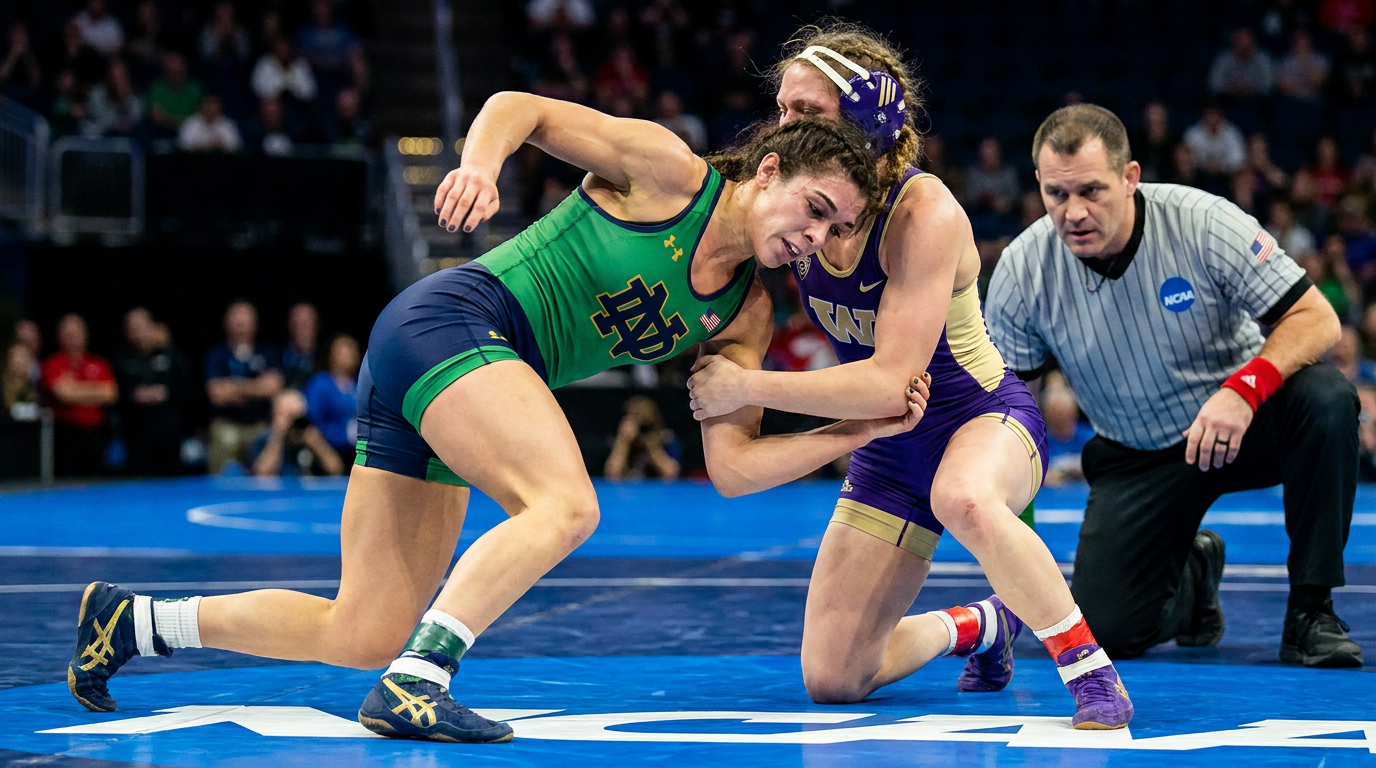
The atmosphere inside the arena was electric, a cacophony of whistles, cheers, and the distinct thud of bodies hitting the mat. But this wasn't just another weekend tournament; it was the culmination of a three-decade fight for recognition. The arrival of the NCAA Women's Wrestling Championship marks a watershed moment in American sports, transforming a grassroots movement into a fully sanctioned collegiate powerhouse.[4]
For years, female wrestlers existed on the margins of the sport. They were often the lone girls on boys' high school teams, changing in referees' locker rooms and fighting for equitable mat time. If they wanted to compete in college, they had to rely on underfunded club programs or small NAIA schools that pioneered the space. Today, the landscape is unrecognizable.[6]
The NCAA's decision to elevate women's wrestling from an "emerging sport" to a fully sanctioned championship sport unlocks millions of dollars in institutional funding. This transition means that universities are now backing these athletes with varsity-level resources: dedicated coaching staffs, athletic trainers, travel budgets, and, most importantly, athletic scholarships.[1][5]
To understand this explosion in growth, one must look at the mechanics of the sport itself. Unlike men's collegiate wrestling, which uses a uniquely American ruleset known as "folkstyle," women's collegiate wrestling uses "freestyle" rules. This was a deliberate, strategic choice made by the sport's early architects to align with global standards.[8]

Freestyle is the international standard used at the Olympic Games. It heavily rewards action and exposure. In folkstyle, a wrestler can score points simply by controlling their opponent on the mat for extended periods. In freestyle, the referee will quickly stand the wrestlers up if action stalls; points are scored by exposing the opponent's back to the mat, leading to a faster-paced, highly dynamic viewing experience.[3][8]
By adopting freestyle, the collegiate system has effectively created a massive, fully funded developmental pipeline for Team USA. Female athletes can now spend four years honing the exact techniques they will need to win Olympic gold, all while earning a college degree. This alignment has already paid dividends on the international stage, where American women have become a dominant global force.[3]
By adopting freestyle, the collegiate system has effectively created a massive, fully funded developmental pipeline for Team USA.
The collegiate boom is directly fueled by an unprecedented surge at the high school level. In 1990, there were barely 800 girls wrestling in United States high schools. By 2026, that number has skyrocketed past 50,000. This exponential growth curve makes women's wrestling the fastest-growing high school sport in the country.[2]

This grassroots explosion was catalyzed by state athletic associations finally sanctioning girls' wrestling as an official championship sport. When a state sanctions the sport, high schools are incentivized to hire dedicated coaches and field distinct girls' teams, rather than forcing girls to compete against boys. Currently, 45 states host official girls' state championships, creating a massive recruiting pool for college scouts.[2][6]
For university athletic directors, adding women's wrestling makes profound financial and legal sense. Under Title IX, universities must provide equitable athletic opportunities for male and female students. Because men's football and wrestling rosters are so large, athletic departments constantly seek cost-effective ways to add female roster spots to maintain compliance.[7]
Women's wrestling fits this need perfectly. It requires relatively minimal overhead—mats, singlets, and a shared practice room—compared to equipment-heavy sports like rowing or equestrian. A fully funded Division I program can add 30 to 40 female athletes to the department's compliance ledger, making it an incredibly attractive option for administrators balancing the books.[7][8]

However, this rapid expansion is not without its growing pains. The sudden influx of over 160 intercollegiate programs has created a severe coaching shortage. There simply are not enough experienced female freestyle coaches to fill the newly created head coaching vacancies, forcing many programs to hire men's folkstyle coaches who must quickly adapt to the international ruleset.[5][7]
Facility logistics also present a hurdle. Most university wrestling rooms were designed decades ago for a single men's team. Athletic departments are now scrambling to retrofit these spaces, scheduling staggered practice times or building entirely new training centers to accommodate dual rosters without compromising the training quality for either squad.[4]

Despite these logistical hurdles, the trajectory of the sport is firmly set. Major Division I programs in the Power Four conferences are beginning to launch teams, signaling to the rest of the country that women's wrestling is a premier collegiate attraction. For the thousands of young girls lacing up their shoes in high school gyms today, the message is clear: the mat is finally theirs, and the pathway to a national title is wide open.[1][6]
How we got here
1990
Only about 800 girls wrestle in US high schools, almost exclusively on boys' teams.
2004
Women's freestyle wrestling makes its official debut at the Athens Olympic Games.
2020
The NCAA officially recognizes women's wrestling as an 'Emerging Sport.'
2023
The sport crosses the 40-program threshold required for NCAA championship consideration.
2026
The NCAA hosts its fully sanctioned national championship for women's wrestling.
Viewpoints in depth
Collegiate Athletic Directors
Focused on the financial and compliance benefits of adding the sport.
For university administrators, the decision to add women's wrestling is often driven by Title IX compliance. Because football and men's wrestling carry massive rosters, athletic departments need female-heavy sports to balance the gender ratio of their student-athletes. Women's wrestling offers a high roster count (often 30+ athletes) with relatively low overhead costs compared to sports that require expensive specialized equipment or off-campus facilities.
Olympic Development Coaches
Focused on the strategic advantage of freestyle rules.
National team coaches view the NCAA's adoption of freestyle rules as a masterstroke. Historically, American men have had to unlearn folkstyle habits to compete internationally. By having women wrestle freestyle in college, the US has created a fully funded, four-year training camp for future Olympians, giving American women a distinct developmental advantage over countries without a collegiate sports infrastructure.
Pioneer Athletes
Focused on the historical validation of their early struggles.
For the women who wrestled in the 1990s and early 2000s, the NCAA championship is a deeply emotional milestone. These pioneer athletes often faced hostility, forfeited matches from opposing boys, and a total lack of collegiate scholarship opportunities. They view the current boom not just as athletic progress, but as a hard-won cultural victory that validates decades of grassroots advocacy.
What we don't know
- How quickly the remaining Power Four conference schools will add Division I programs.
- Whether the supply of experienced female coaches can scale fast enough to meet the exploding demand of new programs.
Key terms
- Freestyle Wrestling
- The international and Olympic style of wrestling where points are awarded for exposing an opponent's back to the mat, used in women's collegiate competition.
- Folkstyle Wrestling
- The traditional American collegiate style used by men's programs, which heavily emphasizes controlling the opponent on the mat.
- Title IX
- A federal civil rights law in the US that prohibits sex-based discrimination in any school or education program receiving federal funding.
- Emerging Sport
- An NCAA classification that provides institutions with a timeline to build programs and demonstrate sustainability before official championship status is granted.
Frequently asked
Why do women wrestle freestyle in college instead of folkstyle?
Women's collegiate wrestling adopted freestyle to align directly with Olympic and international standards, giving US athletes a developmental advantage on the global stage.
Can girls still wrestle on boys' teams?
Yes. In states without sanctioned girls' divisions, or at high schools without dedicated girls' teams, female athletes are still legally permitted to compete on boys' rosters.
Do women's wrestling programs offer full scholarships?
Yes. As a fully sanctioned NCAA sport, varsity women's wrestling programs can offer athletic scholarships, subject to the limits of their specific division (e.g., Division I or II).
Sources
Source coverage
8 outlets
3 viewpoints surfaced








[1]NCAA
NCAA officially adds women's wrestling as a championship sport
Read on NCAA →[2]USA WrestlingNational Team Coaches
Growth of Girls High School Wrestling Reaches Historic Highs
Read on USA Wrestling →[3]FloWrestlingNational Team Coaches
The Title IX Impact: How Women's Wrestling Exploded
Read on FloWrestling →[4]ESPN
Inside the historic first NCAA women's wrestling championship
Read on ESPN →[5]National Wrestling Coaches Association
Women's Collegiate Wrestling Program Directory and Growth Metrics
Read on National Wrestling Coaches Association →[6]Women's Sports FoundationGrassroots Advocates
Expanding Opportunities on the Mat: The Rise of Girls' Wrestling
Read on Women's Sports Foundation →[7]The AthleticAthletic Administrators
From club to varsity: The financial mechanics of adding women's wrestling
Read on The Athletic →[8]Factlen Editorial Team
Synthesis by Factlen editorial team
Read on Factlen Editorial Team →

More in sports
See all 332 stories →Pro Volleyball Boom
The $100M Turf War Building America's First Sustainable Pro Volleyball Ecosystem
6 sources
Adaptive Gaming
How Adaptive Tech and Modular Design Are Leveling the Esports Playing Field
7 sources

Sports Tech
How Artificial Intelligence is Revolutionizing Soccer Scouting and Player Recruitment
8 sources

Fighter Safety
How Impact-Sensing Smart Gloves Are Changing the Science of Boxing Safety
7 sources
Every angle. Every day.
Get sports stories with full source coverage and perspective breakdowns delivered to your inbox.