
Why Fitness Trackers and Smartwatches Struggle with Tattooed Skin
Optical heart rate sensors in modern wearables rely on green light to measure blood flow, but tattoo ink often blocks the signal. This hardware limitation forces tattooed users to rely on DIY hacks or alternative devices to keep their smartwatches functioning.
By Factlen Editorial Team
- Tattooed Consumers
- Seek practical workarounds to restore lost functionality on expensive devices.
- Wearable Manufacturers
- Focus on optimizing green-light PPG for the majority of users while acknowledging physical limitations.
- Health Tech Researchers
- Advocate for better sensor technology that accounts for skin variations and ink.
What's not represented
- · Tattoo Artists
Why this matters
As smartwatches evolve from simple step-counters into essential medical and financial tools, millions of tattooed users are finding themselves locked out of key features. Understanding the optical science behind this blind spot helps consumers choose the right device and avoid wasting money on incompatible hardware.
Key points
- Smartwatches use green light (PPG) to measure blood flow and detect if the watch is being worn.
- Tattoo ink in the dermis absorbs this green light, causing inaccurate heart rate readings and sensor failures.
- When the sensor fails, the watch assumes it has been removed, constantly locking the screen and disabling contactless payments.
- DIY fixes include placing clear epoxy stickers over the sensor or disabling wrist detection entirely.
- Alternative devices like EKG chest straps or smart rings can bypass the wrist-sensor problem.
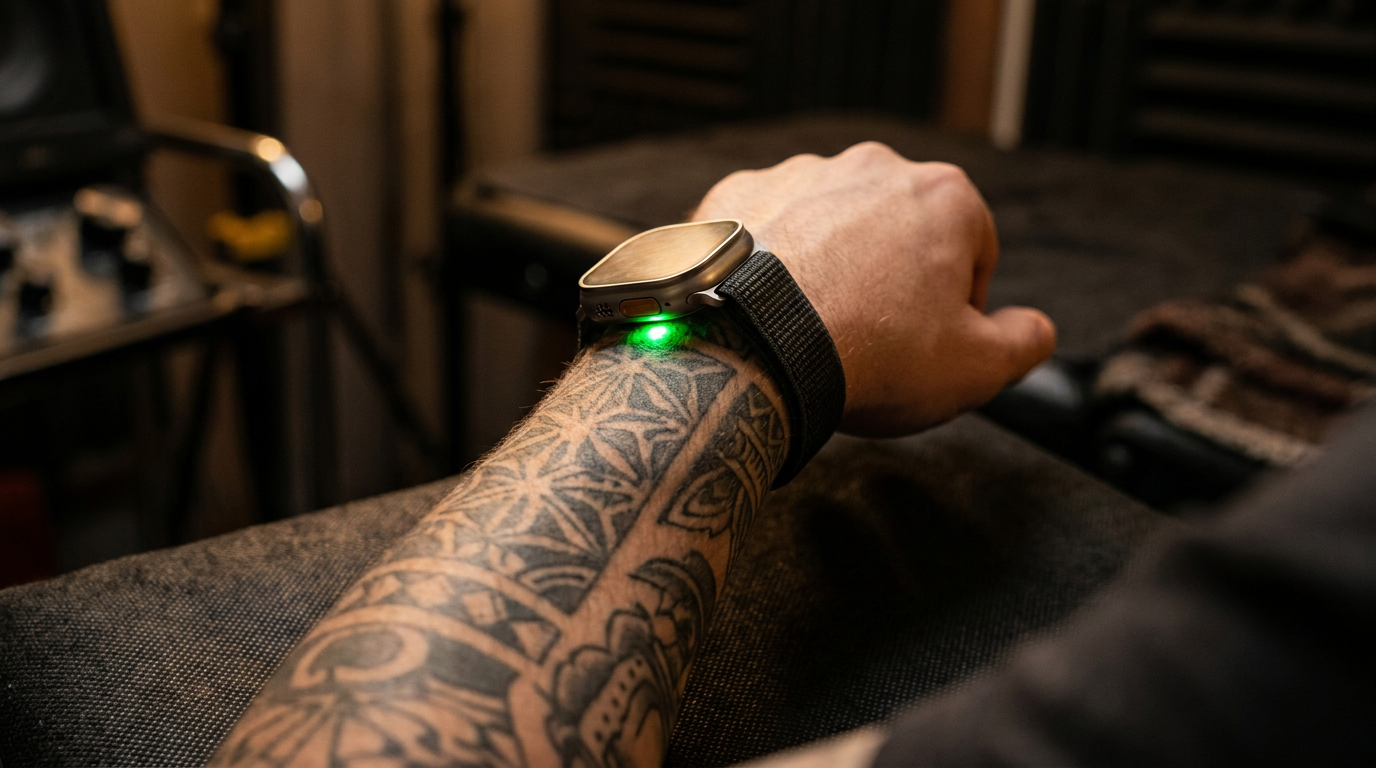
Wearable technology has become deeply integrated into daily life, with smartwatches acting as fitness coaches, sleep monitors, and digital wallets. But for a significant portion of the population, strapping a flagship device to their wrist results in a frustratingly broken experience. Users with heavily tattooed arms frequently report that their devices fail to track workouts, drop heart rate readings, and constantly lock themselves as if they have been taken off.[1][7]
The root of the problem lies in the optical technology that powers almost all modern wrist-based wearables. Devices from Apple, Garmin, Samsung, and others rely on a method called photoplethysmography, or PPG. If you flip a smartwatch over, you will typically see a cluster of rapidly flashing green LED lights paired with light-sensitive photodiodes.[2][3][4]
PPG operates on a simple biological principle: blood is red, meaning it reflects red light and absorbs green light. When your heart beats, the volume of blood flowing through the capillaries in your wrist temporarily increases, absorbing more of the green light emitted by the watch. Between beats, the blood volume drops, and more green light reflects back into the sensor. By tracking these micro-fluctuations hundreds of times per second, the watch calculates your pulse.[2][5][7]

Tattoo ink disrupts this delicate optical loop. When a tattoo is applied, the ink is deposited into the dermis—the second layer of skin, sitting directly above the blood vessels the watch is trying to monitor. Solid, dark pigments like black and red are particularly problematic because they absorb the green light before it can reach the blood vessels, or they block the reflected light from returning to the sensor.[1][2][5][7]
The consequences extend far beyond a missing heart rate chart. Most smartwatches use these same optical sensors for wrist detection, a security feature that keeps the device unlocked while you wear it. When tattoo ink blocks the sensor, the watch assumes it has been removed. It immediately locks the screen, pauses active workouts, and disables contactless payment systems like Apple Pay until the user manually enters a PIN code.[1][2]
The consequences extend far beyond a missing heart rate chart.
Device manufacturers are well aware of the hardware limitation. Apple's official support documentation explicitly warns that the ink, pattern, and saturation of some tattoos can block light from the sensor, making it difficult to get reliable readings. Garmin issues a similar advisory, recommending that users wear their watches on skin free of tattoos for optimal performance.[1][2][6]
Faced with expensive, malfunctioning hardware, tattooed consumers have developed a cottage industry of DIY workarounds. The most popular internet hack involves placing a clear epoxy bottle-cap sticker or a piece of transparent tape directly over the watch's sensor array. While it sounds counterintuitive, the clear layer slightly alters the refraction of the light, sometimes tricking the sensor into registering skin contact and keeping the watch unlocked. However, this does not guarantee accurate heart rate data.[1][7]

For users who cannot get the epoxy hack to work, the primary software workaround is to disable wrist detection entirely. This stops the watch from constantly locking and allows notifications to flow freely, but it permanently disables background heart rate monitoring and requires the user to sacrifice contactless payments, as the device can no longer verify it remains on the authenticated user's wrist.[2][7]
For those who need clinical-level accuracy during workouts, the most reliable solution is to bypass optical sensors entirely. Bluetooth chest straps use electrocardiography rather than light. By measuring the electrical signals generated by the heart muscle, chest straps are completely immune to skin pigmentation and tattoo ink, and they can easily sync their data back to an Apple Watch or Garmin device.[2][4]
Another emerging alternative is the smart ring. While devices like the Oura Ring and RingConn still rely on PPG optical sensors, they are worn on the fingers—an area far less likely to be heavily tattooed than the forearm or wrist. Furthermore, the blood vessels in the fingers are closer to the surface, often providing a stronger optical signal than the wrist.[4][7]

The tattoo issue highlights a broader limitation of green-light PPG sensors: they struggle with anything that alters light absorption. Medical researchers have noted that these same sensors can be less accurate for individuals with darker skin tones, as higher melanin levels also absorb more green light. This has prompted a push within the health-tech industry to develop more inclusive sensor arrays.[3][5][7]
The next generation of wearables is beginning to incorporate multi-wavelength sensors, utilizing red and infrared light alongside green LEDs. Red light has a longer wavelength and penetrates deeper into the tissue, making it less susceptible to surface-level ink and melanin. While infrared is currently used mostly for background sampling and blood oxygen tracking, advancements in motion-artifact filtering could eventually allow deep-penetrating red light to become the standard for all continuous heart rate monitoring, potentially solving the tattoo problem for good.[2][5][7]
How we got here
Late 1800s
The basic principles of photoplethysmography (PPG) are first observed by shining light through skin.
2015
The first Apple Watch launches, and heavily tattooed users immediately report the 'Tattoo-Gate' sensor failures.
2019
Studies highlight that green-light PPG sensors also show varying accuracy based on natural skin melanin levels.
2024
Multi-wavelength sensors using red and infrared light begin appearing in more premium wearables, offering deeper tissue penetration.
Viewpoints in depth
Wearable Manufacturers
Companies acknowledge the physical limitations of optical sensors but prioritize general-use hardware.
Device makers like Apple and Garmin openly document that tattoos can block PPG sensors, but they frame it as an unavoidable limitation of current optical physics rather than a defect. Green LEDs remain the industry standard because they offer the best balance of accuracy and battery life for the vast majority of users, particularly during heavy movement. For now, manufacturers advise tattooed users to wear the device on an uninked wrist or pair it with an external Bluetooth chest strap.
Tattooed Consumers
Users are frustrated by the lack of hardware solutions and reliant on DIY workarounds.
For heavily tattooed individuals, the smartwatch experience is often defined by compromised functionality. Consumers express frustration on forums and support boards when their expensive devices constantly lock or fail to track workouts. Many rely on the 'epoxy sticker hack' or disable wrist detection entirely, accepting that they must sacrifice premium features like Apple Pay and continuous background health monitoring just to use the watch as a basic notification screen.
Health Tech Researchers
Experts are pushing for multi-wavelength sensors to eliminate optical blind spots.
Medical researchers view the tattoo issue as part of a larger problem with green-light PPG, which also struggles to provide clinical-grade accuracy for users with darker skin tones. Researchers advocate for a shift toward multi-wavelength sensor arrays that rely more heavily on red and infrared light. Because red light penetrates deeper into the hypodermis, it bypasses surface-level ink and melanin, offering a more inclusive—though currently more battery-intensive—approach to biometric tracking.
What we don't know
- Whether future software updates can better filter optical noise to read through lighter tattoos.
- When deep-penetrating red/infrared sensors will become standard for continuous workout tracking across all major brands.
Key terms
- Photoplethysmography (PPG)
- An optical technique that uses light to detect changes in blood volume in the microvascular bed of tissue.
- Dermis
- The thick layer of living tissue below the epidermis where tattoo ink is permanently deposited.
- Wrist Detection
- A security feature that uses optical sensors to verify a smartwatch is currently being worn, keeping it unlocked.
- Electrocardiography (EKG/ECG)
- A technology that measures the electrical signals of the heart, immune to optical interference like tattoos.
Frequently asked
Can I use an Apple Watch if I have a full sleeve tattoo?
Yes, but you may experience dropped heart rate readings and constant screen locking. You can work around this by turning off the 'Wrist Detection' feature, though this disables Apple Pay.
Does the color of the tattoo matter?
Yes. Solid, dark colors like black and deep red absorb the most green light and cause the most severe sensor disruptions. Lighter, shaded tattoos may still allow the sensor to function.
Do smart rings have the same problem?
Smart rings use the same optical PPG technology, but because they are worn on the fingers—which are rarely tattooed and have blood vessels close to the surface—they usually bypass the issue.
Why don't watches just use red light?
Red and infrared light penetrate deeper and bypass ink, but they are more susceptible to errors caused by arm movement during exercise. Green light is currently the most reliable for active workouts.
Sources
Source coverage
7 outlets
3 viewpoints surfaced







[1]EngadgetTattooed Consumers
Do fitness trackers still work if you have tattoos?
Read on Engadget →[2]Apple InsiderWearable Manufacturers
How tattoos affect Apple Watch sensors and what you can do
Read on Apple Insider →[3]Mount SinaiHealth Tech Researchers
Wearable fitness trackers and heart health
Read on Mount Sinai →[4]Cleveland ClinicHealth Tech Researchers
Heart Rate Monitors: Types, Uses & Accuracy
Read on Cleveland Clinic →[5]The ConversationHealth Tech Researchers
Why fitness trackers can be less accurate for darker skin and tattoos
Read on The Conversation →[6]Garmin SupportWearable Manufacturers
Factors That Can Affect Heart Rate Sensor Accuracy
Read on Garmin Support →[7]Factlen Editorial TeamHealth Tech Researchers
Synthesis by Factlen editorial team
Read on Factlen Editorial Team →


Every angle. Every day.
Get technology stories with full source coverage and perspective breakdowns delivered to your inbox.