
The Rise of 'New Collar' Apprenticeships: How Tech and Advanced Manufacturing are Bypassing the 4-Year Degree
Driven by a massive build-out in AI and semiconductor infrastructure, tech giants and government agencies are pouring millions into high-wage apprenticeship programs to solve a critical shortage of skilled technicians.
By Factlen Editorial Team
- Industry Employers
- Desperate for skilled talent to operate billions of dollars in new infrastructure, they view funding their own apprenticeships as a necessary cost of doing business.
- Vocational Advocates
- Argue that 'new collar' pathways offer superior financial outcomes by allowing young adults to earn six-figure salaries without accumulating student debt.
- Federal and State Policymakers
- View a robust, highly skilled domestic workforce as a matter of national security and economic resilience, heavily subsidizing the transition.
What's not represented
- · Traditional four-year university administrators facing declining enrollment.
- · Current high school guidance counselors adapting to new career pathways.
Why this matters
As the cost of a traditional four-year college degree continues to soar, the explosion of 'new collar' apprenticeships offers a debt-free, high-wage pathway into the tech industry. For students and career-changers, these programs represent a direct route to the middle class, while for the U.S. economy, they are the critical bottleneck to winning the global semiconductor and AI race.
Key points
- The U.S. Department of Labor has announced $145 million in grants to expand apprenticeships in high-tech sectors like semiconductors and AI.
- Active apprentices in the United States have more than doubled over the last decade, reaching 680,000.
- Major manufacturers like TSMC and Micron are launching their own paid apprenticeship programs to staff new fabrication plants.
- A Deloitte study projects that 2.1 million manufacturing jobs could go unfilled by 2030 without significant workforce intervention.
- 57% of adults now advise high school graduates to consider alternatives to a traditional four-year college degree.
The United States is currently in the midst of a historic industrial build-out, driven by hundreds of billions of dollars in domestic semiconductor fabrication and artificial intelligence infrastructure. However, the physical reality of this unprecedented technological boom has collided with a severe human capital bottleneck. Companies are realizing that they can design the most advanced chips and data centers in the world, but they cannot build or operate them without a massive influx of highly skilled technicians. This realization is forcing a fundamental rethink of how the nation prepares its workforce for the future.[7]
To solve this critical shortage, a powerful coalition of tech giants, community colleges, and government agencies is actively bypassing the traditional four-year university model. They are resurrecting and modernizing the concept of the industrial apprenticeship, creating a surge of what are now known as "new collar" jobs. These roles prioritize hands-on skills, specialized certifications, and practical experience over traditional bachelor's degrees. By paying students to learn on the job, these programs are dismantling the financial barriers to entry that have long plagued higher education, offering a debt-free pathway into the most lucrative sectors of the modern economy.[7]
The scale of the talent deficit facing the American industrial base is staggering, and the economic stakes could not be higher. According to a comprehensive study by Deloitte, the manufacturing skills gap is projected to leave a staggering 2.1 million jobs unfilled by the year 2030. If left unaddressed, this labor shortage could cost the United States economy an estimated $1 trillion in lost productivity and delayed expansion. Manufacturers across the country are reporting that their primary obstacle to growth is no longer capital or supply chain logistics, but simply finding enough qualified hands to operate their advanced machinery.[6]

The rapid acceleration of the artificial intelligence arms race has only exacerbated this workforce crisis. The combined capital expenditure of major technology firms on data centers and related infrastructure is approaching an astonishing $700 billion in 2026 alone. Every single one of these new, hyper-scale facilities requires a small army of specialized electricians, liquid-cooling engineers, and robotics technicians to function. These are complex, highly technical roles that absolutely cannot be outsourced to software or automated away, making the skilled tradesman the most sought-after asset in the AI revolution.[2]
In response to this national imperative, the federal government is stepping in to heavily subsidize alternative training pathways and vocational education. The U.S. Department of Labor recently announced a massive $145 million injection of apprenticeship grants specifically targeting high-tech, high-growth sectors. Rather than focusing solely on traditional construction trades, this new wave of funding is explicitly directed toward fields like semiconductor manufacturing, artificial intelligence, telecommunications, and nuclear energy, signaling a major shift in how the government views the future of blue-collar work.[1]
This coordinated strategy of federal funding and industry partnership is already showing remarkable results across the labor market. According to recent data released by the Labor Department, the number of active apprentices in the United States has more than doubled over the last decade. The figures show a dramatic leap from roughly 318,000 active apprentices in 2014 to over 680,000 by 2024. Over that same period, the annual number of students successfully graduating from these programs jumped by 143%, proving that the earn-while-you-learn model is successfully scaling to meet modern demands.[1]

At the absolute center of this vocational shift is the semiconductor industry, which is currently scrambling to staff massive new fabrication plants across the country. In Arizona, which has become a primary hub for microelectronics, Taiwan Semiconductor Manufacturing Company (TSMC) has committed $5 million to establish a brand-new, registered semiconductor technician apprenticeship program. This initiative, developed in partnership with the City of Phoenix and local educational institutions, is designed to build a hyper-local talent pipeline capable of operating some of the most sophisticated manufacturing equipment on the planet.[3]
At the absolute center of this vocational shift is the semiconductor industry, which is currently scrambling to staff massive new fabrication plants across the country.
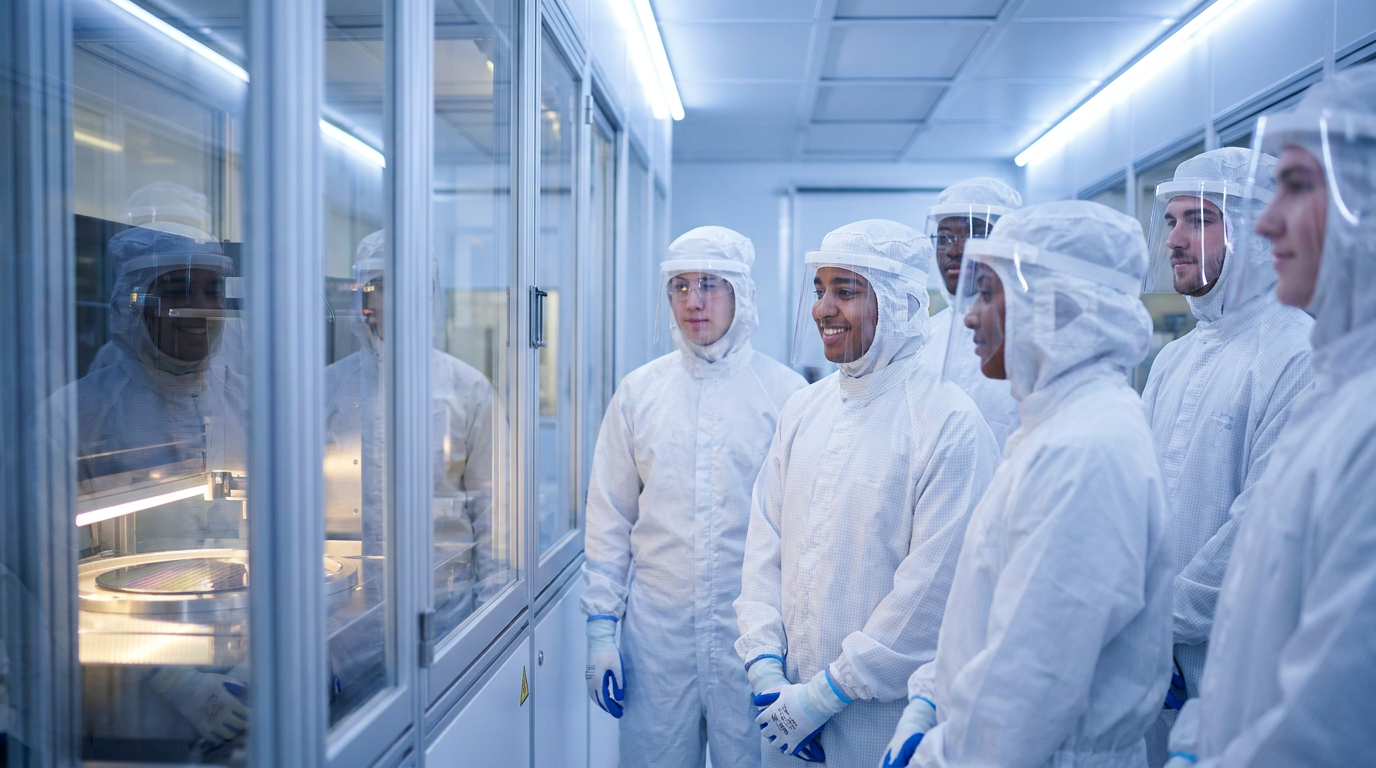
The TSMC Arizona program, which is set to open its highly anticipated first cohort in August 2026, represents the gold standard for these new tech apprenticeships. Participants are hired as full-time employees from day one, allowing them to earn a living wage while receiving rigorous classroom instruction and hands-on training in a pristine cleanroom environment. As they master the complex processes required to fabricate silicon wafers, their wages increase, ensuring that their compensation scales directly with their growing technical expertise and value to the company.[4]
A similarly ambitious initiative is currently launching on the East Coast, further proving that this is a nationwide movement. NY Creates, a leading research and development hub, has partnered with memory-chip manufacturing giant Micron to roll out a comprehensive 16-month Industrial Manufacturing Technician (IMT) apprenticeship. Located at the Albany NanoTech Complex—widely considered the most advanced semiconductor facility in North America—the program is specifically designed to prepare the next generation of technicians for Micron's historic expansion into New York and Idaho.[5]
Trainees enrolled in the NY Creates program will spend their days working full-time alongside industry experts, gaining invaluable exposure to cutting-edge cleanroom operations. Simultaneously, they will complete related technical instruction through a local community college, ensuring they understand the theoretical physics and chemistry behind the machines they operate. Upon successful completion of the 16-month gauntlet, graduates receive a state-certified journeyworker credential and are guaranteed a direct interview for a highly paid, full-time technician role at one of Micron's new facilities.[5]

Community colleges are serving as the critical, on-the-ground engine for this massive workforce transformation, rapidly adapting their curricula to meet industry needs. Maricopa Community Colleges in Arizona, for example, now offers an impressive 31 distinct degree and certificate programs that directly or indirectly support semiconductor careers. Recognizing that some employers need talent immediately, the college system even developed a 10-day accelerated "Quick Start" program, designed to give absolute beginners the baseline skills required to step onto a fab floor as an entry-level technician.[3]
The immense financial incentives waiting at the end of these programs are fundamentally shifting the cultural consensus around higher education. With specialized data center electricians, liquid-cooling technicians, and robotics engineers now commanding starting salaries that routinely stretch well into the six figures, the skilled trades are rapidly shedding their outdated stigma. For many young adults, the prospect of earning $100,000 a year without carrying the crushing burden of student loan debt is making the vocational route far more attractive than a standard university degree.[2]
This economic reality is trickling down to how parents and mentors advise the next generation of workers. A recent poll conducted by the American Staffing Association revealed a stunning shift in public perception: 57% of adults stated they would now actively advise high school graduates to consider alternatives to a four-year college degree. This represents a massive departure from the "college-for-all" mentality that dominated the late 20th and early 21st centuries, suggesting a permanent cultural re-evaluation of what constitutes a successful career path.[1]

However, successfully scaling these high-tech apprenticeship programs presents a unique set of logistical and educational challenges. Modern advanced manufacturing is incredibly complex; it is no longer about repetitive manual labor, but rather about managing interconnected digital systems. Technicians today must master mechatronics, possess high-level data literacy, and understand how to program and troubleshoot programmable logic controllers (PLCs). Finding instructors who possess both this cutting-edge industry knowledge and the ability to teach it effectively remains a significant bottleneck for community colleges.[7]
Furthermore, the sheer volume of workers required to meet the nation's infrastructure goals remains a daunting mathematical reality. While the growth in apprenticeships is highly encouraging, the construction industry alone estimates it needs an additional 530,000 workers in 2026 just to keep pace with the current backlog of projects. Building the physical shells of these data centers and fabs requires an army of pipefitters, welders, and concrete specialists, meaning the vocational training pipeline must expand across all disciplines simultaneously.[2]
Despite these formidable hurdles, the rapid expansion of high-tech apprenticeships represents one of the most optimistic realignments of the American workforce in decades. By paying students to learn, removing the barrier of student debt, and guaranteeing a direct pathway to the middle class, the "new collar" movement is democratizing access to the tech boom. It is proving, in real time, that the future of American innovation relies just as heavily on the men and women wearing cleanroom suits and hard hats as it does on those writing code.[7]
How we got here
2022
The CHIPS and Science Act passes, spurring hundreds of billions in domestic semiconductor investments.
2024
Active apprentices in the U.S. reach 680,000, more than doubling over the previous decade.
January 2024
TSMC and the City of Phoenix announce a $5 million commitment for a new semiconductor technician apprenticeship.
February 2026
The U.S. Department of Labor announces $145 million in grants targeting high-tech apprenticeships.
August 2026
Inaugural cohorts for major semiconductor apprenticeships at TSMC Arizona and NY Creates/Micron begin training.
Viewpoints in depth
Industry Employers
Desperate for skilled talent to operate billions of dollars in new infrastructure, they view funding their own apprenticeships as a necessary cost of doing business.
For major manufacturers and tech giants, the skills gap is no longer a theoretical future problem; it is an immediate existential threat to their expansion plans. Companies like TSMC, Micron, and major data center operators recognize that the traditional education system is not producing technicians fast enough to meet their needs. Consequently, they are taking matters into their own hands, investing millions of dollars to build bespoke training pipelines. From their perspective, paying an apprentice a full-time wage to learn is a highly efficient investment, as it guarantees a steady stream of loyal, hyper-specialized workers who are trained exactly to the company's proprietary standards.
Vocational Advocates
Argue that 'new collar' pathways offer superior financial outcomes by allowing young adults to earn six-figure salaries without accumulating student debt.
Trade advocates and community college leaders argue that the cultural obsession with the four-year university degree has done a disservice to millions of students. They point to the crushing burden of student loan debt and the underemployment of many recent college graduates as evidence that the system is broken. In contrast, they champion the apprenticeship model as a democratizing force. By allowing students to earn a living wage from day one and step directly into high-paying roles in robotics, electrical engineering, and semiconductor fabrication, vocational advocates believe these programs offer a far more reliable and equitable pathway to the American middle class.
Federal and State Policymakers
View a robust, highly skilled domestic workforce as a matter of national security and economic resilience, heavily subsidizing the transition.
For government officials at both the state and federal levels, the push for advanced manufacturing apprenticeships is deeply intertwined with national security and geopolitical strategy. The realization that the United States had outsourced the vast majority of its critical supply chains—particularly in microelectronics—prompted sweeping legislation like the CHIPS Act. However, policymakers understand that bringing factories back to American soil is useless without the human capital to run them. Therefore, they view the aggressive funding of vocational grants and the promotion of 'new collar' jobs as essential steps to securing the nation's technological independence and maintaining its competitive edge globally.
What we don't know
- Whether community colleges and training centers can scale their instructor base fast enough to meet the surging demand for technical education.
- How retention rates in these new accelerated programs will compare to traditional multi-year engineering degrees.
- If the current wage premiums for specialized technicians will stabilize once the initial wave of AI infrastructure construction is completed.
Key terms
- New Collar Job
- A role that prioritizes technical skills, certifications, and hands-on experience over a traditional four-year college degree.
- Registered Apprenticeship
- A federally or state-approved training program that combines paid on-the-job learning with related classroom instruction.
- Cleanroom
- A highly controlled manufacturing environment with exceptionally low levels of airborne pollutants, essential for fabricating sensitive semiconductor chips.
- Mechatronics
- An interdisciplinary engineering field combining mechanical, electrical, and computer systems, heavily used in modern automated manufacturing and robotics.
Frequently asked
What exactly is a 'new collar' job?
A 'new collar' job is a role that requires advanced technical skills, specialized certifications, and hands-on experience, but does not necessarily require a traditional four-year bachelor's degree.
How much do semiconductor apprentices make?
Apprentices earn a percentage of a journeyperson's wage while training, receiving full benefits. Upon completion, they often step into full-time technician roles paying $60,000 to over $100,000 annually.
Do you need prior experience to join these programs?
No. Many programs, such as Maricopa Community College's Quick Start or the NY Creates apprenticeship, require only a high school diploma or GED and a willingness to learn.
Why are tech companies funding these programs directly?
The rapid expansion of AI data centers and domestic semiconductor fabs has created a severe shortage of qualified technicians, forcing companies to build and fund their own talent pipelines to ensure their facilities can operate.
Sources
Source coverage
7 outlets
3 viewpoints surfaced





[1]The Washington TimesFederal and State Policymakers
Apprenticeships surge as more Americans seek alternatives to 4-year college degrees
Read on The Washington Times →[2]LumiChatsVocational Advocates
Data Center Electricians Make $300K: The New-Collar Career Guide for 2026
Read on LumiChats →[3]State of ArizonaFederal and State Policymakers
Arizona Semiconductor Workforce Development and Apprenticeship Initiatives
Read on State of Arizona →[4]TSMCIndustry Employers
TSMC Arizona Technician Apprenticeship Program
Read on TSMC →[5]NY CreatesIndustry Employers
Industrial Manufacturing Technician (IMT) Apprenticeship Program
Read on NY Creates →[6]IMTSIndustry Employers
Closing the Gap: The Cost of the Manufacturing Skills Shortage
Read on IMTS →[7]Factlen Editorial TeamVocational Advocates
Synthesis by Factlen editorial team
Read on Factlen Editorial Team →
Every angle. Every day.
Get education stories with full source coverage and perspective breakdowns delivered to your inbox.