
When Algorithms Meet Sailboats: What the Royal Navy's Drone Collision Reveals About Marine Autonomy
A minor collision between an autonomous Royal Navy vessel and a racing yacht in Portsmouth Harbour is serving as a crucial stress test for the future of uncrewed shipping.
By Factlen Editorial Team
- Naval Innovators
- Argue that rapid, real-world testing in complex environments is essential to iterate autonomous systems and build a resilient hybrid fleet.
- Recreational Mariners
- Emphasize the unpredictability of leisure sailing and the need for strict safety perimeters when testing experimental drones in mixed-use waters.
- Maritime Regulators
- Focus on the immense technical challenge of translating subjective, human-centric collision regulations into rigid algorithmic rules.
What's not represented
- · Commercial ferry operators
- · Marine insurance underwriters
Why this matters
As the maritime industry pushes toward autonomous shipping to reduce human error and cut costs, real-world interactions with unpredictable human sailors are exposing the limits of current AI. How regulators and engineers solve these edge cases will dictate how quickly uncrewed vessels scale across global supply chains.
Key points
- A Royal Navy autonomous vessel collided with a 55-foot racing yacht in Portsmouth Harbour.
- The incident caused minor damage and no injuries, but highlights the difficulty of autonomous navigation in crowded waters.
- Engineers struggle to translate subjective maritime right-of-way rules (COLREGs) into rigid algorithmic code.
- The Royal Navy is investigating whether the drone was fully autonomous or under remote control at the time of impact.
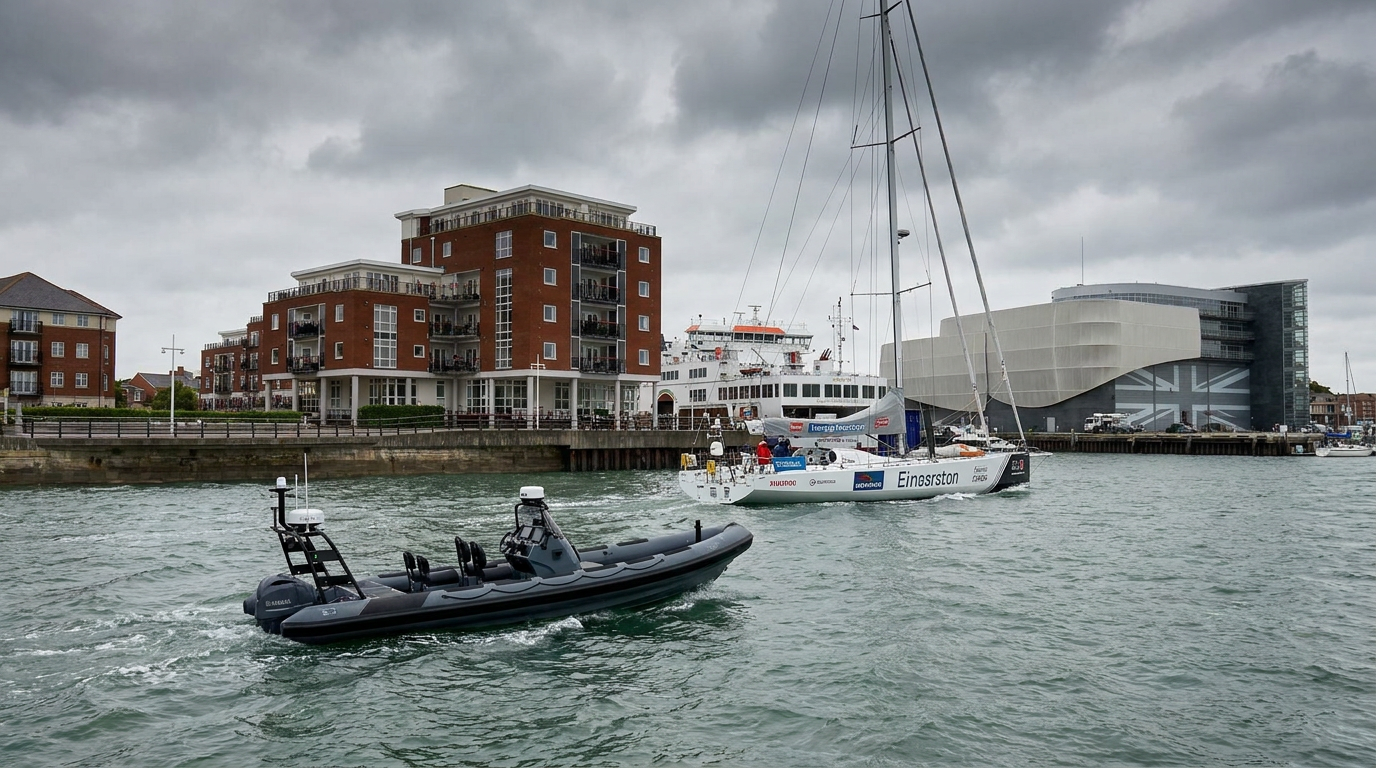
On June 25, 2026, the quiet routine of one of Europe’s busiest waterways was interrupted by a glimpse into the future of naval warfare—and its current limitations. During a controlled training exercise in Portsmouth Harbour, an autonomous surface drone operated by the Royal Navy collided with the Lutine, a 55-foot X-55 racing yacht owned by the Lloyd's Yacht Club. While the incident resulted in no injuries and only minor damage to both vessels, it immediately captured the attention of the broader maritime industry. The collision serves as a highly visible stress test for the rapidly advancing field of uncrewed marine navigation, highlighting the friction that occurs when cutting-edge algorithms are forced to share the water with unpredictable human sailors.[1][2]
The incident occurred as part of an ongoing evaluation by the Royal Navy’s Fleet Experimentation Squadron, which is tasked with integrating autonomous systems into traditional naval operations. Unlike many autonomous vehicle trials that take place in heavily restricted or enclosed testing ranges, the Navy specifically chose the waters off the coast of Portsmouth to push the technology to its limits. Portsmouth Harbour is a chaotic, mixed-use environment where military warships, commercial ferries, heavy tugboats, and weekend recreational sailboats share narrow channels on a daily basis. Operating in this dense traffic is considered the ultimate proving ground for any autonomous system hoping to eventually deploy in complex global waterways.[1][3]
The drone involved in the collision is known as a Rattler, a 7.2-meter uncrewed surface vessel (USV) built on a rigid inflatable boat (RIB) hull. Developed by UK-based SYOS Aerospace in collaboration with the Navy’s Disruptive Capabilities and Technology Office, the Rattler represents a shift toward rapid, iterative defense procurement. The vessels are designed to be highly modular and can be pre-programmed with specific mission profiles and navigational routes. In previous high-profile tests, the Navy successfully demonstrated the ability of multiple Rattlers to operate together in coordinated "wolf packs," escorting larger crewed warships and feeding real-time surveillance data back to operators located hundreds of miles away.[4][5]
The exact mechanics of the Portsmouth collision remain under investigation, but early reports indicate a classic failure of right-of-way recognition. At the time of the incident, the Lutine was reportedly underway under sail. According to foundational maritime law, a vessel operating under sail generally has the right of way over any power-driven vessel, meaning the autonomous drone was obligated to yield. Instead, the USV allegedly failed to alter its course in time, resulting in a strike against the starboard stern of the sailboat. The Lutine was subsequently taken to Hamble Point Marina for repairs to a visible gouge in its hull, while the Lloyd's Yacht Club confirmed the incident without offering further public comment.[2][3]

From an engineering perspective, the collision underscores the core challenge of marine autonomy. Teaching a machine to navigate an empty ocean using GPS waypoints is a largely solved problem. The true frontier of marine artificial intelligence lies in dynamic obstacle avoidance in crowded, unpredictable environments. To achieve this, autonomous vessels rely on a complex process known as sensor fusion. The Rattler is equipped with a suite of military-grade sensors, including marine radar, electro-optic and infrared cameras, and Automatic Identification System (AIS) receivers. The onboard computer must constantly stitch this disparate data together to build a real-time, 360-degree map of its surroundings, identifying not just where objects are, but what they are.[5][6]
Once the autonomous engine builds this map, it must predict the future. The software calculates the Closest Point of Approach (CPA) for every moving vessel in its vicinity, determining exactly how close the ships will get if they maintain their current speeds and headings. If the CPA breaches a predefined safety threshold, the system triggers an evasive maneuver. Advanced systems utilize Model Predictive Control (MPC) algorithms, which can simulate dozens of potential course corrections in a matter of milliseconds, weighing the safest physical path against the rigid rules of maritime law. However, this mathematical precision often clashes with the messy reality of human behavior on the water.[6][7]
Once the autonomous engine builds this map, it must predict the future.
The ultimate governing framework for these algorithms is the Convention on the International Regulations for Preventing Collisions at Sea, universally known as COLREGs. Drafted by the International Maritime Organization in 1972, these rules were written explicitly for human navigators. They dictate who has the right of way in head-on, crossing, and overtaking situations. But COLREGs are notoriously subjective. They require vessels to proceed at a "safe speed" adapted to the prevailing circumstances and to maintain a "proper lookout" using all available means. Translating these inherently human, qualitative judgments into the rigid, quantitative logic required by a machine learning model is one of the most difficult tasks in autonomous engineering.[6][7]
The subjective nature of COLREGs means that human sailors frequently bend the rules, making assumptions based on eye contact, VHF radio chatter, or local harbor customs that an AI cannot perceive. When a human sailor behaves unpredictably—perhaps tacking suddenly to catch a shift in the wind—the autonomous system's predictive models can break down. The AI expects strict adherence to the rules, and when it encounters a deviation, it must recalculate its entire evasive strategy in real-time. Researchers note that until autonomous systems can reliably infer the intent behind a human sailor's erratic movements, mixed-use harbors will remain a highly dangerous environment for uncrewed vessels.[6][7]

To mitigate these exact risks, the King’s Harbour Master (KHM) in Portsmouth enforces strict safety protocols for all autonomous trials. Successive KHM notices require the Rattler USVs to maintain a minimum separation distance of 200 meters from all other craft whenever possible. Furthermore, every autonomous mission must be accompanied by a manned safety vessel tasked with monitoring the drone's behavior and intervening immediately if a close-quarters situation develops. The presence of this safety net makes the collision with the Lutine particularly perplexing, raising questions about the reaction time of the human overseers and the fail-safes built into the testing protocol.[1]
The Royal Navy has launched a comprehensive investigation to determine the exact chain of events that led to the crash. A central question is whether the Rattler was operating in a fully autonomous mode at the moment of impact, or if it was being piloted remotely by a human operator who misjudged the distance. Investigators will also scrutinize the telemetry data to understand why the accompanying safety vessel failed to abort the drone's maneuver before it struck the yacht. The findings will likely dictate whether the Navy needs to overhaul its operating procedures or adjust the software's safety parameters before resuming trials in congested waters.[1][2]
While a dented racing yacht may seem like a minor military mishap, the implications of this investigation stretch far beyond the Royal Navy. The global commercial shipping industry is watching these trials closely. Commercial operators view autonomous technology as the key to drastically reducing operational costs and improving supply chain efficiency. However, commercial cargo ships cannot afford to "go rogue" in busy ports like Rotterdam or Singapore. The military's willingness to test these systems in the chaotic waters of Portsmouth provides invaluable, real-world data that commercial developers are using to refine their own collision-avoidance algorithms.[3][7]
Despite the setback, the overarching push toward marine autonomy remains stronger than ever, driven by a stark statistical reality. Maritime accident investigators estimate that human error—ranging from fatigue and distraction to poor judgment and miscommunication—contributes to between 89 and 96 percent of all marine collisions. The ultimate promise of an autonomous navigation system is that it never gets tired, it never loses focus at the end of a long watch, and it can see perfectly through fog and darkness. Proponents argue that once the software matures, uncrewed vessels will be statistically much safer than those piloted by humans.[7]

The regulatory landscape is already shifting to accommodate this future. The International Maritime Organization’s Maritime Safety Committee is currently drafting the MASS (Maritime Autonomous Surface Ships) Code, a comprehensive framework designed to govern the safe operation of uncrewed vessels globally. The code is expected to be adopted as a non-mandatory guideline in 2026 before becoming strictly mandatory by 2030. Incidents like the Portsmouth collision are considered vital data points for the IMO, helping regulators understand exactly where the theoretical rules of the MASS Code break down when applied to the physical realities of a busy harbor.[6]
Ultimately, the transition to a "hybrid fleet"—where traditional crewed warships operate seamlessly alongside autonomous drones—will inevitably involve growing pains. The Royal Navy's strategy relies on rapid iteration, accepting that minor failures in controlled environments are the price of accelerated innovation. By allowing these systems to fail safely and learn publicly, engineers can gather the critical edge-case data required to refine their algorithms. The dent in the Lutine is a reminder that the technology is not yet perfect, but it is also proof that the maritime industry is actively doing the hard work of teaching machines how to navigate the human world.[4][5]
How we got here
1972
The IMO establishes COLREGs, the international rules of the road for human sailors.
Nov 2025
The Royal Navy successfully tests a 'wolf pack' of five Rattler drones off the coast of Scotland.
Jun 25, 2026
A Rattler drone collides with the Lutine racing yacht during a training exercise in Portsmouth Harbour.
2030
The IMO's MASS Code for autonomous shipping is expected to become globally mandatory.
Viewpoints in depth
Naval Innovators
The necessity of real-world stress testing to iterate autonomous systems.
For defense contractors and naval engineers, testing autonomous systems in sterile, restricted waters only proves that the technology works in a vacuum. To build a resilient 'hybrid fleet,' drones must be exposed to the chaotic, unpredictable nature of mixed-use harbors. Proponents argue that rapid, iterative testing—accepting minor incidents as a cost of innovation—is the only way to gather the edge-case data necessary to train robust AI models.
Recreational Mariners
The unpredictability of the human element and the anxiety of sharing waters with beta-testing robots.
Recreational sailors operate under a mix of formal maritime law and informal local customs, often making split-second decisions based on wind shifts or eye contact with other captains. For this community, the introduction of experimental autonomous vessels into busy waterways introduces a new layer of anxiety. They argue that until AI can reliably infer human intent and yield appropriately to vessels under sail, strict safety perimeters and immediate human overrides must be flawlessly enforced.
Maritime Regulators
The challenge of translating subjective seamanship into software.
Regulators and maritime academics are focused on the immense technical hurdle of coding COLREGs into machine learning models. Because the 1972 rules rely on qualitative concepts like 'safe speed' and 'proper lookout,' they cannot be easily translated into binary logic. Regulators view incidents like the Portsmouth collision as vital data points that will help shape the upcoming MASS Code, ensuring that future laws account for the friction between algorithmic precision and human unpredictability.
What we don't know
- Whether the Rattler was operating in fully autonomous mode or under remote control at the moment of impact.
- Why the manned safety vessel accompanying the drone failed to intervene before the collision.
- If the incident will lead to permanent changes in the Royal Navy's testing protocols in civilian harbors.
Key terms
- USV
- Uncrewed Surface Vessel, a boat that operates on the water without a human crew onboard, controlled either remotely or by autonomous algorithms.
- COLREGs
- The International Regulations for Preventing Collisions at Sea, a set of rules published in 1972 that dictate right-of-way and evasive maneuvers for all vessels.
- Sensor Fusion
- The process of combining data from multiple sensors, such as radar and cameras, to create a single, comprehensive understanding of a vessel's surroundings.
- Closest Point of Approach (CPA)
- A navigational calculation used to determine how close two vessels will get to each other if they maintain their current speeds and headings.
- Model Predictive Control (MPC)
- An advanced algorithm that predicts the future trajectories of nearby ships and proactively adjusts the autonomous vessel's steering to avoid collisions.
Frequently asked
Was anyone injured in the collision?
No injuries were reported. Both the Royal Navy drone and the racing yacht sustained minor damage and returned to port safely.
What is a Rattler USV?
It is a 7.2-meter uncrewed surface vessel built by SYOS Aerospace, used by the Royal Navy to test autonomous navigation and swarming tactics.
Who had the right of way during the incident?
According to maritime rules, a vessel under sail generally has the right of way over a power-driven vessel, meaning the autonomous boat should have yielded.
Will this stop the Royal Navy's autonomous testing?
Unlikely. The Navy views these trials as essential for developing its future "hybrid fleet," though operating procedures in busy harbors may be temporarily tightened.
Sources
Source coverage
7 outlets
3 viewpoints surfaced







[1]Marine Industry NewsRecreational Mariners
Royal Navy USV crashing into yacht raises questions over autonomous vessels in busy harbour
Read on Marine Industry News →[2]BoatNewsRecreational Mariners
A Royal Navy drone collides with a sailboat in Portsmouth
Read on BoatNews →[3]Boat and YachtRecreational Mariners
Royal Navy Uncrewed Vessel Collides With Racing Yacht
Read on Boat and Yacht →[4]Evening StandardNaval Innovators
Royal Navy tests autonomous 'wolf pack' boats to shadow Russian warships
Read on Evening Standard →[5]DroneLifeNaval Innovators
SYOS Aerospace-developed vessels demonstrate fast-track innovation and progress toward a Hybrid Navy
Read on DroneLife →[6]MDPIMaritime Regulators
COLREG-Compliant Collision Avoidance for Autonomous Ships Using Model Predictive Control
Read on MDPI →[7]IntechOpenMaritime Regulators
Autonomous Ship Navigation and Collision Avoidance
Read on IntechOpen →
Every angle. Every day.
Get automotive stories with full source coverage and perspective breakdowns delivered to your inbox.