
Mike Collins Wins Georgia Senate Republican Runoff, Setting Up High-Stakes Race Against Jon Ossoff
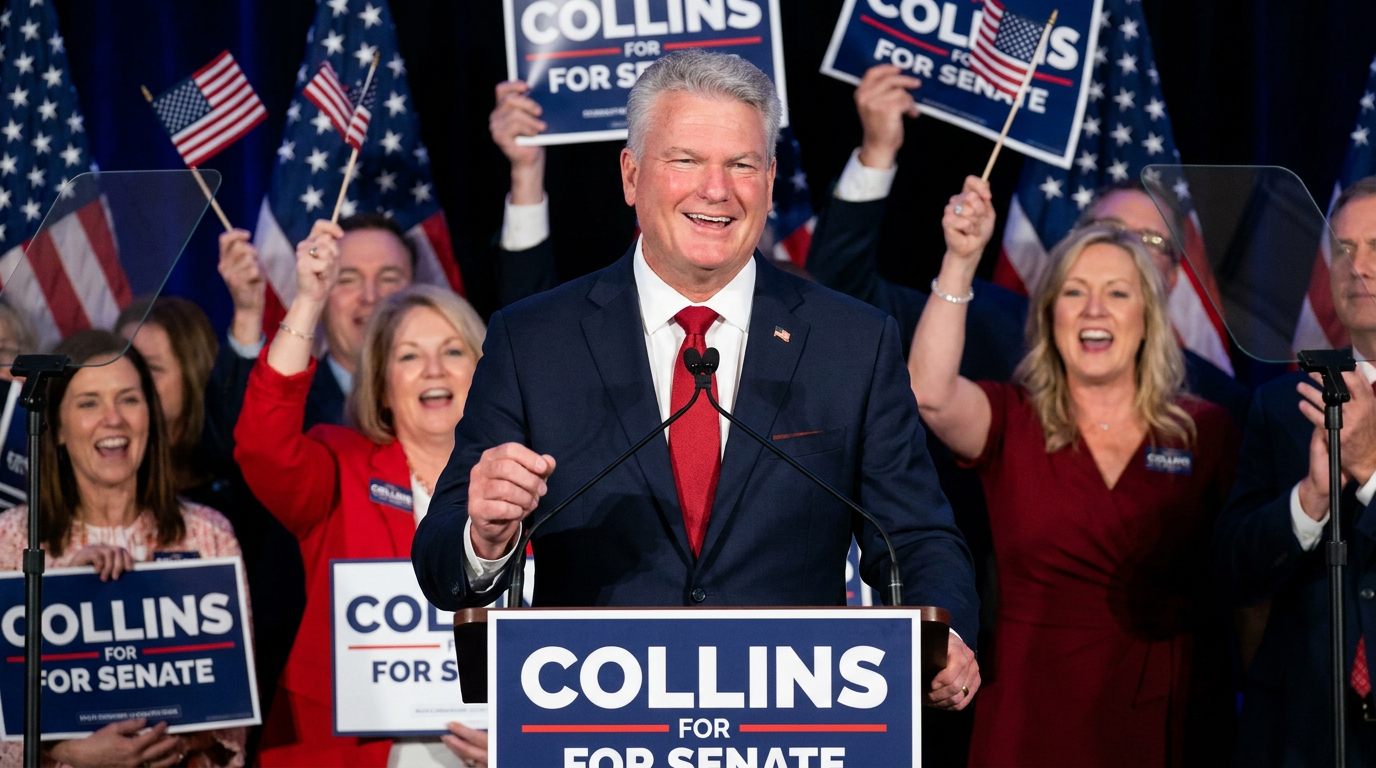
U.S. Representative Mike Collins secured the Republican nomination for Georgia's U.S. Senate seat, defeating his primary challenger in a runoff heavily influenced by Donald Trump's endorsement. Collins will now face incumbent Democratic Senator Jon Ossoff in a race critical to control of the upper chamber.
By Factlen Editorial Team
- Trump-Aligned Republicans
- View Collins's victory as proof that populist, America-First messaging remains the dominant force in the GOP and the best strategy to unseat Ossoff.
- Democratic Strategists
- Argue that Collins's right-wing primary campaign will alienate the moderate suburban voters essential for winning a statewide general election in Georgia.
- Georgia Political Observers
- Focus on the race as a pure turnout battle, emphasizing the tension between rural conservative mobilization and urban/suburban Democratic margins.
What's not represented
- · Independent and undecided suburban voters who frequently split their tickets in Georgia.
- · Local election officials managing the logistics and scrutiny of another high-profile, high-turnout statewide race.
Why this matters
Georgia remains one of the most fiercely contested political battlegrounds in the United States. The matchup between Mike Collins and Jon Ossoff is widely expected to be one of the most expensive and consequential races of the 2026 midterms, directly impacting which party controls the U.S. Senate.
Key points
- Rep. Mike Collins won the Georgia Republican Senate runoff, securing the nomination to challenge incumbent Democrat Jon Ossoff.
- Collins's victory was bolstered by a late endorsement from Donald Trump, solidifying his support among the party's populist base.
- Ossoff enters the race with a massive $28 million war chest and is framing Collins as an extremist out of touch with suburban voters.
- The race is expected to be one of the most expensive in the country, with national control of the U.S. Senate potentially hanging in the balance.
U.S. Representative Mike Collins has officially secured the Republican nomination for the U.S. Senate in Georgia, emerging victorious from a hard-fought primary runoff. The win sets the stage for a high-stakes general election showdown against incumbent Democratic Senator Jon Ossoff this November, in a race that could determine the balance of power in the upper chamber.[1][3]
Collins, a trucking executive and outspoken conservative who has represented Georgia's 10th Congressional District since 2023, defeated his establishment-backed opponent by a comfortable margin. The runoff was triggered after no candidate secured the requisite 50% of the vote in the initial May primary. Political analysts widely attribute Collins's decisive runoff victory to a late-stage rally and a forceful endorsement from Donald Trump, which energized the populist wing of the state's Republican base.[1][2][4]

Addressing a jubilant crowd of supporters in Athens on Tuesday night, Collins framed the upcoming general election as a referendum on the current administration's economic and immigration policies. He heavily criticized Ossoff's voting record, accusing the Democratic incumbent of acting as a rubber stamp for federal spending that has exacerbated inflation and failing to address security concerns at the southern border.[2][6]
Senator Ossoff's campaign wasted no time responding to the runoff results, immediately launching a multi-million-dollar ad blitz across the state's major media markets. Ossoff's team is aggressively framing Collins as an extremist whose policy positions are out of step with the moderate suburban voters who have increasingly decided Georgia's statewide elections. The Democratic incumbent is heavily emphasizing his own record of bipartisan legislative achievements, particularly in securing federal infrastructure and manufacturing investments for the state.[3][4][5]

Senator Ossoff's campaign wasted no time responding to the runoff results, immediately launching a multi-million-dollar ad blitz across the state's major media markets.
The financial landscape of the race is already breaking records. Ossoff enters the general election phase with a massive war chest, having stockpiled over $28 million in cash on hand while avoiding a primary challenge. However, Republican super PACs and national conservative organizations have signaled their intent to flood Georgia with outside spending, viewing Ossoff as one of the most vulnerable Democratic incumbents on the 2026 map.[1][5][7]
Demographically, the Collins-Ossoff matchup presents a classic test of Georgia's shifting political geography. Collins's path to victory relies on maximizing turnout in the state's deeply conservative rural counties and exurban rings, regions where his populist messaging strongly resonates. He must also stem the tide of Republican defections in the affluent northern suburbs of Atlanta, a vulnerability that has plagued GOP statewide candidates in recent cycles.[1][4]

Conversely, Ossoff's reelection strategy hinges on replicating the coalition that delivered his narrow 2021 runoff victory. This requires driving massive turnout among Black voters in Atlanta and other urban centers, while maintaining strong margins among college-educated suburbanites. Democratic strategists believe Collins's close alignment with Donald Trump will alienate the moderate swing voters Ossoff needs to retain his seat.[3][4]
The national implications of the race cannot be overstated. With the Senate map presenting few genuine pickup opportunities for Republicans, flipping Georgia is considered essential to their strategy for reclaiming the majority. Both national parties are preparing to deploy their top surrogates to the Peach State, ensuring that the local race will be thoroughly nationalized over the next five months.[5][7]
As the campaign transitions from the primary to the general election, voters in Georgia can expect an unprecedented barrage of political advertising and ground-game mobilization. With the margins in recent statewide elections often decided by less than a single percentage point, both campaigns are acutely aware that even minor shifts in voter enthusiasm or turnout mechanics could determine the outcome in November.[1][7]
How we got here
May 2026
Georgia holds its initial primary elections; no Republican Senate candidate surpasses the 50% threshold, triggering a runoff.
June 28, 2026
Mike Collins wins the Republican primary runoff, officially becoming the GOP nominee.
November 3, 2026
General election day, where Collins will face incumbent Democratic Senator Jon Ossoff.
Viewpoints in depth
Trump-Aligned Republicans
View Collins's victory as proof that populist, America-First messaging remains the dominant force in the GOP and the best strategy to unseat Ossoff.
For the populist wing of the Republican party, Collins's victory is a validation of the 'America First' platform. Conservative commentators and allied outlets argue that leaning into issues like strict border enforcement, economic protectionism, and cultural conservatism is the only way to generate the massive rural turnout required to win in Georgia. They dismiss concerns that Collins is too extreme for the suburbs, arguing instead that unenthusiastic base turnout—not suburban defection—cost Republicans the Senate seats in the 2021 runoffs.
Democratic Strategists
Argue that Collins's right-wing primary campaign will alienate the moderate suburban voters essential for winning a statewide general election in Georgia.
Democratic operatives view Collins as the ideal opponent for Ossoff. They argue that by embracing Donald Trump and hardline conservative positions to win the primary, Collins has fundamentally alienated the college-educated, suburban swing voters in the Atlanta metro area who have drifted away from the GOP in recent years. The Democratic strategy relies on painting Collins as a radical while highlighting Ossoff's focus on local infrastructure, manufacturing jobs, and bipartisan deal-making.
Georgia Political Observers
Focus on the race as a pure turnout battle, emphasizing the tension between rural conservative mobilization and urban/suburban Democratic margins.
Local political analysts view the upcoming general election as a grueling test of campaign mechanics. They note that Georgia is a deeply polarized state where persuasion plays a smaller role than base mobilization. Observers point out that Collins must run up massive margins in South and North Georgia to offset Ossoff's dominance in Atlanta and its immediate suburbs. The race will likely be decided by a few thousand votes, making ground-game operations, early voting pushes, and massive super PAC spending the deciding factors.
What we don't know
- Whether Donald Trump's involvement in the race will ultimately help Collins drive rural turnout more than it helps Ossoff motivate suburban Democratic voters.
- How much total outside money from super PACs will flood into Georgia's media markets over the next five months.
- If independent voters in the Atlanta suburbs will split their tickets, or vote straight-party in November.
Key terms
- Primary Runoff
- A second election held to determine a party's nominee when no candidate secures an absolute majority (over 50%) in the initial primary vote.
- Super PAC
- An independent political action committee that can raise and spend unlimited amounts of money to advocate for or against candidates, provided they do not coordinate directly with the candidate's campaign.
- War Chest
- The amount of funding a political candidate has accumulated and holds in reserve to spend on their campaign.
Frequently asked
Why was there a runoff election in Georgia?
Under Georgia law, a candidate must receive more than 50% of the vote to win a primary outright. Because no Republican reached that threshold in May, the top two candidates advanced to a runoff.
When is the general election?
The general election between Mike Collins and Jon Ossoff will take place on Tuesday, November 3, 2026.
Why is this specific Senate race so important?
The U.S. Senate is narrowly divided. Georgia is a swing state, and Republicans view unseating Ossoff as one of their best opportunities to gain a seat and potentially win control of the chamber.
Sources
Source coverage
7 outlets
3 viewpoints surfaced







[1]The Atlanta Journal-ConstitutionGeorgia Political Observers
Mike Collins secures GOP Senate nomination, pivots to Ossoff matchup
Read on The Atlanta Journal-Constitution →[2]Fox NewsTrump-Aligned Republicans
Trump-backed Rep. Mike Collins wins Georgia Senate runoff, targets Ossoff
Read on Fox News →[3]CNNDemocratic Strategists
Mike Collins wins Georgia Republican Senate runoff, setting up clash with Jon Ossoff
Read on CNN →[4]The New York TimesDemocratic Strategists
In Georgia, a Trump Loyalist Advances to Face Senator Jon Ossoff
Read on The New York Times →[5]PoliticoGeorgia Political Observers
Collins wins Georgia GOP runoff, kicking off a $100M Senate brawl
Read on Politico →[6]BreitbartTrump-Aligned Republicans
America First Victory: Trump-Endorsed Mike Collins Wins Georgia Senate Primary
Read on Breitbart →[7]The HillGeorgia Political Observers
Georgia Senate race takes shape as Collins wins GOP runoff
Read on The Hill →

More in news politics
See all 6 stories →Swiss Referendum
Swiss Voters Reject Far-Right Proposal to Cap Population at 10 Million, Averting 'Swiss Brexit' With EU
8 sources

Green Card Policy
USCIS Reclassifies Green Card Adjustment of Status as 'Extraordinary Relief' in Sweeping Policy Shift
7 sources

Romania-Moldova Unification
Romania's Parliament Approves 'Tacit Unification' With Moldova, Signaling Major Eastern European Border Shift
6 sources

Immigration Policy
Trump Nominates Former Oklahoma Trooper Lance Schroyer to Head ICE
7 sources

Every angle. Every day.
Get news politics stories with full source coverage and perspective breakdowns delivered to your inbox.