
Climate Analysis Quantifies 'Coffee-Harming Heat' Days, Accelerating the Shift to Drought-Resistant Species
A new climate analysis reveals that the world's top coffee-producing regions are experiencing up to 75 additional days of extreme heat annually. In response, the global coffee industry is rapidly accelerating the cultivation of drought-resistant species and fast-tracking genomic breeding to future-proof the morning cup.
By Factlen Editorial Team
- Climate Agronomists
- Argue that the only way to save the global coffee supply is to rapidly map the genomes of resilient species and deploy marker-assisted breeding.
- Smallholder Farmers
- Focus on the immediate economic viability of new species, prioritizing plants that offer reliable yields and resist unseasonal weather without requiring expensive inputs.
- Market Analysts
- View the climate shift as a supply-chain risk that will permanently alter global pricing and force consumers to adapt to new flavor profiles.
What's not represented
- · Consumer Taste Panels
- · Agrochemical Suppliers
Why this matters
As rising temperatures threaten the delicate Arabica beans that dominate global consumption, the rapid commercialization of resilient species like Excelsa and new genomic hybrids ensures that high-quality coffee will survive—and potentially improve—in a warming world.
Key points
- Major coffee-producing nations are experiencing up to 75 extra days of extreme heat annually due to climate change.
- Temperatures above 30°C and high Vapor Pressure Deficit severely stunt Arabica and Robusta yields.
- Farmers are successfully commercializing resilient, lesser-known species like Excelsa and Liberica.
- A newly identified natural hybrid, Coffea × libex, combines high yields with disease resistance.
- World Coffee Research is using DNA marker-assisted selection to cut breeding cycles from decades to weeks.
The morning cup of coffee is a fragile agricultural miracle. For decades, the global industry has relied almost entirely on two species: the highly prized, flavor-rich Arabica, and the hardier, more caffeinated Robusta. But the narrow genetic base of these two plants has left the $200 billion global coffee sector acutely vulnerable to shifting weather patterns, prompting a quiet revolution in botanical research and farm management.[6][7]
The scale of that vulnerability was quantified in a landmark 2026 analysis by the research group Climate Central. By examining daily temperature records across 25 major producing countries, researchers identified a sharp rise in "coffee-harming heat days"—defined as days where the maximum temperature exceeds 30°C (86°F). At this threshold, coffee plants begin to experience severe physiological stress.[1][4]
Between 2021 and 2025, the world's top five coffee-producing nations experienced an average of 57 extra coffee-harming heat days annually compared to a world without human-driven carbon emissions. Brazil, the world's largest producer, endured 70 additional days of extreme heat per year. Indonesia saw 73 extra days, while Thailand recorded an additional 75 days, pushing traditional growing regions to their biological limits.[1][4]

The mechanism of this damage goes beyond simple temperature readings. Plant physiologists point to Vapor Pressure Deficit (VPD) as the true culprit. As the air grows hotter and drier, it acts like a sponge, pulling moisture directly from the coffee leaves. This forces the plant to close its stomata to conserve water, which halts photosynthesis, stunts cherry development, and ultimately degrades the complex acids and sugars that give high-end coffee its flavor.[3][7]
Historically, the industry viewed Robusta as the natural fallback when Arabica struggled. However, recent agronomic data reveals that Robusta is not immune to the climate shift. Studies show that Robusta yields also decline precipitously when baseline growing-season temperatures are exceeded, proving that the cheaper substitute cannot simply be planted as a universal fix.[3]

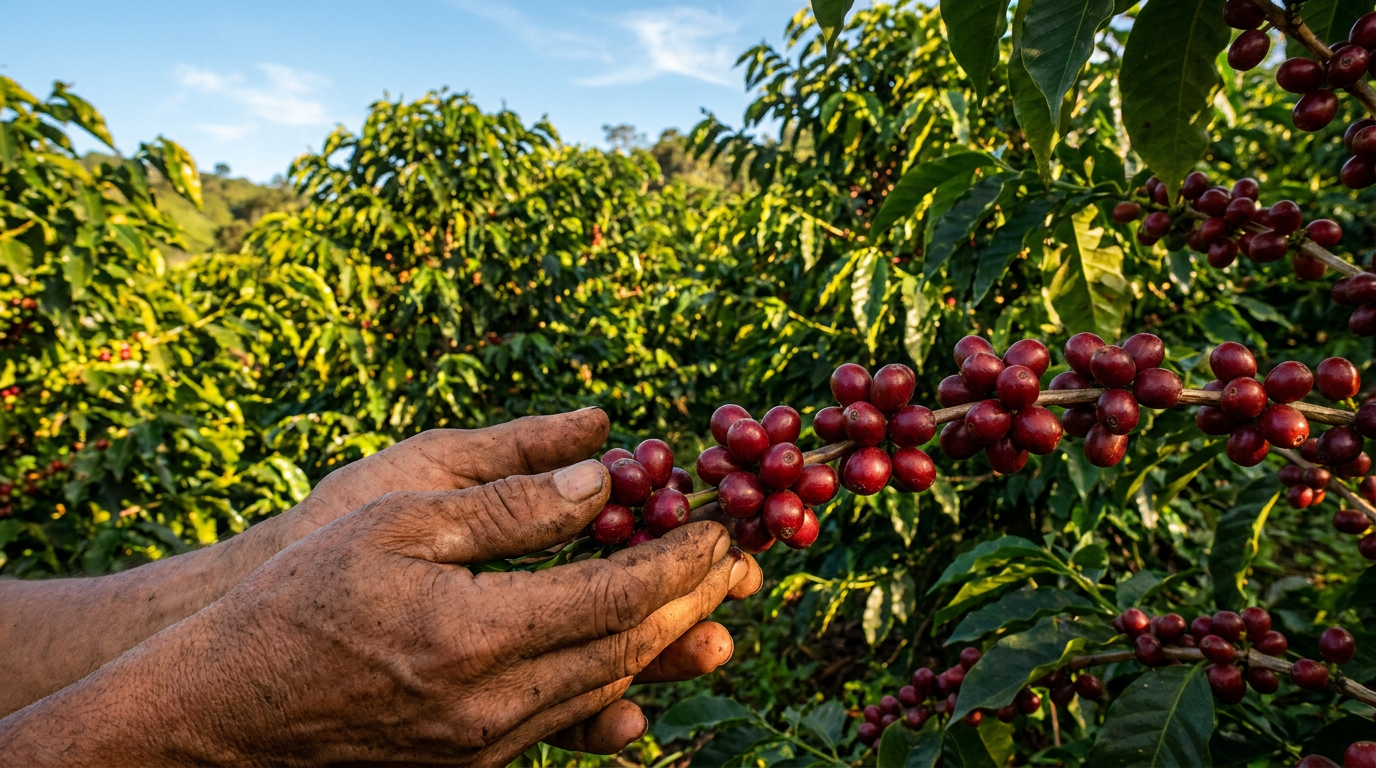
Faced with these biological hard limits, farmers and agronomists are looking past Arabica and Robusta, turning to the forgotten margins of old plantations. Species that were once dismissed as impractical are now being re-evaluated for their deep root systems and heat tolerance. Chief among them is Excelsa (Coffea dewevrei), a species native to Central Africa that was introduced to India in the late 1800s merely as a boundary marker and shade tree.[2][7]
Faced with these biological hard limits, farmers and agronomists are looking past Arabica and Robusta, turning to the forgotten margins of old plantations.
Excelsa grows tall and dense, which historically made it difficult to harvest and commercialize. But its climate resilience is unmatched. The plant thrives in hotter weather and features a long gestation period, meaning its cherries can be harvested in March and April—safely after the unseasonal rains that increasingly devastate Arabica crops have passed. In India, estates like the South India Coffee Company have successfully commercialized decades-old Excelsa trees, selling over four tonnes of the green coffee in 2025 alone.[2]
Alongside Excelsa, researchers are championing Liberica and Stenophylla. Liberica thrives in diverse conditions, from humid lowlands to drier, hotter regions where traditional species wither. Stenophylla, meanwhile, offers a holy grail for roasters: it possesses a heat tolerance superior to Arabica and a drought tolerance rivaling Robusta, yet it yields a complex flavor profile that is nearly indistinguishable from high-end Arabica.[2]
Nature has also provided its own solutions. Researchers at the Kew Royal Botanic Gardens recently identified a naturally occurring hybrid of Liberica and Excelsa, which they have proposed naming Coffea × libex. By analyzing 113 samples across three continents, the Kew team confirmed that "Libex" combines the best traits of its parents: it boasts the higher yields of Excelsa alongside the robust disease resistance and larger seed size of Liberica.[2][5]

While discovering natural hybrids is vital, the industry cannot afford to wait decades for these plants to naturally propagate and adapt. To accelerate the timeline, World Coffee Research (WCR) launched a $1.5 million initiative in June 2026 to drag coffee breeding into the genomic age. Backed by major industry players, the project aims to fundamentally rewrite how new coffee varieties are developed.[6]
Traditional coffee breeding is a marathon, often requiring 25 to 30 years of field observations and crossbreeding to yield a single stable variety. The WCR initiative utilizes marker-assisted selection—a DNA-based tool that allows breeders to peer into the genetic code of a seedling. Instead of waiting years for a tree to mature to see if it resists leaf rust or tolerates heat, scientists can confirm resistance in a matter of weeks, slashing the development cycle by more than half.[6]
This genomic acceleration is not genetic modification; it is the high-tech mapping of natural genetic diversity. By creating foundational genotyping tools for both Arabica and Robusta, the WCR is providing the industry with the "genetic infrastructure" needed to rapidly deploy resilient F1 hybrids to the farmers who need them most.[6][7]

The stakes for this transition are intensely local. For smallholder farmers, who produce the vast majority of the world's coffee, the cost of adapting a one-hectare farm to be heat-resilient is relatively low, yet they currently receive a fraction of a percent of global climate-adaptation funding. The rapid deployment of these new, hardy saplings is an economic lifeline that prevents the abandonment of generational farming land.[4][7]
Ultimately, the future of coffee will look and taste different than it does today. As Excelsa, Liberica, Stenophylla, and advanced F1 hybrids move from experimental plots to supermarket shelves, consumers will be introduced to new flavor profiles and blends. Rather than signaling the end of coffee, this diversification promises a richer, more resilient agricultural ecosystem that can withstand the heat of the 21st century.[2][7]
How we got here
Late 1800s
Excelsa coffee is introduced to India primarily as a boundary marker and shade tree.
2021–2025
Major coffee-producing nations experience a dramatic surge in coffee-harming heat days, stressing global Arabica supplies.
2025
Researchers at Kew Gardens formally identify Coffea × libex, a highly resilient natural hybrid of Liberica and Excelsa.
February 2026
Climate Central publishes data quantifying the exact increase in days above 30°C across 25 coffee-growing countries.
June 2026
World Coffee Research launches a $1.5 million genomic initiative to slash the breeding time of climate-resilient varieties.
Viewpoints in depth
Climate Agronomists
Argue that the only way to save the global coffee supply is to rapidly map the genomes of resilient species and deploy marker-assisted breeding.
For botanical researchers and geneticists, the climate crisis represents a race against biological clocks. They argue that traditional breeding methods—which take up to 30 years to stabilize a new variety—are fundamentally incompatible with the speed of global warming. By shifting focus to marker-assisted selection and F1 hybrids, agronomists believe they can isolate the specific DNA markers responsible for heat tolerance and disease resistance in species like Liberica and Excelsa. Their goal is to provide the industry with a 'genetic infrastructure' that allows for the rapid, continuous deployment of new, highly productive plants without resorting to genetic modification.
Smallholder Farmers
Focus on the immediate economic viability of new species, prioritizing plants that offer reliable yields and resist unseasonal weather without requiring expensive inputs.
Smallholder farmers, who produce the vast majority of the world's coffee, view the crisis through the lens of immediate survival. For them, a drop in yield or a crop lost to unseasonal rain means financial ruin. They are less concerned with the theoretical perfection of a bean's flavor profile and more focused on agronomic hardiness. Farmers championing species like Excelsa point out that its deep root systems and later harvesting cycles naturally bypass the erratic weather patterns that are currently devastating Arabica. They advocate for increased financial support to help transition their plots to these hardier, taller trees, emphasizing that adaptation must be economically viable at the farm level.
Market Analysts
View the climate shift as a supply-chain risk that will permanently alter global pricing and force consumers to adapt to new flavor profiles.
Commodity analysts and commercial roasters are bracing for a permanent structural shift in the coffee market. They note that as Arabica becomes increasingly difficult and expensive to grow, the baseline price of coffee will inevitably rise. This camp argues that the industry's survival depends on consumer education—specifically, retraining the public palate to accept and appreciate the distinct flavor profiles of Excelsa, Liberica, and new F1 hybrids. They view the integration of these alternative species not just as an agricultural necessity, but as a critical supply-chain hedge against future climate shocks.
What we don't know
- How quickly global consumers and high-end cafes will embrace the distinct flavor profiles of Excelsa and Liberica.
- Whether the new genomic breeding tools can scale fast enough to replace aging Arabica trees before the next major climate shock.
- The exact long-term impact of shifting to taller, denser coffee species on the broader agroforestry ecosystems of traditional farms.
Key terms
- Vapor Pressure Deficit (VPD)
- A measurement of the drying power of the air; high VPD means hot, dry air is rapidly pulling moisture out of plant leaves, causing severe stress.
- Marker-Assisted Selection
- A breeding technique that uses DNA markers to identify desirable traits (like disease resistance) in a seedling, drastically speeding up the development of new crop varieties.
- Coffea dewevrei (Excelsa)
- A tall, dense coffee species native to Central Africa that is highly resilient to heat and erratic rainfall, now being commercialized as an alternative to Arabica.
- F1 Hybrid
- The first-generation offspring of two distinctly different parent plants, bred to exhibit 'hybrid vigor'—superior traits like higher yields and greater climate adaptability.
Frequently asked
What is a 'coffee-harming heat day'?
It is a day where the maximum temperature exceeds 30°C (86°F), a threshold at which traditional coffee plants experience severe physiological stress, halting growth and degrading bean quality.
Why can't farmers just switch to Robusta?
While Robusta is hardier than Arabica, recent studies show that its yields also decline significantly when baseline growing-season temperatures become too hot, making it vulnerable to extreme climate shifts.
What makes Excelsa and Liberica better suited for the future?
These species evolved in hotter, more diverse climates. They possess deeper root systems, higher heat tolerance, and different harvesting cycles that allow them to avoid unseasonal, crop-destroying rains.
How does genomic breeding speed up the process?
Instead of waiting years for a crossbred tree to mature to see if it resists disease or heat, scientists use marker-assisted selection to read a seedling's DNA and confirm its resilience in a matter of weeks.
Sources
Source coverage
7 outlets
3 viewpoints surfaced







[1]Climate CentralMarket Analysts
Coffee in a Warming Climate: Heat Days Analysis
Read on Climate Central →[2]MongabaySmallholder Farmers
An overlooked species gains new relevance
Read on Mongabay →[3]ZME ScienceMarket Analysts
What's Going On With The Price of Coffee
Read on ZME Science →[4]Nation ThailandSmallholder Farmers
Climate change is coming for our coffee
Read on Nation Thailand →[5]Kew Royal Botanic GardensClimate Agronomists
New coffee hybrid Coffea × libex identified
Read on Kew Royal Botanic Gardens →[6]World Coffee ResearchClimate Agronomists
WCR Unveils $1.5 Million Plan to Fast-Track Climate-Resilient Coffee Varieties
Read on World Coffee Research →[7]Factlen Editorial TeamMarket Analysts
Synthesis by Factlen editorial team
Read on Factlen Editorial Team →
Every angle. Every day.
Get food drink stories with full source coverage and perspective breakdowns delivered to your inbox.