
Romania's Parliament Approves 'Tacit Unification' With Moldova, Signaling Major Eastern European Border Shift
A legislative proposal to merge Romania and Moldova automatically passed Romania's lower house after a debate deadline expired. While currently a procedural maneuver, the bill forces the prospect of a geopolitical merger onto the international stage.
By Factlen Editorial Team
- Gradual EU Integrationists
- Prefer that Moldova joins the EU as an independent sovereign state through standard accession protocols.
- Pro-Unification Bloc
- Argue that merging is the only viable way to secure Moldova's future against Russian aggression.
- Anti-Russian Security Camp
- Focus on the strategic necessity of severing Moldova's post-Soviet ties to resist Kremlin influence.
- Historical Consensus
- Emphasize the deep cultural, linguistic, and historical ties that drive the modern unification movement.
What's not represented
- · Transnistrian Separatist Leadership
- · The Kremlin / Russian Foreign Ministry
- · Moldovan Opposition Parties (Pro-Russian Bloc)
Why this matters
While currently a procedural maneuver, the advancement of this bill forces the prospect of a Romania-Moldova merger onto the international stage. A unification would instantly bring Moldova into NATO and the EU, fundamentally redrawing Eastern Europe's borders and directly challenging Russia's sphere of influence.
Key points
- The Romanian Chamber of Deputies advanced a bill proposing the unification of Romania and Moldova without a formal debate or vote.
- The bill passed via 'tacit adoption' because a 45-day constitutional deadline for parliamentary review had expired.
- The mainstream Romanian government opposes the unilateral bill, preferring to support Moldova's standard accession into the European Union.
- Moldovan President Maia Sandu has indicated she would vote in favor of unification in a referendum to secure the country against Russian threats.
- A merger would instantly bring Moldova under NATO's Article 5 security umbrella and bypass the traditional EU membership queue.
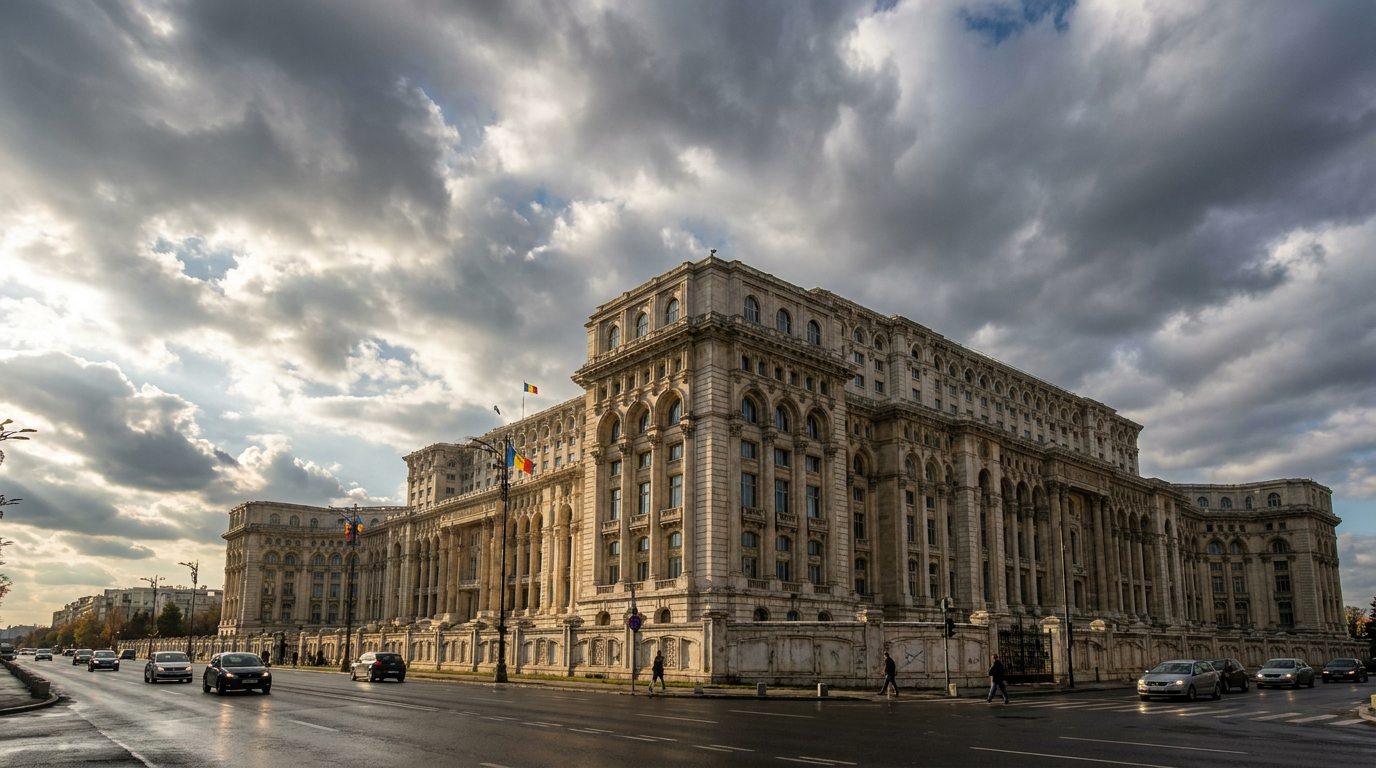
In a procedural move that has sent ripples across Eastern Europe, the lower house of Romania's parliament has advanced a legislative proposal aimed at the outright unification of Romania and the Republic of Moldova. The bill, which envisions merging the two nations into a single sovereign state, passed the Chamber of Deputies this week without a single debate or formal vote.[1]
The mechanism behind this sudden advancement is a constitutional quirk known as "tacit adoption." Under Romanian parliamentary rules, if a legislative chamber fails to debate or vote on a draft bill within a strict 45-day window, the proposal is automatically considered approved and forwarded to the next stage of the legislative process.[1][2]
Session chair Natalia Intotero formally acknowledged the bill's passage during a plenary session, announcing that because the deadline for a final vote had been exceeded, the proposal was legally bound to advance. The document now heads to the Romanian Senate, which serves as the decisive decision-making body for this type of legislation.[1][3][4]
The initiative was originally introduced on April 14 by lawmakers from S.O.S. România, a far-right nationalist party known for its provocative geopolitical stances. The draft law explicitly authorizes the Romanian government to immediately commence negotiations with officials in Chișinău to finalize a territorial and political merger.[3][5]
Despite the bill's advancement, the mainstream Romanian political establishment remains opposed to the unilateral approach. The government in Bucharest has already issued a formal negative opinion on the draft, alongside rejections from the Chamber's Legal and Human Rights committees. The official state priority remains supporting Moldova's independent path toward European Union membership, rather than pursuing a sudden border shift.[3]

Yet, the concept of unification is gaining unprecedented traction across the border in Moldova, driven largely by existential security fears. Following Russia's invasion of neighboring Ukraine, Moldova—a small, non-NATO state—has felt increasingly vulnerable to Moscow's destabilization efforts.[2]
Moldovan President Maia Sandu has become increasingly vocal about the potential for a merger. In early 2026, Sandu stated plainly that she would vote in favor of unification with Romania if the question were put to a national referendum. "It is becoming increasingly difficult for a small country like Moldova to survive as a democratic, sovereign state and resist Russia," Sandu explained.[2]
Moldovan President Maia Sandu has become increasingly vocal about the potential for a merger.
This sentiment is echoed by other top officials in Chișinău. Moldovan Foreign Minister Mihai Popsoi confirmed in late May that he too would support unification at the ballot box, noting that concrete steps toward a merger could materialize if there is "significant openness" from the public.[4]
For Moldova, unifying with Romania offers a compelling geopolitical shortcut. Because Romania is already a member of both the European Union and NATO, a merger would theoretically extend Article 5 security guarantees to Moldovan territory overnight, bypassing the arduous, decades-long accession queues.[3][4]
European officials are watching the developments closely. European Commissioner for Enlargement Marta Kos recently noted that Moldovan citizens ultimately hold the power to decide whether to unify with Romania as a means to accelerate their integration into the European bloc.[3]
The most significant hurdle to any unification scenario remains Transnistria, the breakaway region on Moldova's eastern border that is heavily backed by Moscow and hosts a contingent of Russian troops. Integrating this contested territory into a Greater Romania would likely trigger a severe crisis with the Kremlin.[4]

However, Chișinău has begun signaling that it will not let Transnistria hold its future hostage. President Sandu recently stated that Moldova's integration into the EU—and potentially a merger with Romania—could proceed without taking the unrecognized Pridnestrovian Moldavian Republic into account, effectively leaving the territory behind if necessary.[4]
Public opinion on the matter reveals a stark divide between the two nations. In Romania, the appetite for reunification is overwhelming; a recent poll indicated that nearly 72 percent of Romanian respondents support merging with Moldova.[3]
In Moldova, the picture is more complex. While a majority of citizens now support European integration—backing it in a 2024 referendum—outright unification with Romania remains a more polarizing issue, though support has steadily climbed as regional instability persists.[2]

The push for unity is deeply rooted in the shared cultural and linguistic heritage of the two nations. Following World War I, the territory of modern-day Moldova was part of Greater Romania, before being annexed by the Soviet Union in 1940. Since the fall of the USSR in 1991, a dedicated political movement has sought to reverse that historical fracture.[6]
While the S.O.S. România bill is highly unlikely to survive the upcoming Senate vote, its tacit passage has successfully forced the unification debate onto the main stage. As Moldova races to sever its remaining post-Soviet ties and meet its 2030 EU membership target, the prospect of erasing the border along the Prut River is shifting from a nationalist fringe theory to a mainstream geopolitical contingency.[1][2][3][4]
How we got here
1918
Moldova (then Bessarabia) unites with Greater Romania following World War I.
1940
The Soviet Union annexes the territory, establishing the Moldavian SSR.
1991
Moldova declares independence from the Soviet Union amid the bloc's collapse.
March 2022
Moldova officially applies for European Union membership following Russia's invasion of Ukraine.
April 2026
The far-right S.O.S. România party introduces the unification bill in the Romanian parliament.
June 2026
The bill tacitly passes the Romanian Chamber of Deputies after the 45-day debate deadline expires.
Viewpoints in depth
Unification Advocates
Argue that merging is the only viable way to secure Moldova's future against Russian aggression.
Proponents of immediate unification, including the initiators of the bill and several high-ranking Moldovan officials, view the geopolitical window as rapidly closing. They argue that as a small, non-NATO state, Moldova remains highly vulnerable to Russian destabilization tactics. By unifying with Romania, Moldova would instantly fall under NATO's Article 5 security umbrella and bypass the decades-long bureaucratic process of standard EU accession. For this camp, the historical and cultural ties between the two nations provide the necessary foundation for a swift political merger.
Gradual Integrationists
Prefer that Moldova joins the EU as an independent sovereign state through standard accession protocols.
The official stance of the current Romanian government and mainstream European Union leadership favors a step-by-step approach. They argue that unilateral border changes—even peaceful ones—could severely destabilize Eastern Europe and provoke a direct military response from Russia, particularly concerning the Transnistria region. Instead of a sudden merger, this camp advocates for heavy financial and institutional support to help Moldova meet EU membership criteria by its 2030 target, maintaining its sovereignty while integrating it into the European economic and security architecture.
Russian Sphere Defenders
Strongly oppose any Western integration or border changes, viewing them as NATO expansionism.
Moscow and the leadership of the breakaway Transnistrian republic view any move toward Romanian unification or EU accession as a direct threat to their regional influence. Russian officials have repeatedly warned that Moldova's pivot to the West risks repeating the 'Ukrainian scenario.' For this camp, the tacit approval of the unification bill in Bucharest is evidence of Western imperial ambitions aimed at absorbing post-Soviet states and erasing Russian cultural and political footholds in Eastern Europe.
What we don't know
- How the Romanian Senate will ultimately vote on the legislation, given the government's formal opposition.
- Whether Moscow will retaliate economically or militarily if Chișinău takes concrete steps toward a merger.
- How the breakaway region of Transnistria would be handled legally and militarily in a unification scenario.
Key terms
- Tacit Adoption
- A parliamentary procedure in Romania where a bill automatically passes a legislative chamber if it is not debated or voted on within a strict 45-day deadline.
- Transnistria
- A breakaway, unrecognised state internationally recognized as part of Moldova, which maintains deep ties to Moscow and hosts a contingent of Russian troops.
- Article 5
- The cornerstone principle of the NATO alliance, which states that an armed attack against one member is considered an attack against all members.
- S.O.S. România
- A right-wing nationalist political party in Romania that initiated the legislative proposal for unification.
Frequently asked
Are Romania and Moldova now a single country?
No. The bill only passed the lower house of Romania's parliament due to a procedural technicality. It still requires approval from the Romanian Senate and would ultimately require bilateral agreements and referendums.
Does the Romanian government support this bill?
No. The mainstream Romanian government issued a negative opinion on the draft, preferring to support Moldova's gradual accession into the European Union rather than a sudden territorial merger.
Why do some Moldovan leaders support unification?
Facing intense security threats from Russia, leaders like President Maia Sandu view unification as a potential fast-track to gaining NATO security guarantees and EU economic benefits.
What would happen to Transnistria?
It remains a major complication. However, Moldovan leadership has recently suggested that integration with the West could proceed without the breakaway region if a settlement cannot be reached.
Sources
Source coverage
6 outlets
4 viewpoints surfaced





[1]Anadolu AgencyGradual EU Integrationists
Romanian parliament tacitly adopts bill for unification with Moldova
Read on Anadolu Agency →[2]United24 MediaAnti-Russian Security Camp
Romania Parliament approves tacit unification with Moldova
Read on United24 Media →[3]LIGA.netGradual EU Integrationists
Romanian Chamber of Deputies passes bill on unification with Moldova
Read on LIGA.net →[4]1LurerPro-Unification Bloc
Romania's lower house of parliament approves proposal for unification with Moldova
Read on 1Lurer →[5]Digi24Pro-Unification Bloc
Proiectul de unire cu Republica Moldova, adoptat tacit în Camera Deputaților
Read on Digi24 →[6]WikipediaHistorical Consensus
Unification of Moldova and Romania
Read on Wikipedia →

Every angle. Every day.
Get news politics stories with full source coverage and perspective breakdowns delivered to your inbox.