
From Career-Threatening Injuries to World Cup Gold: Desirae Ridenour's Remarkable Triathlon Comeback
After enduring a severe concussion, a car collision, and long COVID, Canadian triathlete Desirae Ridenour has resurrected her career with a string of international victories. Her dominant start to the 2026 season proves her inspiring return to the sport's elite tier is no fluke.
By Factlen Editorial Team
- Canadian Triathlon Community
- Views Ridenour's return as a vital resurgence for the national program, ending a decade-long World Cup drought.
- Local Hometown Supporters
- Celebrates her resilience and local roots, emphasizing her journey from high school track star to global contender.
- Sports Science Analysts
- Highlights her recovery as a textbook example of overcoming the 'injury spiral' through environmental change and consistent base training.
- International Triathlon Officials
- Focuses on her race execution, tactical maturity, and impact on the global competitive field.
What's not represented
- · Athletes whose careers were permanently ended by similar injury spirals
- · Motorists involved in collisions with training cyclists
Why this matters
For anyone facing seemingly insurmountable physical or professional setbacks, Ridenour's journey offers a masterclass in resilience. Her successful return to elite sport proves that strategic environmental changes and patient rehabilitation can overcome even the most devastating injury spirals.
Key points
- Canadian triathlete Desirae Ridenour has successfully returned to elite racing after a three-year injury spiral.
- Her setbacks included a severe concussion, a car collision, stress fractures, and long COVID.
- She relocated to New Zealand in 2023 to overhaul her training and rehabilitate her body.
- Ridenour won the 2025 World Triathlon Cup in Napier, ending a 12-year drought for Canadian women.
- She opened the 2026 season by defending her title at the Oceania Triathlon Cup in Napier.
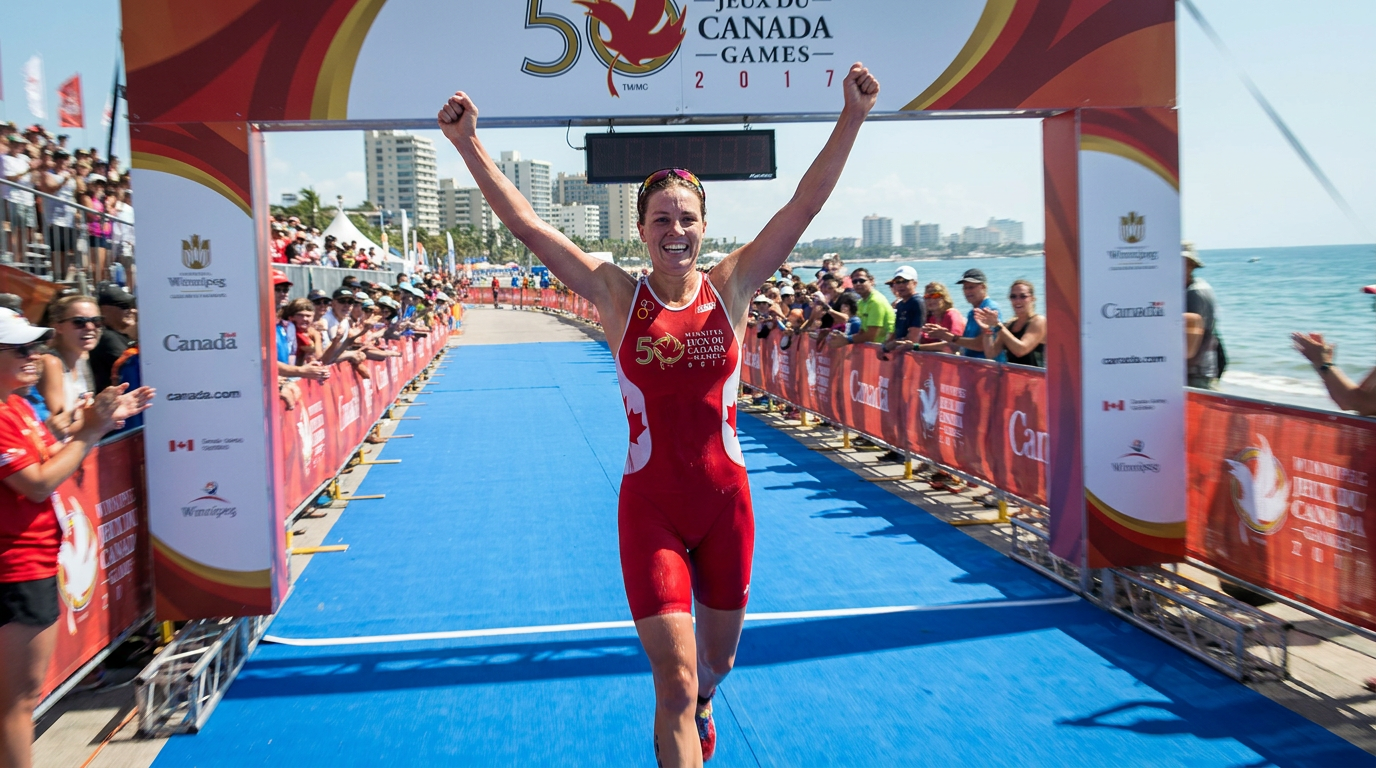
Crossing the finish line at the Oceania Triathlon Cup in Napier in early 2026, Desirae Ridenour immediately fell to the ground to catch her breath. The exhaustion was temporary, but the relief was profound. It wasn't just another race win; it was undeniable proof that her miraculous 2025 resurrection was permanent.[1][6]
For years, the Canadian triathlete had practically vanished from the elite circuit, her promising career derailed by a devastating sequence of physical traumas. Now, she is back at the pinnacle of the sport, dominating international fields and firmly eyeing the Los Angeles 2028 Olympics.[3][4]
The dark years were relentless. Between 2020 and 2023, Ridenour endured what sports medicine experts describe as a textbook "injury spiral." It began with a stress reaction in her hip and cascaded into chronic calf issues, compounded by the lingering, systemic exhaustion of long COVID.[3][4]
The trauma wasn't just physiological—it was violent. During a frenetic open-water swim, Ridenour suffered a severe concussion after being kicked in the head. Later, while out on a routine training ride, she was struck by a car, adding acute trauma to her already fragile recovery.[2][4]

The accumulation of setbacks forced her to withdraw mid-race at the 2023 Pan American Games in Santiago. Overtrained and broken, she disappeared from the international start lists. "I fell off the map and people thought I had quit," she later admitted.[2][3]
But Ridenour refused to let her career end on the pavement. Realizing she needed a drastic environmental and biomechanical reset, she left the National Triathlon Centre in Victoria, British Columbia, in the winter of 2023.[3]
She relocated 8,000 miles away to Cambridge, New Zealand, joining her partner, New Zealand triathlete Trent Thorpe, and linking up with Australian coach Lachie Kerin. The goal was to rebuild her body from the ground up, prioritizing consistency over intensity.[3][4]
The isolation of her recovery period was profound. While the triathlon world moved on, Ridenour quietly logged base miles in the Southern Hemisphere, focusing on neuroplasticity and gradual rehabilitation protocols to heal her brain and bones.[4]

The breakthrough finally arrived in February 2025 at the World Triathlon Cup in Napier. Emerging from the 750-meter swim in the lead pack, Ridenour stayed tucked in the breakaway on the bike before unleashing a devastating kick on the blue carpet.[5][7]
The breakthrough finally arrived in February 2025 at the World Triathlon Cup in Napier.
She broke the tape in 56 minutes and 24 seconds, becoming the first Canadian woman in 12 years to win a World Cup event. The victory shattered a decade-long drought for the national program, which hadn't seen a woman top a World Cup podium since Amelie Kretz in 2013.[2][7]
The 2025 season quickly became a redemption tour. Ridenour captured back-to-back gold medals at the Americas Triathlon Cups in Montreal and Kelowna, rocketing from 120th in the world rankings to 34th by the year's end.[2][3]

However, the comeback faced a late-season test. At the World Triathlon Championship Finals in Wollongong, Australia, a cut on her foot reopened during the run. Attempting to run without her shoe led to severe hamstring cramps, forcing a heartbreaking DNF.[1][6]
Doubters wondered if her body would hold up for another grueling Olympic cycle. Ridenour answered those questions emphatically at the start of the 2026 season, returning to Napier for the Oceania Triathlon Cup.[1][6]
Competing as the sole Canadian on the start list, she delivered a tactical masterclass. After navigating the swim and bike, she unleashed the fastest run split of the day—a blistering 16:48 over five kilometers—to drop Australia's Aspen Anderson and secure the title.[1][6]
"I was also happy that I once again proved to myself that I am good enough and that last year's successes were not a fluke," Ridenour reflected after the race, noting the immense relief of translating winter training into early-season speed.[6]

She carried that momentum into the World Triathlon Cup Haikou in China, battling through a fiercely competitive field to claim fourth place, narrowly missing the podium but cementing her status as a consistent, healthy threat.[5][6]
Sports science analysts point to Ridenour's journey as a textbook example of modern athletic recovery. By stepping away from the pressure cooker of national expectations and focusing on uninterrupted, sustainable training blocks, she bypassed the cycle of chronic re-injury.[4]
Today, Ridenour stands as the undisputed leader of the Canadian women's national program. As she navigates the grueling World Triathlon Championship Series across Europe this summer, her eyes are firmly fixed on the LA 2028 Olympic qualification period.[3][7]
Her resurrection serves as a powerful blueprint for athletes navigating the dark corridors of injury. Ridenour didn't just return to the sport; she reinvented her approach to it, transforming catastrophic setbacks into the foundation of her greatest triumphs.[4]
How we got here
2017–2019
Ridenour emerges as a top prospect, winning Canada Summer Games gold and Pan Am Games mixed-relay silver.
2020–2023
A devastating string of injuries—including a concussion, car collision, and long COVID—forces her out of elite competition.
Winter 2023
She relocates to Cambridge, New Zealand, to overhaul her training environment and rehabilitate.
February 2025
Ridenour wins the World Triathlon Cup in Napier, the first Canadian woman to do so in 12 years.
March 2026
She defends her turf in Napier, winning the Oceania Triathlon Cup and proving her comeback is permanent.
Viewpoints in depth
Canadian High-Performance Program
The national federation's relief and optimism surrounding Ridenour's breakthrough.
For Triathlon Canada, Ridenour's resurgence is a desperately needed lifeline. The national women's program had not seen a World Cup victory since Amelie Kretz's win in 2013, leaving a significant gap in international podiums. Officials view Ridenour's return to form as a stabilizing force heading into the Los Angeles 2028 Olympic cycle, providing both a proven medal threat and a veteran leader for younger developmental athletes.
Sports Science & Rehabilitation Experts
How biomechanical and psychological resets enabled her physical recovery.
Recovery analysts point to Ridenour's relocation to New Zealand as the critical circuit-breaker in her 'injury spiral.' By removing herself from the high-pressure environment where she repeatedly broke down, she allowed her nervous system to reset. Experts emphasize that her success stems from prioritizing uninterrupted, low-intensity base miles over rushed, high-intensity intervals, allowing her bone density and cardiovascular system to fully heal from the compounding traumas of concussions and long COVID.
The Athlete's Inner Circle
The personal toll of the dark years and the mental fortitude required to return.
Those close to Ridenour, including her coaches and training partners, highlight the immense psychological burden of her three-year absence. Enduring a car crash, a severe head injury, and chronic fatigue left her feeling isolated from the sport she loved. Her inner circle credits her profound mental resilience—willing to completely uproot her life and move across the globe—as the true engine of her comeback, proving that physiological healing must be paired with psychological renewal.
What we don't know
- Whether Ridenour's body can withstand the compounding physical toll of the full World Triathlon Championship Series leading into the LA 2028 Olympics.
- How the lingering, unpredictable effects of long COVID might impact her endurance during peak summer racing conditions.
Key terms
- World Triathlon Cup
- The second-highest tier of international elite triathlon racing, sitting just below the World Triathlon Championship Series (WTCS).
- Injury spiral
- A compounding cycle where one injury leads to altered biomechanics or premature return to training, directly causing subsequent injuries.
- Long COVID
- Prolonged symptoms, including severe fatigue and respiratory issues, that persist for months or years after an initial COVID-19 infection.
- Blue carpet
- The iconic blue-colored finishing chute used in World Triathlon events, synonymous with the final sprint of a race.
- DNF
- Did Not Finish; an official race designation for an athlete who starts a competition but is unable to complete the course.
Frequently asked
What injuries did Desirae Ridenour suffer?
Between 2020 and 2023, Ridenour endured a severe concussion from being kicked in the head during a swim, a collision with a car while cycling, a hip stress reaction, calf issues, and long COVID.
When did she win her first World Cup?
She won her first World Triathlon Cup in Napier, New Zealand, in February 2025, breaking a 12-year drought for Canadian women at the World Cup level.
Where does she train now?
In the winter of 2023, she relocated to Cambridge, New Zealand, to train under Australian coach Lachie Kerin and rebuild her fitness base.
What is her current world ranking?
After falling outside the top 100 during her injury years, she climbed to 34th in the world by the end of the 2025 season.
Sources
Source coverage
7 outlets
4 viewpoints surfaced







[1]Triathlon Magazine CanadaCanadian Triathlon Community
Canadian Desirae Ridenour Takes Gold in Napier
Read on Triathlon Magazine Canada →[2]Times ColonistLocal Hometown Supporters
Island triathlete Ridenour wins World Cup race
Read on Times Colonist →[3]Cowichan Valley CitizenLocal Hometown Supporters
After years of injuries, long COVID and a major move abroad, triathlete Desirae Ridenour is winning again
Read on Cowichan Valley Citizen →[4]Triathlon.mxSports Science Analysts
From Career-Ending Injuries to World Championships: How Elite Athletes Stage Remarkable Comebacks
Read on Triathlon.mx →[5]World TriathlonInternational Triathlon Officials
Desirae Ridenour ignites Napier with first World Cup gold in season opener
Read on World Triathlon →[6]Victoria NewsLocal Hometown Supporters
Cowichan Bay's Desirae Ridenour wins Oceania Triathlon Cup
Read on Victoria News →[7]Triathlon BCCanadian Triathlon Community
Cowichan Bay's Desirae Ridenour Becomes First Canadian Woman to Top World Cup Podium Since 2013
Read on Triathlon BC →
More in sports
See all 30 stories →WWE Championship
Sami Zayn Captures Undisputed WWE Championship in Triple Threat Victory at Night of Champions
6 sources

Injury
Chess Injury Report: Abasov's ACL Recovery, Humpy's Stand, and the Medical Power of the Board
6 sources

Standings
FIDE Women's Circuit Standings: Assaubayeva Takes the Lead as Teenagers Hnatyshyn and Savitha Shri Crash the Top 10
8 sources
Injury
Global Netball Injury Report: Harvey Returns to Form as Poi Leads Steel From the Sidelines
7 sources
Every angle. Every day.
Get sports stories with full source coverage and perspective breakdowns delivered to your inbox.