
Second Completely Sealed 2,600-Year-Old Etruscan Tomb Discovered Near Rome, Offering Pristine Cultural Snapshot
Archaeologists have opened a rare, untouched Etruscan burial chamber containing two skeletons and pristine grave goods, marking the second such discovery at the heavily looted San Giuliano necropolis in just one year.
By Factlen Editorial Team
- Archaeological Field Directors
- Focus on the unparalleled value of spatial data and undisturbed context for reconstructing ancient rituals.
- Heritage Protection Authorities
- Emphasize the success of site conservation efforts in preventing looting and preserving cultural heritage.
- Bioarchaeologists
- Highlight the potential for upcoming isotopic and genetic analyses to reveal the health, diet, and lineage of the deceased.
What's not represented
- · Local residents of Barbarano Romano regarding the cultural impact of the discoveries on their community.
- · Art historians specializing in the stylistic evolution of Orientalizing-period Etruscan ceramics.
Why this matters
Because almost all known Etruscan tombs were looted centuries ago, artifacts are usually found stripped of their context. This pristine, sealed chamber provides a rare, undisturbed dataset that allows researchers to reconstruct the exact funerary rituals and daily lives of a civilization that profoundly shaped early Rome.
Key points
- Archaeologists opened a completely sealed 2,600-year-old Etruscan tomb near Rome, the second such find at the site in a year.
- The rock-cut chamber contained the remains of two individuals and was untouched by ancient or modern looters.
- Grave goods included a ceremonial iron spearhead, polished black bucchero cups, and an imported Greek aryballos.
- The discovery provides an exceptionally rare, undisturbed spatial dataset for studying Etruscan funerary rituals.
- Upcoming genetic and isotopic analyses will aim to confirm the sex, health, and familial ties of the deceased.
In a highly exceptional archaeological event, researchers have opened a completely sealed Etruscan burial chamber at the San Giuliano necropolis, located approximately 40 miles northwest of Rome. Dating to the late seventh century BCE, the tomb represents a pristine, undisturbed funerary context. The discovery was made by the San Giuliano Archaeological Research Project (SGARP), led by Baylor University in close collaboration with Italy's archaeological heritage authority. Remarkably, this marks the second intact tomb found at the site in consecutive years, following a similar breakthrough in 2025.[2][3][7]
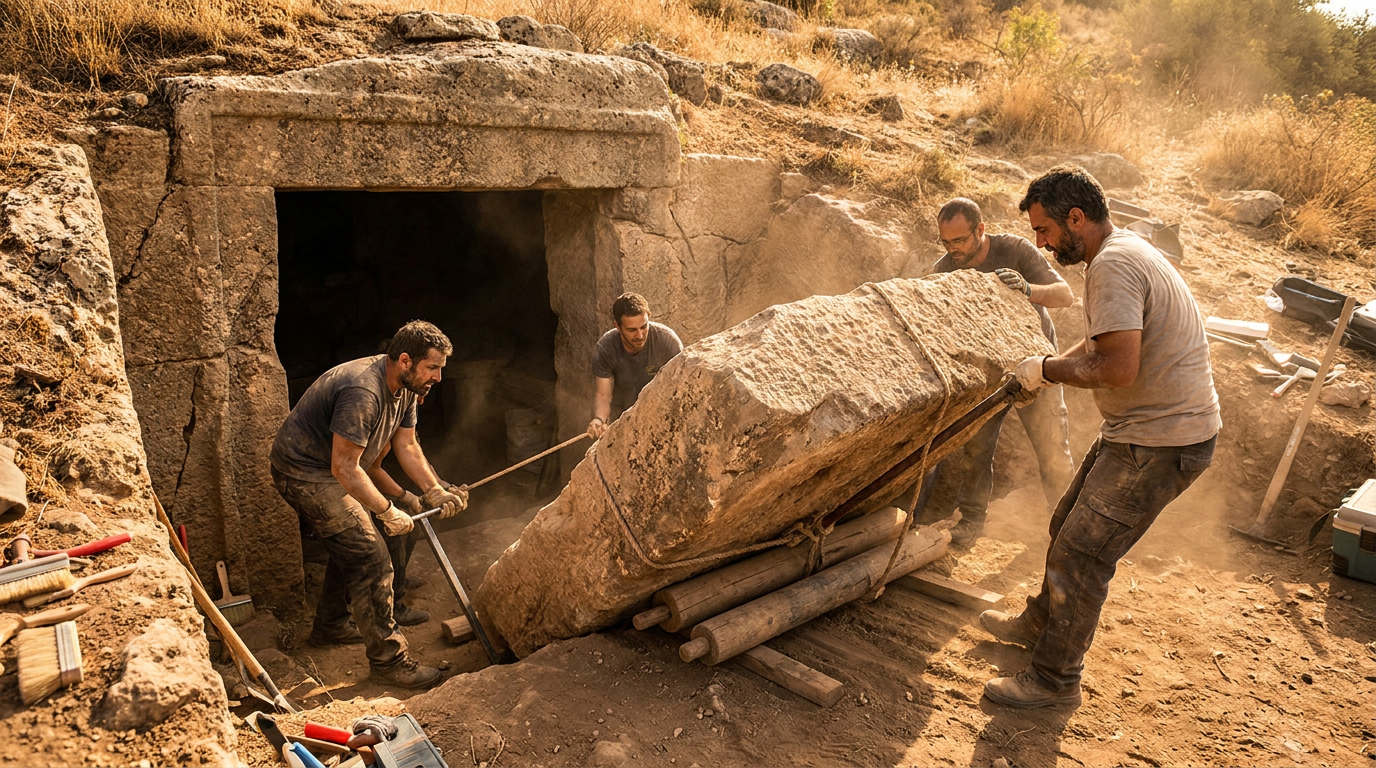
The primary evidence of the tomb's integrity was immediately apparent to the excavation team. The entrance to the rock-cut chamber was found firmly blocked by its original massive stone slab, exhibiting no signs of ancient looting or modern disturbance. Upon carefully removing the seal on June 9, researchers documented the remains of two individuals left exactly as mourners positioned them roughly 2,600 years ago. This pristine spatial arrangement provides a direct evidentiary window into the Orientalizing period of Etruscan history, a time when the culture was reaching its peak of regional influence and trade.[1][4][5]
The grave goods recovered from the chamber offer a detailed, in-situ inventory of Etruscan ritual practices. Archaeologists cataloged a diverse array of artifacts surrounding the bodies, including large ceramic storage vessels known as olle, polished black drinking cups called bucchero, and at least one aryballos—a specialized Greek jar utilized for holding valuable oils or perfumes. The presence of the imported aryballos provides strong evidence of the extensive Mediterranean trade networks the Etruscans maintained, linking central Italy to the broader Aegean economy.[1][2]

Alongside the ceramic vessels, researchers discovered a ceremonial iron spearhead placed near one of the bodies. Based on established Etruscan funerary typologies, the inclusion of martial equipment strongly suggests that one of the interred individuals was male. However, the skeletal remains are only partially preserved due to millennia of natural degradation in the tuff rock environment. While the macroscopic evidence points to a male-female pairing or a warrior burial, definitive biological profiling awaits comprehensive laboratory analysis.[1][2][3]
Alongside the ceramic vessels, researchers discovered a ceremonial iron spearhead placed near one of the bodies.
The scientific value of the 2026 discovery is magnified exponentially by its proximity to the larger, four-person intact tomb uncovered by the same team just a few feet away in 2025. Finding two unlooted chambers side-by-side is virtually unprecedented in southern Etruria. The San Giuliano necropolis contains more than 600 known tombs, the vast majority of which were systematically stripped of their contents by expanding Roman armies in the third century BCE, or by modern tombaroli (tomb raiders) seeking black-market antiquities.[4][5][6]

Dr. Barbara Barbaro, the on-site official for the Superintendency of Archaeology, Fine Arts, and Landscape, emphasized that an undisturbed context elevates artifacts from mere objects to a cohesive scientific dataset. When a tomb is looted, the spatial relationships between the bodies and the ritual offerings are permanently destroyed. The intact nature of these adjacent tombs allows researchers to reconstruct the original layout of the necropolis and map the specific ritual choreography of Etruscan burials with a high degree of confidence.[2][4][7]

While the in-situ evidence is robust, transparent uncertainties remain regarding the specific identities of the deceased. Anthropological, isotopic, and genetic studies are required to confirm the sex, exact age, health status, and familial relationship of the two individuals. Furthermore, researchers plan to analyze the organic residues within the olle and aryballos to identify the specific foodstuffs, wines, and perfumes utilized in the funerary rites. These forthcoming analyses will test the preliminary hypotheses regarding the social status and daily lives of the tomb's occupants.[1][6]
The consecutive discoveries also validate the efficacy of recent conservation and anti-looting protocols implemented by Italian authorities. By successfully securing the San Giuliano Plateau, archaeologists are finally able to apply modern, interdisciplinary excavation techniques to pristine Etruscan contexts. As the SGARP team continues its systematic documentation, the data extracted from these twin tombs will serve as a foundational reference point for future studies, rewriting our understanding of how the pre-Roman inhabitants of Italy lived, traded, and honored their dead.[2][3][5]
How we got here
Late 7th Century BCE
Two individuals are buried in a rock-cut chamber at San Giuliano, sealed with a massive stone slab.
Late 3rd Century BCE
Roman expansion into the region leads to the widespread looting of most tombs in the necropolis.
2016
The San Giuliano Archaeological Research Project (SGARP) begins systematic excavations at the site.
June 2025
Archaeologists discover the first completely intact, unlooted Etruscan tomb at San Giuliano, containing four individuals.
June 9, 2026
A second sealed tomb is opened just feet away from the first, revealing two skeletons and pristine grave goods.
Viewpoints in depth
Archaeological Field Directors
Focus on the unparalleled value of spatial data and undisturbed context for reconstructing ancient rituals.
For field archaeologists, an artifact's value lies primarily in its context rather than its aesthetic beauty. When a tomb is looted, the spatial relationships—where a cup was placed relative to a body, or how a spear was oriented—are destroyed forever. Field directors emphasize that finding two intact tombs side-by-side allows them to map the precise 'choreography' of Etruscan mourning rituals. This pristine spatial data transforms isolated artifacts into a cohesive narrative about how the pre-Roman inhabitants of Italy honored their dead.
Heritage Protection Authorities
Emphasize the success of site conservation efforts in preventing looting and preserving cultural heritage.
Italian heritage officials view these consecutive discoveries as a major victory in the ongoing battle against 'tombaroli' (illegal tomb raiders). Southern Etruria has suffered from decades of black-market looting that strips sites of their historical value. Authorities point to the undisturbed seals on these tombs as concrete proof that recent investments in site security, community partnerships, and rigorous archaeological oversight are successfully protecting Italy's vulnerable cultural landscapes.
Bioarchaeologists
Highlight the potential for upcoming isotopic and genetic analyses to reveal the health, diet, and lineage of the deceased.
While the pottery and weapons offer immediate cultural insights, bioarchaeologists are focused on the skeletal remains and organic residues. They argue that the true scientific breakthrough will come from laboratory analyses. Isotopic testing of the bones can reveal what these individuals ate and where they grew up, while genetic sequencing could determine if the occupants of the two adjacent tombs were related. Furthermore, analyzing the chemical residues inside the sealed jars will provide hard data on the specific foods and perfumes used in 7th-century BCE Italy.
What we don't know
- The exact biological sex, age, and familial relationship of the two individuals, pending genetic and osteological analysis.
- The specific contents of the organic residues left inside the storage jars and perfume flasks.
- Whether the two adjacent tombs (from 2025 and 2026) belonged to the same extended family or clan.
- The precise cause of death for the interred individuals.
Key terms
- Orientalizing period
- A cultural phase in the 8th and 7th centuries BCE when Etruscan art and society were heavily influenced by trade with the Eastern Mediterranean and Greece.
- Bucchero
- A type of polished, black ceramic ware that is considered the signature pottery of the ancient Etruscans.
- Aryballos
- A small spherical or globular flask of Greek origin used to contain valuable perfumes or oils, often found in wealthy ancient burials.
- Olle
- Large, rounded ceramic storage vessels used by the Etruscans for holding food, liquids, or sometimes cremated remains.
- Necropolis
- A large, designed cemetery with elaborate tomb monuments, literally translating from Greek as 'city of the dead.'
Frequently asked
Where is the San Giuliano necropolis located?
It is situated on a plateau in the Caiolo area of Barbarano Romano, approximately 40 miles northwest of Rome in central Italy.
Why is finding an intact Etruscan tomb so rare?
The vast majority of Etruscan tombs were looted over the centuries, first by expanding Roman armies in the third century BCE and later by modern illegal diggers seeking artifacts to sell.
What does the Greek jar (aryballos) tell researchers?
The presence of an imported Greek vessel indicates that the individuals likely belonged to a social class with access to the extensive Mediterranean trade networks that flourished during the Orientalizing period.
How do researchers know one of the individuals was male?
An iron spearhead was found placed next to one of the bodies. In Etruscan funerary tradition, martial equipment is strongly associated with male burials, though biological tests are pending to confirm this.
Sources
Source coverage
7 outlets
3 viewpoints surfaced







[1]Popular MechanicsArchaeological Field Directors
An untouched Etruscan burial chamber has been opened near Rome
Read on Popular Mechanics →[2]Greek ReporterHeritage Protection Authorities
Second Intact Etruscan Tomb Discovered Near Rome
Read on Greek Reporter →[3]Baylor UniversityArchaeological Field Directors
Baylor Team Unearths Second Intact Etruscan Tomb at Caiolo
Read on Baylor University →[4]Daily GalaxyBioarchaeologists
Archaeologists Open a 2,600-Year-Old Perfectly Sealed Tomb and Find Everything Left Untouched Inside
Read on Daily Galaxy →[5]BioScienceBioarchaeologists
Inside A 2,600-Year-Old Etruscan Tomb Near Rome: Untouched Burials And Priceless Artifacts
Read on BioScience →[6]Futura SciencesArchaeological Field Directors
Inside the 2,600-year-old Etruscan tomb opened for the first time in Italy
Read on Futura Sciences →[7]Superintendency of Archaeology, Fine Arts, and LandscapeHeritage Protection Authorities
Eccezionale scoperta a San Giuliano: una seconda tomba intatta
Read on Superintendency of Archaeology, Fine Arts, and Landscape →
Every angle. Every day.
Get science stories with full source coverage and perspective breakdowns delivered to your inbox.