
The Science of the Badminton Smash: How Players Break the 500 km/h Barrier
Badminton is the fastest racket sport on Earth, with smash speeds exceeding those of Formula 1 cars. The secret lies in a biomechanical 'whip' effect and the unique, parachute-like aerodynamics of the shuttlecock.
By Factlen Editorial Team
- Biomechanics Researchers
- Focus on the kinetic chain, joint sequencing, and forearm pronation as the true sources of power rather than brute strength.
- Aerodynamics & Materials Engineers
- Analyze the unique fluid dynamics, drag coefficients, and material properties that govern the shuttlecock's parachute-like flight.
- Competitive Players & Record Keepers
- Prioritize the tactile feel, control, and historical milestones of the sport amid the transition to synthetic materials.
What's not represented
- · Traditional shuttlecock manufacturers facing supply chain crises
- · Amateur players adapting to the cost of equipment
Why this matters
Understanding the physics of the badminton smash not only demystifies an incredible athletic feat, but also highlights the cutting-edge materials science currently reshaping the sport's future as it transitions away from natural feathers.
Key points
- Badminton is the fastest racket sport in the world, with smash speeds exceeding 500 km/h.
- Power is generated through a full-body kinetic chain, not just arm or wrist strength.
- Forearm pronation and shoulder rotation account for over 50% of the racket's final velocity.
- The shuttlecock's parachute-like design causes it to lose more than half its speed within two meters.
- The sport is actively trialing synthetic shuttlecocks due to the rising costs and scarcity of natural goose feathers.
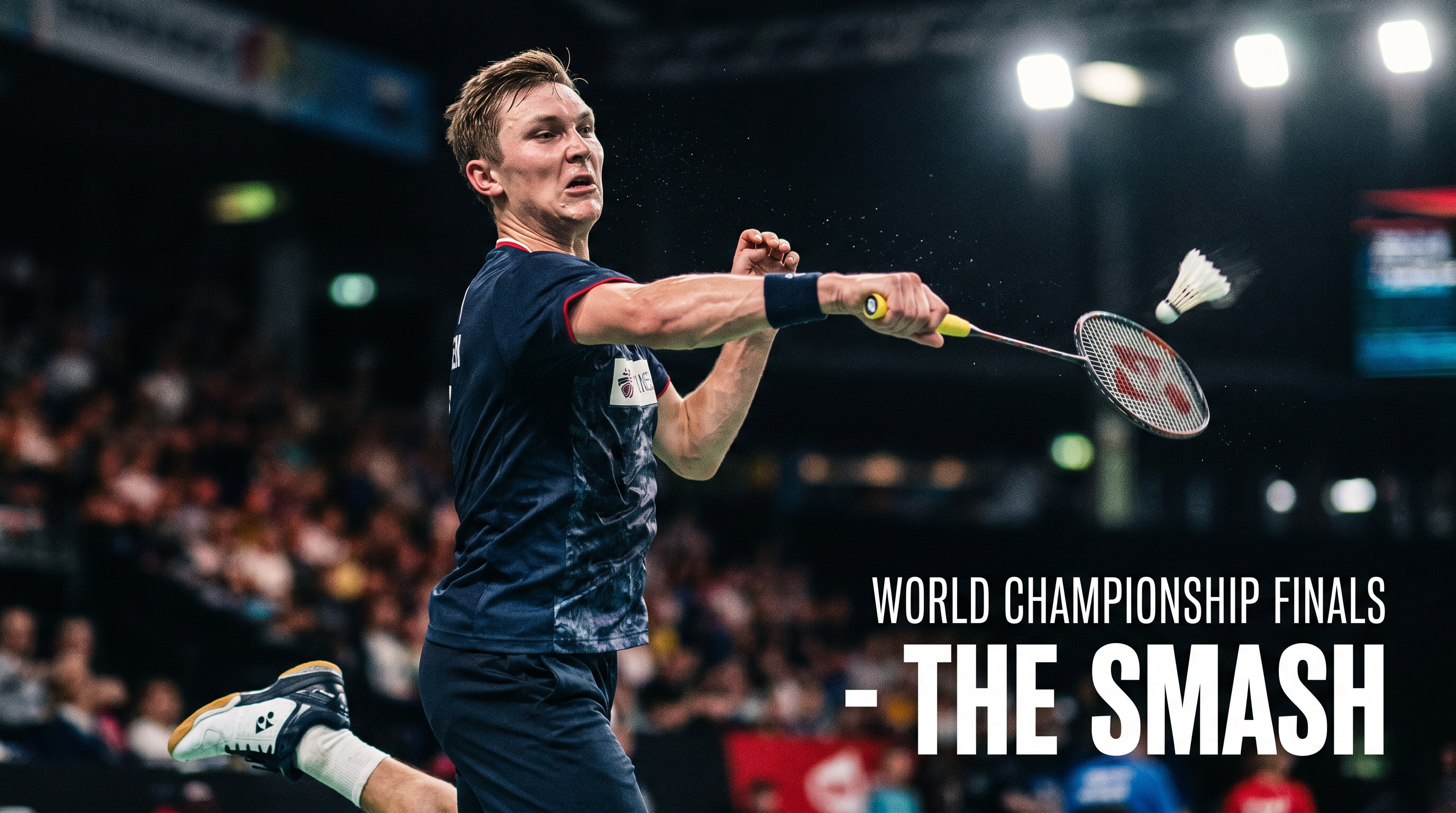
The sound of a world-class badminton smash is a violent, abrupt crack that echoes through the arena. In April 2023, Indian shuttler Satwiksairaj Rankireddy unleashed a smash that was clocked at an astonishing 565 km/h (351 mph) in a controlled environment at a Yonex factory in Japan.[1][2]
To put that velocity into perspective, the fastest recorded speed of a Formula 1 car is roughly 397 km/h. The fastest tennis serve tops out at 263 km/h, and a professional golf drive reaches about 349 km/h. Badminton stands entirely alone as the fastest racket sport on the planet, defying the visual intuition of casual observers.[2]
This presents a fascinating physical paradox: How does a sport played with a lightweight carbon-fiber racket and a fragile projectile made of cork and feathers generate such terrifying speed? The answer lies not in brute muscular strength, but in a perfect symphony of human biomechanics and fluid dynamics.[7]

Sports biomechanists refer to the human body as a biological machine designed to transfer energy. In a badminton smash, this energy transfer happens through the "kinetic chain"—a sequential activation of body segments that acts exactly like a bullwhip breaking the sound barrier.[3][4]
The sequence begins from the ground up. The true power source of the smash actually originates in the ankles and knees as the player pushes off the court. This ground reaction force travels up through the hips, initiating a powerful trunk rotation that loads the core muscles like a coiled spring.[4]
As the energy moves upward, each joint accelerates and then rapidly brakes, passing its momentum to the next, smaller segment. The sequence flows precisely: knee, hip, shoulder, elbow, and finally, the wrist and racket. By the time the energy reaches the racket head, the velocity has compounded exponentially.[4]
For decades, amateur players were taught that the secret to a powerful smash was a "wrist snap." Biomechanical studies have thoroughly debunked this myth. Research shows that up to 53% of the final racket head velocity actually comes from shoulder rotation and radio-ulnar pronation—the inward twisting of the forearm just before impact.[7]
This whip-like pronation requires the player to remain completely relaxed until the exact microsecond of contact. Any premature muscle tension acts as an internal brake, disrupting the kinetic chain and bleeding off potential speed before the racket ever meets the shuttlecock.[3]

This whip-like pronation requires the player to remain completely relaxed until the exact microsecond of contact.
However, generating a 565 km/h initial velocity is only half the physics equation. The other half is the shuttlecock itself. Unlike a tennis ball or a baseball, which follow roughly parabolic trajectories, a shuttlecock behaves more like a miniature parachute.[5]
A traditional shuttlecock consists of 16 goose feathers embedded in a cork base. This unique shape makes it a "bluff body" in aerodynamic terms. It has an exceptionally high drag coefficient—typically around 0.48 for a feather shuttlecock, which forces it to interact heavily with the surrounding air.[5]
Because of this high drag and its low mass of just 5 grams, the shuttlecock decelerates violently. A smash that leaves the racket at 500 km/h will lose more than half its speed within the first two meters of flight, experiencing immense aerodynamic resistance.[5]
This rapid deceleration is precisely what makes badminton playable. If the shuttlecock maintained its initial velocity, human reaction times would be entirely insufficient to return a smash. Instead, it slows down to a manageable speed by the time it crosses the net, eventually reaching a terminal velocity of just 6.5 to 6.8 meters per second as it falls.[5]

While the biomechanics of the smash remain a constant marvel, the projectile itself is currently undergoing a historic evolution. The sport is facing an existential crisis regarding its traditional materials, forcing a shift that is testing the limits of modern engineering.[6]
The cost of high-quality goose feathers has skyrocketed in recent years due to a decline in global duck and goose farming. Because a single premium shuttlecock requires 16 specific "knife feathers" from the wings of multiple birds, the traditional manufacturing model has become economically and environmentally unsustainable.[6]
In response, the Badminton World Federation has been aggressively trialing synthetic shuttlecocks made from advanced polymers like Polyamide 12 (PA12) and Polyether Block Amide (PEBA). These materials aim to replicate the exact flight characteristics of natural feathers while offering vastly superior durability.[6]
Replicating the aerodynamic "intelligence" of a natural feather is a monumental challenge. Wind tunnel tests show that synthetic shuttlecocks often have a higher drag coefficient—around 0.70—because air flows differently through the solid plastic skirts compared to the micro-gaps in natural feathers.[5][6]

Competitive players note that while synthetics are improving, they currently lack the subtle "bite" and self-correcting flight path of natural feathers, especially during delicate net play or when decelerating from a massive, high-speed smash.[6]
As materials science continues to improve, the gap between feather and synthetic is steadily closing. Whether striking a traditional goose feather or a next-generation polymer, the biomechanical marvel of the 500 km/h smash remains one of the most spectacular, physics-defying feats in modern sports.[7]
How we got here
May 2013
Malaysian player Tan Boon Heong sets the smash world record at 493 km/h.
April 2023
Satwiksairaj Rankireddy shatters the record with a 565 km/h smash in a controlled environment in Japan.
July 2023
Guinness World Records officially verifies Rankireddy's achievement as the fastest hit in sports.
2024–2026
The Badminton World Federation expands trials of synthetic shuttlecocks at international tournaments to address feather shortages.
Viewpoints in depth
Biomechanics Researchers
Focus on the kinetic chain and joint sequencing as the true sources of power.
Sports scientists view the badminton smash as a masterpiece of human kinesiology. Rather than focusing on muscular hypertrophy (brute strength), biomechanists study the precise timing of joint acceleration and deceleration. They emphasize that the body acts as a whip, where energy generated by ground reaction forces is multiplied as it travels upward. The final, explosive speed relies heavily on radio-ulnar pronation, debunking the long-held coaching myth that a 'wrist snap' is responsible for a powerful smash.
Aerodynamics Engineers
Focus on the unique fluid dynamics and drag profile of the shuttlecock.
For fluid dynamicists, the shuttlecock is an anomaly in the sports world. Unlike spherical balls that aim to minimize air resistance, the shuttlecock is a 'bluff body' designed to maximize drag. Engineers study how air flows through the micro-gaps of natural feathers to create a self-correcting, parachute-like trajectory. This extreme deceleration is what makes the sport physically playable, transforming a 500 km/h projectile into a returnable object within fractions of a second.
Competitive Players
Focus on the tactile feel, control, and the controversial transition to synthetic materials.
While players appreciate the science behind their speed, their primary concern is the 'feel' of the equipment. The ongoing transition from natural goose feathers to synthetic polymers is a major point of contention. Elite players argue that current synthetic models, despite their durability and cost-effectiveness, lack the natural aerodynamic 'intelligence' of feathers. They report that synthetics can feel heavier and less responsive during delicate net shots, making the adaptation process a significant challenge for the competitive circuit.
What we don't know
- Whether synthetic shuttlecocks will ever perfectly replicate the micro-aerodynamics and 'feel' of natural goose feathers.
- What the absolute biological limit of human smash speed is, and whether the 600 km/h barrier can be broken.
Key terms
- Kinetic Chain
- The sequential activation of body segments—from the feet up to the hand—to efficiently transfer energy and maximize speed at the point of impact.
- Pronation
- The rapid inward twisting of the forearm just before the racket strikes the shuttlecock, which contributes significantly to the final swing speed.
- Drag Coefficient
- A dimensionless number used by aerodynamicists to quantify the air resistance of an object; shuttlecocks have a uniquely high drag coefficient compared to other sports balls.
- Bluff Body
- An aerodynamic term for an object whose shape creates a large wake and high drag, causing it to decelerate quickly in the air.
Frequently asked
What is the fastest badminton smash ever recorded?
The fastest recorded smash is 565 km/h (351 mph), achieved by Indian player Satwiksairaj Rankireddy in April 2023.
Does a powerful smash come from wrist strength?
No. Biomechanical studies show that power comes from a full-body 'kinetic chain' starting at the feet, with the final speed generated largely by shoulder rotation and forearm pronation, not a 'wrist snap'.
Why does a shuttlecock slow down so quickly?
A shuttlecock acts as a 'bluff body' with a very high drag coefficient. Its parachute-like shape causes immense air resistance, rapidly decelerating it from extreme speeds to a hittable velocity.
Why is badminton switching to synthetic shuttlecocks?
Rising costs and declining availability of the specific goose feathers required for traditional shuttlecocks have made them economically and environmentally unsustainable, prompting a shift toward advanced plastics.
Sources
Source coverage
7 outlets
3 viewpoints surfaced






[1]Guinness World RecordsCompetitive Players & Record Keepers
Fastest badminton hit (male)
Read on Guinness World Records →[2]Olympics.comCompetitive Players & Record Keepers
Satwiksairaj Rankireddy breaks Guinness world record for fastest badminton smash
Read on Olympics.com →[3]MDPIBiomechanics Researchers
Biomechanical Analysis of the Forehand Smash in Badminton
Read on MDPI →[4]Journal of Human Sport and ExerciseBiomechanics Researchers
Kinematic characteristics of smash in badminton
Read on Journal of Human Sport and Exercise →[5]World BadmintonAerodynamics & Materials Engineers
Aerodynamics of Badminton Shuttlecocks
Read on World Badminton →[6]The Indian ExpressCompetitive Players & Record Keepers
Soaring prices of feather shuttles have become an existential issue for badminton, but the synthetic ones are not matching up
Read on The Indian Express →[7]Factlen Editorial TeamAerodynamics & Materials Engineers
Synthesis by Factlen editorial team
Read on Factlen Editorial Team →
More in sports
See all 397 stories →Women's Sports
How Women's Wrestling Became the Fastest-Growing Collegiate Sport in America
8 sources

Engine Regulations
The 2026 Formula 1 Engine Revolution: How Sustainable Fuel and a 50/50 Hybrid Split Are Changing the Sport
8 sources
MLB Milestones
Brewers' Jacob Misiorowski Throws Historic 15-Strikeout, One-Hit Shutout
7 sources

Pitching Milestone
Jacob Misiorowski Throws Historic 15-Strikeout, One-Hit Complete Game in Brewers Win
7 sources

Every angle. Every day.
Get sports stories with full source coverage and perspective breakdowns delivered to your inbox.