
The Science of Sleep Tourism: How Hotels Are Engineering the Perfect Night's Rest
As the sleep tourism market booms, luxury hotels are deploying circadian lighting, acoustic cocooning, and AI-powered beds to cure traveler exhaustion.
By Factlen Editorial Team
- Hospitality Innovators
- Believe that sleep is a highly engineerable state and that technology can solve environmental disruptions to rest.
- Sleep Science Advocates
- Focus on behavioral changes, chronobiology, and the measurable health benefits of dedicated recovery time.
- Wellness Skeptics
- Warn that hyper-monitoring sleep metrics can cause anxiety and that the industry commodifies systemic exhaustion.
What's not represented
- · Budget Travelers
- · Night-Shift Workers
Why this matters
As chronic exhaustion becomes a global health crisis, the hospitality industry is transforming from a provider of experiences into a provider of recovery. Understanding the science behind 'sleep tourism' not only reveals the future of travel, but offers practical, evidence-based blueprints for engineering better sleep in your own home.
Key points
- Sleep tourism is projected to grow from a $75 billion market in 2025 to nearly $130 billion by 2032.
- Luxury hotels are redesigning rooms with circadian lighting, acoustic cocooning, and AI-powered beds to optimize rest.
- Environmental engineering targets a room temperature of 18–20°C and ambient noise levels below 30 decibels.
- Programs increasingly include behavioral interventions like chrononutrition and sleep coaching.
- Critics warn that hyper-monitoring sleep metrics can paradoxically induce 'sleep anxiety' and commodify exhaustion.
Vacations were once defined by packed itineraries, early-morning excursions, and the pressure to maximize every waking moment in a new destination. Today, a rapidly growing demographic of travelers is seeking the exact opposite. Driven by a global epidemic of burnout and chronic exhaustion, the hospitality industry is witnessing a fundamental pivot: the rise of the sleepcation. Rather than treating the hotel room as a mere pitstop between activities, guests are increasingly booking stays where deep, restorative rest is the primary objective.[6][7]
This shift has birthed "sleep tourism," a highly specialized sector that treats rest as a legitimate health investment. Valued at over $75 billion globally in 2025, the market is projected to reach nearly $130 billion by 2032. The financial scale reflects a deep consumer need; recent industry data indicates that more than one in four travelers now book spa or wellness treatments specifically to enhance their sleep quality.[3][4]
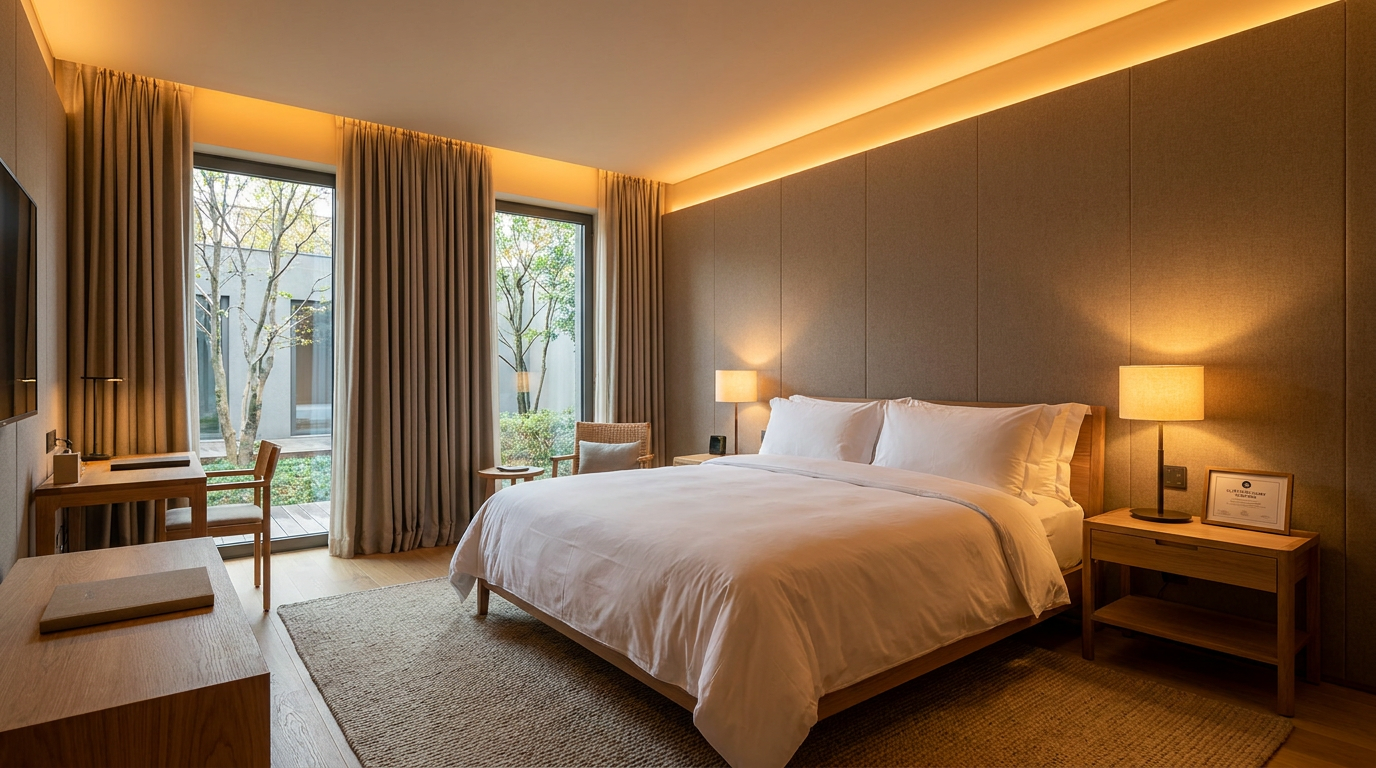
But what separates a true sleep retreat from a standard hotel room with blackout curtains and a lavender pillow spray? The answer lies in the emerging field of neuro-architecture. Luxury properties are moving beyond basic amenities, treating each room as a discreet, clinically precise sleep laboratory. They are engineering environments that actively manipulate light, sound, and temperature to guide the human body into its natural recovery cycles.[5][7]

The foundational pillar of this environmental engineering is circadian lighting. Light exposure is the primary driver of the body's internal clock, dictating when we feel alert and when we feel tired. To harness this, forward-thinking hotels are installing dynamic lighting systems that automatically shift color temperatures throughout the day, mimicking the natural progression of the sun.[3][6]
In the morning, these systems emit cool, blue-toned light—around 6500 Kelvin—which suppresses the production of melatonin and signals the brain to wake up. As evening approaches, the lighting gradually transitions to warm, amber tones closer to 2700 Kelvin. This deliberate absence of blue light allows melatonin levels to rise naturally, preparing the nervous system for sleep long before the guest actually gets into bed.[3][6]
The second critical pillar is "acoustic cocooning." Unpredictable noise spikes—whether from a slamming door in the hallway or a siren on the street—are notorious for pulling sleepers out of deep, restorative sleep stages. To combat this, properties are treating walls, heavy insulated doors, and even ventilation ducts as a single, integrated acoustic system designed to wrap the guest in absolute quiet.[5]
The objective of acoustic cocooning is to drop the ambient room noise below a strict 30-decibel baseline. When paired with advanced HEPA air purification systems that silently filter particulate matter, the room becomes a sensory deprivation chamber that actively lowers cortisol levels and prevents the micro-awakenings that leave travelers feeling groggy the next day.[4][5]

The objective of acoustic cocooning is to drop the ambient room noise below a strict 30-decibel baseline.
At the center of the room is the bed itself, which is undergoing a high-tech revolution. Traditional luxury mattresses are increasingly being replaced by AI-powered smart beds, such as the Bryte Restorative Bed or Eight Sleep systems. These platforms represent a shift from passive comfort to active sleep management.[1][3]
Using integrated biometric sensors, these smart beds read a guest's pressure points and adjust their firmness in real-time as the sleeper changes positions. More importantly, they manage thermal regulation. Sleep science dictates that the optimal room temperature for sleep onset is between 18 and 20 degrees Celsius (64 to 68 degrees Fahrenheit). Smart beds actively cool the mattress surface to help drop the body's core temperature, a biological prerequisite for entering deep sleep.[3][4]
Beyond the physical infrastructure of the room, hotels are introducing behavioral interventions like chrononutrition. Room service menus are being redesigned to feature melatonin-boosting ingredients, functional beverages, and probiotic snacks. By avoiding heavy, late-night meals that spike blood sugar and disrupt digestion, hotels ensure that the body's metabolic processes do not interfere with its overnight recovery.[6]

Some elite properties are taking the clinical approach even further, partnering with neuroscientists and sleep physicians to offer multi-night protocols. These programs often integrate Cognitive Behavioral Therapy for Insomnia (CBT-I) frameworks, providing guests with personalized sleep coaching and digital detox routines designed to break the cycle of chronic restlessness.[6]
Despite these advancements, there is inherent uncertainty in the sleep tourism model. Sleep scientists point to the "first-night effect"—an evolutionary phenomenon where half the brain remains more alert during the first night in an unfamiliar environment. Even in a perfectly engineered room, this biological defense mechanism can reduce sleep efficiency by 10 to 20 percent, raising questions about the efficacy of short-term sleepcations.[5][7]
Furthermore, wellness skeptics warn of the unintended consequences of hyper-monitoring. When sleep is transformed into a performance metric tracked by wearables and AI beds, the pressure to achieve a "perfect score" can paradoxically induce sleep anxiety. Constantly analyzing biometric data can activate the sympathetic nervous system, making it harder to relax and fall asleep naturally.[2]
Critics also argue that the broader wellness economy sometimes commodifies exhaustion. By framing individual self-improvement and luxury retreats as the primary solutions to burnout, the industry risks treating the symptoms of a high-stress, always-on culture with expensive consumer products, rather than addressing the structural pressures driving the exhaustion in the first place.[2][7]

Yet, for many travelers, the true value of a sleep-focused getaway is not the temporary relief of a high-tech mattress, but the education it provides. By experiencing the profound impact of a cool, dark, and acoustically managed environment, guests learn what their bodies actually require to rest.[4][7]
Ultimately, sleep tourism serves as a powerful proof of concept. It demonstrates that quality sleep is not a random occurrence, but a highly engineerable state. Armed with the knowledge of circadian lighting, thermal regulation, and acoustic baselines, travelers can return home and recreate the core elements of these luxury sleep sanctuaries in their own bedrooms.[4][7]
How we got here
2017
Studies on the 'first-night effect' highlight how unfamiliar hotel environments reduce sleep efficiency by up to 20 percent.
2023
The Global Wellness Institute officially recognizes 'sleep tourism' as a distinct and rapidly growing travel category.
2024
Luxury brands launch dedicated AI-powered sleep suites and multi-night recovery retreats.
2025
The global sleep tourism market surpasses $75 billion, driven by rising consumer demand for restorative travel.
2026
Hotels begin integrating clinical frameworks, such as CBT-I and chrononutrition, moving beyond physical room design.
Viewpoints in depth
Hospitality Innovators
Believe that sleep is a highly engineerable state and that technology can solve environmental disruptions to rest.
For the hospitality industry, sleep is no longer a passive amenity; it is a measurable service. Innovators in this space argue that unpredictable environments—fluctuating temperatures, light pollution, and sudden noises—are the primary culprits behind poor travel sleep. By deploying neuro-architecture, such as AI-powered beds that adjust firmness in real-time and circadian lighting that regulates melatonin, they believe they can actively guide the human body into deeper stages of rest. Their focus is on eliminating friction through seamless, invisible technology.
Sleep Science Advocates
Focus on behavioral changes, chronobiology, and the measurable health benefits of dedicated recovery time.
Sleep scientists and wellness experts view the hotel room as a controlled laboratory for behavioral reset. While they support the use of smart mattresses and acoustic cocooning, they emphasize that technology alone cannot cure chronic exhaustion. This camp advocates for holistic interventions, such as chrononutrition and Cognitive Behavioral Therapy for Insomnia (CBT-I). They argue the true value of sleep tourism is educational: it removes daily stressors and teaches guests the fundamentals of sleep hygiene, allowing them to rebuild healthy habits they can maintain long after checkout.
Wellness Skeptics
Warn that hyper-monitoring sleep metrics can cause anxiety and that the industry commodifies systemic exhaustion.
Critics of the booming sleep tech market caution against turning rest into a competitive performance metric. They argue that outfitting beds with biometric sensors and providing guests with daily 'sleep scores' can trigger the sympathetic nervous system, leading to a phenomenon known as sleep anxiety or orthosomnia. Furthermore, skeptics point out that the wellness economy often commodifies burnout. By selling expensive retreats as the cure for exhaustion, the industry frames systemic issues—such as overwork and constant digital connectivity—as individual consumer problems to be solved with luxury purchases.
What we don't know
- Whether high-tech sleep interventions in hotels lead to permanent behavioral changes once guests return to their normal environments.
- The long-term psychological impact of relying on biometric wearables and AI beds to achieve rest.
- How the hospitality industry will standardize 'sleep quality' claims as the trend becomes more mainstream.
Key terms
- Circadian Lighting
- Lighting systems that mimic the sun's natural progression, shifting from cool blue tones in the morning to warm amber at night to regulate the body's melatonin production.
- Acoustic Cocooning
- Advanced architectural soundproofing that treats walls, doors, and ventilation as a single system to block external noise and keep ambient sound below 30 decibels.
- Chrononutrition
- The practice of timing meals and selecting specific foods to align with the body's natural circadian rhythms, avoiding late-night metabolic spikes.
- First-Night Effect
- A biological phenomenon where half the brain remains more alert during the first night in a new environment, temporarily reducing sleep efficiency.
Frequently asked
What exactly is sleep tourism?
Sleep tourism is a travel trend where the primary goal of the trip is restorative rest. Rather than focusing on sightseeing, guests book stays at properties engineered to optimize sleep through specialized lighting, acoustics, and bedding.
Do AI-powered smart beds actually work?
Smart beds can significantly improve physical comfort by adjusting firmness to relieve pressure points and actively cooling the mattress to the optimal temperature for sleep onset, though they cannot cure clinical insomnia.
What is the ideal room temperature for sleep?
Sleep scientists and luxury hotels target a room temperature between 18 and 20 degrees Celsius (64 to 68 degrees Fahrenheit) to help drop the body's core temperature.
Can I recreate hotel-quality sleep at home?
Yes. By investing in blackout curtains, lowering your bedroom thermostat, using breathable cotton sheets, and eliminating clutter, you can replicate the core environmental factors of a luxury sleep suite.
Sources
Source coverage
7 outlets
3 viewpoints surfaced







[1]Hotel DiveHospitality Innovators
How hotels are embracing the “sleep tourism” trend
Read on Hotel Dive →[2]The BeiruterWellness Skeptics
The rise of sleep anxiety and the wellness economy
Read on The Beiruter →[3]The Silent LuxuryHospitality Innovators
Sleep as infrastructure: Circadian Optimization
Read on The Silent Luxury →[4]Mattress MiracleSleep Science Advocates
Sleep Tourism by the Numbers (2025-2026)
Read on Mattress Miracle →[5]Incredible StayHospitality Innovators
Acoustic cocooning and air purification: engineering quiet, breathable luxury
Read on Incredible Stay →[6]Women's Fitness MagSleep Science Advocates
What Is Sleep Tourism?
Read on Women's Fitness Mag →[7]Factlen Editorial TeamSleep Science Advocates
Synthesis by Factlen editorial team
Read on Factlen Editorial Team →
Every angle. Every day.
Get travel stories with full source coverage and perspective breakdowns delivered to your inbox.