
The Physics of Spin: How Table Tennis Players Defy Gravity at 9,000 RPM
Modern table tennis relies on complex fluid dynamics and engineered rubber to generate up to 9,000 revolutions per minute of spin. Through the Magnus effect, this extreme rotation allows lightweight balls to curve, dip, and float at high speeds.
By Factlen Editorial Team
- Sports Physicists
- Focusing on fluid dynamics and the Magnus effect as the core of the sport.
- Equipment Engineers
- Focusing on material science and maximizing energy transfer within regulations.
- Professional Players
- Focusing on biomechanics, wrist acceleration, and tactical deception.
- Hardbat Traditionalists
- Advocating for a return to the pre-sponge era of the game.
What's not represented
- · Amateur basement players
- · Table tennis ball manufacturers
Why this matters
Understanding the mechanics of spin transforms table tennis from a simple basement pastime into a masterclass in aerodynamics and material science. It reveals how human biomechanics and engineered equipment can manipulate physics to achieve seemingly impossible athletic feats.
Key points
- Table tennis players generate up to 9,000 RPM of spin, vastly exceeding the rotational velocity found in tennis or golf.
- The Magnus effect creates a pressure differential around the spinning ball, causing it to curve dramatically in mid-air.
- Modern paddles use a layer of porous sponge beneath the rubber to increase 'dwell time' and maximize spin generation.
- Professional players rely on extreme wrist acceleration, rotating 60 to 90 degrees in milliseconds, to impart rotational force.
- The 2014 shift to plastic balls slightly reduced spin retention, forcing players to adapt with more physical power.
When watching a professional table tennis match, the most mesmerizing moments defy basic intuition. A player backed ten feet away from the table swings their paddle in a violent upward arc, sending the ball soaring on a trajectory that seems destined for the bleachers. Yet, at the last possible fraction of a second, the ball violently dips, catching the very back edge of the table before kicking forward with explosive speed. This is not an optical illusion, nor is it a trick of camera angles. It is a high-speed demonstration of fluid dynamics and material science playing out in real time. At the elite level, table tennis is less about hitting a ball back and forth and more about manipulating invisible aerodynamic forces.[9]
The engine driving this phenomenon is rotational velocity, commonly known as spin. While many racket and club sports utilize spin to control the ball, table tennis exists in a completely different stratosphere of rotational physics. To put this into perspective, a professional golfer hitting a wedge shot might generate around 2,600 revolutions per minute (RPM) of backspin to stop the ball on the green. A world-class tennis player like Rafael Nadal can whip a forehand with an astonishing 3,200 to 3,700 RPM. But in table tennis, elite players routinely generate between 7,000 and 9,000 RPM on their offensive topspin loops.[1][4]
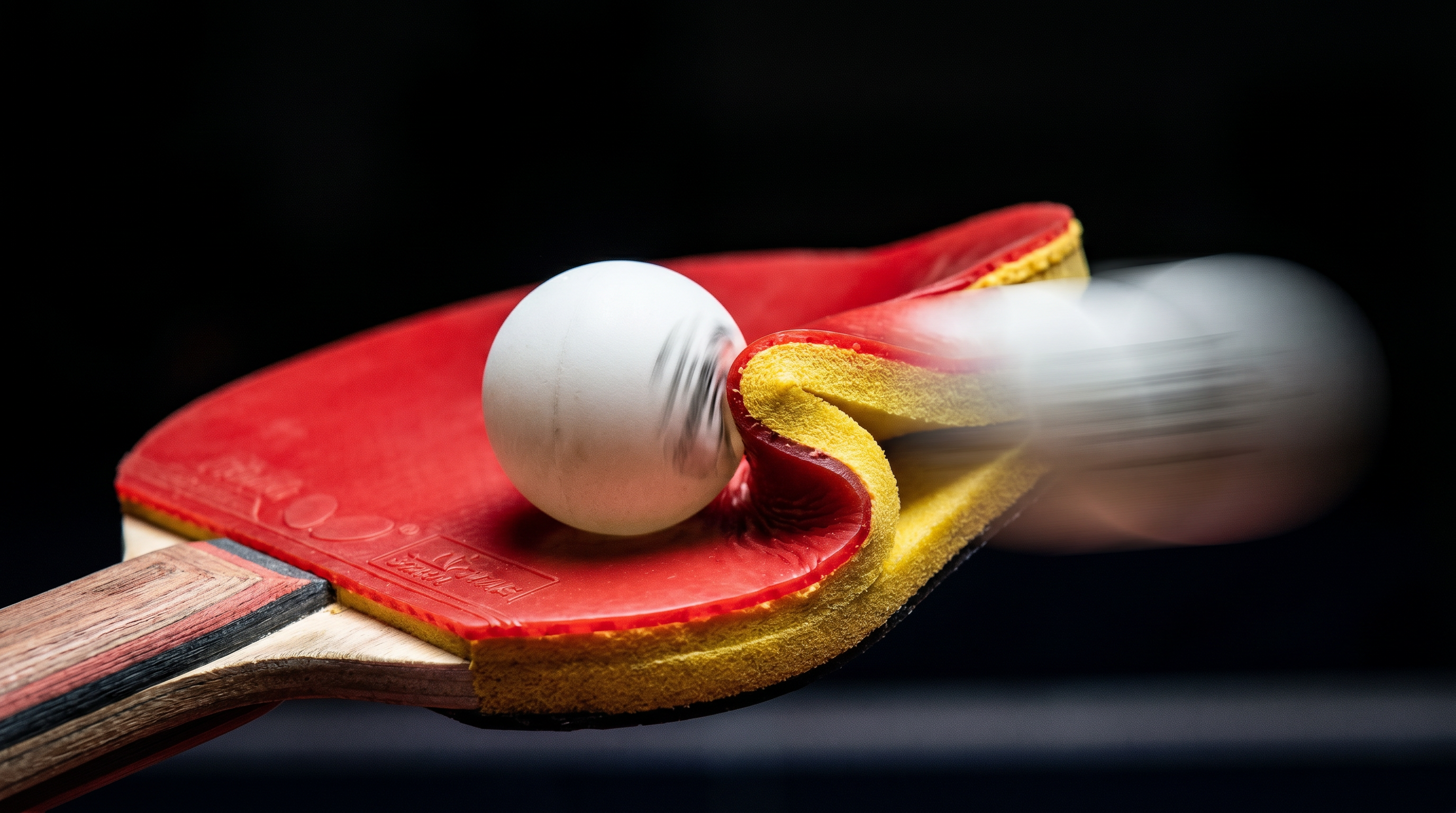
This massive rotational speed is possible because of the unique physical properties of the table tennis ball. Weighing just 2.7 grams and measuring 40 millimeters in diameter, the hollow plastic sphere has incredibly low mass and density. When a player brushes the ball with a high-friction rubber paddle, almost all of the kinetic energy from their wrist snap is converted directly into angular momentum. The ball becomes a spinning gyroscope, rotating up to 150 times per second as it travels across the nine-foot table.[4][5]

Once the ball leaves the paddle, it immediately becomes subject to the Magnus effect, a principle of fluid dynamics named after German physicist Heinrich Gustav Magnus. As the ball spins through the air, its textured surface drags a thin layer of air along with it. On one side of the ball, this rotational drag moves in the same direction as the oncoming airflow, accelerating the air and causing a drop in pressure. On the opposite side, the rotation fights against the oncoming air, decelerating it and creating a high-pressure zone.[2][7]
Nature abhors a pressure imbalance, so the high-pressure zone pushes the ball toward the low-pressure zone. This resulting aerodynamic force acts perpendicular to the ball's direction of travel, physically bending its trajectory in mid-air. The magnitude of this displacement is entirely dependent on the combined effects of the ball's forward velocity and its rate of spin. Because a table tennis ball is so light, the Magnus force easily overpowers the ball's forward momentum and the standard pull of gravity, allowing players to curve the ball in seemingly impossible ways.[2][7]
The direction of the curve depends entirely on the axis of rotation. When a player brushes up on the back of the ball, they create topspin. The Magnus effect exerts a strong downward force, causing the ball to dive sharply toward the table and accelerate forward upon bouncing. Conversely, brushing down on the ball creates backspin. This reverses the pressure differential, generating an upward aerodynamic lift that counteracts gravity. A heavy backspin shot will literally float through the air, and when it hits the table, the backward rotation causes it to skid low, stop, or even bounce backward toward the net.[1][7]

The direction of the curve depends entirely on the axis of rotation.
Generating 9,000 RPM requires more than just a fast arm; it requires highly engineered equipment. A modern professional table tennis racket is a complex, multi-layered composite. At its core is a wooden blade, often interwoven with layers of carbon fiber to increase stiffness and expand the sweet spot. But the true magic happens on the surface. The blade is covered by a layer of porous foam known as the sponge, which is then topped by a sheet of pimpled rubber.[3]
The introduction of the sponge layer in the 1950s fundamentally revolutionized the sport. Before the sponge, paddles were covered in hard, pimpled rubber, and the game was a slower, defensive battle of attrition. The sponge acts as a microscopic trampoline. When the ball strikes the paddle, the sponge compresses, allowing the ball to sink into the rubber. This increases the "dwell time"—the fraction of a millisecond the ball remains in contact with the racket. The International Table Tennis Federation (ITTF) strictly regulates this, capping the maximum combined thickness of the sponge and rubber at 4.0 millimeters.[1][3]
During that microscopic window of dwell time, the surface of the rubber grips the ball. Modern equipment manufacturers use two primary philosophies for grip: tacky and tensor. Tacky rubbers, heavily favored by Chinese professionals, have a sticky surface that relies on chemical adhesion to grip the ball, producing massive spin on slower, brushing strokes. Tensor rubbers, popular in Europe and Japan, have a grippy but non-sticky surface. Instead of surface adhesion, they rely on elastic deformation; the rubber physically stretches and wraps around the ball during impact, snapping back to impart explosive spin and speed.[1]

Even with the most advanced tensor rubbers, generating world-class spin ultimately comes down to human biomechanics. The critical differentiator between an amateur and a professional is wrist acceleration. During a forehand topspin loop, a professional player will rotate their wrist through a 60 to 90-degree arc in a window of just 50 to 80 milliseconds. This whip-like acceleration at the exact moment of impact maximizes the tangential friction against the ball, translating full-body kinetic energy into pure rotational force.[1][5]
The physics of the game are constantly evolving, sometimes by mandate. In 2014, the ITTF transitioned the sport from traditional celluloid balls to slightly larger, non-flammable plastic balls (often denoted as 40+). This subtle material shift changed the aerodynamics and the coefficient of restitution. The plastic balls are slightly heavier and smoother, meaning they experience more aerodynamic drag and retain less spin after bouncing. This shift forced professionals to adapt their techniques, relying more on raw physical power and closer-to-the-table positioning to compensate for the slight reduction in rotational lethality.[6][7]
At the bleeding edge of sports science, researchers are still discovering new aerodynamic quirks in table tennis. Recent particle image velocimetry (PIV) studies in wind tunnels have documented the "Inverse Magnus Effect." At very specific, highly elevated spin ratios (where the rotational speed vastly outpaces the forward velocity), the wake behind the ball can actually reorient itself. This causes the aerodynamic force to briefly flip, making the ball deflect in the opposite direction of the expected curve. It is a phenomenon that explains some of the most baffling, physics-breaking "snake" shots executed by elite defenders.[2]

Ultimately, every rally in modern table tennis is a high-speed dialogue between opposing physical forces. When a player serves a heavy sidespin pendulum, they are setting an aerodynamic trap. The receiver must instantly calculate the ball's rotational axis, adjust their paddle angle by a matter of millimeters, and apply their own counter-spin to neutralize the Magnus effect. It is a game of microscopic margins and macroscopic curves, proving that the most breathtaking athletic feats are often just applied physics in motion.[9]
How we got here
1930s
Rubber is first applied to wooden table tennis blades, introducing basic spin to the game.
1950s
The 'sponge racket' is introduced, placing a layer of foam under the rubber and revolutionizing spin generation.
1986
The ITTF mandates that the two sides of a paddle must be different colors to prevent players from hiding which rubber they are using.
2000s
Tensor rubbers are developed, using elastic deformation to generate massive spin without the need for speed glue.
2014
The sport transitions from celluloid balls to 40+ plastic balls, slightly altering the aerodynamics and spin retention of the game.
Viewpoints in depth
Sports Physicists
Focusing on fluid dynamics and the Magnus effect as the core of the sport.
To sports physicists, table tennis is a high-speed laboratory for aerodynamics. They analyze how boundary layer separation and pressure differentials dictate the ball's flight path. Recent wind tunnel studies utilizing particle image velocimetry have even uncovered the 'Inverse Magnus Effect' at extreme spin ratios, proving that the sport continues to push the boundaries of known fluid dynamics.
Equipment Engineers
Focusing on material science and maximizing energy transfer within regulations.
Equipment manufacturers view spin as an engineering challenge. Their goal is to maximize the coefficient of restitution and dwell time without exceeding the ITTF's strict 4.0-millimeter thickness limit for the rubber and sponge. By developing tensor rubbers that elastically deform around the ball, they have found ways to generate massive rotational force through material science rather than just human effort.
Professional Players
Focusing on biomechanics, wrist acceleration, and tactical deception.
For the athletes at the table, spin is a weapon of tactical deception. They focus on the biomechanics required to generate 9,000 RPM, specifically the 60 to 90-degree wrist acceleration executed in mere milliseconds. To a professional, understanding the physics is secondary to the muscle memory required to read an opponent's spin axis and apply the precise counter-spin needed to keep the ball on the table.
Hardbat Traditionalists
Advocating for a return to the pre-sponge era of the game.
A vocal minority within the table tennis community believes that modern sponge and tensor technologies have made the game too fast and spin-heavy. Hardbat traditionalists prefer the classic style of play using only short-pimpled rubber with no sponge. They argue that reducing the extreme physics of the Magnus effect places the emphasis back on long, strategic rallies and pure athletic endurance rather than equipment superiority.
What we don't know
- How the exact aerodynamics of the 'Inverse Magnus Effect' can be reliably replicated by human players in competitive matches.
- Whether future material regulations by the ITTF will further restrict sponge thickness to slow down the game.
- The absolute biological limit of human wrist acceleration and how much higher spin rates can climb before plateauing.
Key terms
- Magnus effect
- The aerodynamic force that causes a spinning object moving through a fluid to curve away from its principal flight path.
- Topspin
- Forward rotation of the ball that creates a downward aerodynamic force, causing it to dip and accelerate.
- Backspin
- Backward rotation of the ball that creates an upward aerodynamic force, causing it to float and slow down upon bouncing.
- Dwell time
- The fraction of a second (typically 2-8 milliseconds) that the ball remains in contact with the rubber and sponge during a stroke.
- Tensor rubber
- Modern table tennis rubber that uses built-in elastic tension to increase the trampoline effect and spin generation.
- Coefficient of restitution
- A measurement of how much kinetic energy remains after the collision between the ball and the paddle.
Frequently asked
Why do table tennis balls curve so much in the air?
The extreme spin interacts with the air through the Magnus effect, creating pressure differences that push the lightweight ball in the direction of the spin.
How fast does a table tennis ball spin?
Professional players can generate up to 9,000 revolutions per minute (RPM) on heavy topspin loops, vastly exceeding the spin rates of tennis or golf.
What is the difference between topspin and backspin?
Topspin causes the ball to dip sharply in the air and accelerate forward upon bouncing, while backspin makes the ball float and skid or bounce backward.
Why do paddles have different colored rubbers?
The ITTF requires different colors (traditionally red and black) so opponents can visually anticipate the type of spin, as different rubbers on the same paddle can have vastly different friction properties.
Sources
Source coverage
9 outlets
4 viewpoints surfaced









[1]Topspin11Equipment Engineers
Table tennis spin explained: Magnus effect physics, 4 spin types with RPM data
Read on Topspin11 →[2]American Institute of PhysicsSports Physicists
Aerodynamics of a spinning table tennis ball: The inverse Magnus effect
Read on American Institute of Physics →[3]WikipediaEquipment Engineers
Table tennis rubber
Read on Wikipedia →[4]Olympic.caProfessional Players
The Science of Spin in Sports
Read on Olympic.ca →[5]SpinSightProfessional Players
How much spin in revolutions per second do professionals achieve?
Read on SpinSight →[6]ResearchGateProfessional Players
Spin characteristics of short and long services in elite table tennis
Read on ResearchGate →[7]VSportSports Physicists
Spin and effect in ping pong: The physics of the game
Read on VSport →[8]MediumHardbat Traditionalists
The Physics of Table Tennis
Read on Medium →[9]Factlen Editorial TeamSports Physicists
Synthesis by Factlen editorial team
Read on Factlen Editorial Team →

More in sports
See all 397 stories →Women's Sports
How Women's Wrestling Became the Fastest-Growing Collegiate Sport in America
8 sources

Engine Regulations
The 2026 Formula 1 Engine Revolution: How Sustainable Fuel and a 50/50 Hybrid Split Are Changing the Sport
8 sources
MLB Milestones
Brewers' Jacob Misiorowski Throws Historic 15-Strikeout, One-Hit Shutout
7 sources

Pitching Milestone
Jacob Misiorowski Throws Historic 15-Strikeout, One-Hit Complete Game in Brewers Win
7 sources

Every angle. Every day.
Get sports stories with full source coverage and perspective breakdowns delivered to your inbox.