
The Evidence on At-Home Red Light Therapy Masks: Do They Actually Work?
Clinical data shows that red and near-infrared light can genuinely stimulate collagen and reduce acne, but dermatologists warn that at-home results are modest and require months of consistent use.
By Factlen Editorial Team
- Medical Realists
- Emphasize that while the science is real, at-home devices lack the power of clinical lasers, resulting in modest improvements.
- Clinical Researchers
- Focus on the measurable cellular changes, such as increased ATP production and collagen density, validating the therapy.
- Consumer Advocates
- Highlight the accessibility, safety, and cumulative benefits of at-home devices for users seeking non-invasive skincare.
Why this matters
Consumers are spending hundreds of dollars on at-home LED masks based on viral social media claims. Understanding the actual clinical evidence helps buyers separate biological reality from marketing hype, ensuring they invest in devices that are both safe and effective.
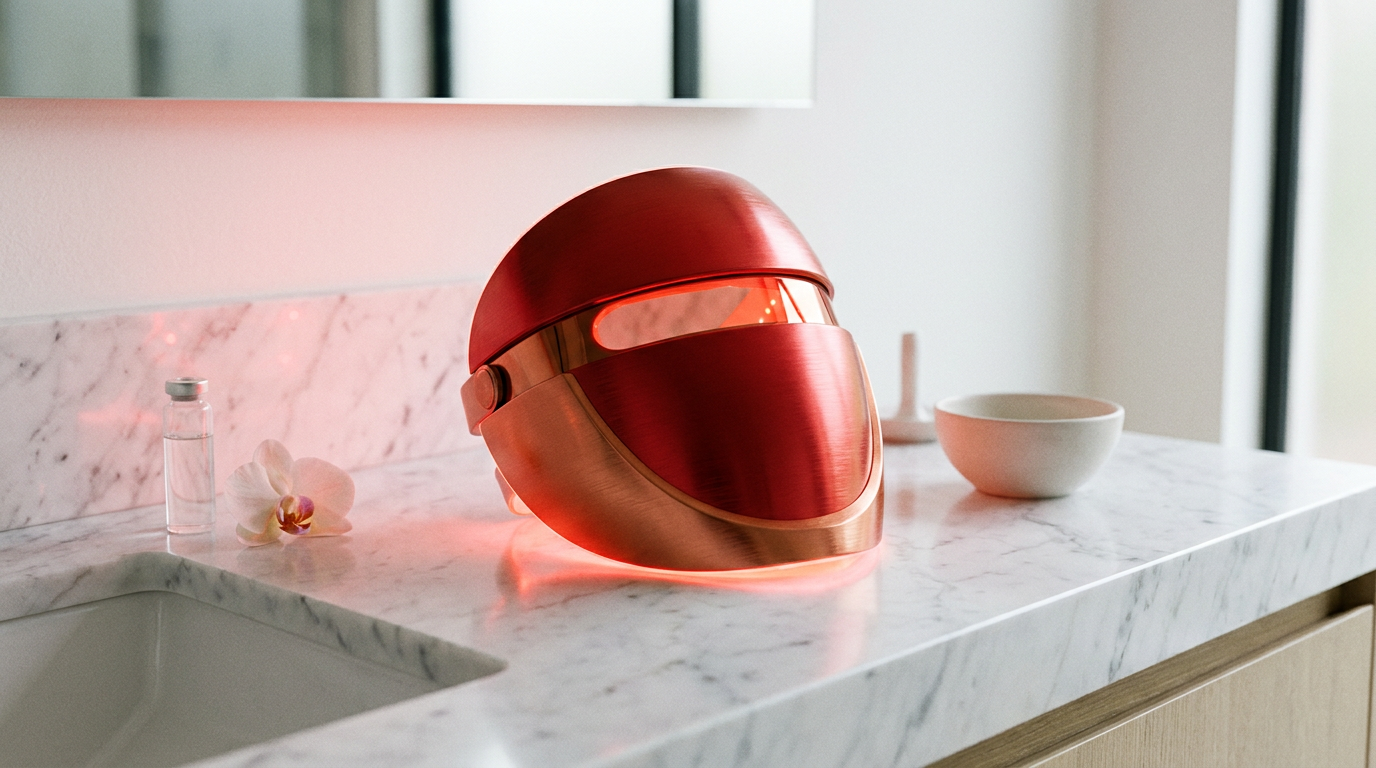
It is nearly impossible to scroll through social media without encountering an influencer wearing a glowing, futuristic face mask. At-home red light therapy (RLT) devices have exploded into a billion-dollar industry, promising to erase wrinkles, banish acne, and stimulate collagen—all from the comfort of a living room couch. But as the market floods with devices ranging from $50 knock-offs to $500 FDA-cleared models, consumers are left wondering if the underlying science justifies the steep price tag.[4][8]
The short answer from the medical community is yes, the science is real—but the results require patience and realistic expectations. Unlike many skincare fads, red light therapy is rooted in decades of clinical research. Originally developed and studied for wound healing and tissue repair, the treatment relies on a biological process known as photobiomodulation. When specific wavelengths of light penetrate the skin, they trigger a cascade of cellular reactions rather than relying on thermal damage, which is how many cosmetic lasers operate.[2][4][8]
The mechanism is surprisingly straightforward. Red and near-infrared light are absorbed by cytochrome c oxidase, a light-sensitive enzyme located within the mitochondria—the powerhouses of our cells. This absorption excites electrons and boosts the production of adenosine triphosphate (ATP), the primary energy currency of the cell. With more energy available, specialized cells called fibroblasts are stimulated to synthesize new collagen and elastin, the structural proteins responsible for the skin's firmness and elasticity.[2][7]

Clinical trials have repeatedly validated this cellular mechanism. A landmark 2014 controlled trial utilizing ultrasound imaging found a 31 percent increase in collagen density among participants who used red light therapy consistently for eight weeks. More recently, a 2023 systematic review published in the Aesthetic Surgery Journal confirmed that consistent use of red and near-infrared light produces meaningful improvements in skin texture, elasticity, and the reduction of fine lines.[7][8]
Beyond anti-aging, the evidence is particularly strong for acne management. Many at-home masks combine red light with blue light (typically around 415 nanometers). While red light reduces the inflammatory response, blue light directly targets and neutralizes Cutibacterium acnes, the bacteria responsible for breakouts. A March 2025 meta-analysis published in JAMA Dermatology reviewed multiple studies and found that at-home LED devices reduced acne lesions by approximately 45 percent over a four-to-eight-week period.[8]
Beyond anti-aging, the evidence is particularly strong for acne management.
However, dermatologists are quick to temper expectations. The central limitation of at-home masks is their power density, measured in milliwatts per square centimeter (mW/cm²). Clinical devices used in a dermatologist's office typically deliver 100 to 200 mW/cm², while most at-home masks max out between 10 and 50 mW/cm². This massive power gap means that achieving a comparable dose of light energy requires significantly more treatment time and unyielding consistency.[5][8]

“You can expect a little bit of a modest benefit, but it's not something that I would recommend as a sole treatment,” notes Dr. Raman Madan, a dermatologist with Northwell Health. Experts emphasize that an at-home mask will not replicate the dramatic results of Botox, chemical peels, or fractional laser resurfacing. Instead, it functions as a supportive, cumulative therapy—much like going to the gym. A single session does nothing, but consistent use over three to four months yields visible, structural improvements.[5]
When shopping for a device, consumers are often misled by the term "FDA-cleared." While it sounds like a guarantee of efficacy, a 501(k) clearance from the U.S. Food and Drug Administration primarily means the device is safe for public use and equivalent to existing low-risk products on the market. It ensures the mask will not burn the skin or cause electrical hazards, but it does not mandate rigorous proof that the device actually reduces wrinkles.[3][4]
To ensure efficacy, experts recommend looking for devices that explicitly state their wavelengths. The most robust clinical data supports red light in the 630 to 660 nanometer range for surface-level rejuvenation, and near-infrared light in the 810 to 850 nanometer range for deeper dermal penetration and collagen synthesis. Devices that do not disclose their specific wavelengths or irradiance levels are often underpowered and unlikely to produce results.[6][7]

Safety is another critical factor. While red light therapy is non-invasive and does not carry the DNA-damaging risks of ultraviolet (UV) light, it is not universally harmless. The most significant risk involves the eyes. Masks that incorporate blue light can cause photochemical retinopathy—retinal damage—if the eyes are not properly shielded. Dermatologists strongly advise using the built-in eye protection or blackout goggles provided with high-quality masks.[1][8]
Additionally, individuals taking photosensitizing medications—such as certain antibiotics like doxycycline, diuretics, or oral isotretinoin (Accutane)—should consult a physician before starting light therapy, as these drugs can make the skin abnormally sensitive to light, leading to severe irritation or hyperpigmentation. Those with conditions like lupus or a history of light-triggered seizures should also avoid the treatment.[1]
Ultimately, the scientific consensus is that red light therapy is a legitimate, evidence-backed tool in the skincare arsenal. It is not a miracle cure, but for consumers willing to invest the time—typically 10 to 20 minutes a day, several times a week, for months on end—the biological rewards are real. As the technology continues to improve, these glowing masks are proving to be more than just a fleeting internet aesthetic.[1][2][8]
Viewpoints in depth
Medical Realists
Dermatologists who emphasize the limitations and modest outcomes of at-home devices.
This camp acknowledges that the underlying science of photobiomodulation is sound, but they caution that the consumer market is rife with over-promising. Because at-home masks are legally restricted to lower power outputs to ensure safety, they cannot deliver the rapid, dramatic results of in-office clinical lasers. These experts argue that consumers often abandon the treatment before the necessary 12-to-16-week mark, making the high upfront cost a poor investment compared to proven topical treatments like prescription retinoids.
Clinical Researchers
Scientists focused on the measurable cellular changes induced by specific light wavelengths.
Researchers view red light therapy as a fascinating intersection of physics and biology. Their focus is on the precise dosimetry—the exact wavelengths, irradiance, and exposure times required to trigger mitochondrial ATP production. This camp points to robust, peer-reviewed data showing statistically significant increases in collagen density and accelerated wound healing. For them, the efficacy of the treatment is not in question; the challenge lies in standardizing the technology so that consumer devices reliably hit the necessary therapeutic thresholds.
Consumer Advocates
Skincare experts and users who value the accessibility and safety of non-invasive treatments.
For this group, the appeal of at-home LED masks lies in their non-invasive, pain-free nature. Unlike chemical peels or microneedling, red light therapy requires zero recovery time and carries virtually no risk of thermal damage. Advocates argue that while the results may be gradual, the ability to perform treatments daily while watching television or reading makes it an highly sustainable habit. They view the masks as a long-term investment in skin health that compounds over time.
What we don't know
- The exact optimal 'dose' (duration and frequency) for at-home devices remains debated among researchers.
- It is difficult for consumers to verify if a specific brand's mask actually delivers the power density it claims on the box.
- Long-term data on the efficacy of combining red light therapy with active skincare ingredients like retinoids is still emerging.
Sources
Source coverage
8 outlets
3 viewpoints surfaced








[1]Harvard UniversityMedical Realists
The truth about red light therapy
Read on Harvard University →[2]Stanford MedicineMedical Realists
Deciphering the science of red light therapy
Read on Stanford Medicine →[3]American Academy of DermatologyConsumer Advocates
Is red light therapy safe and effective?
Read on American Academy of Dermatology →[4]Science FocusClinical Researchers
Do red light therapy masks actually work?
Read on Science Focus →[5]MedPage TodayMedical Realists
The Truth About Red Light Therapy Masks, According to a Dermatologist
Read on MedPage Today →[6]CNETConsumer Advocates
Best LED Face Masks of 2026
Read on CNET →[7]Scientific Research PublishingClinical Researchers
Light-Emitting Diodes in Dermatology: A Systematic Review
Read on Scientific Research Publishing →[8]Factlen Editorial Team
Synthesis by Factlen editorial team
Read on Factlen Editorial Team →

Every angle. Every day.
Get shopping stories with full source coverage and perspective breakdowns delivered to your inbox.