
The Evidence Behind 'Missing Middle' Zoning Reforms and Housing Affordability
A critical mass of empirical data from cities like Austin, Minneapolis, and Auckland demonstrates that eliminating restrictive zoning laws successfully increases housing supply and lowers rent prices.
By Factlen Editorial Team
- Market Deregulation Advocates
- Argue that removing restrictive zoning laws and allowing private developers to build more housing is the primary solution to the affordability crisis.
- State Intervention Proponents
- Argue that while supply helps, the market alone will not serve the lowest-income brackets, requiring robust public subsidies and top-down action.
- Empirical Researchers
- Focus on measuring the actual market outcomes of zoning reforms using statistical modeling and counterfactuals.
What's not represented
- · Neighborhood Preservationists
- · Low-Income Tenant Advocates
Why this matters
For decades, the housing crisis has felt unsolvable, locking an entire generation out of homeownership and draining household budgets. New empirical data proves that specific policy changes—namely, legalizing denser housing—can successfully reverse this trend and lower rent prices.
Key points
- A critical mass of data from 2024 to 2026 proves that upzoning and removing single-family mandates successfully increases housing supply.
- Austin, Texas added 120,000 new homes over a decade, resulting in a 7% drop in rent prices for large apartment buildings.
- A landmark study in Auckland, New Zealand found that rents would have been 28% higher had the city not implemented sweeping zoning reforms in 2016.
- "Missing middle" housing, such as townhomes and triplexes, provides a naturally more affordable entry point for buyers compared to detached single-family homes.
- While increased supply lowers median rents across the board, researchers note that direct public subsidies are still necessary to house the lowest-income brackets.
For decades, the American housing market has been defined by a punishing mathematical reality: demand has vastly outpaced supply, driving prices to historic highs and locking an entire generation out of homeownership. Across the country, the cost of shelter has consumed an increasingly disproportionate share of household income, forcing families to relocate further from urban job centers and exacerbating economic inequality. Traditional policy responses often focused on demand-side subsidies, such as first-time homebuyer grants or rent control, which frequently failed to address the underlying shortage of physical homes. The root cause of this scarcity, economists argued, was not a lack of land or construction capacity, but rather a web of restrictive local land-use regulations that made it functionally illegal to build dense housing in the places where people most wanted to live.[8]
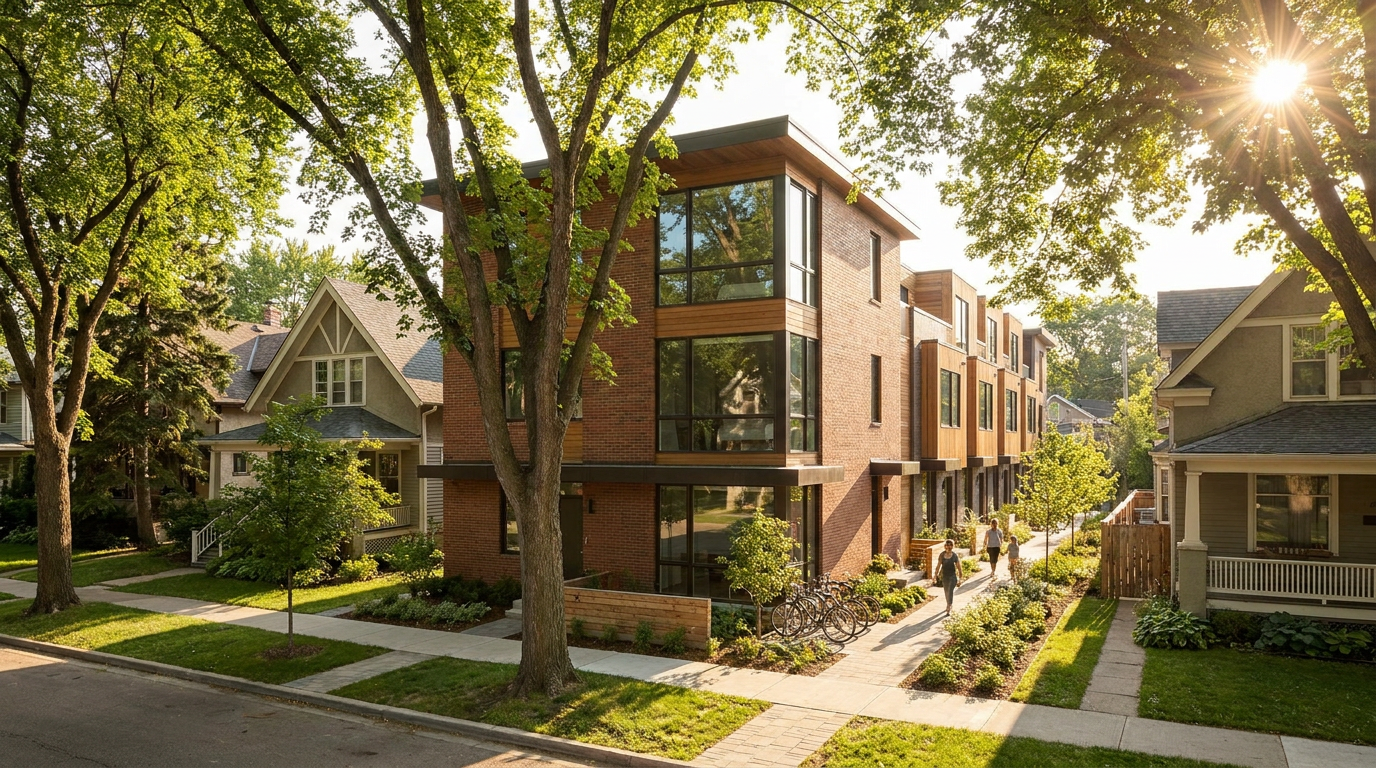
In response to this deepening crisis, a vocal counter-movement took hold in city halls and state legislatures across the country. The "Yes In My Backyard" (YIMBY) coalition hypothesized that stripping away restrictive zoning laws—specifically the pervasive single-family mandates that dominate American suburbs—would unleash a wave of private construction and naturally stabilize prices. By legalizing "missing middle" housing, such as duplexes, triplexes, and low-rise apartment buildings, advocates argued that cities could absorb population growth without sprawling outward. For years, this supply-side argument was fiercely debated in academic circles and local planning meetings, with skeptics warning that deregulation would only enrich developers and accelerate the gentrification of working-class neighborhoods.[8]
By mid-2026, however, this debate is no longer confined to academic theory or predictive modeling. A critical mass of cities across the globe has now implemented sweeping land-use reforms, providing researchers with enough empirical data to rigorously evaluate the claims of the supply-side movement. From the sunbelt boomtowns of Texas to the progressive enclaves of the Midwest, and even internationally in New Zealand, the results of these natural experiments are coming into focus. The data provides a clear, evidence-based verdict on whether changing the legal code of a city can actually alter the fundamental economics of its housing market.[8]
The first major claim tested by the recent wave of data is whether upzoning reliably triggers a surge in housing construction. The evidence here is highly robust and consistent across multiple jurisdictions. When cities legalize missing middle housing and remove bureaucratic bottlenecks, developers consistently respond to the new incentives by pulling permits and breaking ground. This dynamic holds true even in environments where construction costs and interest rates present macroeconomic headwinds, suggesting that regulatory barriers were indeed the primary choke point holding back the housing supply.[7][8]
Austin, Texas, serves as the most striking recent example of this dynamic in action. Following a sustained package of reforms that included comprehensive rezoning, expedited permitting processes, and the total elimination of parking minimums, the city experienced a historic building boom. By removing the mandate that every new apartment must include costly off-street parking, developers were able to utilize smaller parcels of land and reduce overall project costs, making a wider variety of housing types financially viable to construct.[1]

The sheer volume of this construction boom is difficult to overstate. Between 2015 and 2024, Austin added an astonishing 120,000 new housing units to its market. This represented a staggering 30% increase in the city's total housing stock over a single decade, achieving a construction rate that was more than three times the national average. This influx of new supply fundamentally altered the trajectory of the city's real estate market, proving that local governments possess the regulatory tools necessary to scale housing production to meet intense population demand.[1]
Washington, D.C., achieved similar supply victories through a slightly different mechanism, demonstrating that there are multiple pathways to abundance. Rather than relying solely on passive deregulation and waiting for the private market to respond, the district utilized top-down government action to actively bundle land and finance necessary infrastructure. By partnering with developers to create mixed-use neighborhoods, Washington increased its average annual construction from roughly 4,000 units to nearly 6,700 units over a six-year period, consistently outpacing larger cities in raw per-capita production.[4]
The second, and historically more contested, claim is that this increased supply directly stabilizes or lowers rent for average residents. For years, anti-development advocates argued that building luxury apartments would only induce demand, drawing wealthier residents to an area and driving up costs for everyone else. They posited that new market-rate construction was fundamentally disconnected from the affordability struggles of lower-income renters. However, the empirical data from the mid-2020s points firmly in the opposite direction, validating the core economic principle of supply and demand.[8]
Extensive research from the Pew Charitable Trusts analyzed rent trajectories across the United States and found a direct correlation between construction volume and price relief. In metropolitan areas that added the most housing, rents declined most steeply for the older, more affordable apartments typically occupied by lower-income renters. The data revealed that new construction acts as a pressure valve; by absorbing the demand of high-income earners, it prevents them from bidding up the prices of the existing, older housing stock.[1]
In metropolitan areas that added the most housing, rents declined most steeply for the older, more affordable apartments typically occupied by lower-income renters.
In Austin, the massive surge in supply yielded undeniable results for renters. The city saw rents in large apartment buildings fall by 7% from 2023 to 2024, marking the steepest decline of any large metropolitan area in the United States. This price drop occurred even as the city continued to experience robust population and job growth, proving that the rent reductions were driven by an abundance of supply rather than a collapse in demand or an economic recession.[1]
The international evidence supporting the supply-side thesis is equally compelling. A landmark 2023 study from the University of Auckland analyzed the city's sweeping 2016 upzoning initiative, which allowed denser housing across much of the urban core. Prior to the reform, Auckland was suffering from one of the most severe housing affordability crises in the developed world, with home prices vastly outpacing local wage growth and pushing homeownership out of reach for the middle class.[2]

Using a sophisticated synthetic control method to model an alternate reality, researchers were able to isolate the specific impact of the zoning changes. They found that six years post-reform, rents in Auckland would have been 28% higher had the upzoning not occurred. The policy successfully decoupled the city's rent growth from its population growth, providing a powerful, peer-reviewed proof of concept that large-scale zoning reform can fundamentally alter the trajectory of a major metropolitan housing market.[2]
Minneapolis, which famously became the first major U.S. city to eliminate single-family-only zoning citywide in 2019, offers another strong data point. The city's "2040 Plan" legalized triplexes on all residential lots and encouraged higher-density development along transit corridors. Despite experiencing a 10% increase in household growth, Minneapolis managed to limit rent growth to just 1% over a multi-year period, effectively keeping housing costs flat in real terms while peer cities saw double-digit rent spikes.[1]
The third major claim evaluates whether "missing middle" housing provides naturally more affordable entry points for prospective homebuyers. The National Bureau of Economic Research notes that strict minimum lot sizes force families to buy larger homes—and more land—than they actually need, artificially driving up costs and exacerbating racial and economic segregation. By legalizing smaller footprints, cities can allow the market to provide housing that matches the demographic reality of shrinking household sizes and an aging population.[3]
Early data from Arlington, Virginia's "Expanded Housing Options" policy clearly demonstrates how smaller footprints alter the financial math of homeownership. By allowing multi-unit structures to be built on lots previously reserved for single-family homes, the city saw the average square footage of new units drop significantly. Instead of developers tearing down old homes to build massive 5,000-square-foot mansions, they began constructing right-sized townhomes and multiplexes that better fit the needs of average families.[6]
The first of these missing-middle homes in Arlington sold for approximately $1.6 million. While this figure remains objectively expensive and out of reach for many, it must be viewed in its local context: the price was 45% lower than the average sales price of newly built single-detached homes in the exact same zip code. This data point proves the relative affordability of the missing-middle model, offering a crucial stepping stone for buyers who are priced out of the detached single-family market.[6]

The primary economic mechanism driving these price drops across the broader market is known as "filtering." When higher-income residents move into newly constructed, premium market-rate housing, they vacate older, existing units. This chain reaction continues down the income ladder in a predictable sequence, as middle-income earners move into the newly vacated units, which in turn frees up older, more basic apartments for lower-income renters. Economists liken this process to the market for used cars; just as the production of new luxury vehicles eventually creates a robust market for affordable used cars, the construction of new apartments eventually yields affordable older apartments.[5][8]
This filtering process effectively increases the supply of affordable housing at the bottom of the market without requiring direct government subsidies or complex tax credits. While the new construction itself may be branded as "luxury," its presence in the market absorbs the purchasing power of the wealthy, preventing them from gentrifying older neighborhoods and displacing working-class residents from the existing housing stock.[5]
Despite the overwhelming empirical evidence supporting the supply-side argument, researchers caution against viewing zoning reform as a standalone cure for the entire housing crisis. Analysts at the Roosevelt Institute argue that regulatory reform is a complement to targeted public investment, not a replacement for it. They emphasize that while the private market is highly efficient at housing the middle and upper classes, it structurally cannot build housing cheap enough to serve the lowest-income brackets without financial assistance.[5]

These experts note that while upzoning successfully lowers median rents and stops runaway price spirals, robust public subsidies, housing vouchers, and social housing initiatives remain absolutely essential to protect vulnerable populations. Ultimately, the empirical record of the mid-2020s has shifted the burden of proof in urban planning. The data from Auckland to Austin definitively proves that while building more housing may not solve every single facet of the affordability crisis, failing to build it guarantees the crisis will continue.[5][8]
How we got here
2016
Auckland, New Zealand implements sweeping zoning reforms, allowing denser housing across much of its urban core.
2019
Minneapolis becomes the first major U.S. city to eliminate single-family-only zoning citywide.
2023
University of Auckland researchers publish landmark data showing the city's upzoning successfully suppressed rent prices.
2024
Austin, Texas records a 7% drop in rent prices following a decade-long boom that added 120,000 new housing units.
2025
California passes SB 79, enacting historic transit-oriented housing reform to bypass local development blockades.
Viewpoints in depth
Market Deregulation Advocates
Proponents of removing zoning barriers to let private developers build more housing.
This camp, heavily represented by YIMBY organizations and supply-side economists, argues that the housing crisis is fundamentally a math problem caused by artificial scarcity. By making it illegal to build dense housing in high-demand areas, local governments have forced prices up. They point to data from Austin and Auckland as proof that when developers are legally allowed to build 'missing middle' housing and large apartment blocks, the resulting surge in supply naturally stabilizes the market and lowers rents through the filtering process.
State Intervention Proponents
Advocates who believe deregulation must be paired with active government involvement.
While generally supportive of building more housing, this perspective cautions against relying entirely on private developers. Analysts in this camp argue that the free market will never voluntarily build housing cheap enough for the lowest-income brackets. They point to Washington, D.C.'s success in actively bundling land and financing infrastructure, arguing that zoning reform is merely a baseline. To truly solve the affordability crisis, they advocate for pairing deregulation with robust public subsidies, social housing initiatives, and tenant protections.
Neighborhood Preservationists
Local residents and groups opposed to state-mandated upzoning.
Though their influence is waning in state legislatures, neighborhood preservationists remain a powerful force in local city councils. They argue that blanket upzoning destroys the character of historic neighborhoods, strains local infrastructure like parking and schools, and enriches developers without guaranteeing affordable outcomes. In many jurisdictions, these groups have successfully countered state-level YIMBY laws by lobbying for strict design standards and historic preservation overlays that effectively block new multi-unit construction.
What we don't know
- Whether the aggressive pace of construction seen in cities like Austin can be sustained in a higher interest rate environment.
- The exact threshold of new supply required to trigger price drops in severely constrained mega-cities like New York or San Francisco.
- How effectively local municipalities will be able to use design standards and historic designations to block state-mandated upzoning laws.
Key terms
- Upzoning
- Changing local zoning codes to allow for taller buildings or more housing units on a single plot of land.
- Filtering
- The process by which older housing becomes more affordable as higher-income residents move into newly constructed market-rate homes.
- YIMBY
- An acronym for 'Yes In My Backyard,' a pro-housing movement advocating for the removal of restrictive zoning laws to build more homes.
- Synthetic Control Method
- A statistical technique used by researchers to estimate what would have happened in a city if a specific policy (like zoning reform) had never been enacted.
- Minimum Lot Size
- A zoning rule dictating the smallest parcel of land a house can be built on, often used to limit density and mandate large yards.
Frequently asked
What is missing middle housing?
It refers to multi-unit housing types like duplexes, triplexes, and townhomes that fall between single-family homes and large apartment complexes in scale.
Does building luxury apartments lower rent for everyone?
Yes, evidence shows it triggers a 'filtering' effect. When high-income earners move into new luxury units, they vacate older apartments, increasing the supply of affordable options for lower-income renters.
Is zoning reform enough to solve the housing crisis?
While it successfully lowers median rents and stops price spirals, researchers note that direct public subsidies are still required to house the lowest-income brackets.
What is single-family zoning?
A land-use regulation that makes it illegal to build anything other than one detached house on a given plot of land, effectively banning apartments and townhomes.
Sources
Source coverage
8 outlets
3 viewpoints surfaced








[1]Pew Charitable TrustsMarket Deregulation Advocates
Minneapolis Land-Use Reforms Offer a Blueprint for Housing Affordability
Read on Pew Charitable Trusts →[2]University of Auckland Economic Policy CentreEmpirical Researchers
Can Zoning Reform Reduce Housing Costs? Evidence from Rents in Auckland
Read on University of Auckland Economic Policy Centre →[3]National Bureau of Economic ResearchEmpirical Researchers
Housing Supply and Housing Affordability
Read on National Bureau of Economic Research →[4]Washington MonthlyState Intervention Proponents
Washington DC, America's Bluest City, is Building More Homes Per Capita Than Houston
Read on Washington Monthly →[5]Davis VanguardState Intervention Proponents
Researcher Challenges Anti-YIMBY Paper, Argues Evidence Supports Housing Supply Growth
Read on Davis Vanguard →[6]YIMBYs of Northern VirginiaMarket Deregulation Advocates
Insights from the 2025 Expanded Housing Option Annual Data Report
Read on YIMBYs of Northern Virginia →[7]California YIMBYMarket Deregulation Advocates
The Homework: Historic Victory Alert
Read on California YIMBY →[8]Factlen Editorial TeamEmpirical Researchers
Synthesis by Factlen editorial team
Read on Factlen Editorial Team →

Every angle. Every day.
Get real estate stories with full source coverage and perspective breakdowns delivered to your inbox.