
Defense Secretary Hegseth Announces Review of U.S. Forces in Europe, Cuts Crisis Commitments
U.S. Defense Secretary Pete Hegseth announced a six-month review of American troop deployments in Europe and immediately reduced the military assets Washington would provide NATO in a crisis. The move signals a major shift toward a 'NATO 3.0' model requiring European allies to take primary responsibility for their own defense.
By Factlen Editorial Team
- U.S. Administration
- Argues that Europe must take primary responsibility for its own conventional defense.
- European Defense Ministries
- Warns that a rapid U.S. drawdown creates dangerous security gaps that cannot be immediately filled.
- NATO Leadership
- Emphasizes alliance unity and highlights the recent surge in European defense spending.
What's not represented
- · Eastern European frontline states
- · U.S. Congressional defense committees
Why this matters
The immediate reduction in U.S. crisis commitments and the potential drawdown of American troops fundamentally alter the post-Cold War security architecture. European nations will now be forced to rapidly accelerate their defense spending and military readiness to fill the gap left by Washington.
Key points
- Defense Secretary Pete Hegseth announced a six-month review of U.S. troop deployments in Europe.
- The U.S. is immediately reducing the number of fighter jets, bombers, and warships it pledges to NATO in a crisis.
- Hegseth criticized European allies for prioritizing domestic social policies over military readiness.
- The Pentagon chief also condemned allies who denied the U.S. base access during the recent conflict with Iran.
- NATO Secretary-General Mark Rutte stated that European nations are prepared to take on a larger share of the defense burden.
- The review sets the stage for a potentially contentious NATO summit in Ankara this July.
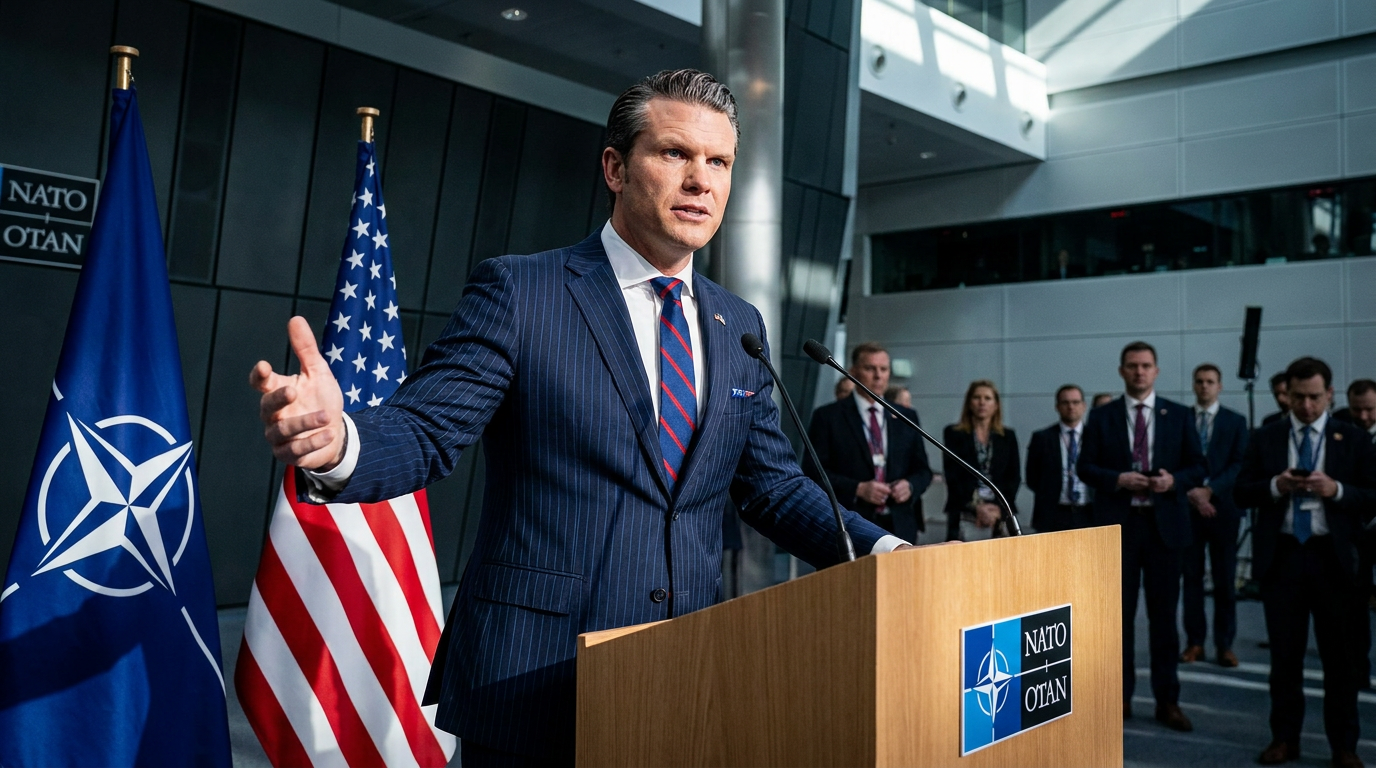
U.S. Defense Secretary Pete Hegseth delivered a stark ultimatum to European allies on Thursday, announcing a comprehensive six-month Pentagon review of American troop deployments across the continent. Speaking at NATO headquarters in Brussels, Hegseth declared that the outcome of the assessment will depend entirely on how rapidly European nations assume responsibility for their own security. Framing the initiative as a necessary reckoning, he warned defense ministers that the review is a test "that some countries will fail and others will pass with flying colors."[1][4]
While the troop review will take months to conclude, Washington is already scaling back its emergency obligations. The Pentagon is immediately reducing the number of military assets it pledges to activate for Europe in the event of a crisis. This immediate drawdown includes a roughly 33 percent reduction in the number of U.S. fighter jets committed to the NATO force model, alongside cuts to the availability of strategic bombers, reconnaissance drones, and warships.[3][6]
The moves are designed to force a transition to what the Trump administration calls "NATO 3.0." Hegseth explicitly stated that the post-Cold War era of American military underwriting is over, and that the alliance must irreversibly shift toward a model where Europe takes the lead in conventional defense. The objective, according to U.S. officials, is to transform NATO back into a hard-power alliance while freeing up American military capacity to meet global commitments elsewhere.[5][6]

Hegseth’s address in Brussels was notably combative, featuring a broad critique of European domestic and defense priorities. He accused allied governments of allowing their defense budgets to crater while expanding welfare states and opening their borders. "Instead of tanks and fighters and air defenses, the focus has been on gender equity and climate change and defense austerity," Hegseth told his counterparts, echoing long-standing frustrations from the Trump administration regarding burden-sharing.[4][7]
Hegseth’s address in Brussels was notably combative, featuring a broad critique of European domestic and defense priorities.
A significant catalyst for the diplomatic rupture stems from the recent U.S. military conflict with Iran. Hegseth lambasted European allies who denied the United States access to regional bases and restricted overflight rights for war-related activities. He characterized the lack of operational support as "shameful," arguing that allied nations put American service members at risk by entangling U.S. forces in arcane legal debates rather than providing predictable logistical access.[4][7]
NATO leadership attempted to project stability in the face of the American rebuke. Secretary-General Mark Rutte confirmed that the United States has adjusted its pledges to the alliance's force model, but sought to downplay the operational impact. Rutte emphasized that European allies and Canada are "ready, willing and able to do more," pointing to an unprecedented $90 billion increase in non-U.S. defense spending over the past year as evidence that the continent is already stepping up.[4][5]

Despite the diplomatic reassurances, military planners acknowledge a severe capability gap. European nations currently lack the inventory to seamlessly backfill the strategic assets Washington is withholding. German Defense Minister Boris Pistorius warned that it is "difficult and dangerous" for European security if advanced capabilities—particularly deep-strike platforms and strategic bombers—are withdrawn before European defense industries can manufacture replacements.[6]
The execution of the Pentagon's six-month review will also face domestic political hurdles in Washington. Hegseth noted that the Defense Department will consult closely with the U.S. Congress throughout the process. Lawmakers on Capitol Hill have previously legislated minimum requirements for the number of American forces stationed in Europe, setting the stage for a potential clash between the executive branch's drawdown ambitions and congressional defense committees.[6]

The abrupt shift in U.S. posture injects immense pressure into the alliance's immediate future. With the pool of American crisis capabilities already shrinking, European defense ministries are scrambling to reorganize their joint forces and war plans. The new division of labor, and the friction it has generated, will dominate the agenda when NATO leaders convene for a high-stakes summit in Ankara, Turkey, early next month.[2][6]
How we got here
2024-2025
European NATO members significantly increase defense spending, adding $90 billion to their combined budgets.
Spring 2026
The U.S. engages in a military conflict with Iran, during which some European allies deny Washington base access and overflight rights.
May 2026
The U.S. privately informs NATO allies it will shrink the pool of military capabilities available to the alliance in a crisis.
June 18, 2026
Defense Secretary Hegseth publicly announces the immediate reduction in crisis assets and a six-month review of all U.S. forces in Europe.
July 7-8, 2026
NATO leaders are scheduled to meet for a summit in Ankara, Turkey, where the U.S. posture will be a central focus.
Viewpoints in depth
The U.S. Administration
Washington argues that Europe must take primary responsibility for its own conventional defense after decades of reliance on American taxpayers.
The Trump administration views the current NATO structure as an outdated model that allows wealthy European nations to underfund their militaries while relying on the U.S. security umbrella. Defense officials argue that by forcing Europe to take the lead on conventional deterrence, the U.S. can redirect its strategic focus and resources to other global priorities. The administration also views the denial of European base access during the recent conflict with Iran as a breach of allied solidarity, reinforcing their mandate to scale back guaranteed protections.
European Defense Ministries
Allied military leaders warn that a rapid withdrawal of U.S. strategic assets creates dangerous vulnerabilities.
While European governments acknowledge the need to increase defense spending—and point to recent budget surges as proof of their commitment—they argue that money cannot instantly buy military readiness. Defense ministries emphasize that replacing U.S. deep-strike capabilities, strategic bombers, and advanced intelligence assets will take years of industrial production. They caution that pulling these capabilities from the NATO force model prematurely degrades the alliance's immediate deterrence against regional threats.
NATO Leadership
The alliance's central command seeks to project unity by highlighting Europe's financial commitments and readiness to adapt.
NATO officials, led by Secretary-General Mark Rutte, are attempting to manage the diplomatic fallout by framing the U.S. shift as a natural evolution rather than a fracture. They emphasize that the U.S. nuclear umbrella remains intact and that European nations are already stepping up to fill conventional roles. By focusing on the $90 billion increase in allied defense spending, NATO leadership aims to reassure both the American administration that burden-sharing is improving, and the European public that the continent's security remains robust.
What we don't know
- Whether the six-month review will result in a permanent withdrawal of U.S. troops currently stationed in Europe.
- How quickly European defense industries can manufacture the strategic assets needed to replace U.S. bombers and deep-strike capabilities.
- How the U.S. Congress, which has previously legislated minimum troop levels in Europe, will respond to potential drawdown recommendations.
Key terms
- NATO Force Model
- The framework by which the alliance organizes its joint forces, war plans, and the specific military assets each member pledges to provide in a crisis.
- Crisis Commitments
- Military assets, such as fighter jets and warships, that a nation agrees to activate and place under NATO command in the event of an attack.
- Deep-Strike Capabilities
- Long-range weapons, such as strategic bombers and advanced missiles, designed to hit targets far behind enemy lines.
Frequently asked
Is the U.S. leaving NATO?
No. Defense Secretary Hegseth stated the goal is to transition to a 'NATO 3.0' where European nations take the lead on conventional defense, while the U.S. remains committed to the alliance's nuclear umbrella.
Are U.S. troops coming home immediately?
Not immediately. The Pentagon is conducting a six-month review of its troop posture. However, the U.S. is immediately reducing the emergency assets, such as fighter jets and bombers, that it pledges to NATO in a crisis.
Why is the U.S. making this move now?
The administration argues that Europe has underfunded its militaries for decades. The move was also accelerated by frustration over some European allies denying the U.S. base access during the recent conflict with Iran.
Sources
Source coverage
7 outlets
3 viewpoints surfaced







[1]BBCNATO Leadership
Hegseth announces US review of Europe forces, says some allies will fail
Read on BBC →[2]Al JazeeraNATO Leadership
Pentagon chief announces review of US forces in Europe, slams NATO allies
Read on Al Jazeera →[3]The Washington PostEuropean Defense Ministries
The United States will review force levels and is immediately cutting the number of assets it would activate for the continent in a crisis
Read on The Washington Post →[4]Associated PressU.S. Administration
U.S. Defense Secretary Pete Hegseth lashed out at NATO allies on Thursday, announcing a six-month Pentagon review of American forces in Europe
Read on Associated Press →[5]CNNU.S. Administration
US Defense Secretary Pete Hegseth doubled down on the Trump administration's combative posture towards NATO
Read on CNN →[6]Defense NewsEuropean Defense Ministries
U.S. Defense Secretary Pete Hegseth announced a new review of America's troop deployments in Europe
Read on Defense News →[7]YnetnewsNATO Leadership
Hegseth lashes out at NATO allies, announces review of US forces in Europe
Read on Ynetnews →

More in news politics
See all 6 stories →Election Integrity
Evidence Pack: The Real Impact of AI Deepfakes on Recent Global Elections
6 sources

Second Amendment
Supreme Court Narrows Federal Law Banning Drug Users From Owning Guns
8 sources

Second Amendment
Supreme Court Unanimously Narrows Federal Gun Ban for Drug Users
8 sources

US-Iran Pact
US and Iran Sign 14-Point Memorandum to End 110-Day War and Reopen Strait of Hormuz
8 sources
Every angle. Every day.
Get news politics stories with full source coverage and perspective breakdowns delivered to your inbox.