
The 2026 Guide to Choosing Between an EV and a Plug-in Hybrid
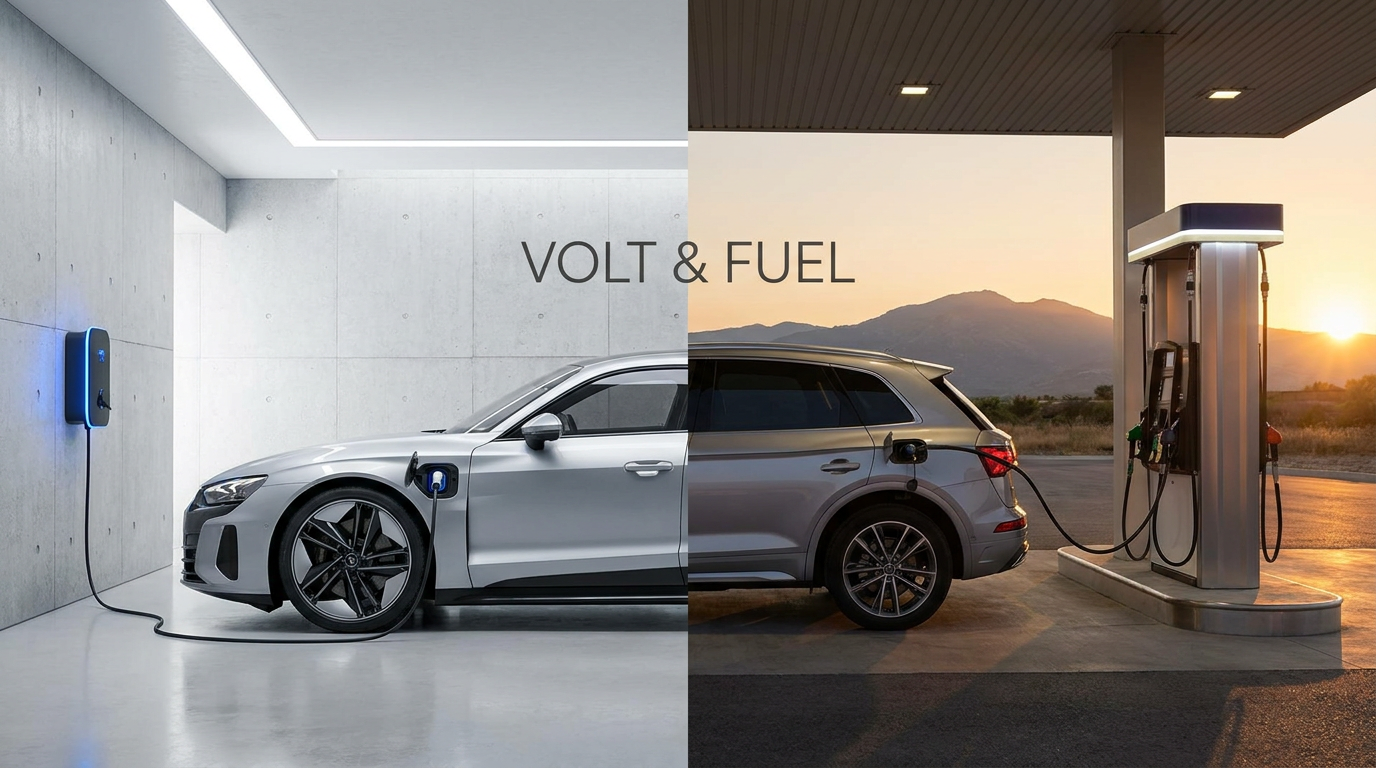
As the automotive market matures in 2026, the choice between a pure electric vehicle and a plug-in hybrid comes down to a strict calculation of daily driving habits, home charging access, and maintenance tolerance.
By Factlen Editorial Team
- Pure Electric Advocates
- Argue that EVs are the only true path forward, offering superior long-term economics and simplicity.
- Plug-in Pragmatists
- View PHEVs as the necessary bridge technology for a world with imperfect charging infrastructure.
- Reliability & Data Analysts
- Focus strictly on repair rates, manufacturing complexity, and real-world usage statistics.
What's not represented
- · Apartment renters without charging access
- · Used car market buyers
Why this matters
Choosing between an EV and a PHEV is one of the most expensive decisions a modern household will make. Understanding the hidden maintenance costs and daily charging requirements ensures buyers do not overpay for technology that fails to fit their actual lifestyle.
Key points
- EVs offer significantly lower maintenance costs by eliminating the internal combustion engine entirely.
- PHEVs provide a safety net for range anxiety but require diligent daily charging to realize fuel savings.
- Consumer Reports data shows PHEVs suffer 80% more reliability problems than standard gas cars.
- J.D. Power reports that EV owners are notably more satisfied with their cost of ownership than PHEV owners.
- The best choice depends entirely on a driver's access to home charging and frequency of long road trips.
For the 2026 car buyer, the transition away from traditional gasoline engines has never offered more compelling options, but it has also never been more complex. As automotive technology matures, the decision for millions of drivers has narrowed to a head-to-head evaluation: the Battery Electric Vehicle (EV) versus the Plug-in Hybrid Electric Vehicle (PHEV). Both promise to slash daily fuel costs and reduce tailpipe emissions, but they take fundamentally different mechanical paths to get there. Choosing the right powertrain is no longer just about environmental values; it is a strict mathematical calculation based on daily driving habits, home infrastructure, and tolerance for maintenance.
To understand the trade-offs, buyers must first understand the architecture. An EV operates entirely on battery power, utilizing electric motors and a large battery pack that typically delivers 250 to 400 miles of range. A PHEV, by contrast, houses two complete powertrains: a smaller battery that provides 30 to 50 miles of pure electric driving, paired with a traditional internal combustion engine that takes over when the battery depletes. This dual-system design is the defining characteristic that drives both the primary advantages and the hidden costs of the PHEV experience.
When evaluating the case for the pure EV, the strongest argument centers on mechanical simplicity and long-term maintenance savings. Because an EV lacks an internal combustion engine, it eliminates dozens of failure points. There are no oil changes, no spark plugs, no transmission fluid flushes, and no exhaust systems to rust. Furthermore, regenerative braking significantly extends the life of brake pads. Automotive data analysts note that this streamlined architecture translates directly to the owner's wallet, saving drivers an average of $330 annually on routine maintenance compared to hybrid or gas counterparts.[4][5]
The evidence supporting the EV's cost-of-ownership advantage is robust in 2026. According to the latest J.D. Power U.S. Electric Vehicle Experience Ownership Study, BEV owners report significantly higher satisfaction than PHEV owners. In the premium segment, EV owners scored 114 points higher in cost-of-ownership satisfaction than their PHEV counterparts. The study concluded that while PHEVs offer improved battery performance over traditional gas cars, they still carry the unavoidable service needs of a combustion engine—costs that pure EV drivers bypass entirely.[2]

However, the case against the EV remains rooted in upfront pricing and infrastructure reliance. While prices are falling, the average new EV still commands a premium, often hovering around $62,000 before any applicable state or local incentives. More importantly, an EV demands a lifestyle adjustment for those without dedicated home charging. Relying solely on public fast-charging networks can be more expensive than gasoline and adds logistical friction to road trips, making the pure electric route challenging for apartment dwellers or frequent cross-country travelers.[4]
This infrastructure hurdle forms the core case for the PHEV, which is widely championed as the ultimate pragmatic safety net. For drivers who want to dip their toes into electrification without range anxiety, the PHEV offers a compelling compromise. Owners can complete their daily school runs and work commutes entirely on cheap, home-charged electricity, but still have a gas tank ready for spontaneous weekend getaways or long-haul holiday travel. It effectively eliminates the need to map out charging stations along rural routes.
This infrastructure hurdle forms the core case for the PHEV, which is widely championed as the ultimate pragmatic safety net.
The evidence for the PHEV's utility is highlighted by standout models that have perfected the formula. Consumer Reports has praised vehicles like the Toyota RAV4 Prime and the Kia Sportage Plug-in Hybrid for transforming the driving experience, offering abundant power and impressive efficiency. When plugged in diligently, these vehicles allow owners to go months without visiting a gas station, delivering the quiet, smooth acceleration of an EV during the workweek while retaining the rapid refueling convenience of a gas car on the highway.[6]
Yet, the case against the PHEV is increasingly documented by reliability data, centering on the inherent complexity of housing two distinct powertrains in one chassis. A PHEV requires the owner to maintain both a high-voltage electrical system and a mechanical combustion engine. If a driver fails to plug the vehicle in daily, the electric advantage evaporates. The vehicle simply becomes a heavier, less efficient gas car, dragging around hundreds of pounds of dead battery weight, which drastically reduces overall fuel economy.
The evidence against the PHEV is starkly quantified in recent reliability surveys. Consumer Reports data from late 2025 and 2026 revealed that PHEVs suffer 80% more problems on average than conventional gas cars, dragging down overall brand reliability scores. While standard hybrids (which do not plug in) actually have 15% fewer problems than gas cars, the added complexity of the plug-in architecture has proven difficult for some manufacturers to master. Several high-profile PHEV models were even discontinued for 2026 following major battery and integration issues.[1]

Furthermore, the assumption that PHEVs are a cheaper entry point into electrification is being challenged by market data. Research from the UK's Energy and Climate Intelligence Unit (ECIU) in 2026 found that the ten best-selling new PHEVs actually cost an average of £4,150 more to purchase than their fully electric equivalents. Because automakers are packing two powertrains into a single vehicle, the manufacturing costs remain high, often erasing the savings gained by using a smaller battery pack.[3]
Ultimately, the decision requires a brutally honest assessment of daily habits. To realize the financial and environmental benefits of a PHEV, the owner must treat it like an EV every single night. Industry data shows that the fuel consumption of PHEVs in the real world is often much higher than manufacturer claims, simply because a large percentage of owners rely on the gas engine and rarely bother to plug the vehicle in.[3]
In final guidance, the pure EV fits well when a buyer has reliable access to Level 2 charging at home or work, drives a predictable daily route, and wants to permanently eliminate the hassle of mechanical engine maintenance. It is the superior financial choice for high-mileage commuters who can capitalize on cheap overnight electricity rates to offset the higher purchase price. The EV does not fit well when a driver frequently travels through rural charging deserts or lacks any dedicated overnight parking with electrical access.

Conversely, the PHEV fits well when a driver has a short daily commute that falls strictly within the vehicle's 30-to-50-mile electric range, can charge at home every night, but regularly takes long road trips where fast-charging infrastructure is sparse. It serves as an excellent bridge technology for one-car households that need maximum versatility. The PHEV does not fit well if the owner lacks the discipline to plug it in daily, or if they are seeking the lowest possible maintenance costs over a ten-year ownership horizon.
How we got here
1997
Toyota launches the Prius, introducing hybrid technology to the mass market.
2010
The Chevrolet Volt and Nissan Leaf debut, kicking off the modern PHEV and EV eras.
2020
EV ranges consistently cross the 250-mile threshold, significantly reducing daily range anxiety.
2025
Consumer Reports data reveals PHEVs suffer significantly higher problem rates due to dual-powertrain complexity.
2026
Market data shows EVs offering superior cost-of-ownership satisfaction, while PHEVs remain popular as bridge vehicles.
Viewpoints in depth
Pure Electric Advocates
Argue that EVs are the only true path forward, offering superior long-term economics and simplicity.
This camp emphasizes that the transition to electric mobility should be absolute rather than incremental. They point to data showing that once a driver adapts to home charging, the mechanical simplicity of a pure EV drastically lowers lifetime ownership costs. From their perspective, carrying around a combustion engine 'just in case' is an inefficient crutch that anchors drivers to legacy maintenance schedules and fossil fuel infrastructure.
Plug-in Pragmatists
View PHEVs as the necessary bridge technology for a world with imperfect charging infrastructure.
Pragmatists argue that range anxiety is still a valid concern for millions of drivers, particularly in rural areas or for those who frequently take long road trips. They advocate for PHEVs because these vehicles cover 90% of daily commuting needs on electric power, while the gas engine provides an unbeatable safety net for the remaining 10%. To this group, the flexibility of a dual-powertrain outweighs the added maintenance costs.
Reliability & Data Analysts
Focus strictly on repair rates, manufacturing complexity, and real-world usage statistics.
Data-driven analysts look past the marketing to evaluate how these vehicles perform in the real world. They highlight that PHEVs are inherently the most complex vehicles on the road, leading to an 80% higher problem rate than standard gas cars. Furthermore, they note a behavioral failure: many PHEV owners simply do not plug their cars in daily, effectively turning them into heavy, inefficient gas vehicles and negating their environmental and financial benefits.
What we don't know
- How long the current generation of PHEV dual-powertrains will last past the 10-year mark compared to pure EVs.
- Whether future battery breakthroughs will render the PHEV bridge technology obsolete before 2030.
Key terms
- BEV (Battery Electric Vehicle)
- A vehicle powered entirely by an electric battery and motors, requiring external charging and using no gasoline.
- PHEV (Plug-in Hybrid Electric Vehicle)
- A vehicle with both an electric battery that can be plugged in for short-range driving and a gas engine for longer trips.
- HEV (Hybrid Electric Vehicle)
- A standard hybrid that charges its small battery through braking and the gas engine, but cannot be plugged into a wall.
- Regenerative Braking
- A system that captures the kinetic energy normally lost during braking and uses it to recharge the vehicle's battery.
- Level 2 Charging
- A 240-volt home or public charging station that can typically fully recharge an EV overnight.
Frequently asked
Do I have to plug in a PHEV for it to work?
No, a PHEV will operate on its gas engine even if the battery is empty. However, failing to plug it in means you are driving a heavy, inefficient gas car and losing all potential fuel savings.
Which vehicle is cheaper to maintain?
Pure EVs are significantly cheaper to maintain because they lack a combustion engine, eliminating the need for oil changes, spark plugs, and transmission service.
Are PHEVs cheaper to buy than EVs?
Not always. Because they contain two complete powertrains, many popular PHEVs actually cost more upfront than their fully electric counterparts.
How far can a PHEV drive on electricity alone?
Most modern PHEVs offer an electric-only range of 30 to 50 miles before the gas engine automatically takes over.
Sources
Source coverage
6 outlets
3 viewpoints surfaced






[1]CleanTechnicaReliability & Data Analysts
Consumer Reports Finds Plug-In Hybrids Have 80% More Problems
Read on CleanTechnica →[2]J.D. PowerPure Electric Advocates
2026 U.S. Electric Vehicle Experience (EVX) Ownership Study
Read on J.D. Power →[3]The IndependentPure Electric Advocates
New research challenges belief plug-in hybrids cost less to buy than EVs
Read on The Independent →[4]CarzingPlug-in Pragmatists
The honest case for a hybrid in 2026
Read on Carzing →[5]Cars.co.zaPlug-in Pragmatists
Maintenance costs: EV vs PHEV vs REEV
Read on Cars.co.za →[6]QuartzPlug-in Pragmatists
The 5 best plug-in hybrid cars in 2026, according to Consumer Reports
Read on Quartz →


Every angle. Every day.
Get shopping stories with full source coverage and perspective breakdowns delivered to your inbox.