
How the Antikythera Mechanism Rewrote the History of Technology
Discovered in a Roman-era shipwreck, a 2,000-year-old bronze device has been revealed as the world's first analog computer, capable of predicting eclipses and modeling the cosmos.
By Factlen Editorial Team
- Archaeometallurgists & Engineers
- Focuses on the physical construction challenges, such as how the ancient Greeks managed to cut millimeter-long teeth and nest concentric tubes without modern lathes.
- Historians of Science
- Focuses on the paradigm shift the device represents, proving that the 'mechanical philosophy' of a predictable universe existed centuries earlier than previously thought.
- Astronomers & Mathematicians
- Focuses on the brilliant translation of complex Babylonian and Greek astronomical cycles into exact, prime-number gear ratios.
What's not represented
- · Marine Archaeologists
- · Modern Horologists
Why this matters
The Antikythera Mechanism proves that ancient civilizations possessed technological and mathematical capabilities far beyond what modern history previously recorded. Understanding this device forces us to rethink the timeline of human innovation and the origins of mechanical engineering.
Key points
- Discovered in 1901, the Antikythera Mechanism is a 2,000-year-old Greek artifact widely considered the world's first analog computer.
- The hand-cranked device used at least 37 interlocking bronze gears to predict eclipses and track the complex motions of the Moon and planets.
- In 2021, UCL researchers successfully modeled the missing front panel, revealing how it compressed epicyclic planetary gears into a 25-millimeter space.
- The mechanism proves that the ancient Greeks possessed a highly advanced tradition of mechanical engineering that was subsequently lost for over a millennium.
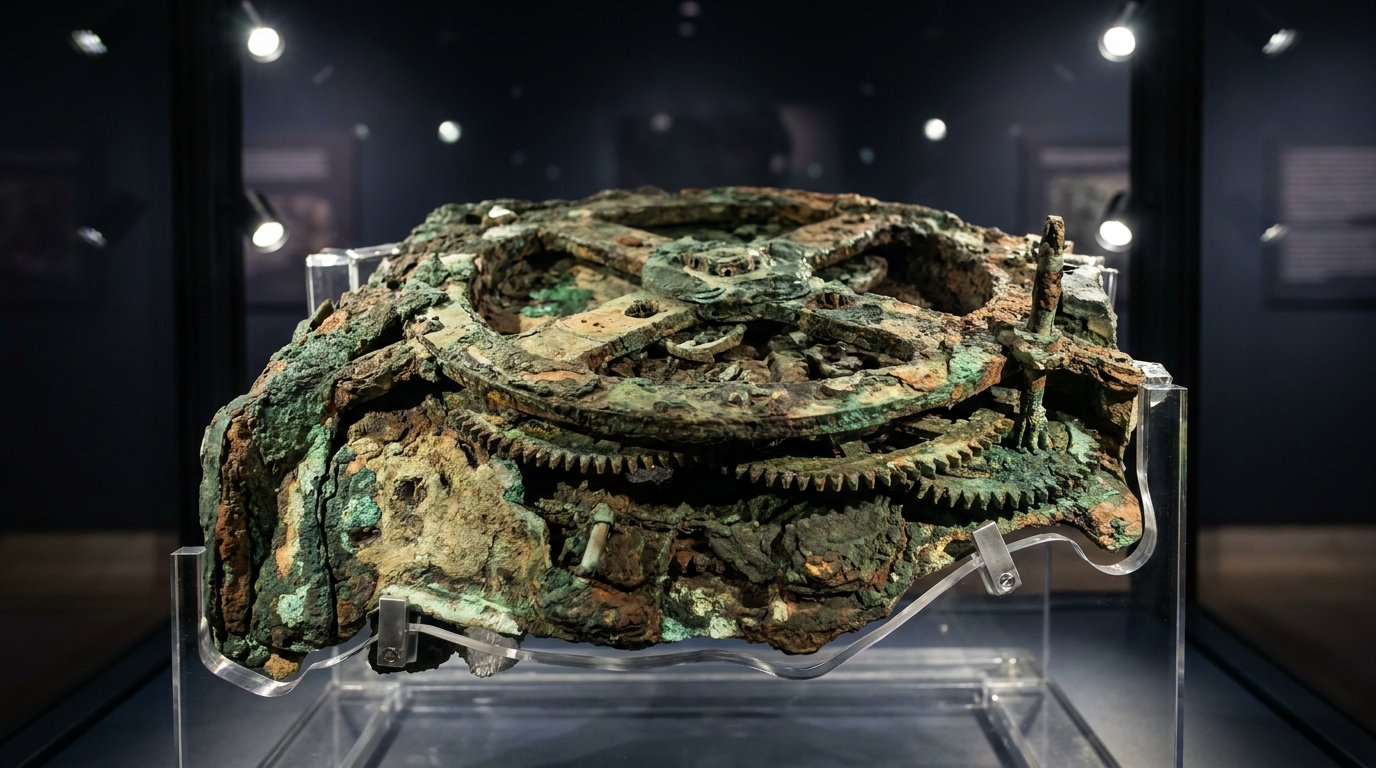
In the spring of 1901, a crew of Greek sponge divers seeking shelter from a severe storm anchored off the tiny, rugged island of Antikythera. While exploring the seabed, they stumbled upon the scattered remains of a Roman-era shipwreck that had met its demise in the first century BC. Among the salvaged treasures—which included magnificent marble and bronze statues, glassware, and amphorae—was a calcified, greenish lump of bronze and wood. Overshadowed by the more glamorous artistic finds, this heavily corroded artifact initially garnered little attention from the archaeologists cataloging the haul in Athens.[1][3]
It took months for the wooden exterior of the corroded mass to dry and split open, revealing a sight that defied all contemporary understanding of classical antiquity. Crammed inside the oxidized rock were traces of technology that seemed impossibly anachronistic: precision-cut bronze gears with neat triangular teeth, stacked in complex arrangements, alongside a ring meticulously divided into degrees. It looked exactly like the interior of a modern clock, yet it had been resting at the bottom of the Mediterranean Sea for two millennia. For decades, the artifact baffled scholars, who struggled to reconcile its advanced engineering with the known capabilities of the ancient world.[1]
The true nature of the 'Antikythera Mechanism' remained obscured by calcification until the advent of advanced imaging technologies. In the 1970s, pioneering X-ray imaging pierced the corrosion, revealing that the device must have been designed to replicate the motions of the heavens. The real breakthrough, however, arrived in 2006 when researchers utilized high-resolution microfocus computed tomography (CT) scanning. These powerful 3D scans laid bare the intricate inner workings of the surviving fragments, exposing hidden inscriptions and a labyrinth of interlocking gearwheels that confirmed the device was far more than a simple astrolabe.[1][3]

Constructed somewhere between 200 and 100 BC, the device is now universally recognized by historians and scientists as the world's first known analog computer. Originally housed in a wooden case roughly the size of a modern shoebox—measuring approximately 34 by 18 by 9 centimeters—it functioned as a hand-powered orrery, a complex mechanical model of the solar system. By turning a small knob or crank on the side of the wooden box, the user could drive a sophisticated train of at least 37 interlocking bronze gears, winding the mechanism forward or backward through time.[2][3][4]
These gears were not simple toys or decorative novelties; they were rigorous mathematical translations of the cosmos, designed to calculate astronomical positions with astonishing precision. The mechanism's back dials were dedicated to tracking the lunar calendar and predicting solar and lunar eclipses. It achieved this by utilizing the Saros cycle, an 18.2-year period of eclipse repetition that the Greeks had inherited from centuries of meticulous Babylonian astronomical observations. The device even featured a specialized dial dedicated to tracking the four-year cycle of the ancient Olympic Games and other Panhellenic athletic festivals, linking celestial time to human cultural events.[2][3]
Perhaps most remarkably, the gear trains were engineered to model the irregular, elliptical orbit of the Moon. Because the Moon's orbit is not a perfect circle, it appears to move faster across the sky when it is at perigee (closest to Earth) than at apogee (farthest away). The ancient engineers replicated this subtle anomaly using an ingenious pin-and-slot gear system that caused the lunar pointer to speed up and slow down at the correct intervals. This specific mechanical solution directly reflects the advanced astronomical theories developed by Hipparchus of Rhodes in the second century BC, leading some historians to suspect he may have consulted on the machine's construction.[3]

Perhaps most remarkably, the gear trains were engineered to model the irregular, elliptical orbit of the Moon.
While the back of the mechanism and its eclipse-predicting dials were largely understood by the early 2000s, the front panel remained a profound mystery. The physical evidence for the front display was almost entirely lost to the sea, leaving only tantalizing clues. Inscriptions on the surviving bronze fragments strongly suggested that the front face originally displayed the movements of the Sun, the Moon, and the five planets known to antiquity: Mercury, Venus, Mars, Jupiter, and Saturn. However, exactly how the Greeks managed to mechanically model the complex, wandering paths of these planets remained an open question.[2][6]
In 2021, a multidisciplinary team of researchers at University College London (UCL) announced a major breakthrough that finally solved the puzzle of the front panel. Drawing on previous scholarly work, mathematical methods described by the ancient Greek philosopher Parmenides, and the mechanism's own microscopic inscriptions, the UCL team successfully reconstructed the missing planetary gear system. They discovered that the ancient engineers used complex epicyclic gearing—small gears riding on the faces of larger ones—to model the retrograde motions of the planets, which occasionally appear to stop and reverse direction in the night sky when viewed from Earth.[5][6]
The sheer precision required to cut these gears by hand is difficult to overstate. Some of the internal wheels feature prime numbers of teeth—such as 53 or 127—which were necessary to accurately model the specific ratios of lunar months to solar years. Cutting a gear with exactly 127 perfectly spaced, identical triangular teeth using only hand files and rudimentary dividers requires a level of master craftsmanship that rivals the finest Swiss watchmakers of the 18th century. It is a level of metallurgical and geometric mastery that historians previously assumed did not exist in the Hellenistic world.[4][7]
Even more astounding than the epicyclic math was the spatial constraint the ancient makers operated under. The UCL researchers demonstrated how the entire intricate web of planetary gears could be elegantly compressed into a space just 25 millimeters deep. The astronomical output was then displayed on the front dial via a brilliant system of nested, concentric tubes that carried the individual planetary pointers across the main face. The mechanism's inscriptions revealed highly specific planetary periods, such as a 462-year cycle for Venus, proving that the Greeks possessed the mathematical acumen to translate long-term astronomical cycles into exact gear tooth counts.[5][6]

The existence of the Antikythera Mechanism forces a radical, permanent rewrite of the history of technology. No other geared mechanism of such staggering complexity is known to exist from the ancient world. In fact, nothing approaching its level of mechanical sophistication would appear again in the archaeological record until the development of medieval cathedral clocks in Europe, more than a full millennium later. This massive chronological anomaly has led historians to conclude that the device was not an isolated stroke of genius, but rather the surviving pinnacle of a long, lost tradition of Hellenistic mechanical engineering.[1][2]
Beyond its sheer mechanical brilliance, the device represents a profound philosophical shift in how humanity viewed its place in the cosmos. It embodies the 'mechanical philosophy'—the revolutionary idea that the universe is not driven by the unpredictable whims of the gods, but operates according to predefined, predictable, and mathematically rigorous rules. The ancient mechanics who captured the heavens in bronze were not merely modeling existing astronomical theories; they were actively shaping a scientific worldview that would eventually form the bedrock of modern physics and engineering.[1][7]

Today, the academic challenge has shifted from understanding the mechanism's theoretical design to the practical realities of its physical construction. Researchers and materials scientists are now attempting to build fully functional physical models using only the tools, materials, and techniques that would have been available in antiquity. A particular challenge lies in proving whether the delicate system of nested tubes and the microscopic, millimeter-long gear teeth could be reliably manufactured by hand without the aid of modern lathes or magnification.[5][6]
As these physical reconstructions continue in workshops and universities around the world, the Antikythera Mechanism remains a profound testament to human ingenuity and the enduring power of scientific curiosity. It serves as a humbling reminder that the ancients were capable of technological marvels that rival the conceptual sophistication of modern engineering. Rescued from a watery grave after two thousand years of silence, this ancient bronze computer continues to bridge the gap between classical antiquity and the modern digital age, forever altering our perception of what the human mind could achieve long before the dawn of the industrial revolution.[4][7]
How we got here
100–200 BC
The Antikythera Mechanism is constructed by unknown Greek engineers, possibly in Rhodes.
1st Century BC
A Roman merchant ship carrying the device sinks in a storm off the island of Antikythera.
Spring 1901
Greek sponge divers discover the shipwreck and salvage the corroded bronze fragments.
1970s
X-ray imaging reveals the hidden internal gears, confirming the artifact's astronomical purpose.
2006
High-resolution CT scans expose microscopic inscriptions and the complex lunar anomaly mechanism.
2021
UCL researchers publish a complete theoretical reconstruction of the missing front planetary display.
Viewpoints in depth
Archaeometallurgists & Engineers
Focuses on the physical construction challenges of building such a device in antiquity.
For engineers and materials scientists, the Antikythera Mechanism presents a profound manufacturing puzzle. The theoretical math is brilliant, but the physical execution is what truly astounds modern horologists. Ancient Greek craftsmen had to cut millimeter-long triangular gear teeth out of bronze sheet metal using only hand files, rudimentary dividers, and the naked eye. Furthermore, the UCL reconstruction requires a system of eight nested, concentric tubes to carry the planetary outputs to the front dial. Proving that such delicate, frictionless nested tubing could be reliably manufactured without the aid of a modern precision lathe remains one of the most significant ongoing challenges in experimental archaeology.
Historians of Science
Focuses on the paradigm shift the device represents for our understanding of classical philosophy.
Historians of science view the mechanism not just as a calculator, but as a physical manifestation of a radical philosophical shift. Before the Hellenistic period, the heavens were largely viewed as the domain of unpredictable gods. The Antikythera Mechanism embodies the 'mechanical philosophy'—the belief that the universe operates like a machine, governed by predefined, mathematically rigorous rules. By capturing the cosmos in bronze, the ancient Greeks were actively shaping a scientific worldview that would eventually form the bedrock of modern physics. The fact that this worldview was mechanized 2,000 years ago forces historians to completely re-evaluate the intellectual capabilities of the classical world.
Astronomers & Mathematicians
Focuses on the brilliant translation of complex astronomical cycles into exact gear ratios.
From a mathematical perspective, the mechanism is a masterpiece of applied astronomy. The ancient engineers had to translate long-term observational data—such as the 18.2-year Babylonian Saros eclipse cycle and the 462-year cycle of Venus—into physical gear trains. This required calculating exact prime-number gear ratios, such as wheels with 53 or 127 teeth, to accurately model the specific ratios of lunar months to solar years. Furthermore, they successfully modeled the Moon's elliptical orbit using a pin-and-slot epicyclic gear system, proving that they not only understood complex orbital anomalies but possessed the geometric mastery to replicate them mechanically.
What we don't know
- The exact identity of the genius engineer or workshop that designed and built the mechanism.
- Whether this specific device was a unique prototype or one of many such machines produced in the Hellenistic world.
- Exactly how the ancient craftsmen managed to manufacture the millimeter-scale gear teeth and nested tubes without modern precision tools.
Key terms
- Orrery
- A mechanical model of the solar system that illustrates or predicts the relative positions and motions of the planets and moons.
- Epicyclic gearing
- A system consisting of one or more outer gears revolving around a central gear, used to model complex planetary motions like retrograde.
- Saros cycle
- An 18.2-year period after which eclipses of the Sun and Moon repeat themselves, originally discovered by Babylonian astronomers.
- Retrograde motion
- The apparent reversal of a planet's direction of motion in the sky as observed from Earth, caused by differences in orbital speeds.
- Perigee and Apogee
- The points in the Moon's elliptical orbit where it is respectively closest to and farthest from the Earth.
Frequently asked
Who built the Antikythera Mechanism?
The exact creator is unknown, but historians suspect it was built by highly skilled Greek engineers, possibly associated with the astronomer Hipparchus in Rhodes or the school of Archimedes.
How was the device powered?
It was not powered by clockwork springs or weights; it was a hand-driven device operated by turning a small crank or knob on the side of its wooden case.
Why did this advanced technology disappear?
The exact reasons are lost to history, but the collapse of the Hellenistic world and the Roman Empire's reliance on different technological priorities likely contributed to the loss of this advanced mechanical engineering tradition.
Sources
Source coverage
7 outlets
3 viewpoints surfaced







[1]Smithsonian MagazineHistorians of Science
Decoding the Antikythera Mechanism, the First Computer
Read on Smithsonian Magazine →[2]BritannicaHistorians of Science
Antikythera mechanism | Description, Purpose, & Facts
Read on Britannica →[3]WikipediaAstronomers & Mathematicians
Antikythera mechanism
Read on Wikipedia →[4]Kotsanas Museum of Ancient Greek TechnologyAstronomers & Mathematicians
The Antikythera Mechanism: The First Computer in History
Read on Kotsanas Museum of Ancient Greek Technology →[5]UCL NewsArchaeometallurgists & Engineers
Experts recreate a mechanical Cosmos for the world's first computer
Read on UCL News →[6]The GuardianArchaeometallurgists & Engineers
Scientists may have solved ancient mystery of 'first computer'
Read on The Guardian →[7]Factlen Editorial TeamHistorians of Science
Synthesis by Factlen editorial team
Read on Factlen Editorial Team →
Every angle. Every day.
Get culture stories with full source coverage and perspective breakdowns delivered to your inbox.