
The Science of Emulsions: How to Master Vinaigrettes, Mayonnaise, and Pan Sauces
Understanding the physical chemistry of amphiphilic molecules and droplet shearing can help home cooks achieve flawless, restaurant-quality sauces.
By Factlen Editorial Team
- Food Scientists
- Focus on the molecular mechanics, emphasizing amphiphilic structures, droplet shearing, and thermodynamic stability.
- Culinary Traditionalists
- Emphasize classical technique, fresh ingredients, and sensory intuition to maintain delicate warm emulsions.
- Modernist Cooks
- Advocate for utilizing extracted stabilizers and mechanical tools for foolproof, hyper-stable results.
What's not represented
- · Industrial Food Manufacturers
Why this matters
Mastering emulsions is the fundamental difference between a greasy, separated dressing and a silky, cohesive sauce. Understanding this science empowers home cooks to troubleshoot broken recipes and elevate their everyday meals without relying on store-bought stabilizers.
Key points
- Emulsions are physical suspensions of two unmixable liquids, typically oil and water, requiring mechanical force to create.
- Amphiphilic molecules, such as the lecithin found in egg yolks, stabilize these mixtures by coating the suspended droplets.
- Mayonnaise is a permanent oil-in-water emulsion, while a classic vinaigrette is a temporary suspension that relies on mustard for stability.
- Warm sauces like beurre blanc require precise temperature control to invert the natural water-in-oil structure of butter.
- A broken emulsion can almost always be rescued by slowly whisking the separated mixture into a fresh binder or a splash of warm water.
It is a universal kitchen frustration: a vinaigrette that stubbornly separates into a slick oil layer and a watery puddle, or a mayonnaise that suddenly turns into a curdled, greasy mess. This is the culinary battle of immiscibility, where two fundamental ingredients refuse to cooperate.[4]
At a molecular level, oil and water are sworn enemies. Water molecules are polar, meaning they have distinct positive and negative ends that attract each other like microscopic magnets. Oil molecules, conversely, are non-polar and hydrophobic, actively repelling the water molecules that try to surround them.[1]
To force these two liquids to coexist, cooks rely on a process called emulsification. An emulsion is a mixture of two liquids that normally refuse to blend, where one liquid is suspended as microscopic droplets within the other, creating a completely new texture.[2]
There are two primary types of culinary emulsions. An "oil-in-water" emulsion, like mayonnaise or milk, suspends tiny droplets of oil within a continuous phase of water. A "water-in-oil" emulsion, like butter or a classic vinaigrette before it breaks, suspends water droplets within a continuous phase of fat.[1][2]

Creating this suspension requires immense mechanical force. Whisking, blending, or shaking shears the dispersed liquid into millions of microscopic droplets. However, thermodynamics dictates that these droplets will eventually seek each other out and merge back together to conserve energy—a destructive process called coalescence.[5]
This is where emulsifiers step in as the culinary peacemakers. Emulsifiers are amphiphilic molecules, meaning they possess a split personality: a hydrophilic (water-loving) head and a hydrophobic (oil-loving) tail, allowing them to bridge the gap between the two hostile liquids.[3][6]
When introduced into a mixture, these molecules race to the boundary between the oil and water. They embed their tails into the oil droplets and face their heads outward into the water, forming a protective chemical shield that physically prevents the droplets from fusing back together.[6]
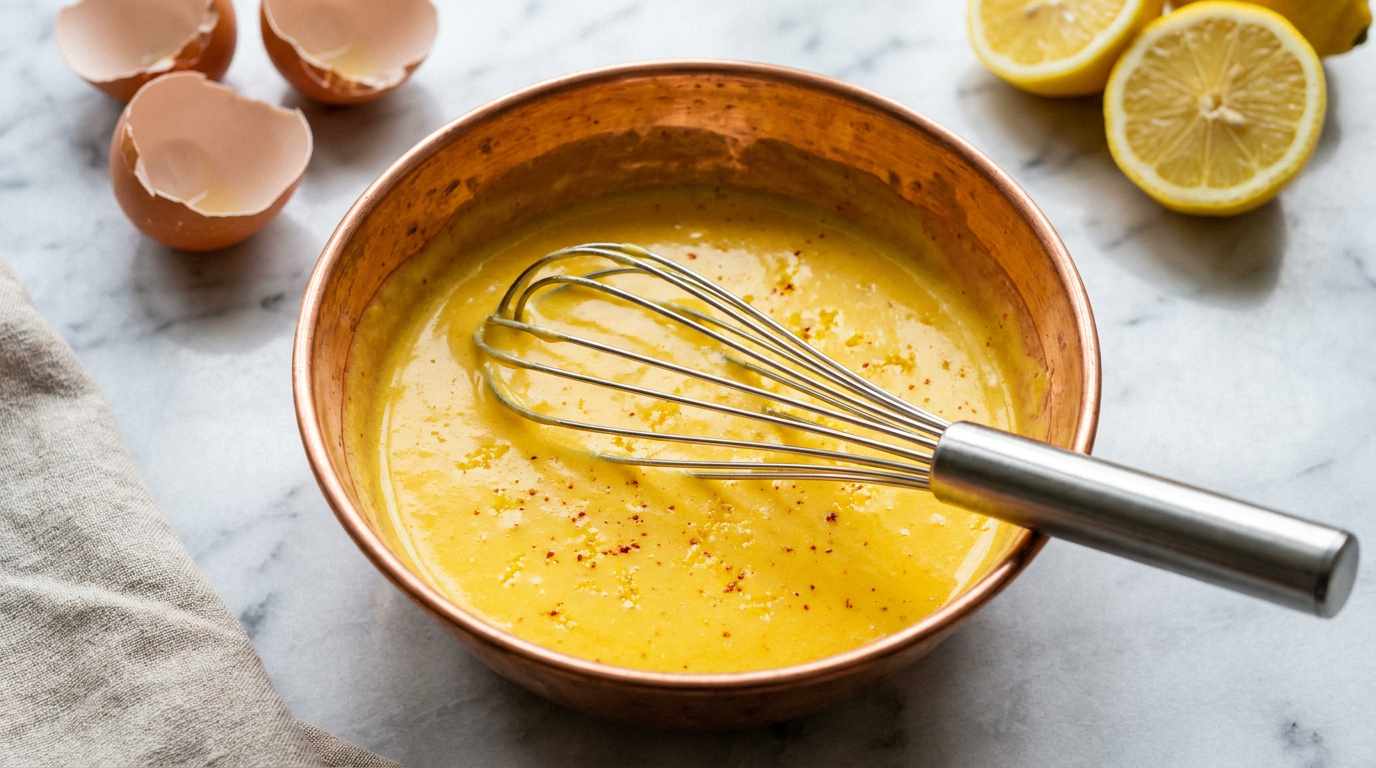
The undisputed king of natural kitchen emulsifiers is the egg yolk. A single yolk contains a potent cocktail of stabilizing compounds, most notably lecithin—a phospholipid that acts as a powerful surfactant and is heavily utilized in both home kitchens and industrial food production.[3][4]
Egg yolks also contain cholesterol, which, unlike lecithin, tends to stabilize water-in-oil emulsions. The delicate balance of these compounds allows a single egg yolk to hold up to a cup of oil in suspension, creating the thick, permanent emulsion we know as mayonnaise.[3]

Egg yolks also contain cholesterol, which, unlike lecithin, tends to stabilize water-in-oil emulsions.
Mustard is another crucial tool in the emulsification arsenal. While it lacks the sheer binding power of lecithin, mustard seeds contain complex carbohydrates and proteins—often referred to as mucilage—that thicken the water phase and physically obstruct oil droplets from colliding.[4]
This makes mustard the traditional backbone of a stable vinaigrette. A classic ratio of three parts oil to one part acid (like vinegar or lemon juice), vigorously shaken with a dollop of Dijon, creates a semi-permanent emulsion that will hold together long enough to dress a salad perfectly.[4]
Temperature introduces a new layer of complexity, particularly in classic French warm sauces like hollandaise and beurre blanc. These sauces are notoriously temperamental because heat increases molecular kinetic energy, making the suspended droplets move faster and collide with greater force.[2]
A beurre blanc is a fascinating feat of food physics. It begins by reducing an acidic liquid—typically white wine and vinegar with shallots—until it is almost entirely dry. Then, cold cubes of butter are whisked in one by one over low heat.[7]
Butter itself is a water-in-fat emulsion, consisting of about 80 percent fat, 15 percent water, and 5 percent milk proteins. As the cold butter melts into the hot reduction, the vigorous whisking actually inverts the emulsion, turning it into a fat-in-water suspension stabilized by the butter's natural casein proteins.[1][7]

If the heat is too high, the butterfat melts too quickly and the emulsion breaks, leaving a greasy pool. If it is too cold, the butter will not incorporate. The margin of error is razor-thin, which is why traditionalists insist on strict temperature control and constant agitation.[2][7]
Modernist cooks, however, often bypass this anxiety by utilizing extracted stabilizers. A pinch of commercial soy lecithin or xanthan gum can lock an emulsion in place almost indefinitely, allowing for creative applications like airy foams and hyper-stable pan sauces that can sit on a pass for hours.[6]
Even with the best technique, emulsions can and do break. When a mayonnaise splits, the oil droplets have coalesced, squeezing out the water phase. The instinct is often to whisk harder, but this only exacerbates the problem by further agitating the separated fats.[4]
The scientifically proven rescue method is to start fresh. By placing a small amount of a new binder—a fresh egg yolk, a teaspoon of mustard, or even just a splash of warm water—in a clean bowl, the broken sauce can be slowly whisked back in, drop by drop.[4]

This re-establishes the continuous phase and shears the coalesced oil back into microscopic droplets. Alternatively, the sheer mechanical force of a high-speed blender can often force a broken emulsion back together by pulverizing the droplets to a fraction of their original size.[2][4]
Understanding the physical chemistry behind these mixtures transforms cooking from a game of chance into a predictable science. Whether whisking a simple salad dressing or executing a flawless hollandaise, mastering the emulsion is the key to unlocking restaurant-quality texture and flavor at home.[7]
Viewpoints in depth
Food Scientists
Focus on the molecular mechanics of amphiphilic structures and droplet shearing.
From a food science perspective, emulsification is a battle against thermodynamics. Scientists focus on the precise shear rates required to break dispersed phases into microscopic droplets, and the chemical structures of surfactants like lecithin that prevent coalescence. They view culinary failures not as a lack of skill, but as a predictable breakdown in the ratio of continuous phase to dispersed phase, or a failure to introduce enough kinetic energy during the mixing process.
Culinary Traditionalists
Emphasize classical technique, fresh ingredients, and sensory intuition.
Traditional chefs approach emulsions as an art form requiring sensory intuition. They argue that the freshest eggs, the right copper bowl, and a keen eye for temperature are irreplaceable by synthetic stabilizers. For traditionalists, the fragility of a warm hollandaise or a beurre blanc is part of its appeal—it demonstrates a cook's mastery over heat and timing, yielding a texture and flavor profile that industrial shortcuts cannot replicate.
Modernist Cooks
Advocate for utilizing extracted stabilizers and mechanical tools for foolproof results.
Modernist cuisine embraces the laboratory to eliminate the anxiety of broken sauces. By utilizing precise measurements of extracted stabilizers like soy lecithin, xanthan gum, or polysorbates, modernist cooks can create hyper-stable emulsions that survive extreme temperatures and long holding times. They argue that understanding the chemistry allows cooks to break traditional rules, creating novel textures like airy foams and dairy-free butter sauces that would be impossible using classical methods alone.
What we don't know
- The exact optimal shear rate for hand-whisking versus mechanical blending to achieve maximum long-term stability without over-processing.
- How the complex matrices of different vinegars and wines chemically interact with natural emulsifiers over extended periods.
Key terms
- Emulsion
- A mixture of two liquids that normally do not mix, where one is suspended as microscopic droplets within the other.
- Amphiphilic
- A molecule possessing both a water-loving (hydrophilic) and an oil-loving (hydrophobic) end, allowing it to bind immiscible liquids.
- Continuous Phase
- The base liquid in an emulsion that surrounds and suspends the droplets of the other liquid.
- Lecithin
- A natural phospholipid found in egg yolks and soybeans that acts as a powerful emulsifier.
- Coalescence
- The process by which microscopic droplets in an emulsion merge back together, causing the mixture to separate or break.
Frequently asked
Why do you have to add oil slowly when making mayonnaise?
Adding oil too quickly overwhelms the continuous water phase, preventing the emulsifier from coating the droplets before they coalesce and break the sauce.
Can I fix a broken vinaigrette?
Yes. Whisking in a small amount of warm water or a fresh binder like mustard can re-establish the continuous phase and pull the emulsion back together.
Why does my pan sauce always separate?
Pan sauces usually break due to excessive heat melting the butterfat too quickly, or a lack of sufficient reduction in the acidic base before the butter is added.
Is soy lecithin better than egg yolks for emulsifying?
Soy lecithin is a highly concentrated, neutral-tasting stabilizer that provides a stronger, longer-lasting hold than egg yolks, making it popular in modernist cooking, though traditionalists prefer the flavor of eggs.
Sources
Source coverage
7 outlets
3 viewpoints surfaced







[1]Harvard Science and CookingFood Scientists
The Physical Chemistry of Food Emulsions
Read on Harvard Science and Cooking →[2]Serious EatsModernist Cooks
The Food Lab: The Science of Emulsions
Read on Serious Eats →[3]Journal of Agricultural and Food ChemistryFood Scientists
Amphiphilic Properties of Egg Yolk Lecithin and Cholesterol
Read on Journal of Agricultural and Food Chemistry →[4]Chef's NotesCulinary Traditionalists
Understanding Culinary Emulsifications and Binders
Read on Chef's Notes →[5]Kerry Food ScienceFood Scientists
Emulsifiers in Food: Mechanisms and Applications
Read on Kerry Food Science →[6]Kings ResearchFood Scientists
Lecithin Emulsifier: Mechanisms and Applications
Read on Kings Research →[7]Factlen Editorial TeamCulinary Traditionalists
Synthesis by Factlen editorial team
Read on Factlen Editorial Team →

Every angle. Every day.
Get lifestyle stories with full source coverage and perspective breakdowns delivered to your inbox.