
How to Navigate Kyoto's Strict New 2026 Tourism Rules: Luggage Bans, Gion Fines, and Transit Shifts
Kyoto has implemented a sweeping set of new rules for 2026, including strict luggage bans on city buses, a ¥10,000 fine for trespassing in Gion, and a massive tax hike on luxury stays. The measures aim to combat overtourism and force visitors to travel more sustainably.
By Factlen Editorial Team
- Kyoto Residents & Officials
- Prioritizes the livability of the city, aiming to reduce traffic gridlock and protect private property from overtourism.
- International Tourists
- Seeks clear, English-language guidance to navigate the new rules without facing unexpected fines or logistical hurdles.
- Tourism Operators
- Focuses on providing the infrastructure—like luggage forwarding and luxury experiences—to support the new high-value tourism model.
What's not represented
- · Budget Travelers
- · Local Commuters
Why this matters
Showing up in Kyoto unprepared in 2026 can result in denied bus boarding, hefty fines for trespassing, and logistical nightmares on the bullet train. Understanding these new rules is essential for a smooth, respectful, and fine-free trip to Japan's ancient capital.
Key points
- Kyoto has strictly banned large suitcases on city buses to prevent overcrowding.
- The popular ¥700 bus-only pass has been discontinued in favor of a ¥1,100 subway-and-bus pass.
- Tourists face a ¥10,000 fine for entering private residential alleys in the historic Gion district.
- Shinkansen passengers must reserve specific seats if their luggage exceeds 160 centimeters in total dimensions.
- A new progressive accommodation tax charges up to ¥10,000 per night for luxury stays over ¥100,000.
Kyoto is welcoming record numbers of international visitors in 2026, but the ancient capital has fundamentally changed how it manages them. The era of spontaneous, unstructured tourism—where visitors could simply show up, drag a massive suitcase onto a crowded city bus, and wander into any residential alleyway—is officially over. In its place, the city has implemented a comprehensive system of logistical rules, transit shifts, and strict fines designed to protect the daily lives of its residents.[6]
This shift is part of a broader national strategy that the Japan National Tourism Organization champions as sustainable travel. Rather than capping visitor numbers outright, Kyoto is pioneering a model that forces tourists to travel smarter. By heavily incentivizing off-peak transit, penalizing disruptive behavior, and taxing high-end stays, the city is attempting to balance its booming tourism economy with its fragile historic infrastructure.[3][6]
The most immediate and visible change for travelers in 2026 is the strict enforcement of luggage rules. Kyoto's city buses, long the primary artery for budget travelers, are now effectively "no-suitcase zones." To combat the severe overcrowding that frequently left local commuters stranded at bus stops, drivers have been granted the authority to refuse entry to anyone carrying large baggage.[1][4]
Instead of dragging bags through the streets, visitors are now expected to utilize the city's expanded "Hands-Free Kyoto" network. Counters located throughout Kyoto Station offer same-day delivery services, transporting suitcases directly to hotels for approximately ¥1,500 per item. Dropping bags upon arrival allows tourists to navigate the city's narrow sidewalks and crowded temples without contributing to the gridlock.[1][3]

This luggage crackdown extends far beyond Kyoto's city limits. On the Tokaido Shinkansen—the vital bullet train artery connecting Tokyo, Kyoto, and Osaka—strict oversized baggage rules are now heavily enforced. Any suitcase with combined dimensions (height, width, and depth) exceeding 160 centimeters requires a specific "oversized baggage seat" reservation.[3][5]
Travelers who fail to book these specific seats in advance face a logistical nightmare. Train conductors will levy an immediate on-board fine and force the relocation of the luggage to designated areas, assuming space is even available. During peak holiday seasons, failing to secure this reservation can mean being denied boarding entirely.[5]
Travelers who fail to book these specific seats in advance face a logistical nightmare.
To further ease street-level congestion, Kyoto has completely overhauled its transit ticketing system. For years, the ¥700 "Bus One-Day Pass" was the default choice for tourists, inadvertently incentivizing them to crowd onto surface streets. Recognizing this flaw, the city has officially discontinued the bus-only pass.[1]
In its place, Kyoto now heavily promotes the ¥1,100 "Subway & Bus One-Day Pass." The strategic goal is explicit: force tourists underground. By making the subway network the primary mode of transportation and using buses only for the final, unavoidable leg of a journey, the city hopes to break the traffic gridlock that has plagued its major thoroughfares.[1]

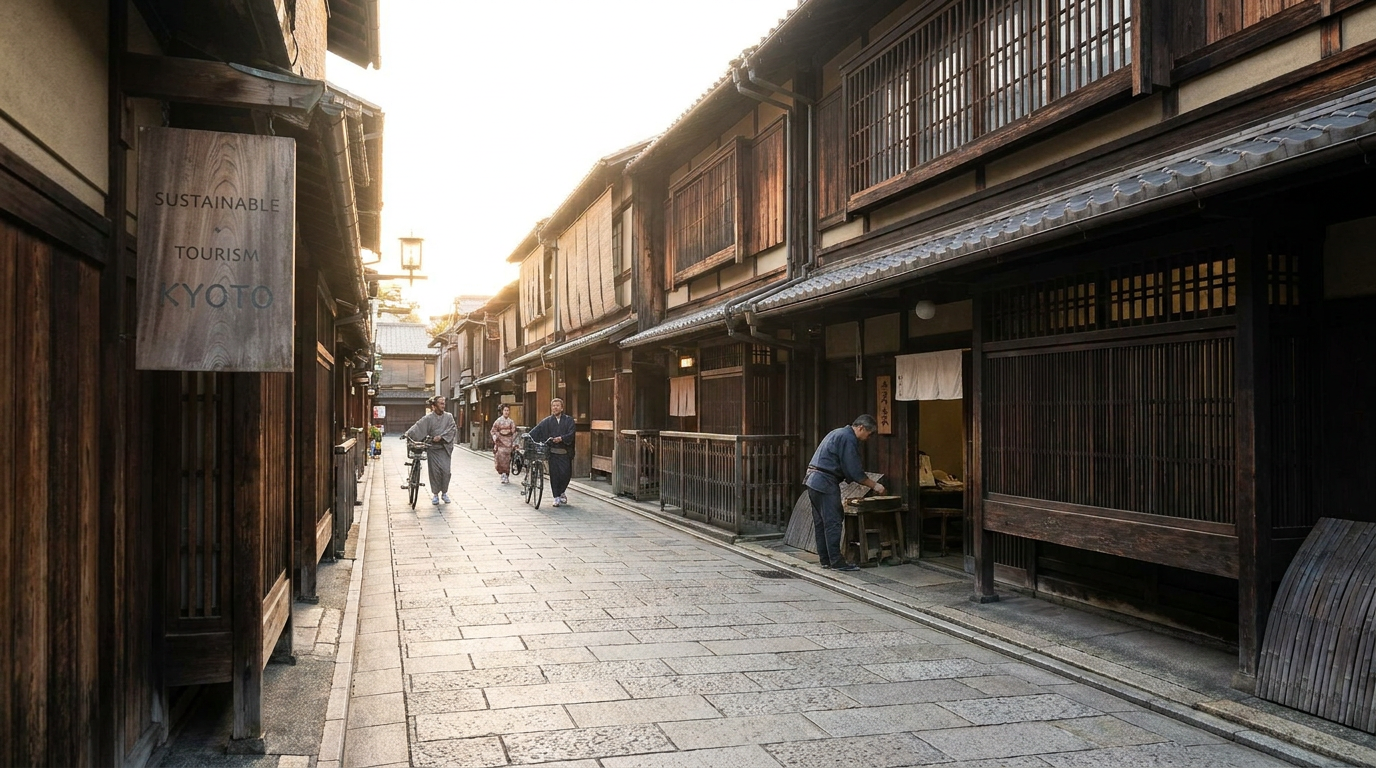
Beyond transit logistics, Kyoto is aggressively cracking down on neighborhood etiquette, particularly in the historic Gion district. Following years of complaints about tourists harassing geiko (geisha) and trespassing on private property for photographs, the city has drawn a hard line. Multilingual signs now warn visitors of a ¥10,000 penalty for unauthorized entry into private residential alleys.[4]
It is crucial to understand that this is not a blanket ban on the Gion district. Major public thoroughfares, such as Hanamikoji Street and Sannenzaka, remain fully open and welcoming to visitors. The fines specifically target the narrow, privately owned side streets where tourists have historically disrupted the quiet, daily lives of local residents.[4]
Kyoto is also utilizing taxation to manage its tourism footprint and fund preservation efforts. Effective March 1, 2026, the city implemented a massive hike in its accommodation tax, specifically targeting high-end stays. While the tax was previously capped at a nominal ¥1,000 per night, it now features a progressive structure.[2]
Under the new rules, luxury accommodations costing over ¥100,000 per person, per night are subject to a tax of up to ¥10,000. This represents the highest municipal accommodation tax rate in Japan. The revenue generated from this hike is strictly earmarked for preserving traditional wooden machiya townscapes, maintaining stone-paved streets, and upgrading multilingual congestion management systems.[2]

Even cycling, a highly popular and eco-friendly way to navigate Kyoto's relatively flat terrain, has seen a regulatory tightening. Rental companies are now required to provide thorough briefings on local traffic laws. Police are strictly enforcing rules against distracted riding, with fines of around ¥12,000 for using a smartphone while cycling, and ¥6,000 for running a red light or riding against traffic.[2]
For travelers planning a trip to Kyoto in 2026, these rules require a fundamental shift in mindset. Planning ahead—whether that means booking luggage forwarding, reserving specific train seats, or understanding local neighborhood boundaries—is no longer optional. Ultimately, Kyoto's strict new framework isn't designed to punish visitors, but to save the city from being loved to death, ensuring it remains a magical destination for decades to come.[6]

How we got here
May 2020
JR introduces mandatory reservations for oversized luggage on the Tokaido Shinkansen.
April 2024
Kyoto begins installing multilingual warning signs in Gion's private alleys.
February 2026
The popular 700-yen Bus One-Day Pass is officially discontinued to reduce surface congestion.
March 2026
Kyoto implements a progressive accommodation tax, raising fees on luxury stays up to ¥10,000 per night.
April 2026
Strict enforcement of the 'no-suitcase' policy on city buses takes full effect ahead of the spring travel season.
Viewpoints in depth
Kyoto Residents & Officials
Prioritizes the livability of the city, aiming to reduce traffic gridlock and protect private property from overtourism.
For locals, the influx of millions of tourists had turned daily commutes into grueling ordeals and quiet residential streets into crowded photo backdrops. Officials argue that the new rules—particularly the discontinuation of the bus-only pass and the strict luggage bans—are essential survival mechanisms. By forcing tourists to use the subway and penalizing trespassing in Gion, the city hopes to reclaim its surface streets and restore a baseline of privacy for its citizens.
International Tourists
Seeks clear, English-language guidance to navigate the new rules without facing unexpected fines or logistical hurdles.
Many international visitors are happy to comply with sustainable tourism initiatives, provided the rules are clearly communicated. The primary frustration among tourists stems from the fragmented nature of booking systems—such as the specific Shinkansen oversized baggage reservations—which can catch first-time visitors off guard. However, those who adapt to the 'Hands-Free' luggage forwarding systems often report that traveling without heavy bags significantly improves their overall experience.
Tourism Operators
Focuses on providing the infrastructure—like luggage forwarding and luxury experiences—to support the new high-value tourism model.
Hotels, transit companies, and delivery services are rapidly scaling up their operations to meet the demands of Kyoto's new regulatory environment. Luxury ryokans are absorbing the impact of the ¥10,000 accommodation tax by elevating their service standards and offering exclusive cultural programs. Meanwhile, logistics companies are expanding their station-to-hotel delivery networks, viewing the city's strict luggage rules not as a hurdle, but as a lucrative new business vertical.
What we don't know
- Whether the ¥10,000 fines in Gion will be strictly enforced by police or rely primarily on the deterrent effect of the multilingual signs.
- If the ¥1,100 Subway & Bus pass will successfully shift enough tourist traffic underground to meaningfully reduce surface-level bus congestion during peak autumn foliage season.
- How the massive increase in the luxury accommodation tax will impact booking rates at Kyoto's highest-end ryokans and international hotel brands.
Key terms
- Ku-Tsu-Ri
- A Japanese concept translating to 'empty tourism,' focusing on dispersing crowds to off-peak times and lesser-known areas.
- Hands-Free Tourism
- A nationwide initiative encouraging travelers to use delivery services to send luggage directly between stations, airports, and hotels.
- Machiya
- Traditional wooden townhouses typical of Kyoto's historic districts, many of which sit on the private alleys now protected by fines.
- IC Card
- Rechargeable transit cards (like Suica or ICOCA) used to tap in and out of Japan's subway and train networks.
- Oversized Baggage
- On the Shinkansen, any suitcase with combined dimensions (height + width + depth) between 160 cm and 250 cm, requiring a special reservation.
Frequently asked
Can I still bring a suitcase on the Kyoto city bus?
No. Drivers are now authorized to refuse entry to passengers with large luggage to prevent aisles from being blocked. Visitors must use luggage forwarding or taxis.
Is the Gion district completely closed to tourists?
No. Public streets like Hanamikoji remain open. The ¥10,000 fines apply only to unauthorized entry into narrow, privately owned residential side streets.
How much is the new Kyoto transit pass?
The new Subway & Bus One-Day Pass costs ¥1,100. The cheaper bus-only pass has been discontinued to encourage subway use.
Do I need to book a special train ticket for my luggage?
Yes, if you are riding the Shinkansen and your suitcase's combined dimensions exceed 160 cm, you must reserve an 'oversized baggage seat' in advance.
Sources
Source coverage
6 outlets
3 viewpoints surfaced






[1]NavitimeKyoto Residents & Officials
Changes to Transportation: New Rules for 2026
Read on Navitime →[2]Arigato TravelTourism Operators
New Rules for Luxury Travelers in Kyoto
Read on Arigato Travel →[3]Japan National Tourism OrganizationTourism Operators
Sustainable Travel in Japan: Hands-Free Tourism
Read on Japan National Tourism Organization →[4]Self Guide JapanKyoto Residents & Officials
Kyoto Safety and Rules: The Gion Private-Alley Rule
Read on Self Guide Japan →[5]CCT 2026Tourism Operators
Kyoto Transport and Big Luggage Rule
Read on CCT 2026 →[6]Factlen Editorial TeamInternational Tourists
Synthesis by Factlen editorial team
Read on Factlen Editorial Team →
Every angle. Every day.
Get travel stories with full source coverage and perspective breakdowns delivered to your inbox.