
The Maturation of Hydrail: How Hydrogen Trains Found Their Niche
After early hype as a universal replacement for diesel, hydrogen-powered trains are finding their true calling on long-distance, hard-to-electrify routes.
By Factlen Editorial Team
- Battery-First Pragmatists
- Argue that battery-electric trains are the most efficient and cost-effective solution for the vast majority of regional routes.
- Long-Haul & Resilience Advocates
- Focus on hydrogen's unmatched range and ability to bypass vulnerable electrical grids.
- Transport Operators
- Prioritize daily reliability, consistent fuel supply chains, and predictable maintenance costs.
What's not represented
- · Passengers experiencing service disruptions during technology transitions
- · Green hydrogen producers scaling up supply chains
Why this matters
Decarbonizing transportation is critical to meeting global climate goals, but electrifying rural rail networks is often prohibitively expensive. Understanding the balance between battery and hydrogen technology reveals how the last remaining diesel engines will finally be retired.
Key points
- Hydrogen trains use fuel cells to generate electricity onboard, emitting only water vapor.
- Early deployments faced logistical hurdles, including inconsistent fuel supply chains and complex maintenance.
- Battery-electric trains are increasingly winning contracts for short regional routes due to lower costs.
- Hydrogen technology is now being targeted specifically at long-distance routes exceeding 1,000 kilometers.
For decades, the diesel locomotive has been the stubborn, polluting workhorse of rural rail networks. While urban and high-speed lines have long enjoyed the benefits of clean electricity, electrifying remote regional lines with continuous overhead wires is often prohibitively expensive due to challenging topography and vast distances. This infrastructure gap has left transport authorities searching for a clean alternative that can sever the industry's reliance on fossil fuels.[3]
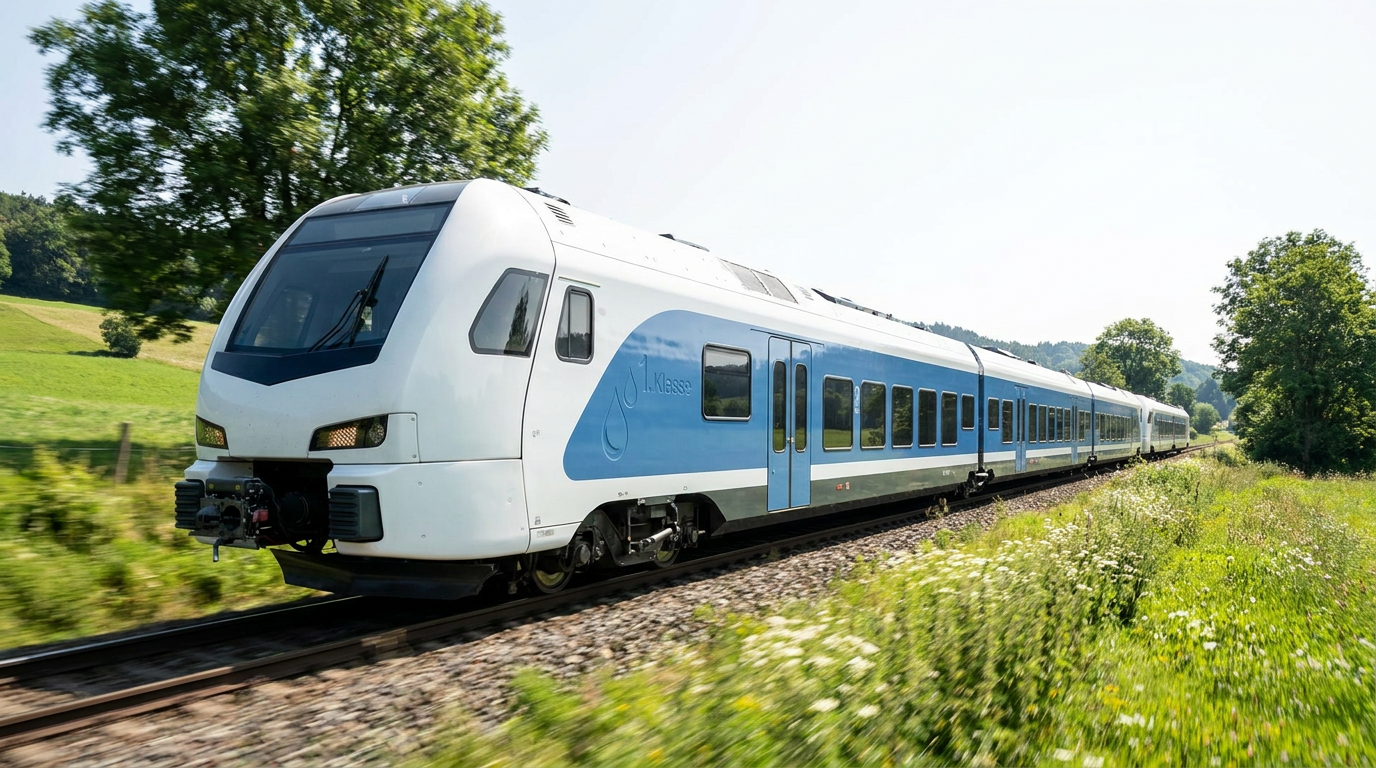
Enter "hydrail"—passenger trains powered entirely by hydrogen. When the first commercial models debuted in Germany in 2018, they were hailed as the ultimate zero-emission silver bullet. Policymakers and environmental advocates envisioned a future where hydrogen would seamlessly replace diesel across the globe, requiring no new trackside electrical infrastructure.[7]
The underlying technology is undeniably elegant. Rather than burning fuel in a traditional combustion engine, hydrogen trains are essentially electric vehicles that generate their own power onboard using advanced fuel cells.[3]
Inside these cells, stored hydrogen gas reacts electrochemically with oxygen pulled from the outside air. This reaction generates the electricity needed to drive the train's traction motors. The only byproduct emitted from the train's tailpipe is pure, harmless water vapor.[3]

However, as the technology has moved from early prototypes to widespread commercial deployment in 2026, the rail industry is experiencing a necessary reality check. The lived experience of operating daily hydrogen fleets has revealed unexpected logistical and maintenance hurdles that early models did not fully anticipate.[1]
In Germany’s Taunus region, a highly anticipated rollout of 27 hydrogen trains was delayed until 2026. The transit authority cited persistent technical issues with the fuel cells and a shortage of replacement parts, which prevented the fleet from entering full service on schedule.[6]
Similarly, operators in Lower Saxony—home to the world's first hydrogen rail network—faced operational friction. When their regional hydrogen supply chains proved inconsistent, the transit authority was forced to temporarily revert to older diesel railcars to ensure commuters were not left stranded.[2]
Maintenance has also proven more complex than initially advertised. Industry manufacturers note that hydrogen fuel cells currently require replacement every three years. Combined with the intricacies of managing high-pressure gas logistics, this adds significant overhead compared to simpler electric systems.[1][8]
Maintenance has also proven more complex than initially advertised.
As a result of these growing pains, a formidable competitor has emerged for shorter regional routes: the battery-electric multiple unit (BEMU). Rather than generating power onboard, these trains store grid electricity in massive lithium-ion battery packs.[3]
For regional routes spanning 40 to 80 kilometers, battery trains are proving cheaper and easier to maintain. They can charge rapidly on short stretches of electrified track at stations, and then run entirely on battery power for the remainder of the journey through rural areas.[3][8]

This economic reality has led to a strategic pivot across the industry. Major rail manufacturers are fulfilling their existing hydrogen orders but are increasingly positioning battery trains as the default choice for short-haul regional transit, acknowledging that batteries simply make more sense for brief commuter hops.[2][7]
Yet, hydrogen is far from dead—it is simply finding its specific, highly valuable niche. For long-distance routes exceeding 1,000 kilometers, batteries are currently too heavy and lack the necessary energy density to complete the journey without frequent, time-consuming stops.[6]
In these vast, open corridors, hydrogen remains the only viable zero-emission alternative to diesel. A single tank can power a passenger train for over 1,100 kilometers, and refueling the high-pressure tanks takes just 15 minutes—a turnaround time that battery technology cannot currently match.[6][7]
This long-haul potential is driving hydrail expansion outside of Europe. In April 2026, Transport Canada published a comprehensive study on the successful deployment of a hydrogen passenger train in Quebec, laying the regulatory and operational groundwork for broader North American adoption where distances between cities are vast.[4]

Furthermore, hydrogen trains offer a unique advantage in an era of increasing climate volatility: grid resilience. Because they carry their own fuel onboard, hydrail systems can continue operating smoothly even during massive electrical grid failures, providing a critical lifeline during emergencies.[5]
They also completely bypass the need for trackside power infrastructure. This is becoming a crucial economic advantage as global copper prices reach record highs in 2026, making the prospect of stringing thousands of miles of new overhead wires financially unfeasible for many governments.[5]
Ultimately, the decarbonization of the rail industry is no longer viewed as a search for a single magic bullet. It has matured into a sophisticated, multi-tool approach where transit authorities match the specific technology to the specific route.[3]

How we got here
2018
The world's first hydrogen fuel cell passenger train enters commercial service in Germany.
2022
A hydrogen train sets a record by covering 1,175 kilometers on a single tank of fuel.
Late 2025
Major rail manufacturers pause development of new hydrogen models to focus on battery-electric alternatives for short routes.
April 2026
Transport Canada publishes a comprehensive study on the successful deployment of hydrogen rail in North America.
Viewpoints in depth
Long-Haul & Resilience Advocates
Focus on hydrogen's unmatched range and ability to bypass vulnerable electrical grids.
This camp, which includes infrastructure analysts and long-distance transport operators, argues that battery technology will never overcome the physics of weight and range for vast rural networks. They point to the rising cost of copper and the increasing frequency of grid failures as proof that carrying fuel onboard is a necessary resilience strategy, making hydrogen the only true successor to diesel for remote routes.
Battery-First Pragmatists
Argue that battery-electric trains are the most efficient and cost-effective solution for the vast majority of regional routes.
Rail manufacturers and efficiency advocates note that 80% of non-electrified regional routes are short enough to be serviced by battery-electric multiple units (BEMUs). Because batteries have fewer moving parts, require no high-pressure gas logistics, and avoid the energy losses associated with electrolysis, this camp believes hydrogen should be strictly reserved for edge cases rather than deployed as a default standard.
Transport Operators
Prioritize daily reliability, consistent fuel supply chains, and predictable maintenance costs.
For the transit authorities actually running the trains, the debate is less about technological purity and more about operational reality. After experiencing delayed deployments and inconsistent hydrogen supply chains in early pilot programs, these operators are demanding mature, plug-and-play solutions. They are willing to adopt whichever technology—battery or hydrogen—can guarantee that commuters will not be left stranded on the platform.
What we don't know
- Whether the cost of green hydrogen production will fall fast enough to make hydrail economically competitive with diesel in the long term.
- How quickly North American regulators will adapt safety standards to allow for widespread high-pressure hydrogen refueling at passenger stations.
Key terms
- Hydrail
- A generic term for any rail vehicle powered by hydrogen fuel cells rather than diesel or overhead electric lines.
- Fuel Cell
- A device that generates electricity through an electrochemical reaction between hydrogen and oxygen, emitting only water vapor.
- BEMU
- Battery Electric Multiple Unit; a train powered by onboard batteries, often recharged via short sections of electrified track at stations.
- Electrolysis
- The process of using electricity to split water into hydrogen and oxygen, which is required to produce clean, "green" hydrogen.
Frequently asked
Do hydrogen trains burn fuel like diesel engines?
No. They use onboard fuel cells to combine hydrogen with oxygen, which generates electricity electrochemically to power the train's motors.
Why not use battery trains for every route?
Batteries are heavy and currently have a limited range of roughly 80 to 120 kilometers, making them unsuitable for long rural corridors without frequent charging stops.
Are hydrogen trains completely zero-emission?
The trains themselves emit only water vapor. However, their true climate impact depends on whether the hydrogen fuel was produced using renewable energy (green hydrogen) or fossil fuels.
Do hydrogen trains require overhead wires?
No. Because they carry their energy onboard in high-pressure tanks, they can operate on entirely non-electrified tracks, saving the massive cost of stringing copper wires.
Sources
Source coverage
8 outlets
3 viewpoints surfaced







[1]CleanTechnicaBattery-First Pragmatists
The real-world experience of hydrogen trains in Europe
Read on CleanTechnica →[2]Railway ProTransport Operators
Operational challenges across Europe
Read on Railway Pro →[3]IlluminemBattery-First Pragmatists
Hydrogen trains: a tool, not a universal substitute
Read on Illuminem →[4]Transport CanadaTransport Operators
Study on the deployment of the Alstom Coradia iLint
Read on Transport Canada →[5]ForbesLong-Haul & Resilience Advocates
Spain's Grid Failure Highlights The Case For Hydrail
Read on Forbes →[6]Fortune Business InsightsLong-Haul & Resilience Advocates
Hydrogen Train Market Size, Share, and Industry Analysis 2026-2034
Read on Fortune Business Insights →[7]AutonocionTransport Operators
The Coradia iLint, seven years later
Read on Autonocion →[8]OptiFuel SystemsBattery-First Pragmatists
Hydrogen trains are more complex to maintain than battery-electric equivalents
Read on OptiFuel Systems →
Every angle. Every day.
Get transportation stories with full source coverage and perspective breakdowns delivered to your inbox.