
How North America is Engineering Nature Back Across Its Highways
A continent-wide boom in wildlife crossings is reconnecting fragmented habitats, saving animal populations from genetic collapse while drastically reducing fatal highway collisions.
By Factlen Editorial Team
- Conservation Biologists
- Focus on preventing localized extinctions and preserving genetic diversity.
- Transportation & Safety Officials
- Prioritize the reduction of fatal accidents and billions in property damage.
- Urban Planners & Policymakers
- Advocate for integrating wildlife infrastructure into standard highway development.
- Macro-Level Analysts
- Focus on the continent-wide paradigm shift in infrastructure and ecology.
What's not represented
- · Freight and Logistics Operators
- · Private Landowners
Why this matters
By engineering nature back across our highways, North America is solving a crisis that causes $8 billion in property damage and 200 human deaths annually. These wildlife corridors not only save drivers' lives but also rescue isolated animal populations from genetic collapse and localized extinction.
Key points
- The $114 million Wallis Annenberg Wildlife Crossing, the world's largest, will open in Southern California in December 2026.
- The Yellowstone to Yukon Initiative has successfully facilitated over 200 wildlife crossings across its 2,000-mile corridor.
- Wildlife-vehicle collisions cost the U.S. $8 billion annually and result in roughly 200 human fatalities.
- Crossings in Banff and Montana have proven to reduce wildlife collisions by 80% to 90%.
- The 2021 federal infrastructure bill dedicated $350 million specifically to fund wildlife connectivity projects.
- Regional planners are now working to make wildlife infrastructure a standard feature of all future highway development.
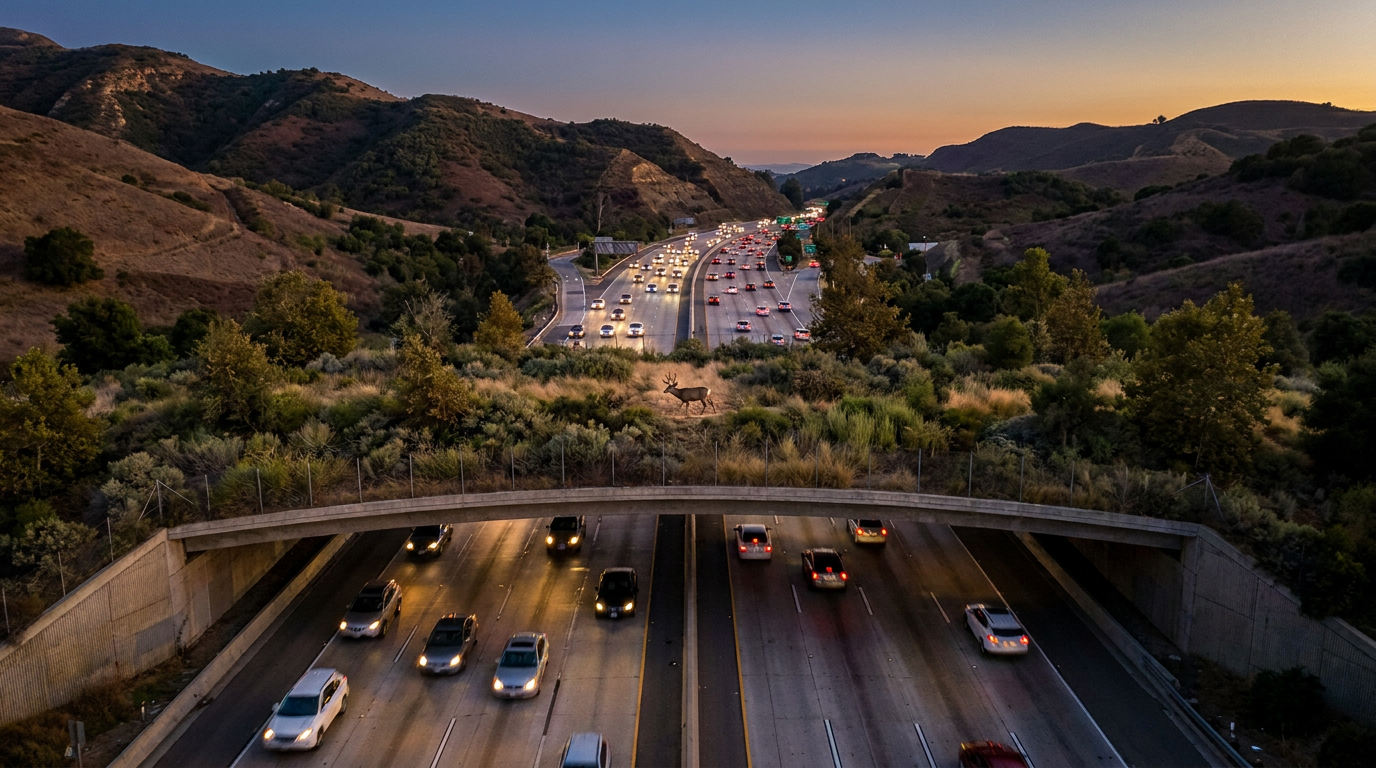
In December 2026, Southern California will officially open the Wallis Annenberg Wildlife Crossing, a $114 million vegetated bridge spanning ten lanes of the US-101 freeway. Stretching 210 feet long and 174 feet wide, the structure is the largest of its kind in the world. It is designed to provide safe passage for mountain lions, bobcats, and deer whose habitats have been severed by decades of urban sprawl.[2][8]
The Annenberg project is the most visible symbol of a quiet revolution in North American infrastructure. Across the continent, governments, conservationists, and Indigenous groups are engineering nature back across the continent's highways, fundamentally changing how humans and wildlife coexist.[8]
For decades, the prevailing model of conservation was to draw a boundary around a pristine area and declare it a protected park. However, conservation biologists eventually realized a distressing corollary: as human development expanded, these parks became isolated "extinction islands."[6]
When animals are trapped in fragmented habitats, they cannot migrate to find food, adapt to climate changes, or reach new mates. This isolation leads to genetic inbreeding and localized extinctions, a crisis that prompted scientists to shift their focus from protecting isolated blocks of land to protecting the pathways that connect them.[6][8]

The granddaddy of this connectivity movement is the Yellowstone to Yukon (Y2Y) Conservation Initiative. Conceived in 1993, the project envisioned an interconnected system of wild lands stretching 2,000 miles from Wyoming to the Canadian Arctic.[6]
Over three decades, that vision has materialized into concrete results. According to the initiative's latest impact reports, more than 200 wildlife crossings now span busy roads across the Y2Y region, allowing animals to bypass the deadly friction of human infrastructure.[3]
The biological impact of these corridors has been profound. By giving apex predators room to roam, conservationists have shrunk the geographic gap between isolated grizzly bear populations in the southern Rockies from 150 miles down to less than 45 miles, significantly boosting their genetic resilience.[3]

While ecologists champion the biodiversity benefits, transportation officials are increasingly driven by human safety and economics. The ever-growing network of North American roads has created a deadly friction point between migrating herds and motorists.[4]
While ecologists champion the biodiversity benefits, transportation officials are increasingly driven by human safety and economics.
An estimated one to two million wildlife-vehicle collisions occur on U.S. roads every year. These accidents cause roughly 200 human deaths, 26,000 injuries, and a staggering $8 billion in property damage annually. In rural states like Wyoming, wildlife encounters account for 15% of all reported crashes.[4]
Wildlife crossings offer a proven, highly effective solution to this crisis. Data from Banff National Park, which features a famous network of overpasses across the Trans-Canada Highway, shows an 80% reduction in collisions with large mammals. Similarly, a network of 81 crossings along Montana's Highway 93 reduced deer-vehicle collisions by over 90%.[5]

Recognizing these dual benefits, lawmakers are pouring unprecedented capital into wildlife infrastructure. The federal Infrastructure Investment and Jobs Act dedicated $350 million in grants specifically for projects that reduce wildlife collisions and improve habitat connectivity.[4]
State governments are also mobilizing. Florida lawmakers recently allocated $400 million to protect 18 million acres of interconnected natural areas for species like the endangered Florida panther, while California's transportation commission provided the final $18.8 million push to complete the Annenberg crossing.[1][4]
The design of these crossings is highly specialized, tailored to the psychological preferences of different species. Elk and pronghorn, which rely on sight to evade predators, strongly prefer wide, open overpasses. Conversely, black bears and cougars often favor the enclosed, hidden cover of underpasses and culverts.[8]

Indigenous leadership has become a cornerstone of the movement's modern era. First Nations and tribal governments are driving large-scale land conservation, such as the Indigenous-led expansion of the Klinse-za/Twin Sisters Park in British Columbia, which has been vital for mountain caribou recovery.[3][6]
As the Annenberg crossing nears its ribbon-cutting, regional planners are already looking past singular mega-projects. The California Department of Transportation recently awarded a $700,000 grant to map Southern California's fragmented ecosystems and design a standardized, region-wide framework for future corridors.[7]
How we got here
1993
The Yellowstone to Yukon (Y2Y) Conservation Initiative is conceived to connect 2,000 miles of habitat.
2021
The federal Infrastructure Investment and Jobs Act allocates $350 million specifically for wildlife crossings.
2022
Groundbreaking takes place for the Wallis Annenberg Wildlife Crossing in Southern California.
Dec 2026
The Wallis Annenberg crossing is scheduled to officially open to wildlife.
Viewpoints in depth
Conservation Biologists
Focus on preventing localized extinctions and preserving genetic diversity.
For decades, the standard conservation model was to protect isolated blocks of land as national parks. However, biologists realized that without safe pathways between these parks, they effectively become 'extinction islands.' When animals cannot migrate to find new mates, populations suffer from genetic inbreeding and become highly vulnerable to disease and climate shifts. To this camp, wildlife corridors are the only viable long-term solution to preserve the continent's biodiversity.
Transportation & Safety Officials
Prioritize the reduction of fatal accidents and billions in property damage.
While ecologists focus on animal welfare, transportation departments view wildlife crossings as a critical public safety investment. With one to two million wildlife-vehicle collisions occurring annually in the U.S., the human toll—200 deaths and 26,000 injuries—is staggering. Because crossings like those in Banff and Montana have proven to reduce collisions by up to 90%, safety officials argue that the upfront construction costs are quickly offset by the billions saved in property damage and emergency response.
Urban Planners
Advocate for integrating wildlife infrastructure into standard highway development.
Regional planners argue that relying on massive, philanthropically funded mega-projects like the Annenberg crossing is not a scalable model for the entire continent. Instead, they are pushing to make wildlife infrastructure—such as underpasses, culverts, and directional fencing—a standard, cost-effective requirement for all new highway and transit projects. By mapping fragmented ecosystems regionally, planners hope to build interconnected networks proactively rather than retrofitting them after the fact.
What we don't know
- How climate change will shift historical migration routes, potentially rendering some newly built crossings obsolete if animals move to different latitudes.
- Whether smaller, less charismatic species like amphibians and insects will utilize the massive overpasses designed primarily for large mammals.
- How long it will take for the most isolated animal populations to discover and trust the new infrastructure enough to restore genetic diversity.
Key terms
- Wildlife Corridor
- A naturally occurring or human-made pathway that connects isolated patches of habitat, allowing animals to move safely.
- Habitat Fragmentation
- The division of large, continuous habitats into smaller, isolated patches, often caused by roads, fences, and urban development.
- Genetic Inbreeding
- A decline in population health that occurs when isolated groups of animals are forced to mate with close relatives due to a lack of safe pathways to other populations.
- Counterfactual Conservation
- A scientific approach that measures the impact of a conservation effort by comparing it to what would have happened if the effort didn't exist.
Frequently asked
Do animals actually know how to use these bridges?
Yes. While it can take a few years for local populations to adapt, animals naturally follow the vegetation, soil, and topography designed into the crossings.
Why are some crossings overpasses and others underpasses?
Different species have different survival instincts. Prey animals like elk prefer open overpasses to spot predators, while bears and cougars often prefer the enclosed cover of underpasses.
How are these expensive projects funded?
Funding comes from a mix of public and private sources, including federal infrastructure grants, state transportation budgets, and private philanthropy.
Sources
Source coverage
8 outlets
4 viewpoints surfaced







[1]California GovernmentUrban Planners & Policymakers
Governor Newsom announces funding to complete Wallis Annenberg Wildlife Crossing
Read on California Government →[2]Los Angeles TimesUrban Planners & Policymakers
The world's largest wildlife crossing finally has an opening date
Read on Los Angeles Times →[3]Yellowstone to Yukon Conservation InitiativeConservation Biologists
Y2Y's 2025 Impact Report
Read on Yellowstone to Yukon Conservation Initiative →[4]National Conference of State LegislaturesTransportation & Safety Officials
Snapshot: Wildlife Migration Corridors
Read on National Conference of State Legislatures →[5]National Wildlife FederationTransportation & Safety Officials
Improving Wildlife Movement in the United States
Read on National Wildlife Federation →[6]Sierra ClubConservation Biologists
The Yellowstone to Yukon Conservation Initiative
Read on Sierra Club →[7]The AcornUrban Planners & Policymakers
Caltrans grant aims to scale up wildlife corridor blueprint
Read on The Acorn →[8]Factlen Editorial TeamMacro-Level Analysts
Synthesis by Factlen editorial team
Read on Factlen Editorial Team →
Every angle. Every day.
Get world stories with full source coverage and perspective breakdowns delivered to your inbox.