
Induction vs. Gas Ranges: The 2026 Guide to Upgrading Your Kitchen
As health research and energy efficiency take center stage, the choice between induction and gas cooking has become the most consequential infrastructure decision in the modern home.
By Factlen Editorial Team
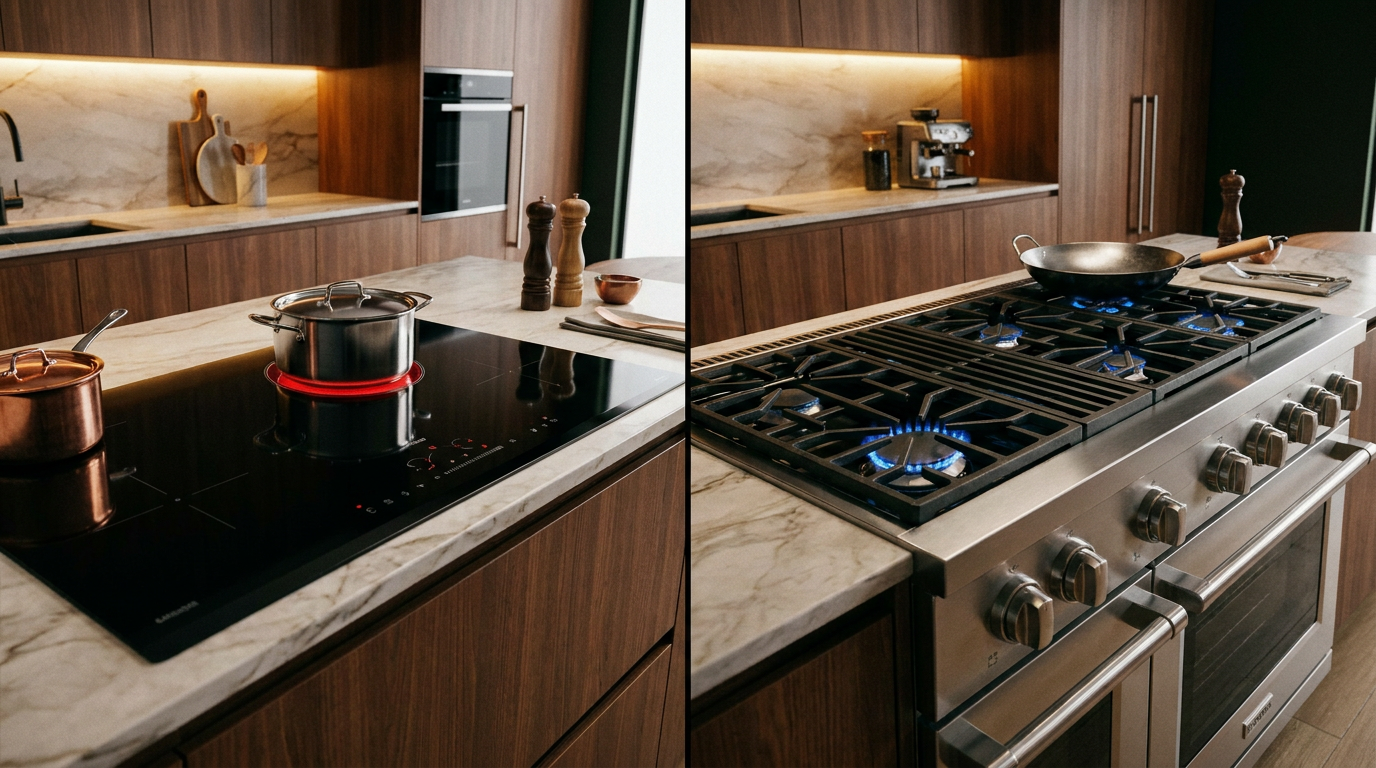
- Public Health & Efficiency Advocates
- Argues that the health risks and climate impacts of gas combustion make induction the necessary standard for modern homes.
- Consumer & Infrastructure Pragmatists
- Focuses on the upfront costs, existing home infrastructure, and the practical hurdles of upgrading electrical panels versus long-term savings.
- Editorial Synthesis
- Weighs the thermodynamic and health benefits of induction against the logistical and financial realities of retrofitting gas kitchens.
What's not represented
- · Professional chefs who rely on gas for specific culinary techniques like wok hei
- · Renters who have no control over their kitchen appliances or ventilation systems
Why this matters
Choosing a stove is no longer just about culinary preference; it directly impacts your family's indoor air quality, your home's energy footprint, and your long-term utility bills.
Key points
- Induction cooktops use electromagnetism to heat pans directly, achieving up to 90% energy efficiency.
- Gas stoves lose over half their heat to the surrounding air and are significantly slower to boil water.
- Recent studies link indoor gas combustion to elevated levels of benzene and a 42% increased risk of childhood asthma.
- Switching to induction often requires a dedicated 240-volt electrical circuit, which can add hundreds to installation costs.
- Induction requires ferrous cookware like cast iron or magnetic stainless steel; aluminum and copper will not work.
The choice between induction and gas cooking has evolved from a simple culinary preference into one of the most consequential infrastructure decisions a homeowner can make in 2026. For generations, the blue flame of a gas range was marketed as the gold standard for serious home chefs, synonymous with professional kitchens and tactile control. Today, that dominance is being aggressively challenged by the maturation of induction technology. As consumers weigh their options for kitchen renovations or appliance replacements, the conversation has expanded far beyond how quickly a pan can sear a steak. Buyers are now forced to navigate a complex matrix of indoor air quality research, volatile utility costs, and the logistical hurdles of home electrification. The decision requires balancing the familiar comfort and lower upfront price of traditional combustion against the thermodynamic superiority and zero-emission profile of modern electromagnetism.[6]
Understanding the fundamental mechanics of each technology is essential for evaluating their respective trade-offs. Gas cooktops rely on the combustion of natural gas or liquid propane, creating an open flame that heats the air, which in turn heats the bottom and sides of the cookware. This indirect transfer is inherently lossy, with a significant portion of the generated heat escaping into the ambient kitchen environment. Induction, conversely, bypasses the air entirely. Beneath the smooth glass surface lie tightly wound copper coils that generate an oscillating high-frequency magnetic field. When a compatible pan is placed on the cooking zone, this magnetic field induces electrical currents within the metal of the cookware itself. The pan effectively becomes its own heat source, allowing for a highly controlled, nearly instantaneous transfer of thermal energy directly into the food.[1][2]
The case for induction centers heavily on its raw speed and unmatched thermodynamic efficiency. Because the heat is generated directly inside the cookware, induction ranges achieve an energy efficiency rating of 85 to 90 percent. In stark contrast, traditional gas burners operate at a mere 32 to 40 percent efficiency, wasting more than half of their consumed energy by heating the surrounding air. This efficiency translates directly into cooking velocity. In standardized testing, an induction burner can bring 60 ounces of water to a rolling boil in just over five minutes—roughly half the time required by a comparable gas stove. Furthermore, because the glass surface itself does not generate heat, it remains relatively cool to the touch during operation, preventing spilled food from baking onto the cooktop and making cleanup as simple as a quick wipe with a damp cloth.[1][2][5]

The case against induction is primarily rooted in its strict compatibility requirements and higher logistical barriers to entry. The technology relies entirely on magnetic resistance, meaning it only functions with ferrous cookware. Cast iron, enameled cast iron, and most magnetic stainless steel pots work perfectly, but pure aluminum, copper, and glass cookware are rendered entirely useless. Beyond the potential cost of replacing a kitchen's worth of pans, the installation itself often presents a significant financial hurdle. Induction ranges require a dedicated 240-volt, 50-amp electrical circuit. For homeowners transitioning from gas, hiring a licensed electrician to run new high-voltage wiring and potentially upgrade an older electrical panel can add anywhere from $200 to over $1,000 to the total project cost, eroding the immediate financial appeal of the appliance.[2][5]
The case for gas rests on its tactile familiarity, visual feedback, and lower initial purchase price. For many home cooks, the instant visual cue of a flame provides an intuitive way to gauge and adjust heat levels that digital touchpads struggle to replicate. Gas ranges also accommodate any type of cookware, allowing chefs to seamlessly transition between a seasoned carbon steel wok and a lightweight aluminum skillet. Economically, gas appliances remain highly competitive at the point of sale. Entry-level gas ranges typically start between $600 and $700, whereas basic induction models rarely fall below the $1,000 mark. If a kitchen is already plumbed with an active gas line, installation is often as simple as connecting a flexible hose, bypassing the expensive electrical upgrades that can complicate an induction retrofit.[2][5]
The case for gas rests on its tactile familiarity, visual feedback, and lower initial purchase price.
The evidence against gas, however, has mounted significantly in recent years, driven by a growing body of peer-reviewed health and environmental research. Studies conducted by Stanford University and PSE Healthy Energy have fundamentally shifted the narrative, revealing that gas stoves emit harmful pollutants even when they are turned off. The research demonstrates that gas combustion releases nitrogen dioxide (NO2) and fine particulate matter (PM2.5) into the home, frequently pushing indoor air quality past the safety thresholds established by the Environmental Protection Agency for outdoor air. Most alarmingly, the studies detected emissions of benzene—a known carcinogen linked to leukemia—at concentrations comparable to secondhand tobacco smoke. Because these gases are invisible and odorless, they represent a hidden hazard in millions of kitchens.[1][3][4]
The tangible health impacts of this indoor air pollution are becoming impossible for consumers to ignore. A comprehensive meta-analysis of 41 studies concluded that children living in homes with gas stoves face a 42 percent increased risk of developing asthma compared to those in homes with electric cooking appliances. Public health experts estimate that over 12 percent of current childhood asthma cases in the United States can be attributed directly to gas stove exposure. While proper ventilation can mitigate some of these risks, the reality of American infrastructure complicates the solution. Industry data indicates that up to 85 percent of households with gas cooking lack range hoods with sufficient capture efficiency to adequately vent these combustion byproducts outside, leaving the pollutants trapped within the living space.[1][3]

When evaluating the long-term economic trade-offs, buyers must weigh the volatile cost of fossil fuels against the steady efficiency of electromagnetism. While natural gas has historically been cheaper per unit of energy than electricity in many regions, the sheer inefficiency of gas burners narrows the operating cost gap. Because a gas stove requires significantly more site energy to deliver the same amount of heat to the food, an induction range's 90 percent efficiency often offsets the higher per-kilowatt-hour price of electricity. For households that cook daily, particularly those engaging in long simmering tasks, the energy savings from induction can accumulate noticeably over the appliance's 15-year lifespan. Furthermore, as the national electrical grid continues to decarbonize and incorporate more renewable energy, the environmental footprint of operating an induction stove shrinks every year.[1][2]
Ultimately, induction fits well when homeowners prioritize indoor air quality, rapid heating performance, and effortless daily maintenance. It is the optimal choice for households with young children or individuals with respiratory sensitivities who need to eliminate indoor combustion byproducts. Induction is also the logical path for consumers actively looking to electrify their homes and reduce their carbon footprint, provided they already possess the necessary 240-volt electrical infrastructure or have the budget to accommodate an electrical panel upgrade. For those willing to invest in compatible magnetic cookware and adapt to a digital interface, the technology offers a thermodynamically superior cooking experience that outpaces traditional methods in both speed and precision.[1][6]

Conversely, gas fits well when a home is already plumbed for a natural gas or liquid propane line and lacks the electrical panel capacity to support a high-voltage appliance upgrade. It remains a highly practical choice for cooks who rely heavily on non-ferrous specialty cookware, such as traditional copper pots or round-bottomed aluminum woks, which cannot interface with a flat magnetic surface. Gas is also the more accessible option for buyers strictly constrained by a lower immediate renovation budget, as the upfront cost of the appliance and the simplicity of a direct hose connection keep initial expenses manageable. For those who prioritize the tactile experience of flame control and are diligent about using high-capacity exterior ventilation, gas continues to offer a reliable and familiar culinary platform.[2][6]
How we got here
Early 1900s
Gas stoves become the standard in American kitchens, replacing wood and coal with a cleaner-burning, controllable flame.
1970s
Induction cooking technology is first introduced to the consumer market, but high costs and limited cookware keep it a niche novelty.
2010s
Induction technology matures and drops in price, gaining massive popularity in Europe and professional commercial kitchens.
2023
Stanford University publishes landmark research linking gas stove emissions to benzene and elevated indoor NO2 levels.
2026
Induction ranges reach price parity with high-end gas models, accelerating the electrification of residential kitchens.
Viewpoints in depth
The Health and Climate Perspective
Focuses on the urgent need to eliminate indoor combustion.
Public health researchers and environmental advocates argue that the kitchen is the last acceptable place for unvented fossil fuel combustion in the home. Citing studies that link gas stoves to a 42 percent increase in childhood asthma and significant benzene exposure, this camp views the transition to induction not as a luxury upgrade, but as a critical public health intervention. They emphasize that even when the grid is powered by mixed energy sources, the elimination of point-source pollution in the living space makes electrification an immediate necessity.
The Pragmatic Consumer View
Highlights the financial and logistical hurdles of kitchen electrification.
Consumer advocates and infrastructure pragmatists point out that while induction is technologically superior, the American housing stock is not entirely ready for it. Upgrading a kitchen from gas to induction often requires installing a dedicated 240-volt circuit, which can trigger a cascade of expensive electrical panel upgrades in older homes. This camp argues that until government rebates or landlord incentives fully bridge this infrastructure gap, gas remains the most economically viable option for millions of middle- and lower-income households who cannot afford a multi-thousand-dollar retrofit.
What we don't know
- How quickly local building codes will mandate electrical upgrades for older homes transitioning away from gas appliances.
- Whether the price of entry-level induction ranges will drop below the $600 threshold to truly compete with the cheapest gas models.
- The exact long-term impact of widespread induction adoption on local electrical grid peak loads during evening cooking hours.
Key terms
- Electromagnetic Induction
- A process where a magnetic field generates electrical currents inside a ferrous metal pan, turning the cookware itself into the heat source.
- Ferrous Cookware
- Pots and pans containing iron, such as cast iron or magnetic stainless steel, which are required for induction cooking.
- Nitrogen Dioxide (NO2)
- A harmful gas produced by the combustion of fossil fuels, linked to respiratory issues and asthma, commonly emitted by gas stoves.
- Site Energy
- The amount of energy directly consumed by an appliance at the home, not accounting for the energy lost during power generation and transmission.
Frequently asked
Do I need to buy all new pots and pans for an induction stove?
Not necessarily. Induction requires magnetic cookware, so cast iron and most stainless steel will work perfectly. Aluminum, copper, and glass will not.
Is induction cooking the same as a traditional electric glass-top stove?
No. Traditional electric stoves use radiant coils under the glass to heat the surface, which then heats the pan. Induction uses electromagnetism to heat the pan directly, making it much faster and more efficient.
Will an induction range increase my electric bill?
While it uses electricity, induction is highly efficient. The increase in your electric bill is often offset by the elimination of your gas usage for cooking, though exact savings depend on local utility rates.
Are the health risks of gas stoves eliminated by using a range hood?
Range hoods help significantly, but studies show they do not capture 100% of emissions. Furthermore, many residential range hoods only recirculate air rather than venting it outside, which does not remove pollutants like NO2 or benzene.
Sources
Source coverage
6 outlets
3 viewpoints surfaced






[1]Energy SolutionsPublic Health & Efficiency Advocates
Induction vs Gas Cooktops: The Definitive Health, Efficiency & Economic Analysis (2026)
Read on Energy Solutions →[2]CNETConsumer & Infrastructure Pragmatists
Induction vs. Gas vs. Electric: Which Stove Is Best for You?
Read on CNET →[3]ForbesPublic Health & Efficiency Advocates
Induction stoves beat out gas stoves on health and the environment
Read on Forbes →[4]Environmental Health NewsPublic Health & Efficiency Advocates
The health impact of kitchen choices: Gas vs. induction cooking
Read on Environmental Health News →[5]Consumer ReportsConsumer & Infrastructure Pragmatists
Gas, electric, or neither: The best cooktops, according to Consumer Reports
Read on Consumer Reports →[6]Factlen Editorial TeamEditorial Synthesis
Synthesis by Factlen editorial team
Read on Factlen Editorial Team →



Every angle. Every day.
Get shopping stories with full source coverage and perspective breakdowns delivered to your inbox.