
How Small Language Models and On-Device AI Are Transforming Smartphones
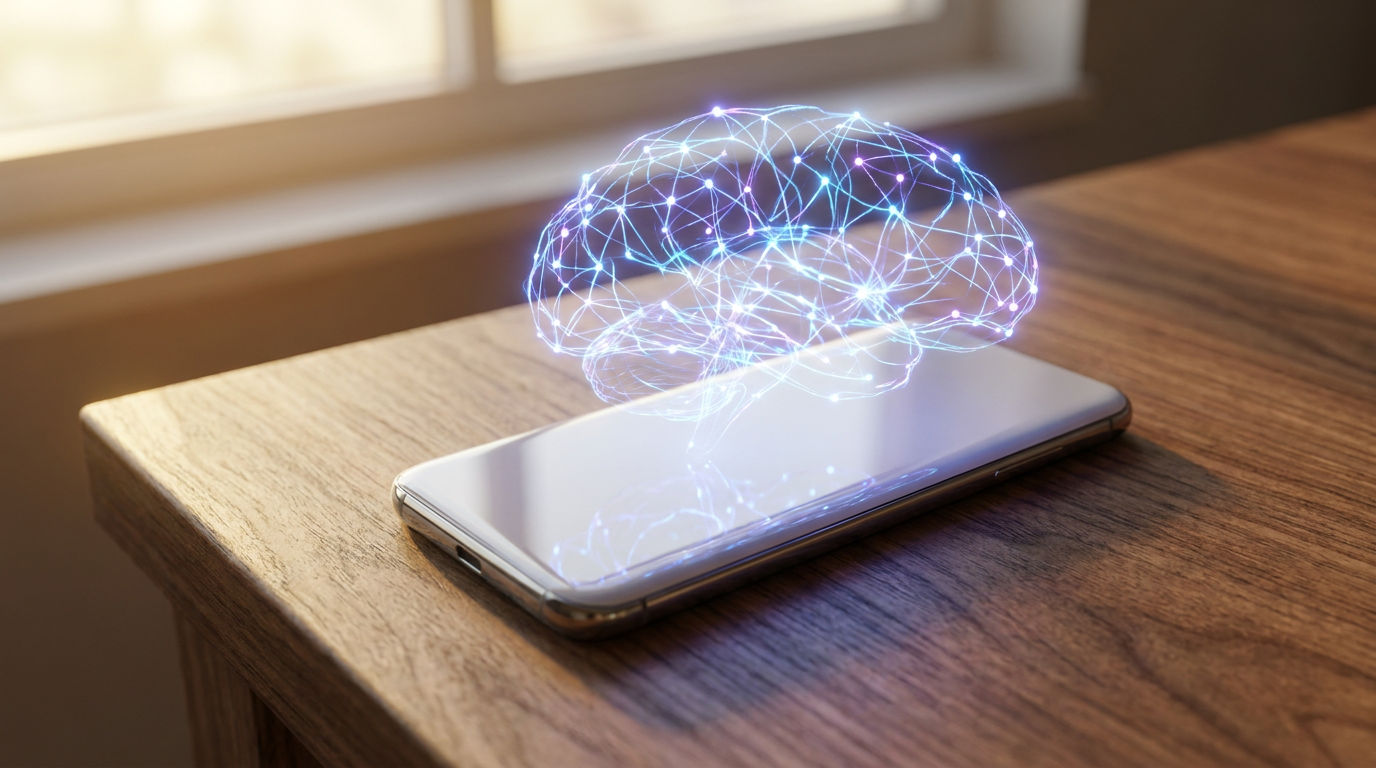
The era of cloud-dependent artificial intelligence is ending as tech companies deploy 'Small Language Models' directly onto consumer smartphones. This shift to on-device AI guarantees absolute data privacy, zero latency, and offline capabilities.
By Factlen Editorial Team
- Privacy Advocates
- Champions of data sovereignty who view local AI as the ultimate safeguard against corporate surveillance.
- Hardware Manufacturers
- Chipmakers and device manufacturers driving the physical infrastructure of the Edge AI revolution.
- Cloud AI Proponents
- Researchers and enterprise developers who maintain that true artificial general intelligence requires massive, centralized compute.
What's not represented
- · Environmental analysts evaluating the e-waste impact of forcing consumers to upgrade to NPU-equipped devices.
- · Open-source developers who rely on SLMs to build independent applications outside of Big Tech ecosystems.
Why this matters
By processing AI tasks locally on your device rather than sending them to a distant server, the new generation of smartphones guarantees absolute privacy for your personal data, eliminates lag, and works even when you have no internet connection.
Key points
- The tech industry is shifting from massive cloud-based AI to Small Language Models (SLMs) that run locally on consumer devices.
- On-device AI ensures absolute privacy because personal data never leaves the smartphone to be processed on a corporate server.
- Dedicated Neural Processing Units (NPUs) allow phones to run complex AI tasks instantly and entirely offline.
- A hybrid approach is emerging, where phones handle daily tasks locally but securely escalate complex reasoning to the cloud.
For the past three years, the artificial intelligence industry has been locked in a relentless arms race defined by a single philosophy: bigger is better. Tech giants poured billions of dollars into massive data centers, training Large Language Models (LLMs) with hundreds of billions of parameters to achieve human-like reasoning.[1][7]
But in 2026, the most significant breakthrough in consumer technology is moving in the exact opposite direction. The era of the "Small Giant" has arrived, fundamentally reshaping how we interact with our smartphones, wearables, and smart home devices.[4][8]
Instead of relying on distant servers to process every voice command or text prompt, the tech industry is pivoting to "on-device AI"—also known as Edge AI. By utilizing Small Language Models (SLMs) that live entirely on your phone's local storage, devices are becoming genuinely intelligent without needing to phone home.[5][6]
To understand this shift, it helps to look at the numbers. A massive cloud model might boast over a trillion parameters, requiring warehouses of specialized servers and massive cooling systems to function. In contrast, models like Microsoft's Phi-3.5 mini or Google's Gemma 2 pack their intelligence into just 2 to 8 billion parameters.[2][7]

These compact models are not merely scaled-down toys. Through advanced training techniques on highly curated, textbook-quality data, a 3.8-billion parameter model in 2026 can outperform the massive, room-sized AI models that shocked the world just a few years ago.[2][7]
Getting these models to fit on a smartphone requires a process called quantization. This technique compresses the AI's neural network by using lower-precision mathematics, shrinking the model's footprint by up to 75 percent. The result is an AI that delivers 80 to 90 percent of a large model's capabilities while fitting comfortably alongside your photos and apps.[2][5]
The hardware inside consumer devices has evolved rapidly to meet this moment. Modern smartphones are now equipped with muscular Neural Processing Units (NPUs)—specialized chips designed exclusively for the heavy mathematical lifting required by artificial intelligence.[3][4]
In 2026, flagship processors from companies like Qualcomm and Apple are hitting 45 to 80 TOPS (Trillion Operations Per Second). This computational muscle allows a smartphone to run sophisticated AI tasks locally without melting the battery or causing the device to overheat.[4][7]

In 2026, flagship processors from companies like Qualcomm and Apple are hitting 45 to 80 TOPS (Trillion Operations Per Second).
For the average consumer, the most immediate benefit of on-device AI is absolute privacy. When an AI operates entirely on local hardware, your personal data—diaries, financial screenshots, intimate text messages—never leaves the device.[4][5]
This local processing solves the fundamental tension of the AI era: users want highly personalized digital assistants that understand their context, but they rightfully fear uploading their entire digital lives to a corporate server. With Edge AI, the "brain" lives in your pocket, reading your data locally and keeping it out of the cloud.[5][8]
Speed is the second major advantage. Because there is no "internet hop"—the time it takes for a device to send data to a server, wait for processing, and receive a response—on-device AI reacts instantly.[4][6]
This zero-latency environment makes real-time applications possible. Live translation during a phone call, instant scene detection in a camera viewfinder, and immediate voice-command execution all happen in the blink of an eye.[5][6]
Furthermore, on-device AI severs the tether to the internet. Whether you are on a remote camping trip, deep in a subway tunnel, or flying at 30,000 feet, your smartphone's intelligence remains fully operational. You can summarize long documents or generate text without a single bar of cellular service.[3][4]

Of course, the transition to local AI does not mean the cloud is dead. The industry is settling into a "hybrid" architecture, pioneered by systems like Apple Intelligence and Google's Android ecosystem.[4][8]
In this hybrid model, the smartphone acts as a triage center. The local Small Language Model handles the vast majority of daily tasks—drafting emails, organizing notifications, and answering basic questions.[5][8]
However, when a user asks a highly complex question that requires massive reasoning or up-to-the-minute world knowledge, the device securely escalates the request to a larger cloud model, often warning the user that the data is leaving the device.[4][8]

This localized intelligence is also bleeding into new form factors. Because SLMs require so little power, they are breathing life into the next generation of smart glasses and wearables, enabling devices that can "see" and "hear" the world around you in real-time without being tethered to a heavy battery pack.[6][8]
How we got here
Early 2023
The AI boom begins, dominated entirely by massive, cloud-based Large Language Models requiring immense server farms.
Late 2024
Researchers begin successfully compressing models using quantization, proving that smaller parameter counts can yield high performance.
Mid 2025
Chipmakers introduce the first wave of consumer smartphone processors with dedicated Neural Processing Units (NPUs) exceeding 40 TOPS.
June 2026
Major tech ecosystems fully integrate Small Language Models into their operating systems, making offline, on-device AI the default consumer experience.
Viewpoints in depth
Privacy Advocates
Champions of data sovereignty who view local AI as the ultimate safeguard against corporate surveillance.
This camp argues that the cloud-first era of AI was a privacy disaster waiting to happen, requiring users to trade their personal data for convenience. They view Small Language Models and Edge AI as a necessary course correction. By ensuring that sensitive information—from health queries to personal photos—is processed entirely on the local Neural Processing Unit, privacy advocates believe we can finally decouple digital intelligence from mass data collection.
Hardware Manufacturers
Chipmakers and device manufacturers driving the physical infrastructure of the Edge AI revolution.
For companies like Qualcomm, Apple, and Intel, the shift to on-device AI is a massive business opportunity and a justification for aggressive hardware upgrade cycles. They focus heavily on metrics like TOPS (Trillion Operations Per Second) and NPU efficiency. This camp argues that the true bottleneck for AI adoption is no longer software, but the thermal and battery limitations of consumer hardware, which they are rapidly solving with specialized silicon.
Cloud AI Proponents
Researchers and enterprise developers who maintain that true artificial general intelligence requires massive, centralized compute.
While acknowledging the utility of Small Language Models for basic tasks, this camp warns against overestimating what a smartphone can do. They point out that SLMs still suffer from hallucinations and lack the deep, emergent reasoning capabilities of trillion-parameter cloud models. Cloud proponents argue that the future is strictly hybrid, and that the most transformative AI applications—like complex coding, deep scientific analysis, and advanced agentic workflows—will always require the raw power of centralized data centers.
What we don't know
- Whether consumers will upgrade their perfectly functional older phones solely to access on-device AI features.
- How quickly third-party app developers will abandon cloud APIs in favor of integrating local Small Language Models.
- The long-term impact of constant NPU usage on smartphone battery degradation over a multi-year lifespan.
Key terms
- Small Language Model (SLM)
- A compact AI system designed to run locally on consumer hardware, typically containing under 10 billion parameters.
- Neural Processing Unit (NPU)
- A specialized chip inside modern smartphones dedicated exclusively to running artificial intelligence tasks efficiently.
- Edge AI
- The practice of processing artificial intelligence algorithms locally on a hardware device rather than relying on a remote cloud server.
- Quantization
- A compression technique that shrinks the file size of an AI model by using lower-precision numbers, allowing it to fit on a phone.
- TOPS
- Trillion Operations Per Second, a metric used to measure the speed and capability of an AI processor.
Frequently asked
Do I need an internet connection to use on-device AI?
No. Because the AI model is stored directly on your phone's hardware, tasks like translation, text summarization, and photo editing work entirely offline.
Will on-device AI drain my smartphone battery?
Actually, it is highly efficient. Modern smartphones use dedicated Neural Processing Units (NPUs) that consume significantly less power than traditional processors when running AI tasks.
Can my phone's AI see my private messages?
Yes, but the data never leaves your device. On-device AI processes your personal information locally, meaning it is not uploaded to a corporate cloud server for analysis.
Is a Small Language Model as smart as ChatGPT?
Not quite. While SLMs can handle about 80 to 90 percent of daily tasks like drafting emails or summarizing text, highly complex reasoning still requires larger cloud-based models.
Sources
Source coverage
8 outlets
3 viewpoints surfaced








[1]IBMHardware Manufacturers
Small language models: Powering the next generation of mobile AI
Read on IBM →[2]DataCampCloud AI Proponents
Top 15 Small Language Models of 2026
Read on DataCamp →[3]Best BuyHardware Manufacturers
CES 2026: Edge AI is forging a path forward
Read on Best Buy →[4]Vertex KnowledgePrivacy Advocates
Gadgets That Learn You: How On-Device AI Is Quietly Revolutionising Electronics in 2026
Read on Vertex Knowledge →[5]Dev ITPrivacy Advocates
Why On-Device AI Is Taking Centre Stage in 2026
Read on Dev IT →[6]Bolder AppsHardware Manufacturers
CES 2026: AI is no longer just cloud-based
Read on Bolder Apps →[7]MediumCloud AI Proponents
The Death of Bigger is Better: Small Language Models
Read on Medium →[8]Factlen Editorial TeamCloud AI Proponents
Synthesis by Factlen editorial team
Read on Factlen Editorial Team →

More in technology
See all 6 stories →Battery Tech
The 7,000mAh Era: How Silicon-Carbon Batteries Are Finally Solving the Smartphone Power Crisis
6 sources
AI Defense
The AI Vulnerability Spike: Why a Record Number of Software Bugs is Actually Good News
8 sources

AI Security
How AI is Transitioning from Finding Software Bugs to Automatically Fixing Them
8 sources

Mobile Accessibility
Apple and Google Unveil Breakthrough AI Accessibility Features for Next-Generation Smartphones
6 sources

Every angle. Every day.
Get technology stories with full source coverage and perspective breakdowns delivered to your inbox.