
How the Antikythera Mechanism Rewrote the History of Ancient Technology
Discovered in a 2,000-year-old shipwreck, the world's first analog computer continues to yield its secrets to modern X-ray scanning and digital simulation, revealing a level of precision that vanished for over a millennium.
By Factlen Editorial Team
- Mechanical Engineers & Horologists
- Focuses on the gear ratios, manufacturing tolerances, and the mathematical brilliance of the device.
- Archaeological Traditionalists
- Focuses on the physical context of the shipwreck and the material culture of the Hellenistic period.
- Historians of Science
- Focuses on the paradigm shift in understanding ancient Greek technology and the fragility of scientific progress.
What's not represented
- · Ancient Greek artisans who manufactured the device
- · The original owner or commissioner of the mechanism
Why this matters
The Antikythera Mechanism forces us to completely rethink the capabilities of the ancient world. It proves that human technological progress is not a straight line, and that profound knowledge can be lost and rediscovered.
Key points
- The Antikythera Mechanism is a 2,000-year-old analog computer used to predict astronomical positions and eclipses.
- It was discovered in 1900 by sponge divers exploring a Roman-era shipwreck off the coast of Greece.
- High-resolution X-ray scans revealed 37 internal gears and an inscribed user manual hidden inside the calcified fragments.
- A 2021 UCL study successfully reconstructed the device's front display, which tracked the Sun, Moon, and five planets.
- Recent digital simulations prove the ancient builders achieved a level of manufacturing precision that rivaled Renaissance clockmakers.
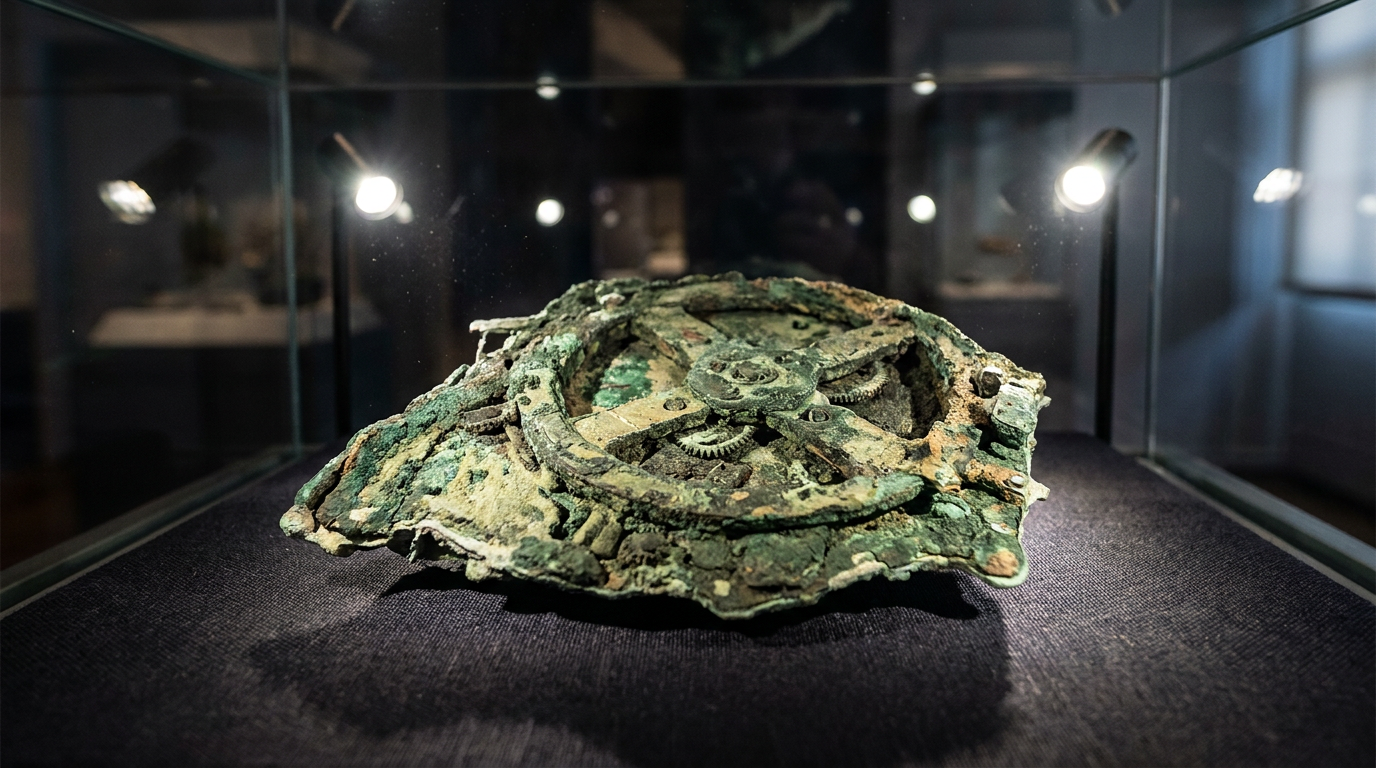
In the spring of 1900, a crew of Greek sponge divers seeking shelter from a Mediterranean storm anchored near the tiny island of Antikythera. When they finally dove, they discovered not sponges, but a Roman-era shipwreck scattered across the seabed at a depth of 140 feet. They recovered a spectacular haul of marble and bronze statues, glassware, and coins, alongside a heavily calcified, shoebox-sized lump of bronze and wood.[5][2]
For two years, that corroded lump sat largely ignored in the National Archaeological Museum in Athens, overshadowed by the life-sized statues. Then, the lump split open, revealing a shock to the archaeological community: precision-cut bronze gear wheels with teeth just millimeters long.[2][5]
For decades, the artifact remained an enigma. It wasn't until the 1950s and 1970s that historian Derek de Solla Price began a systematic study of the fragments, famously dubbing the device a "calendar computer." Price realized that the ancient Greeks had possessed a level of mechanical engineering that completely defied the accepted historical record.[5]

Today, the Antikythera Mechanism is widely recognized as the world's oldest known analog computer and a hand-cranked orrery. Built around the first or second century BCE, it was designed to track the movements of the cosmos, predict eclipses, and model the irregular orbits of celestial bodies with astonishing mathematical precision.[1][4]
The device was operated by turning a small hand crank on the side of its wooden casing, which drove a complex train of interlocking bronze gears. As the user turned the crank to move forward or backward in time, pointers on the front and back dials would rotate to display the state of the heavens for any given date.[2][1]
The front dial served as a planetarium, displaying the Greek Cosmos. It tracked the position of the Sun, the phases of the Moon, and the movements of the five planets known to antiquity: Mercury, Venus, Mars, Jupiter, and Saturn. The back of the device featured two large spiral dials: one tracking the 19-year Metonic calendar, and another predicting solar and lunar eclipses using the 223-month Saros cycle.[1][4]
The engineering required to achieve this is staggering. To model the elliptical orbit of the Moon—which appears to move faster when it is closer to Earth—the builders used epicyclic gearing. This involved a pin-and-slot mechanism where one gear rode upon another, mechanically recreating what astronomers call the first lunar anomaly.[4]

To model the elliptical orbit of the Moon—which appears to move faster when it is closer to Earth—the builders used epicyclic gearing.
How do modern researchers know all this if only 82 fragmented, water-damaged pieces survive? The modern breakthrough arrived in 2005, when an international research team used high-resolution X-ray computed tomography (CT) to look inside the calcified rock.[4]
These powerful X-ray scans revealed 37 meshing bronze gears hidden inside the fragments. Crucially, the scans also illuminated thousands of tiny Greek characters inscribed on the bronze plates, effectively providing a user manual that described dials and planetary cycles that were missing from the physical remains.[4][1]
In 2021, a multidisciplinary team at University College London (UCL) used this inscribed manual to solve a major piece of the puzzle. While previous researchers had mapped the back dials, the gearing required to drive the five planets on the front display had remained a mystery.[1]
The UCL team proposed a brilliant mechanical solution that matched the physical evidence. They designed a system of nested, hollow tubes that could carry the complex astronomical outputs from the internal gear trains to the front display without the axles colliding.[1]

The sheer precision of the device continues to challenge modern assumptions about ancient manufacturing. In May 2026, engineering researchers published digital simulations that modeled the gear trains using the exact measurements of the surviving, warped fragments.[2]
The simulation revealed a fascinating paradox: when modeled with the imperfections of the surviving pieces, the virtual mechanism jammed almost immediately, rarely completing even four months of simulated movement. This proved that to function smoothly, the original ancient Greek builders had to achieve a level of manufacturing precision that rivaled the master clockmakers of the European Renaissance.[2]
Meanwhile, the shipwreck that carried the mechanism continues to yield physical clues. In July 2025, the Swiss School of Archaeology in Greece announced the recovery of new hull fragments from the Antikythera site.[3]

These wooden fragments—made of elm and oak—confirmed that the Roman vessel was built using a "shell-first" construction method, a dominant shipbuilding technique of the era. Alongside the wood, divers recovered a terracotta mortar used by the crew, providing a richer context of the merchant ship that carried this priceless scientific instrument to its doom around 65 BCE.[3]
The Antikythera Mechanism remains a profound anomaly that forces a reevaluation of human history. It proves that technological progress is not a steady, upward trajectory. Instead, it is a fragile accumulation of genius that can be lost to time, waiting millennia in the dark to be rediscovered.[6]
How we got here
1900-1901
Sponge divers discover the Roman-era shipwreck off the coast of Antikythera and recover a corroded bronze lump.
1951-1974
Historian Derek de Solla Price conducts the first comprehensive study, identifying the device as a "calendar computer."
2005
The Antikythera Mechanism Research Project uses high-resolution X-ray tomography to reveal 37 internal gears and hidden inscriptions.
2021
A UCL team publishes a complete theoretical reconstruction of the front "Cosmos" display and its complex nested-tube gearing.
2025
Archaeologists recover new hull fragments from the shipwreck, confirming its "shell-first" construction method.
2026
Digital simulations prove the original builders had to achieve Renaissance-level manufacturing precision to prevent the gears from jamming.
Viewpoints in depth
Archaeological Traditionalists
Focuses on the physical context of the shipwreck and the material culture of the Hellenistic period.
For traditional archaeologists, the mechanism cannot be separated from the Roman cargo ship that carried it. The 2025 discovery of the ship's 'shell-first' hull construction and the crew's terracotta mortars provide crucial context. This camp argues that understanding the trade routes, the wealthy patrons who commissioned such devices, and the broader cargo of statues and glassware is just as important as the gear ratios in understanding the artifact's place in history.
Mechanical Engineers & Horologists
Focuses on the gear ratios, manufacturing tolerances, and the mathematical brilliance of the device.
Engineers view the mechanism as a staggering achievement of mechanical logic. Recent digital simulations prove that the ancient builders had to achieve Renaissance-level precision to prevent the epicyclic gears and nested tubes from jamming. This perspective is less concerned with who owned it and more focused on how the ancient Greeks solved complex spatial and mathematical problems using bronze and hand tools.
Historians of Science
Focuses on the paradigm shift in understanding ancient Greek technology and the fragility of scientific progress.
For historians of science, the Antikythera Mechanism is a cautionary tale about the non-linear nature of human progress. It proves that profound technological knowledge can be achieved and then completely lost for over a millennium. This camp studies how the astronomical theories of figures like Hipparchus were translated into physical machinery, and why this tradition of complex clockwork failed to survive the fall of the Hellenistic world.
What we don't know
- The exact identity of the genius who designed and built the mechanism.
- Whether this device was a unique prototype or one of many such calculators in the ancient world.
- Who the intended recipient of the device was before the ship sank en route to Rome.
Key terms
- Analog computer
- A device that uses continuous physical phenomena, such as the rotation of gears, to model and solve mathematical problems.
- Orrery
- A mechanical model of the solar system that illustrates or predicts the relative positions and motions of the planets and moons.
- Saros cycle
- A period of approximately 223 lunar months (about 18 years) used by ancient astronomers to predict solar and lunar eclipses.
- Epicyclic gearing
- A gear system consisting of one or more outer gears revolving around a central gear, used in the mechanism to model the irregular speed of the Moon's orbit.
- Tomography
- A technique for displaying a representation of a cross section through a solid object using X-rays, crucial for seeing inside the mechanism's calcified fragments.
Frequently asked
Who built the Antikythera Mechanism?
Its exact creator is unknown, but its use of Hipparchus's lunar theory suggests it may have been built by followers of Hipparchus or Archimedes in Rhodes or Syracuse.
How was the device powered?
It was not automated; it was a hand-powered device operated by turning a small crank or knob on the side of its wooden casing.
Why is it called an analog computer?
Because it uses continuous physical mechanisms—specifically, the rotation of interlocking bronze gears—to calculate and model mathematical and astronomical data.
Are there other devices like it from the ancient world?
No other mechanism of this complexity has ever been found from antiquity. Similar geared clockwork did not appear in the archaeological record until the 14th century in Europe.
Sources
Source coverage
6 outlets
3 viewpoints surfaced






[1]University College LondonMechanical Engineers & Horologists
Experts recreate a mechanical Cosmos for the world's first computer
Read on University College London →[2]Futura SciencesMechanical Engineers & Horologists
The 2,000 year old Greek computer that defies modern engineering
Read on Futura Sciences →[3]Archaeology MagazineArchaeological Traditionalists
New Discoveries from Famed Antikythera Shipwreck
Read on Archaeology Magazine →[4]MediumHistorians of Science
The Antikythera Mechanism is Still Rewriting History
Read on Medium →[5]American Philosophical SocietyArchaeological Traditionalists
Gears from the Greeks: The Antikythera Mechanism
Read on American Philosophical Society →[6]Factlen Editorial TeamHistorians of Science
Synthesis by Factlen editorial team
Read on Factlen Editorial Team →
Every angle. Every day.
Get culture stories with full source coverage and perspective breakdowns delivered to your inbox.