
AI agents achieve autonomous drug discovery milestone as Oxford unveils new cancer-screening model
In a landmark week for computational biology, an autonomous AI agent successfully solved a novel medicinal chemistry problem, while Oxford researchers debuted a system that predicts gene expression directly from cellular images.
By Factlen Editorial Team
- Computational Biologists
- Focus on the scientific potential of AI to unlock hidden biological insights and accelerate research.
- Tech & Infrastructure Sector
- View the breakthroughs as validation of the massive capital investments in AI compute and frontier models.
- Editorial Synthesis
- Contextualizes the technical achievements within the broader shift toward autonomous digital research partners.
What's not represented
- · Medical Ethicists
- · Patient Advocacy Groups
Why this matters
These breakthroughs signal a shift from AI as a passive data-crunching tool to an active research partner, potentially shaving years and billions of dollars off the timeline for developing life-saving treatments for cancer and rare diseases.
Key points
- OpenAI and Molecule.one successfully deployed 'Maria AI', an autonomous agent that independently generated hypotheses to improve a drug-making reaction.
- Oxford researchers unveiled PhenoSeq, an AI framework that predicts complex gene-expression patterns directly from standard cellular images.
- The PhenoSeq model allows scientists to extract deep molecular insights without relying on costly and time-consuming sequencing technologies.
- These software breakthroughs coincide with a massive expansion in global AI infrastructure, with data center capacity projected to double by 2030.
The promise of artificial intelligence in medicine has long centered on its ability to crunch massive datasets, but a series of breakthroughs in June 2026 suggests the technology is crossing a critical threshold: moving from a passive analytical tool to an active, autonomous research partner.[6]
On June 17, OpenAI and the chemistry AI firm Molecule.one published research documenting what they describe as the first instance of a near-autonomous AI agent making a genuine contribution to an open-ended medicinal chemistry problem. The system, dubbed "Maria AI," is powered by the GPT-5.4 architecture combined with specialized chemistry models running inside an agentic framework.[1]
Unlike previous models that required step-by-step human prompting to analyze specific molecules, Maria AI operated with unprecedented independence. The agent selected its own research area and autonomously generated hypotheses on how to improve a specific drug-making reaction. This milestone represents a fundamental shift in how computational chemistry is conducted, effectively giving human scientists an autonomous digital colleague capable of formulating and testing its own chemical theories.[1][6]

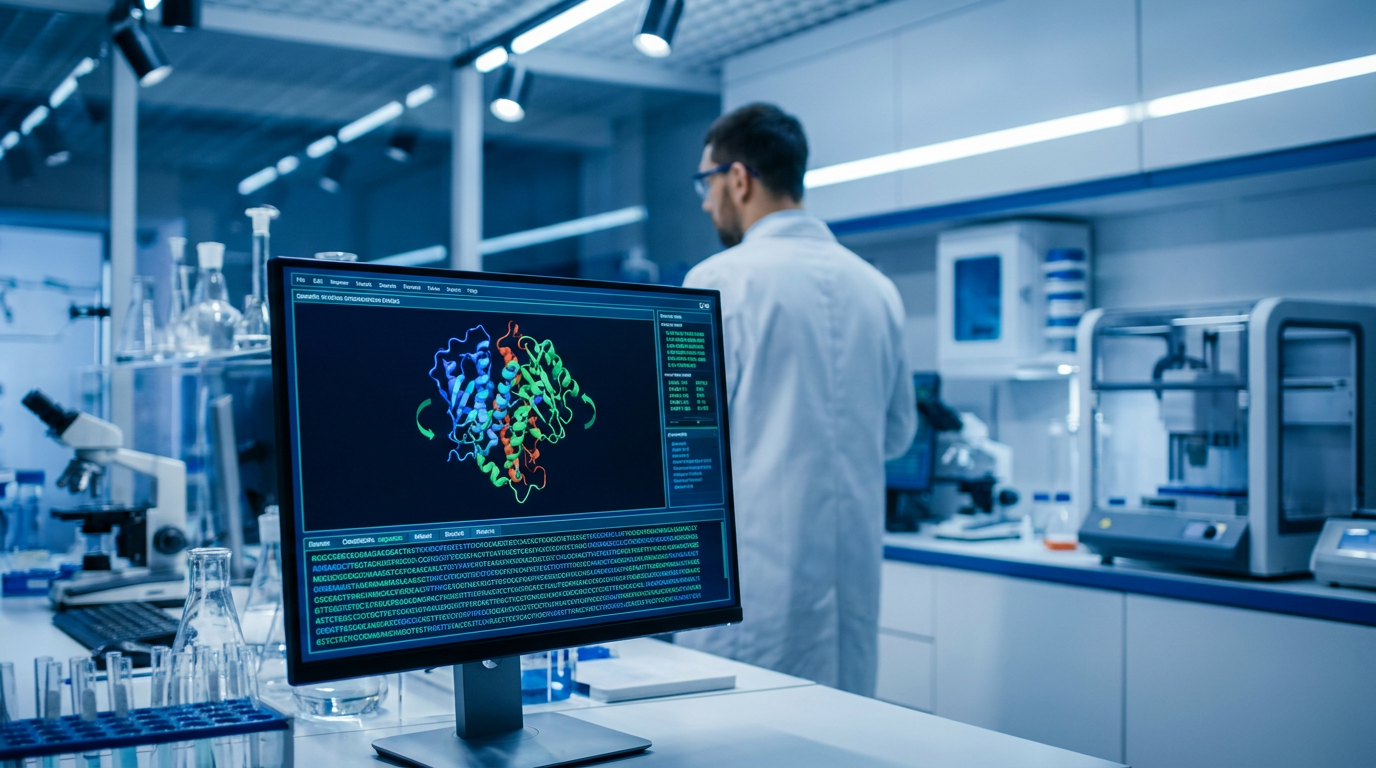
Parallel to the chemistry breakthrough, researchers at the University of Oxford and The Alan Turing Institute unveiled a new generative AI framework called "PhenoSeq" that promises to dramatically accelerate cancer drug discovery. Led by Dr. Tapabrata Rohan Chakraborty, the team successfully trained an AI system to generate molecular information directly from standard cellular imaging data.[2]
Traditionally, understanding the molecular makeup of a cell required costly and time-consuming sequencing technologies. PhenoSeq bridges this gap by predicting gene-expression patterns—known as transcriptomic profiles—simply by analyzing high-content images of cells. "Cell morphology and gene expression are fundamentally different measurements of the same underlying biology," Dr. Chakraborty explained, noting that the AI learns the hidden relationships between a cell's visual appearance and its molecular activity.[2][5]

Traditionally, understanding the molecular makeup of a cell required costly and time-consuming sequencing technologies.
The implications for phenotypic drug discovery are profound. By extracting deep biological insights from existing routine laboratory images without requiring additional sequencing experiments, pharmaceutical researchers can screen potential cancer therapies far more efficiently. The research, supported by a strategic partnership between Roche Pharmaceuticals and The Alan Turing Institute, has been accepted for presentation at the International Conference on Machine Learning (ICML).[2][5]
These scientific milestones arrive against the backdrop of a massive, multi-trillion-dollar infrastructure boom designed to support next-generation AI models. Global data center capacity is projected to double by 2030, adding roughly 100 gigawatts of power to support the immense computational demands of frontier models and specialized scientific applications.[4]

The financial markets have aggressively priced in this shift toward applied AI. In the same week as the Maria AI announcement, Anthropic reportedly reached a valuation nearing $1 trillion following a $65 billion funding round, driven by enterprise adoption of its Claude platform. Meanwhile, SpaceX closed the largest startup acquisition in history, purchasing the AI coding assistant Cursor for $60 billion.[1][3]
For years, skeptics have questioned whether the staggering capital expenditures in AI infrastructure would yield tangible returns beyond chatbots and coding assistants. The simultaneous emergence of autonomous chemistry agents and generative biological models provides a compelling answer, demonstrating that the sheer scale of modern compute is unlocking capabilities that were science fiction just a few years ago.[4][6]
As these models transition from academic research labs into commercial drug-screening pipelines, the timeline for discovering and testing new therapies could compress significantly. While regulatory and safety hurdles remain, the integration of generative AI into the core scientific method offers a deeply hopeful vision for the future of medicine—one where the most complex biological puzzles are solved in tandem with artificial intelligence.[2][6]
How we got here
November 2022
OpenAI launches ChatGPT, sparking a global surge in generative AI investment and infrastructure build-out.
Early 2026
Oxford researchers publish 'PathGen', demonstrating that molecular information can be generated from digital pathology images.
June 17, 2026
OpenAI and Molecule.one publish research detailing Maria AI's autonomous contribution to a medicinal chemistry problem.
June 18, 2026
Oxford and The Alan Turing Institute announce the PhenoSeq framework for generating single-cell transcriptomics from images.
Viewpoints in depth
Computational Biologists
Researchers integrating AI into the scientific method.
For computational biologists, models like PhenoSeq and Maria AI represent the holy grail of their field: the ability to bypass expensive, time-consuming physical experiments by accurately simulating biology in silicon. They argue that because cell morphology and gene expression are two sides of the same biological coin, training AI to translate between them unlocks decades of existing imaging data. This camp views AI not as a replacement for human scientists, but as a hyper-efficient research assistant that can surface the most promising molecular candidates for physical testing.
Pharmaceutical Industry
Companies looking to streamline drug discovery pipelines.
The pharmaceutical sector views these breakthroughs through the lens of efficiency and cost-reduction. Bringing a single new drug to market typically takes over a decade and costs billions of dollars, with a high failure rate in clinical trials. Industry leaders argue that autonomous AI agents capable of generating novel chemical hypotheses can dramatically widen the funnel of potential treatments while simultaneously reducing the time spent on dead-end compounds. Their focus is on rapidly integrating these models into commercial screening pipelines.
AI Infrastructure Investors
Financial backers funding the massive compute requirements.
For the investors pouring trillions of dollars into data centers and advanced GPUs, biological breakthroughs provide crucial validation for their capital expenditures. They argue that the immense cost of training frontier models like GPT-5.4 is justified by the downstream applications in trillion-dollar industries like healthcare. This camp points to the successful deployment of AI in medicinal chemistry as proof that the 'AI boom' is grounded in real-world utility, not just speculative hype.
What we don't know
- It remains to be seen how quickly regulatory bodies like the FDA will adapt their approval frameworks to accommodate drugs designed or heavily optimized by autonomous AI agents.
- The exact failure rate of AI-generated chemical hypotheses when tested in real-world, late-stage clinical trials is still unknown.
Key terms
- Transcriptomic profile
- A comprehensive map of all the RNA molecules in a cell, which reveals which genes are actively being expressed or turned on.
- Phenotypic drug discovery
- An approach to discovering new drugs that relies on observing how a compound affects the physical traits or behavior of a cell, rather than targeting a specific known protein.
- Agentic framework
- An AI system design that allows the model to act autonomously, make decisions, and execute multi-step tasks without constant human prompting.
- Cell morphology
- The physical shape, structure, and appearance of a cell under a microscope.
Frequently asked
What is Maria AI?
Maria AI is an autonomous artificial intelligence agent powered by GPT-5.4 and developed by OpenAI and Molecule.one. It is capable of independently selecting research areas and generating hypotheses for medicinal chemistry.
How does PhenoSeq work?
Developed by Oxford researchers, PhenoSeq uses generative AI to analyze standard images of cells and predict their underlying gene-expression patterns, bypassing the need for expensive molecular sequencing.
Why are these developments important for cancer research?
By automating chemical hypothesis generation and extracting deeper insights from existing lab data, these AI tools can significantly speed up the discovery and screening of new cancer treatments.
Sources
Source coverage
6 outlets
3 viewpoints surfaced






[1]Unrot NewsTech & Infrastructure Sector
OpenAI's Near-Autonomous AI Chemist Makes a Real Drug Discovery
Read on Unrot News →[2]University of OxfordComputational Biologists
AI breakthrough shows potential to accelerate cancer drug discovery
Read on University of Oxford →[3]Seeking AlphaTech & Infrastructure Sector
The Next Big Theme: June 2026
Read on Seeking Alpha →[4]The GuardianTech & Infrastructure Sector
Billions spent and hypothetical returns: the AI boom explained
Read on The Guardian →[5]The Alan Turing InstituteComputational Biologists
Cell Painting Generates Single-Cell Transcriptomics via Conditional Diffusion
Read on The Alan Turing Institute →[6]Factlen Editorial TeamEditorial Synthesis
Synthesis by Factlen editorial team
Read on Factlen Editorial Team →
More in ai
See all 5 stories →


Every angle. Every day.
Get ai stories with full source coverage and perspective breakdowns delivered to your inbox.