
Why 'Slow Birding' Is Emerging as a Powerful Tool for Brain Health and Anxiety Relief
A growing body of 2026 research reveals that mindful birdwatching physically reshapes the brain to resist cognitive decline while significantly lowering stress hormones.
By Factlen Editorial Team
- Cognitive Researchers
- Focus on how the complex mental demands of bird identification build neuroplasticity and protect against cognitive decline.
- Mental Health Professionals
- Emphasize the immediate physiological benefits of birdsong, such as cortisol reduction, and its use as a grounding tool for trauma.
- Mindful Birding Advocates
- Prioritize deep observation of local bird behavior and slowing down over the competitive pursuit of rare species.
What's not represented
- · Urban planners designing green spaces
- · Conservationists tracking local bird populations
Why this matters
In an era of chronic overstimulation and rising anxiety, slow birding offers a free, accessible way to build cognitive resilience and lower cortisol, requiring nothing more than stepping outside and paying attention.
Key points
- Nearly 96 million Americans now participate in birding, driven by a desire for screen-free hobbies.
- A 2026 MRI study revealed that expert birdwatchers have denser neural networks, protecting against cognitive decline.
- Just 30 minutes of walking accompanied by birdsong significantly lowers the stress hormone cortisol.
- Universities are increasingly using mindful birding as an ecotherapy tool to help students cope with PTSD.
In an era defined by digital overstimulation and chronic stress, millions of people are seeking an antidote that doesn't involve a screen. Enter birdwatching, a pastime that has quietly transformed from a niche hobby into a mainstream wellness movement. According to the U.S. Fish and Wildlife Service, roughly 96 million Americans—more than a third of the adult population—now identify as birders. Driven initially by pandemic lockdowns, the surge has been sustained by younger generations discovering the profound psychological relief of stepping outside and looking up. But as the demographic shifts, so does the methodology. The modern birder is less likely to be a competitive lister chasing rare species across the globe, and more likely to be someone simply seeking a moment of quiet in their own neighborhood.[2][3]
This shift has given rise to a practice known as "slow birding" or mindful birding. Championed by evolutionary biologists and mental health professionals alike, slow birding strips away the pressure of identification and accumulation. Instead of traveling hundreds of miles to tick an exotic species off a "life list," practitioners are encouraged to stay local and observe the intricate behaviors of the birds already around them. It is a deliberate pivot from acquisition to appreciation, transforming a hobby that could sometimes feel like a competitive sport into a grounding, meditative practice.[8]
Evolutionary biologist Joan E. Strassmann, author of 'Slow Birding', has been instrumental in popularizing this approach. She argues that the true joy of the practice lies in understanding the complex social lives of common, everyday birds—like the territorial disputes of Northern Cardinals or the foraging strategies of White-throated Sparrows. By focusing on behavior rather than mere identification, observers are forced to slow their pace, quiet their minds, and engage in sustained attention. This simple act of prolonged observation turns out to be exactly what our exhausted brains need.[8]
What began as a grassroots shift in how people enjoy nature has recently caught the attention of neuroscientists and psychologists. A wave of clinical research published in 2026 is confirming what mindful birders have long suspected: this specific type of focused, sensory observation physically changes the brain. The benefits extend far beyond the general perks of getting fresh air, offering measurable improvements in cognitive resilience, memory retention, and emotional regulation.[1][2]

The most striking evidence comes from a February 2026 study published in the Journal of Neuroscience. Canadian researchers utilized MRI scans to compare the brain structures of 29 expert birdwatchers against a control group of beginners. They wanted to understand how the complex, multi-sensory task of tracking and identifying birds impacts the brain's physical architecture over time. The results revealed profound structural differences that could have major implications for how we treat cognitive aging.[1]
The researchers found that the expert birders possessed significantly denser neural networks in the regions of the brain responsible for perception, attention, and memory. The rigorous mental exercise required to distinguish subtle differences in plumage, track erratic flight patterns, and memorize complex songs creates a "scaffolding" effect in the brain. This structural efficiency allows experienced birders to retain details and absorb new information far better than non-experts. Crucially, these denser neural pathways appear to offer a protective buffer against the cognitive decline typically associated with aging and dementia.[1]
Dr. Siyun Peng, an expert in aging studies, notes that the sheer complexity of birding is what makes it such a potent neurological workout. When a person is actively birding, they are simultaneously engaging visual processing, auditory memory, spatial awareness, and pattern recognition. If you were to look at an MRI of a birder in the field, multiple regions of the brain would light up simultaneously to process the incoming data. This high-level neuroplasticity keeps the mind sharp, proving that the brain is very much a "use it or lose it" organ.[4]
While the long-term cognitive protections are compelling, the immediate physiological benefits are equally profound. For many, the primary draw of slow birding is its ability to act as a rapid-response intervention for acute stress. In a society where anxiety disorders are surging and burnout is commonplace, the simple act of listening to birdsong offers a physiological reset that few other accessible activities can match.[5]

While the long-term cognitive protections are compelling, the immediate physiological benefits are equally profound.
A May 2026 study conducted by the University of Tübingen quantified this calming effect. Researchers found that just a 30-minute walk through a city park accompanied by birdsong resulted in a significant drop in cortisol, the body's primary stress hormone. Participants also exhibited lower blood pressure and self-reported a clear increase in positive emotions. The study demonstrated that you do not need to embark on a wilderness expedition to reap the benefits; urban green spaces filled with common avian life are entirely sufficient to trigger the relaxation response.[5]
The psychological boost provided by avian encounters is surprisingly potent. Research from the Senckenberg and Kiel universities, which analyzed data from over 26,000 adults across Europe, found a direct correlation between local bird diversity and human life satisfaction. The study concluded that living in an environment with a high variety of bird species induces a sense of happiness comparable to the emotional lift of receiving a significant pay raise. The presence of birds signals a healthy, thriving ecosystem, which subconsciously signals safety and abundance to the human nervous system.[5]
Wildlife ecologists attribute these benefits to the specific type of attention that birding demands. When you are tracking a sparrow flitting through a hedge or trying to isolate a specific melody from a chorus of morning birdsong, your brain cannot simultaneously ruminate on work emails or personal anxieties. The sensory engagement pulls the observer out of the "default mode network"—the brain state associated with mind-wandering and depressive rumination—and anchors them firmly in the present moment.[7]
This powerful anchoring effect has led universities and mental health professionals to embrace mindful birding as a formal clinical tool. Known as ecotherapy, structured nature-based activities are increasingly being prescribed to support individuals dealing with severe trauma. For college students coping with Post-Traumatic Stress Disorder (PTSD), slow birding is emerging as a highly effective, non-invasive grounding practice that helps regulate the nervous system during moments of dysregulation.[6]

For trauma survivors, the world can often feel unpredictable and dangerous. Mindful birding offers a gentle counter-narrative. The cyclical, predictable rhythms of bird life—the morning chorus, the seasonal migrations, the building of nests—remind observers that the natural world continues in an orderly fashion, even amidst personal chaos. Pausing to watch a heron lift off a lake or a finch crack a seed provides a safe, neutral focal point that can interrupt intrusive thoughts and reconnect an individual with their immediate surroundings.[6]
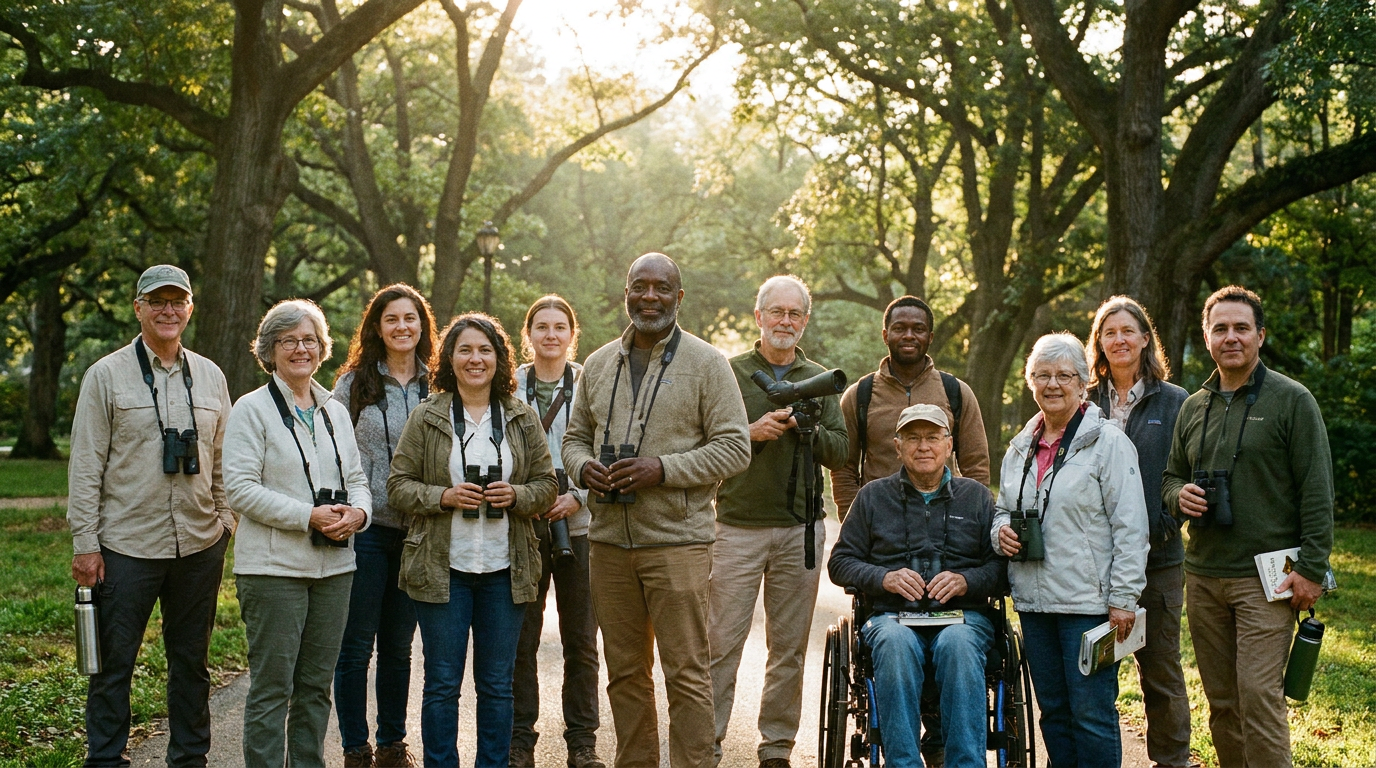
One of the greatest advantages of slow birding as a public health tool is its radical accessibility. Unlike expensive wellness retreats, boutique fitness classes, or specialized therapy, birding is entirely free. It requires no specialized gear, no travel budget, and no baseline level of physical fitness. It can be practiced from a park bench, a wheelchair, or even through an open apartment window, making it an equitable intervention for urban populations who might otherwise lack access to expansive wilderness.[3][6]
Technology has played a massive role in democratizing the hobby. The digital side of birding has lowered the barrier to entry so dramatically that anyone with a smartphone can become an amateur ornithologist in seconds. The Cornell Lab of Ornithology's Merlin Bird ID app, which identifies species by analyzing photos and audio recordings of their songs, added an astonishing 7.5 million new users in 2024 alone. These tools have turned millions of casual walkers into engaged citizen scientists.[3]
However, advocates of slow birding caution against letting the screen entirely mediate the experience. While apps are phenomenal learning tools, staring at a phone to log a sighting can sometimes defeat the purpose of the exercise. The cognitive and emotional benefits stem from the act of sustained observation and sensory immersion, not from the gamified dopamine hit of checking a species off a digital list. Experts recommend using technology to assist with identification, but then putting the device away to simply watch the bird live its life.[3][4]

For those looking to integrate slow birding into their daily routine, the instructions are refreshingly simple. Start in your own backyard or a nearby neighborhood park. Leave the camera and the checklist behind. Find a comfortable place to sit, and wait. When a bird appears, resist the urge to immediately identify it and move on. Instead, ask questions about its behavior: How is it foraging? How does it interact with other birds? What does its call sound like?[7][8]
In an attention economy that constantly harvests our focus for outrage and anxiety, choosing to watch a bird is a quiet act of rebellion. Slow birding offers a rare opportunity to reclaim our attention and direct it toward something beautiful, complex, and entirely indifferent to human concerns. By simply slowing down, looking up, and listening, we can build healthier brains, calmer minds, and a deeper connection to the world right outside our doors.[6][7]
How we got here
2022
U.S. Fish and Wildlife Service survey reveals 96 million Americans identify as birders, driven by a pandemic-era surge.
October 2023
Research confirms that seeing or hearing birds improves mental well-being long after the encounter ends.
2024
The Merlin Bird ID app adds 7.5 million new users, reflecting the growing mainstream appeal of avian observation.
February 2026
A Journal of Neuroscience study reveals that expert birdwatchers develop denser brain regions, protecting against cognitive decline.
May 2026
University of Tübingen researchers publish findings showing that just 30 minutes of birdsong significantly lowers cortisol levels.
Viewpoints in depth
Cognitive Researchers
Focus on how the complex mental demands of bird identification build neuroplasticity and protect against cognitive decline.
Neuroscientists view birding not just as a relaxing hobby, but as a rigorous cognitive workout. Because identifying a bird requires the brain to simultaneously process visual patterns, auditory cues, and spatial memory, it forces the brain to build new neural pathways. Researchers argue that this 'scaffolding' effect creates a structural buffer in the brain, allowing older adults to retain memory and attention skills that typically degrade with age. They emphasize that the protective benefits come specifically from the active learning process, not just passive observation.
Mental Health Professionals
Emphasize the immediate physiological benefits of birdsong, such as cortisol reduction, and its use as a grounding tool for trauma.
Psychologists and therapists are increasingly prescribing nature-based interventions, pointing to clinical data that shows birdsong acts as a rapid physiological reset. For patients dealing with anxiety, burnout, or PTSD, the sensory engagement required to watch a bird pulls the mind out of depressive rumination and anchors it in the present moment. Mental health experts value slow birding because it is free, accessible in urban environments, and offers a gentle, predictable rhythm that helps dysregulated nervous systems feel safe.
Mindful Birding Advocates
Prioritize deep observation of local bird behavior and slowing down over the competitive pursuit of rare species.
Proponents of the slow birding movement argue that traditional birding has become too focused on acquisition—traveling long distances to check rare species off a 'life list.' Instead, they advocate for staying local and observing the complex social behaviors of common backyard birds. This camp believes that true connection to nature comes from sustained, quiet attention rather than gamified collection, and they caution against letting identification apps mediate the entire outdoor experience.
What we don't know
- Whether the cognitive benefits of birding apply equally to casual observers versus those who actively study identification.
- The exact threshold of time spent birding required to achieve long-term structural changes in the brain.
- How the decline of global bird populations might impact the public health benefits of ecotherapy in the future.
Key terms
- Slow Birding
- A mindful approach to birdwatching that prioritizes deep observation of local bird behavior over traveling to check off rare species.
- Neuroplasticity
- The brain's ability to reorganize itself by forming new neural connections, which can be stimulated by learning complex skills like bird identification.
- Ecotherapy
- Structured, nature-based activities designed to restore mental and physical well-being.
- Cortisol
- A primary stress hormone that studies show decreases significantly when humans listen to birdsong.
Frequently asked
Do I need to live near a forest to get the benefits of birding?
No. Studies show that even urban parks or backyard birding provide significant mental health benefits, as long as you are actively observing and listening.
How does birdwatching protect against cognitive decline?
The complex task of identifying birds by sight and sound exercises multiple brain regions simultaneously, building neural density that helps preserve memory and attention as we age.
What is the difference between traditional birding and slow birding?
Traditional birding often involves traveling to spot as many rare species as possible for a 'life list,' while slow birding focuses on staying local and deeply observing the everyday behaviors of common birds.
Sources
Source coverage
8 outlets
3 viewpoints surfaced








[1]CBC NewsCognitive Researchers
Expert birdwatchers have fascinating brain changes that protect against cognitive decline
Read on CBC News →[2]CBS NewsCognitive Researchers
Study finds birding may boost brain health and guard against cognitive decline
Read on CBS News →[3]Raleigh News & ObserverMindful Birding Advocates
Birding is having a moment and it's not just retirees with binoculars anymore
Read on Raleigh News & Observer →[4]CP24Cognitive Researchers
Bird Brain: New study finds birdwatching may boost brain health and slow cognitive aging
Read on CP24 →[5]BluewinMental Health Professionals
Researchers measure lower stress levels: Birds improve our mental health
Read on Bluewin →[6]Red Rock AudubonMental Health Professionals
Mindful Birding as Ecotherapy
Read on Red Rock Audubon →[7]AudubonMindful Birding Advocates
Use Birding as a Balm
Read on Audubon →[8]Penguin Random HouseMindful Birding Advocates
Slow Birding by Joan E. Strassmann
Read on Penguin Random House →


Every angle. Every day.
Get lifestyle stories with full source coverage and perspective breakdowns delivered to your inbox.