
SAG-AFTRA Members Ratify Landmark 2026 Agreement, Cementing Historic AI Protections
Following months of negotiations, SAG-AFTRA members have overwhelmingly ratified the 2026 TV/Theatrical Agreement, establishing unprecedented guardrails around synthetic performers and digital replicas.
By Factlen Editorial Team
- Union Leadership & Performers
- Views the agreement as a vital shield that protects human artistry and ensures fair compensation in an evolving technological landscape.
- Studios & Producers
- Values the contract for providing a clear, legally predictable framework that allows the safe and regulated use of new AI tools.
- Tech & Labor Analysts
- Sees the agreement as a pioneering template for how global labor forces can successfully negotiate the integration of generative AI.
What's not represented
- · Independent filmmakers operating outside the studio system
- · Background actors who face the highest risk of digital replacement
Why this matters
This landmark agreement proves that workers and tech-driven industries can successfully negotiate the boundaries of artificial intelligence without halting innovation. By establishing a clear, consent-based framework for AI in Hollywood, it sets a powerful precedent for how other global industries can protect human jobs while embracing new tools.
Key points
- SAG-AFTRA members have ratified the 2026 TV/Theatrical Agreement, securing three years of labor peace.
- The contract requires clear, informed consent and compensation before a studio can use a digital replica of an actor.
- New restrictions have been placed on fully 'synthetic' AI performers to prevent them from replacing human union members.
- The agreement also includes compounded wage increases and boosted contributions to health and retirement funds.
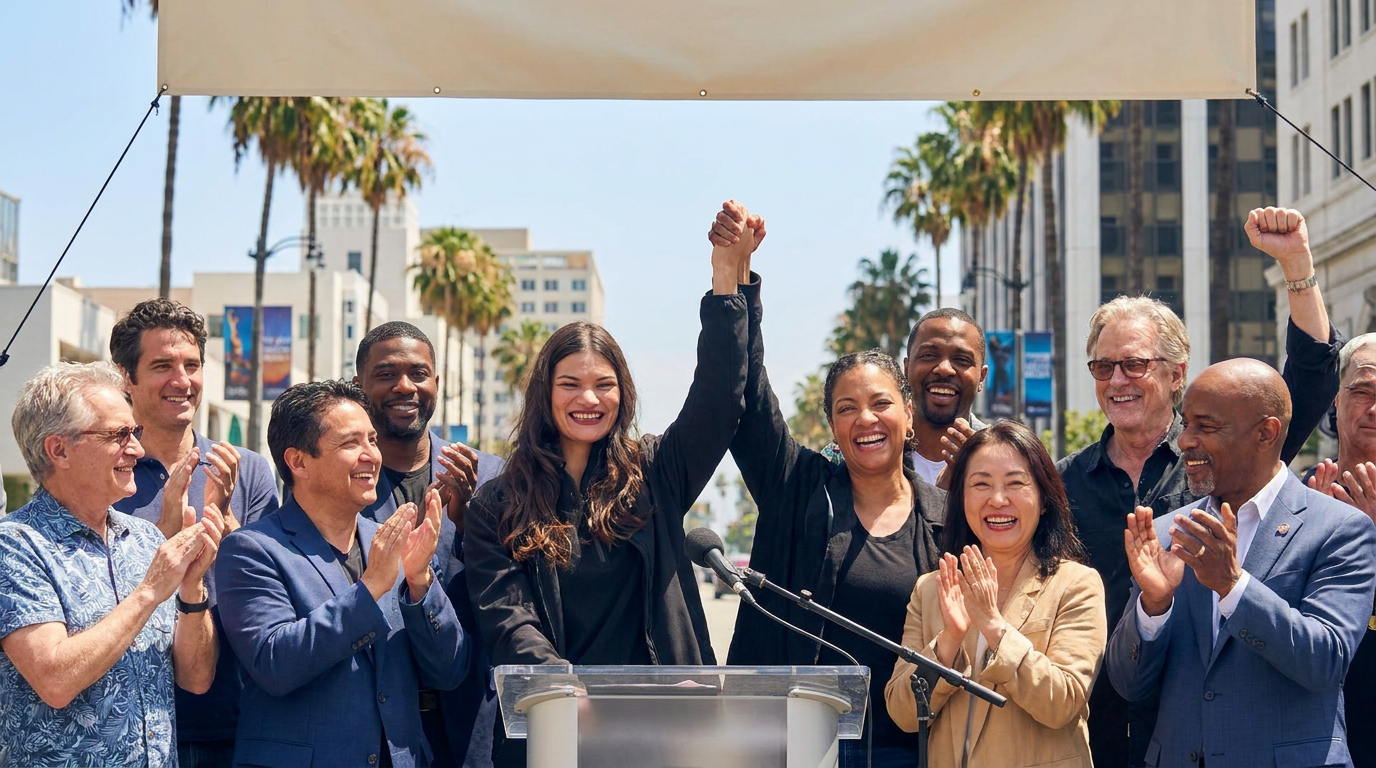
Following months of intensive negotiations, Hollywood has officially secured its future in the age of artificial intelligence. On Friday, members of the Screen Actors Guild-American Federation of Television and Radio Artists (SAG-AFTRA) overwhelmingly ratified the 2026 TV/Theatrical Agreement. The landmark three-year contract establishes unprecedented guardrails around the use of synthetic performers and digital replicas, marking a historic victory for human artistry. Unlike the bitter labor disputes that paralyzed the industry in recent years, this agreement was reached with a spirit of collaboration, ensuring that film and television production will continue uninterrupted through the end of the decade. The ratification is being celebrated not just as a win for actors, but as a stabilizing moment for the entire global entertainment ecosystem.[1][2][3][4]
The overwhelming vote of approval reflects a deep sense of relief and optimism among working actors. The new contract directly addresses the existential anxieties that have shadowed the profession since generative AI first emerged as a viable production tool. By securing these terms, the union has effectively guaranteed that technology will be used to enhance human performance rather than replace it. Industry insiders note that the high ratification margin sends a clear message of unity, proving that the membership is highly informed and deeply invested in the specific legal mechanisms that protect their likenesses and livelihoods.[1][2][4][5][6]
At the core of the 2026 agreement is a robust framework regulating two distinct categories of artificial intelligence: digital replicas and synthetic performers. A digital replica involves using AI to recreate the voice or visual likeness of a specific, identifiable actor. The new contract mandates that studios must obtain clear, conspicuous, and highly specific consent before creating or utilizing such a replica. This "Informed Consent" standard eliminates the practice of burying broad AI rights in the fine print of massive studio contracts. Actors must now be told exactly how their digital twin will be used, whether for a brief background shot or a complex dialogue scene, and they must be compensated accordingly.[1][4][6][7][8]

Perhaps the most groundbreaking aspect of the new contract is its strict regulation of "synthetic performers." Unlike digital replicas, synthetics are entirely AI-generated characters that do not directly map to any single real-world human. Previously, this represented a massive legal gray area, with actors fearing that studios could simply generate entirely new casts from scratch to avoid paying human talent. The 2026 agreement introduces stringent new terms that restrict the use of these synthetics, ensuring they cannot be used to bypass the hiring of union members for covered work. This distinction is being hailed by labor experts as a vital firewall protecting the future of the acting profession.[2][4][5][7][8]
This distinction is being hailed by labor experts as a vital firewall protecting the future of the acting profession.
The successful ratification of this contract is the culmination of a multi-year strategy by SAG-AFTRA to build a comprehensive net of AI protections across all media formats. The groundwork was laid during the grueling 118-day strike of 2023, which forced the major studios to acknowledge AI as a mandatory subject of bargaining. Since then, the union has systematically closed loopholes, securing a dedicated AI voice agreement in early 2024 and ratifying the Interactive Media Agreement for video games in 2025. The 2026 TV/Theatrical Agreement represents the final, most complex piece of this puzzle, harmonizing the rules across the highest-grossing sectors of the entertainment industry.[1][2][3][4][7]

Interestingly, the major studios and streaming platforms represented by the Alliance of Motion Picture and Television Producers (AMPTP) are also viewing the ratified contract as a significant win. For the past two years, producers have been hesitant to fully integrate emerging AI tools into their pipelines due to the looming threat of litigation and labor grievances. This agreement provides them with a clear, legally predictable framework. By defining exactly what is permissible and establishing standard rates for digital replica usage, studios can now budget for and utilize these technologies safely, without fear of triggering a sudden walkout or a massive class-action lawsuit.[2][3][5][8]
Beyond the headline-grabbing AI guardrails, the 2026 contract delivers substantial economic gains that fortify the middle-class actor. The agreement includes compounded wage increases that outpace recent inflation metrics, ensuring that scale performers see a meaningful boost in their take-home pay. Additionally, the contract secures vital increases in employer contributions to the union's health and retirement funds. These financial victories, combined with enhanced on-set safety protocols regarding intimacy coordinators and stunt work, represent a holistic approach to worker well-being that extends far beyond the digital realm.[1][2][4][6]

The ripple effects of this agreement are already being felt far beyond the borders of Hollywood. Labor unions representing workers in diverse fields—from journalism and graphic design to customer service and software engineering—are closely analyzing the SAG-AFTRA contract as a potential template for their own collective bargaining efforts. By successfully defining the boundaries of generative AI and enforcing a strict consent-and-compensate model, the actors' union has provided a concrete roadmap for how human labor can coexist with automation. As the ink dries on the 2026 agreement, it stands as a hopeful testament to the power of negotiation, proving that technological progress does not have to come at the expense of human dignity.[1][5][7][8]
How we got here
Nov 2023
SAG-AFTRA concludes a historic 118-day strike, securing initial AI protections for film and television.
Jan 2024
The union signs a groundbreaking agreement with Replica Studios covering AI voice generation.
July 2025
Members ratify the Interactive Media Agreement, establishing AI guardrails for the video game industry.
June 2026
The 2026 TV/Theatrical Agreement is ratified, introducing strict new restrictions on fully synthetic performers.
Viewpoints in depth
Union Leadership & Performers
Views the agreement as a vital shield that protects human artistry.
For the actors and union negotiators, the 2026 agreement is the culmination of years of existential dread transformed into concrete legal protection. They argue that acting is fundamentally a human endeavor, relying on lived experience and emotional truth that a machine cannot replicate. By forcing studios to adhere to strict consent and compensation models for digital replicas, and by placing hard limits on fully synthetic performers, the union believes it has saved the profession from being hollowed out by cost-cutting automation. This camp emphasizes that they are not anti-technology, but rather pro-human, insisting that AI must remain a tool wielded by artists, not a replacement for them.
Studios & Producers
Values the contract for providing a clear, legally predictable framework for AI.
From the perspective of the major studios and streaming platforms, the ratification of this contract brings much-needed stability to a volatile production landscape. For the past two years, producers have operated in a state of legal ambiguity regarding generative AI, hesitant to fully deploy new tools due to the risk of labor strikes or copyright lawsuits. This agreement provides a standardized rulebook. By clearly defining what constitutes a digital replica and establishing fixed compensation rates, studios can now accurately budget for AI-assisted production. They view the contract not as a restriction, but as a roadmap that allows them to safely and legally integrate cutting-edge technology to streamline post-production and visual effects.
Tech & Labor Analysts
Sees the agreement as a pioneering template for global labor forces.
Technology and labor analysts are looking far beyond Hollywood, viewing the 2026 SAG-AFTRA contract as a historic precedent for the global workforce. They point out that white-collar and creative industries worldwide are currently grappling with the exact same automation anxieties that actors faced. Analysts argue that SAG-AFTRA's success in defining 'synthetic' versus 'replica' outputs, and enforcing a strict 'Informed Consent' standard, provides a highly adaptable blueprint for other unions. This perspective highlights that the agreement shifts the power dynamic, proving that organized labor can successfully force massive tech and corporate entities to negotiate the ethical implementation of artificial intelligence, rather than simply accepting it as an unstoppable disruption.
What we don't know
- How quickly smaller, independent studios will be able to adapt to the new compliance and reporting requirements for AI usage.
- How international labor unions will adapt these specific American contractual definitions for their own local entertainment industries.
Key terms
- Digital Replica
- A digital recreation of a specific, identifiable human performer's voice or visual likeness.
- Synthetic Performer
- An entirely AI-generated character that does not directly replicate any single real-world actor.
- Informed Consent
- A legal standard requiring studios to provide a reasonably specific description of how a digital replica will be used before an actor signs off.
Frequently asked
Does this agreement ban AI in movies and TV?
No. It establishes strict rules requiring consent and compensation when AI is used to replicate human actors, rather than banning the technology outright.
How is a synthetic performer different from a digital replica?
A digital replica is based on a real, recognizable person, while a synthetic performer is generated entirely from scratch using AI models.
Will this affect video games?
Video games are covered under a separate Interactive Media Agreement, which SAG-AFTRA ratified in 2025 with similar AI protections.
Sources
Source coverage
8 outlets
3 viewpoints surfaced








[1]VarietyUnion Leadership & Performers
SAG-AFTRA Members Overwhelmingly Ratify 2026 TV/Theatrical Contract With Historic AI Guardrails
Read on Variety →[2]The Hollywood ReporterStudios & Producers
Actors Union Ratifies New Three-Year Deal, Cementing Protections Against 'Synthetic' Performers
Read on The Hollywood Reporter →[3]DeadlineStudios & Producers
Hollywood Breathes Sigh Of Relief As SAG-AFTRA Ratifies 2026 Contract Without A Strike
Read on Deadline →[4]SAG-AFTRAUnion Leadership & Performers
SAG-AFTRA Members Ratify New TV/Theatrical Agreement, Securing Added Protection Against AI
Read on SAG-AFTRA →[5]Los Angeles TimesStudios & Producers
How the new SAG-AFTRA contract creates a roadmap for AI in Hollywood
Read on Los Angeles Times →[6]BackstageUnion Leadership & Performers
What the 2026 SAG-AFTRA Contract Means for Working Actors
Read on Backstage →[7]TechCrunchTech & Labor Analysts
Hollywood's new labor deal sets a global standard for regulating generative AI
Read on TechCrunch →[8]The VergeTech & Labor Analysts
SAG-AFTRA's new contract finally defines the rules for AI 'synthetic' actors
Read on The Verge →

Every angle. Every day.
Get entertainment stories with full source coverage and perspective breakdowns delivered to your inbox.