
How Cricket is Rewiring Itself for the LA28 Olympics
With cricket returning to the Olympic Games in 2028 for the first time in 128 years, the sport is undergoing a massive logistical and structural transformation. From drop-in pitches in Los Angeles to a fierce global qualification battle, here is how the Olympic format will actually work.
By Factlen Editorial Team
- IOC & Commercial Partners
- Views cricket's inclusion primarily as a vehicle to unlock the massive South Asian broadcast market and engage a younger, global demographic.
- Emerging Cricket Nations
- Sees Olympic status as a lifeline that forces local governments to fund cricket development, infrastructure, and women's programs.
- Traditional Cricket Boards
- Supports the move but worries about the logistical strain on the existing international calendar and the brutal six-team qualification limit.
What's not represented
- · Domestic franchise league owners whose tournaments overlap with the Games
- · Players' unions negotiating release windows
Why this matters
Olympic inclusion unlocks millions in government funding for cricket in non-traditional markets, transforming the sport from a Commonwealth pastime into a truly global athletic pursuit. For fans, it means a condensed, high-stakes tournament format unlike any existing World Cup.
Key points
- Cricket will return to the Olympics in 2028 after a 128-year absence, utilizing the three-hour T20 format.
- The tournament will be strictly capped at six teams per gender to comply with the IOC's athlete limits.
- Organizers will rely on off-site 'drop-in pitches' to convert American stadiums into viable cricket grounds.
- Olympic inclusion unlocks vital government funding for developing cricket nations, particularly boosting women's programs.
The last time cricket featured in the Olympic Games, the Wright brothers had not yet flown, and the match consisted of a single two-day contest between Great Britain and a French team composed mostly of British expatriates. That 1900 Paris exhibition has stood as a historical anomaly for over a century. But when the Olympic flame reaches Los Angeles in July 2028, cricket will officially return to the world's biggest sporting stage. The inclusion, ratified by the International Olympic Committee (IOC), represents a monumental shift for a sport that has historically been confined to the borders of the British Commonwealth.[1][2]
The decision to bring cricket to LA28 is not merely a nostalgic nod to the past; it is a calculated economic and strategic marriage between the IOC and the International Cricket Council (ICC). For the IOC, cricket offers a golden key to the South Asian market, particularly India, where the sport commands a religious following and billions of dollars in commercial value. For the ICC, the Olympic rings provide the ultimate stamp of global legitimacy, unlocking government funding for developing cricket nations that only subsidize Olympic sports.[2][4]
However, adapting a sport famous for multi-day matches into the rigid, two-week window of the Summer Olympics requires severe structural compromises. The LA28 tournament will utilize the Twenty20 (T20) format, the shortest established version of the international game. A T20 match lasts roughly three hours, making it highly digestible for broadcasters and compatible with the Olympic scheduling grid. Yet, even with the condensed format, the logistics of hosting a cricket tournament in Southern California present unprecedented engineering challenges.[1][3]

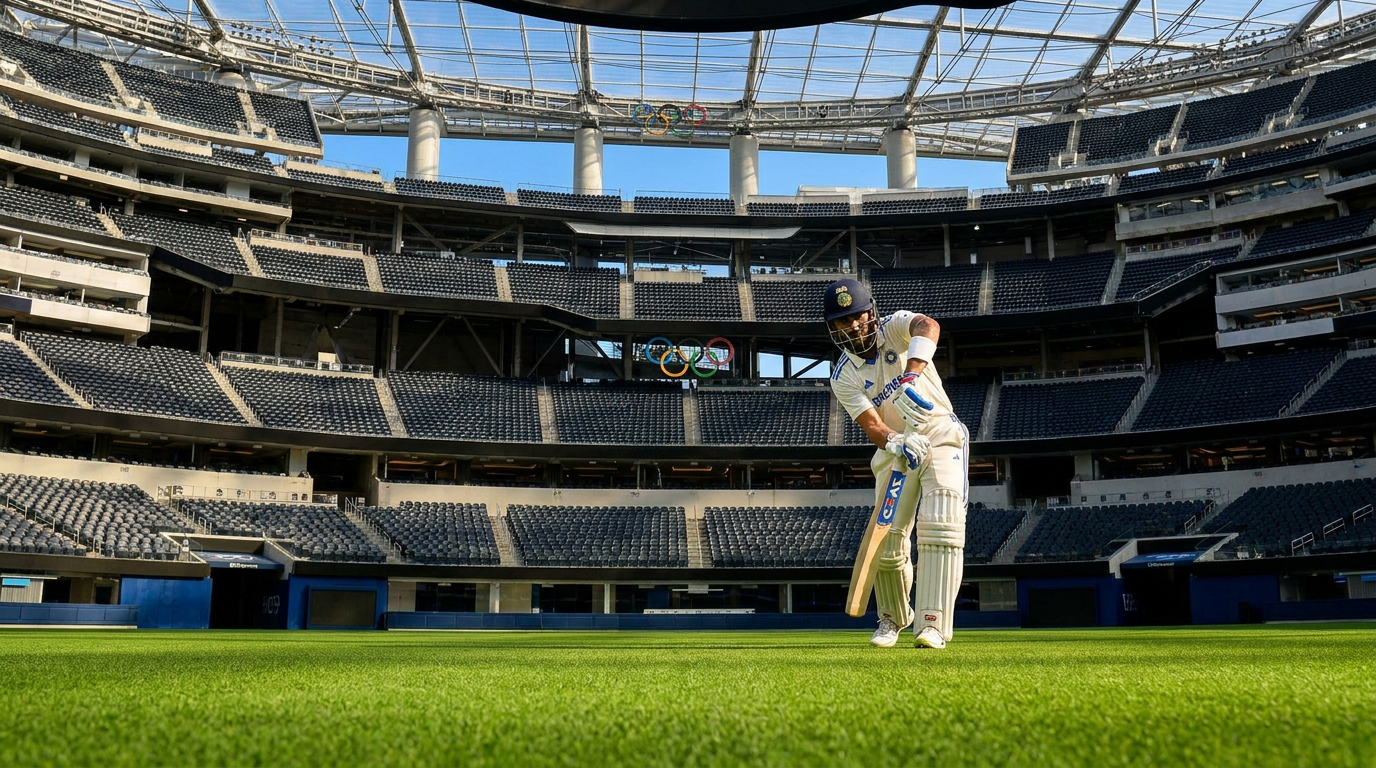
The most pressing physical hurdle is the playing surface itself. Cricket cannot be played on a standard grass field or artificial turf; it requires a highly specialized, meticulously rolled strip of clay and grass known as a pitch. Because Los Angeles lacks existing world-class cricket infrastructure, organizers will rely on "drop-in pitches." This technology involves growing the clay-and-grass wicket in a steel tray off-site for several months, then transporting it via heavy machinery into a multi-purpose stadium just days before the event.[3][5]
Drop-in pitches have been used successfully in Australia and New Zealand to convert Australian Rules Football ovals into cricket grounds, and they were recently utilized in New York during the 2024 T20 World Cup. The engineering requires precise moisture control and compaction to ensure the ball bounces consistently and safely. If the pitch is too soft, the ball will not carry; if it is too dry, it will crumble under the bowler's footmarks. LA28 organizers are currently studying soil compositions that can withstand the dry Southern California summer while delivering an authentic contest.[3][5]
Beyond the physical infrastructure, the tournament's structure is defined by the IOC's strict athlete quotas. To keep the total number of Olympic athletes under 10,500, the IOC has capped the cricket event at just six teams per gender. This is a drastic reduction from the 20-team T20 World Cup, transforming the Olympic tournament into an ultra-exclusive, high-stakes sprint rather than a sprawling global festival.[1][2]
The six-team limit forces a brutal qualification pathway. As the host nation, the United States receives an automatic berth, leaving only five spots available for the rest of the world. The ICC is expected to allocate these remaining slots based on global T20 rankings at a specific cutoff date, likely in early 2027. This means traditional powerhouses like Australia, India, England, South Africa, and Pakistan will be locked in a fierce statistical battle just to make the flight to Los Angeles.[2][5]
As the host nation, the United States receives an automatic berth, leaving only five spots available for the rest of the world.
The economic mechanics of this six-team tournament are staggering. Industry analysts estimate that the inclusion of cricket—specifically the guarantee of the Indian men's national team participating—could boost the IOC's broadcast rights in South Asia by upwards of $2.5 billion for the 2028 and 2032 cycles. This financial windfall fundamentally alters the IOC's revenue model, which has historically relied heavily on North American and European broadcasters.[4][5]

For the players, the Olympic tournament introduces a new pinnacle of achievement. While the ICC World Cup remains the sport's traditional holy grail, the allure of an Olympic gold medal carries a unique, transcendent prestige. Elite cricketers, who typically spend their summers navigating a lucrative web of domestic franchise leagues, are already signaling their intent to prioritize LA28.[3][5]
However, this enthusiasm creates a massive headache for global cricket schedulers. The LA28 Games will take place in the second half of July, plunging straight into the heart of the English cricket summer and overlapping with major franchise tournaments like Major League Cricket (MLC) in the US and the Hundred in the UK. National boards will have to carve out a dedicated Olympic window in an already saturated calendar, forcing complex negotiations over player release clauses and broadcast exclusivity.[3][5]
The most profound impact of LA28, however, will not be felt in London or Mumbai, but in emerging cricket markets like Brazil, Rwanda, and Japan. In many countries, national sports ministries only allocate funding, training facilities, and visas to sports officially recognized by the Olympic charter. Overnight, the IOC's ratification transformed cricket from a niche club sport into a state-backed priority in dozens of associate nations.[2][5]
This influx of government funding is particularly transformative for women's cricket. The LA28 inclusion mandates equal participation, meaning the six-team women's tournament will receive the same platform and resources as the men's. For developing nations, investing in the women's game often provides a faster pathway to global competitiveness, and Olympic status accelerates this investment exponentially.[2][5]

As the countdown to 2028 continues, the ICC and LA28 organizers are finalizing the venue strategy. While Major League Cricket's stadium in Dallas offers a ready-made template, the IOC prefers events to remain within the host city's footprint. Proposals include retrofitting existing baseball stadiums or constructing a temporary modular arena in the Greater Los Angeles area, similar to the pop-up stadium built in Nassau County for the 2024 World Cup.[3][5]
The success of the LA28 experiment will likely determine cricket's long-term Olympic future. If the drop-in pitches hold up, the broadcast numbers meet expectations, and the world's top players deliver a compelling spectacle, cricket is virtually guaranteed a spot in the 2032 Brisbane Games—a natural fit given Australia's deep cricketing heritage.[1][4]
Ultimately, the 2028 Olympics represent a collision of two massive sporting ecosystems. The IOC gets access to a billion new fans, while cricket gets a golden ticket out of its Commonwealth silo. It is a complex, high-stakes logistical puzzle, but one that promises to redefine the boundaries of the world's second most popular sport.[2][5]
How we got here
1900
Cricket makes its first and only Olympic appearance in Paris, with Great Britain defeating France.
Oct 2023
The IOC officially votes to include cricket in the LA28 sports program during its session in Mumbai.
Early 2027
Expected cutoff date for the ICC global rankings that will determine the final five qualification spots.
July 2028
The Olympic cricket tournament is scheduled to begin in Los Angeles.
Viewpoints in depth
The IOC and Broadcasters
Viewing cricket as the ultimate commercial key to the Indian subcontinent.
For the International Olympic Committee, bringing cricket into the fold is a calculated commercial maneuver. The Olympic brand is historically weak in South Asia, a region home to nearly two billion people. By guaranteeing the presence of the Indian national cricket team, the IOC instantly transforms its broadcast rights valuation in the region. Analysts project that this single sport addition could inject over $2.5 billion into the Olympic movement over the next two cycles, diversifying the IOC's revenue streams away from a heavy reliance on American and European networks.
Emerging Cricket Nations
Seeing Olympic status as a catalyst for state funding and infrastructure.
In countries where cricket is not a traditional pastime, national sports ministries often refuse to fund sports outside the Olympic charter. The LA28 inclusion changes this dynamic overnight. Associate nations in South America, Africa, and East Asia can now apply for government grants, access national training facilities, and secure athlete visas much more easily. This structural shift is particularly vital for women's cricket, as Olympic mandates require equal investment, providing a fast-tracked pathway for developing nations to build professional women's programs.
Traditional Cricket Schedulers
Grappling with the logistical nightmare of fitting the Olympics into a crowded calendar.
While the prestige of the Olympics is undeniable, the practical reality of a July tournament creates severe friction for the sport's traditional powers. The LA28 Games land squarely in the middle of the English domestic summer and overlap directly with lucrative franchise tournaments like the Caribbean Premier League and the US-based Major League Cricket. National boards are currently negotiating how to carve out a dedicated window for the Games without cannibalizing their own domestic broadcast revenues, a tension exacerbated by the fact that only six nations will actually get to participate.
What we don't know
- Which specific stadiums in the Los Angeles area will be retrofitted to host the matches.
- The exact qualification pathway and whether regional qualifiers will supplement the global rankings.
- How domestic franchise leagues will adjust their schedules to release top players for the Olympic window.
Key terms
- Twenty20 (T20)
- A shortened format of cricket where each team bats for a single innings restricted to a maximum of 20 overs, typically lasting about three hours.
- Drop-in Pitch
- A cricket playing surface prepared off-site in a steel frame and transported into a multi-purpose stadium just before a match.
- Associate Nation
- A country where cricket is firmly established and organized, but which does not qualify for Full Member status (and automatic entry to major events) under the ICC.
Frequently asked
Will the US national team play in the LA28 cricket tournament?
Yes. As the host nation, the United States receives an automatic qualification spot in both the men's and women's tournaments.
How long does an Olympic cricket match take?
The tournament will use the Twenty20 (T20) format, meaning each match will be completed in approximately three hours.
Where will the cricket matches be played in Los Angeles?
Organizers are still finalizing venues, but options include retrofitting existing baseball stadiums in Southern California or building a temporary modular stadium using drop-in pitches.
Sources
Source coverage
5 outlets
3 viewpoints surfaced





[1]International Olympic CommitteeIOC & Commercial Partners
Cricket at the Olympic Games: LA28 Inclusion
Read on International Olympic Committee →[2]International Cricket CouncilEmerging Cricket Nations
ICC welcomes cricket's inclusion in LA28 Olympic Games
Read on International Cricket Council →[3]ESPNcricinfoTraditional Cricket Boards
The logistical hurdles of Olympic cricket in Los Angeles
Read on ESPNcricinfo →[4]Sports Business JournalIOC & Commercial Partners
The billion-dollar broadcast impact of Olympic cricket
Read on Sports Business Journal →[5]Factlen Editorial TeamEmerging Cricket Nations
Synthesis by Factlen editorial team
Read on Factlen Editorial Team →

More in sports
See all 6 stories →Endurance Physiology
The Science of Zone 2: Why Cyclists Are Going Slow to Get Faster
7 sources

Sports Tech
BWF Approves Synthetic Shuttlecocks for International Play Amid Global Feather Shortage
6 sources

Viral Fame
New Zealand's Viral Defender Tim Payne Signs With Paraguayan Giants Club Olimpia
7 sources
Women's Soccer
The 2026 Watershed: How NWSL Expansion and USL Realignment Are Reshaping US Women's Soccer
7 sources

Every angle. Every day.
Get sports stories with full source coverage and perspective breakdowns delivered to your inbox.