
How the Fourth Amendment Protects Your Digital Data: A 2026 Explainer
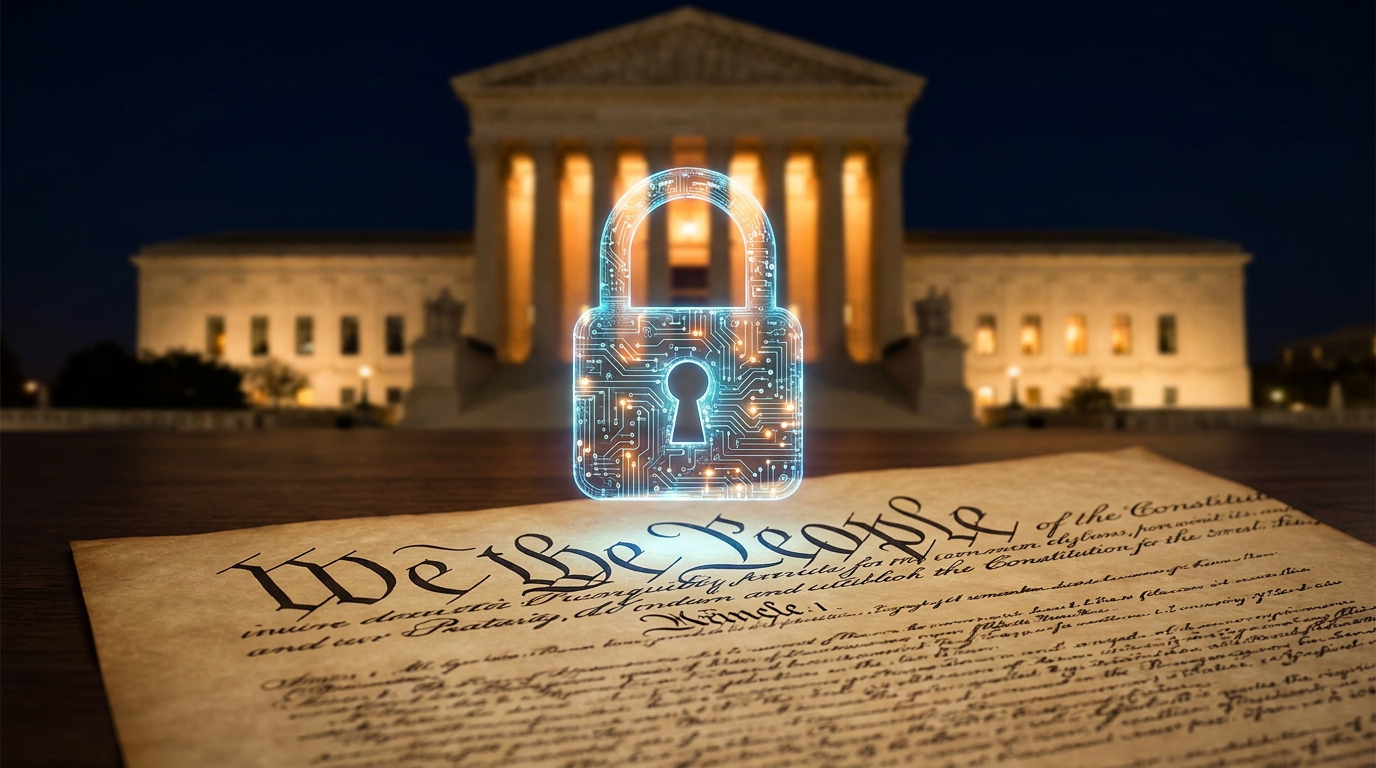
As our lives move entirely online, courts are adapting 18th-century constitutional protections to shield smartphones, location data, and biometrics from warrantless searches.
By Factlen Editorial Team
- Digital Privacy Advocates
- Argue that all digital trails, from location data to cloud storage, require strict warrant protections to prevent mass surveillance.
- Judicial Pragmatists
- Seek to balance the historical text of the Constitution with the practical realities of modern technology and law enforcement needs.
- Factlen Synthesis
- Provides an overarching analysis of how legal precedents and technological realities intersect to form modern privacy rights.
What's not represented
- · Technology Companies (Data Custodians)
- · Law Enforcement Agencies
Why this matters
Every time you unlock your phone, use a map app, or upload a photo to the cloud, you generate highly sensitive personal data. Understanding how the Constitution protects this data empowers you to navigate the digital world with confidence and advocate for your civil liberties.
Key points
- The Fourth Amendment requires law enforcement to obtain a warrant before searching digital devices like smartphones.
- The Supreme Court ruled in 2018 that accessing historical cell phone location data also requires a warrant.
- Courts are moving away from the idea that sharing data with a cloud provider automatically eliminates your privacy rights.
- Biometric data, such as facial recognition and DNA, represents the next major frontier for constitutional privacy law.
- Several states are passing their own constitutional amendments to explicitly protect electronic data from warrantless searches.
When the framers of the U.S. Constitution drafted the Bill of Rights in 1789, they were concerned with British soldiers breaking down physical doors to search through physical desks. They could not have anticipated a world where a small glass rectangle in a citizen's pocket contains more personal information than a colonial-era library. Yet, the Fourth Amendment—which protects against "unreasonable searches and seizures"—is proving to be remarkably resilient. Over the past decade, a series of landmark legal decisions and advocacy efforts have successfully translated this 18th-century parchment into a robust shield for 21st-century digital life.[2][6]
The core mechanism of the Fourth Amendment relies on a simple premise: law enforcement generally needs a warrant, backed by probable cause and signed by a judge, to search your "persons, houses, papers, and effects." For over a century, courts interpreted this strictly through the lens of physical property and trespass. If the police didn't physically intrude on your property, a search hadn't occurred. But as technology evolved, this physical-only framework began to show severe limitations, prompting the judiciary to rethink what privacy actually means in a modern society.[2]
The foundational shift occurred long before the smartphone era, during the 1967 Supreme Court case Katz v. United States. Federal agents had attached an eavesdropping device to the outside of a public telephone booth to record a suspect's conversations. Because they didn't physically penetrate the booth, the government argued no search occurred. The Court disagreed, famously declaring that the Fourth Amendment "protects people, not places." This established the modern standard: if a person has a "reasonable expectation of privacy" that society recognizes as legitimate, the government needs a warrant.[2][6]
This "reasonable expectation" test faced its ultimate trial with the advent of the smartphone. By the early 2010s, it was standard police practice in many jurisdictions to search the cell phones of arrested individuals without a warrant, treating the devices legally similarly to a wallet or a pack of cigarettes found in a suspect's pocket. Civil liberties organizations argued this was a gross violation of privacy, noting that a phone contains medical records, banking details, intimate communications, and location history.[3][5]

The turning point arrived in 2014 with Riley v. California. In a unanimous 9-0 decision, Chief Justice John Roberts wrote that comparing a modern cell phone to a physical wallet is "like saying a ride on horseback is materially indistinguishable from a flight to the moon." The Court ruled that police must obtain a warrant to search a cell phone seized during an arrest. This decision firmly planted a constitutional flag in the digital realm, establishing that the sheer volume and deeply personal nature of digital data require heightened protections.[5][6]
However, protecting the device in your pocket was only half the battle. The next major hurdle was the "Third-Party Doctrine." Established in the 1970s, this legal theory held that if you voluntarily give information to a third party—like dialing a phone number through a telecom company or giving financial records to a bank—you surrender your expectation of privacy. In the cloud computing era, where almost all our data is held by third parties like Apple, Google, and Amazon, this doctrine threatened to render the Fourth Amendment obsolete.[3][5]
However, protecting the device in your pocket was only half the battle.
The collision between the Third-Party Doctrine and modern technology came to a head over Cell-Site Location Information (CSLI). Every time your phone connects to a cell tower, it creates a time-stamped location record held by your wireless carrier. Law enforcement agencies were routinely requesting months of this data without warrants to retroactively track suspects' movements, arguing that users "voluntarily" shared this data with their carriers simply by turning their phones on.[1][3]
In the 2018 case Carpenter v. United States, the Supreme Court pushed back against this surveillance practice. The Court ruled that accessing seven or more days of historical CSLI requires a warrant. The majority opinion recognized a profound reality of modern life: carrying a cell phone is not truly "voluntary" if one wants to participate in contemporary society. Therefore, the government cannot exploit the necessity of mobile technology to create a warrantless, retroactive dragnet of a citizen's physical movements.[1][6]

Today, the frontier of Fourth Amendment law has moved to biometrics and cloud storage. As facial recognition technology and DNA databases become more prevalent, legal scholars and privacy advocates are debating how constitutional protections apply to our physical bodies as data. Lower courts are currently split on whether police can force a suspect to unlock a phone using their face or fingerprint, navigating the complex intersection of the Fourth Amendment's protection against unreasonable searches and the Fifth Amendment's protection against self-incrimination.[4][5]
Another highly contested area is the "border search exception." Historically, the government has broad authority to conduct warrantless searches at international borders and airports to protect national security. However, civil liberties groups are actively challenging the practice of border agents conducting forensic downloads of travelers' laptops and phones without suspicion. Recent appellate court rulings have begun to rein in these practices, suggesting that the digital contents of a device require more justification to search than physical luggage.[3][6]
While federal courts move slowly, many states are bypassing the judicial wait by amending their own constitutions. States like Michigan, Missouri, and California have passed explicit constitutional amendments or robust state laws that specifically protect "electronic data" and "electronic communications" from warrantless searches. This state-level laboratory of democracy is accelerating the modernization of privacy rights, ensuring that local law enforcement operates under strict digital guidelines regardless of federal ambiguity.[5][6]

Simultaneously, the technology industry is building mathematical walls where legal ones are still being constructed. The widespread adoption of end-to-end encryption by messaging platforms ensures that even if the government obtains a warrant for cloud data, the service provider cannot hand over readable messages. This shifts the legal battleground from "can the government demand the data" to "can the government force a company to break its own security," a debate that continues to shape the future of digital infrastructure.[3][6]
Ultimately, the evolution of the Fourth Amendment is a testament to the adaptability of democratic institutions. While technology moves at breakneck speed, the foundational principle—that citizens have a right to a private sphere free from arbitrary government intrusion—remains intact. Through a combination of landmark judicial rulings, tireless advocacy, and technological safeguards, the digital panopticon is being actively checked, ensuring that the rights drafted by candlelight continue to protect us in the glow of our screens.[2][5][6]
How we got here
1791
The Fourth Amendment is ratified as part of the Bill of Rights, protecting against unreasonable searches of 'papers and effects.'
1967
Katz v. United States establishes that the Fourth Amendment protects people, not just physical places, creating the 'reasonable expectation of privacy' standard.
2014
In Riley v. California, the Supreme Court unanimously rules that police must obtain a warrant to search a suspect's cell phone.
2018
Carpenter v. United States establishes that law enforcement needs a warrant to access historical cell-site location information.
Viewpoints in depth
Digital Privacy Advocates
Organizations focused on civil liberties argue that the digital age requires absolute constitutional safeguards against mass surveillance.
Groups like the Electronic Frontier Foundation and the Brennan Center for Justice argue that the sheer volume and intimate nature of digital data make traditional legal frameworks inadequate. They contend that the 'Third-Party Doctrine' should be entirely abandoned in the digital age, as using cloud services and mobile networks is a prerequisite for modern life, not a voluntary surrender of privacy. These advocates push for strict warrant requirements for all digital trails, including biometrics, location data, and communication metadata, warning that without these protections, the government possesses a retroactive panopticon capable of mapping anyone's life without suspicion.
Judicial Pragmatists
Legal scholars and moderate jurists seek to carefully adapt historical constitutional text to modern technological realities without breaking the legal system.
This perspective, often reflected in recent Supreme Court majority opinions, attempts to thread the needle between 18th-century text and 21st-century technology. Pragmatists acknowledge that a smartphone is fundamentally different from a physical diary, requiring new rules like those established in Riley and Carpenter. However, they are cautious about sweeping declarations that might inadvertently cripple legitimate law enforcement investigations. They prefer to rule narrowly on specific technologies—like cell-site location data—rather than overturning decades of precedent like the Third-Party Doctrine entirely, resulting in a slow but steady modernization of the Fourth Amendment.
What we don't know
- Whether the Supreme Court will ultimately rule that forcing a suspect to unlock a phone with their face or fingerprint violates the Constitution.
- How courts will apply Fourth Amendment protections to emerging technologies like brain-computer interfaces and advanced biometric continuous-monitoring devices.
- The extent to which the 'border search exception' will be permanently narrowed to protect the digital data of international travelers.
Key terms
- Fourth Amendment
- The provision in the U.S. Constitution's Bill of Rights that protects citizens from unreasonable searches and seizures by the government.
- Probable Cause
- The legal standard requiring law enforcement to have sufficient reason based on known facts to believe a crime has been committed before obtaining a search warrant.
- Reasonable Expectation of Privacy
- A legal test established in 1967 determining whether a person's subjective expectation of privacy is one that society recognizes as reasonable and therefore protected by the Fourth Amendment.
- Cell-Site Location Information (CSLI)
- Data generated every time a mobile phone connects to a cell tower, which can be used to map a person's historical physical movements.
- Third-Party Doctrine
- A legal principle suggesting that individuals do not have a reasonable expectation of privacy for information they voluntarily turn over to third parties, such as telecom companies or banks.
Frequently asked
Do police need a warrant to search my cell phone?
Yes. Under the 2014 Supreme Court ruling in Riley v. California, law enforcement must generally obtain a warrant signed by a judge before searching the digital contents of a cell phone, even during a lawful arrest.
What is the Third-Party Doctrine?
It is a legal theory stating that people lose their expectation of privacy for information they voluntarily share with third parties, like banks or internet providers. However, recent rulings have limited this doctrine regarding highly sensitive digital data.
Can the government track my phone's location without a warrant?
Generally, no. The 2018 Carpenter v. United States decision established that law enforcement needs a warrant to access historical cell-site location information (CSLI) spanning seven days or more.
Can border agents search my laptop without a warrant?
Currently, border agents have broad authority to conduct basic searches of devices at international borders without a warrant. However, lower courts are increasingly requiring reasonable suspicion for deep, forensic downloads of a device's data.
Sources
Source coverage
6 outlets
3 viewpoints surfaced





[1]Supreme Court of the United StatesJudicial Pragmatists
Carpenter v. United States
Read on Supreme Court of the United States →[2]Legal Information InstituteJudicial Pragmatists
Fourth Amendment: Search and Seizure
Read on Legal Information Institute →[3]Electronic Frontier FoundationDigital Privacy Advocates
The Fourth Amendment in the Digital Age
Read on Electronic Frontier Foundation →[4]Harvard Law ReviewJudicial Pragmatists
The Fourth Amendment and Biometric Technologies
Read on Harvard Law Review →[5]Brennan Center for JusticeDigital Privacy Advocates
Digital Privacy and the Constitution
Read on Brennan Center for Justice →[6]Factlen Editorial TeamFactlen Synthesis
Synthesis by Factlen editorial team
Read on Factlen Editorial Team →
Every angle. Every day.
Get law justice stories with full source coverage and perspective breakdowns delivered to your inbox.