
Global Climate Indicators Signal Imminent El Niño as UN Negotiators Clash Over 1.5°C Overshoot
Scientific monitoring agencies have issued high-certainty warnings of an impending El Niño that will compound record-breaking global temperatures. Meanwhile, diplomats at the UN climate talks in Bonn are clashing over how to address the increasingly likely scenario of overshooting the 1.5°C warming limit.
By Factlen Editorial Team
- Scientific Consensus & Monitoring
- Argues that empirical data shows an unprecedented acceleration in warming, necessitating immediate global preparation.
- Humanitarian Impact & Vulnerability
- Focuses on the immediate human cost of the data, demanding urgent adaptation finance and early warning systems.
- International Climate Diplomacy
- Highlights the political friction caused by integrating strict 'overshoot' mitigation scenarios into binding UN policy.
What's not represented
- · Local coastal communities facing immediate displacement from intensifying marine heatwaves and sea-level rise.
- · Agricultural workers in regions projected to experience severe El Niño-induced droughts.
Why this matters
The convergence of a new El Niño with record-high baseline temperatures means extreme weather events—from severe droughts to devastating floods—are highly likely to intensify globally in late 2026. Understanding the data and the political gridlock surrounding it is crucial, as these climate shocks will directly impact global food prices, coastal security, and international energy policies.
Key points
- The WMO reports a 90% certainty that a strong El Niño will develop by August 2026.
- Global temperatures in May 2026 hovered 1.42°C above pre-industrial levels, continuing a year-long streak of extreme warmth.
- Subsurface Pacific Ocean temperatures are currently 6°C above the historical average, fueling the impending El Niño.
- UN agencies warn the compounding climate shocks will severely threaten food security in vulnerable regions.
- Diplomats at the UN climate talks in Bonn clashed over how to formally address the likelihood of overshooting the 1.5°C limit.
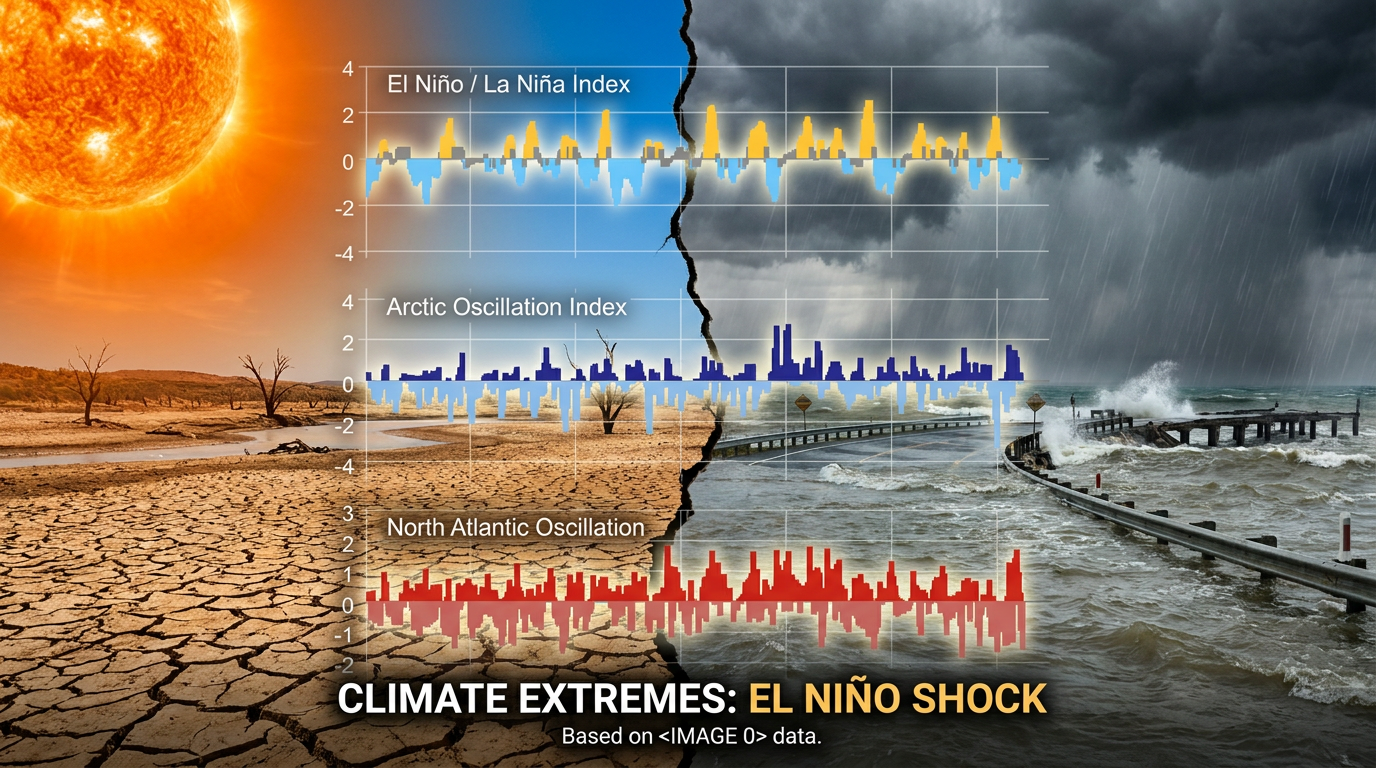
The global climate system is entering a highly volatile phase in mid-2026, driven by the convergence of record-high baseline warming and the imminent arrival of a new El Niño event. According to a June 2026 update from the World Meteorological Organization (WMO), there is a 90 percent certainty that El Niño conditions will take hold by August, threatening to 'pour fuel on the fire of a warming world.' This development comes at a time when the Earth's energy balance is already drifting further out of alignment, prompting urgent warnings from scientific monitoring agencies. The combination of these factors suggests that the global climate is crossing a critical threshold, with profound implications for weather patterns, food security, and international climate diplomacy over the next eighteen months.[1][6]
The evidence for this acceleration is anchored in unprecedented oceanic and atmospheric data. The European Union’s Copernicus Climate Change Service reported that May 2026 was the joint second-warmest May on record, with global temperatures hovering 1.42°C above pre-industrial levels. This continues a relentless streak of extreme global warmth that has persisted since the record-breaking temperatures of 2024. Meteorologists note that while natural variability plays a role, the sheer scale of the temperature anomalies cannot be explained without factoring in the compounding effects of human-caused greenhouse gas emissions. The baseline temperature of the planet has shifted upward so significantly that even 'cooler' months are now breaking historical records.[2][5]
To understand the mechanics of the current crisis, scientists are looking closely beneath the ocean's surface. The WMO has tracked unusually warm subsurface conditions across the tropical Pacific Ocean, where temperatures are currently exceeding 6°C above the historical average. This massive, deep-water reservoir of heat is steadily rising to the surface, feeding the surface temperature anomalies that trigger the atmospheric shifts characteristic of an El Niño event. As this heat breaches the surface, it alters wind patterns and atmospheric pressure systems, setting off a chain reaction that disrupts weather norms across the globe.[1]

The transition from the neutral conditions observed in early 2026 to a full-fledged El Niño is occurring with remarkable speed and predictability. Multi-model ensemble forecasts indicate a nearly unanimous trajectory toward El Niño, overcoming the typical 'spring predictability barrier' that often makes early-year climate forecasts highly uncertain. This high degree of confidence among meteorologists and climate modelers suggests that the latter half of 2026 will see significant, unavoidable disruptions to global weather patterns. The models project a rapid intensification of the phenomenon, meaning the window for anticipatory preparation is rapidly closing.[1][7]
The consequences of this oceanic warming extend far beyond immediate weather disruptions; they strike at the core of the Earth's carbon cycle and marine ecosystems. Data from the European Space Agency (ESA) and the broader Earth-observing satellite network reveals that sea-surface temperatures are rising at an unprecedented rate globally, not just in the Pacific. This rapid, widespread warming is intensifying marine heatwaves, which cause severe ecosystem damage, trigger mass coral bleaching events, and undermine the coastal livelihoods of millions of people who depend on the ocean for their economic survival.[6]
Crucially, the ESA data indicates that the ocean's fundamental capacity to absorb carbon is showing signs of weakening. Because warmer water holds less dissolved gas, the oceans are becoming less efficient carbon sinks. This creates a dangerous, self-reinforcing feedback loop: as the oceans absorb less carbon dioxide, a higher concentration of greenhouse gases remains in the atmosphere, which in turn further accelerates global temperature rise. This structural shift in the carbon cycle is one of the most alarming indicators for climate scientists, as it suggests that the planet's natural buffering systems are beginning to fail under the strain of continuous emissions.[6][7]

The compounding effects of this baseline warming and the impending El Niño are already triggering severe humanitarian alarms across the globe. The United Nations Food and Agriculture Organization (FAO) and the World Food Programme (WFP) have issued stark warnings that the changing rainfall patterns associated with El Niño could trigger a massive wave of climate-related disruption. These agencies emphasize that the physical data points collected by satellites and ocean buoys translate directly into crop failures, water shortages, and economic devastation for the world's most vulnerable populations.[3]
The compounding effects of this baseline warming and the impending El Niño are already triggering severe humanitarian alarms across the globe.
Historical data and current predictive models show that El Niño typically brings severe, prolonged drought to regions like East Africa, Southern Africa, and parts of Latin America, while simultaneously causing devastating, infrastructure-destroying floods in other areas. The UN agencies stress that millions of people who are already facing displacement and economic hardship are directly in the crosshairs of this impending climate shock. Consequently, humanitarian organizations are pleading for immediate investments in early warning systems and anticipatory action, arguing that preparing for these disasters now is far more effective and less costly than responding to famines and floods after they occur.[1][3]
Against this backdrop of escalating physical risks and humanitarian warnings, the scientific consensus regarding the Paris Agreement's 1.5°C target is undergoing a stark, pragmatic revision. The Intergovernmental Panel on Climate Change (IPCC) and other leading scientific bodies have increasingly focused their modeling on scenarios involving an 'overshoot'—a period where global average temperatures temporarily breach the 1.5°C limit. In these models, temperatures are theoretically brought back down later in the century through a combination of aggressive, rapid emissions reductions and the deployment of large-scale carbon removal technologies.[4][7]
The reality of this impending overshoot collided forcefully with international diplomacy at the UN Subsidiary Bodies (SB64) climate talks held in Bonn, Germany, in June 2026. As negotiators gathered to lay the technical and scientific groundwork for the upcoming COP31 summit, the role of climate science in shaping binding international policy became a fierce diplomatic battleground. The tension centered on how to formally acknowledge and plan for a reality where the primary goal of the Paris Agreement is temporarily, or perhaps permanently, missed.[4]
According to reports from the Bonn conference, a coalition of fossil-fuel-reliant nations, notably including Saudi Arabia and India, actively opposed draft texts that encouraged scientific work on minimizing the magnitude and duration of a 1.5°C overshoot. These nations argued against formalizing scenarios that could dictate rapid, economically disruptive energy transitions. From their perspective, embedding strict overshoot mitigation pathways into UN texts threatens their economic sovereignty and forces developing economies to abandon fossil fuels faster than their infrastructure or financial resources can currently support.[4][7]

In response to this resistance, dozens of countries formed a diplomatic coalition dubbed the 'Friends of Science.' Diplomats from the European Union, Fiji, Nepal, Switzerland, and several other nations publicly called out what they described as 'coordinated attacks' by fossil fuel interests aimed at undermining the IPCC's findings. This coalition demanded that UN decision-making remain strictly anchored to the 'best available science,' regardless of the political or economic discomfort it causes, arguing that ignoring the data will only lead to more catastrophic outcomes.[4]
This diplomatic friction in Bonn underscores a broader, systemic tension between the physical realities documented by climate scientists and the economic priorities of developing and fossil-fuel-dependent nations. While agencies like the WMO and Copernicus provide undeniable, empirical evidence of a rapidly warming planet and an impending climate shock, the policy mechanisms required to address these facts remain mired in geopolitical gridlock. The disconnect between the urgency of the scientific data and the pace of international negotiations has never been more apparent.[1][2][4]
The evidence pack assembled from mid-2026 data presents a clear, albeit sobering, picture of the immediate future. The combination of a 6°C subsurface Pacific anomaly, a 1.42°C surface temperature baseline anomaly, and the measurable weakening of oceanic carbon sinks points to a near-certain acceleration of climate impacts in the short term. The physical climate system is reacting exactly as models predicted it would under current emission levels, leaving policymakers with a rapidly shrinking window to mitigate the worst effects.[1][2][6]

What remains uncertain is not whether the climate will warm further in 2026 and 2027, but exactly how high the El Niño peak will reach and how long the inevitable 1.5°C overshoot will last. As the WMO notes, while the science of the impending El Niño is clear, the exact spatial pattern of its impacts will only unfold in the coming months. This leaves vulnerable populations, humanitarian agencies, and global governments racing against the clock to prepare for a climate reality that is no longer a future projection, but a present emergency.[1][7]
How we got here
2015
The Paris Agreement establishes the international goal of limiting global warming to 1.5°C above pre-industrial levels.
2023–2024
A strong El Niño event compounds human-caused warming, contributing to 2024 becoming the warmest year on record.
May 2026
Global temperatures reach 1.42°C above pre-industrial levels, continuing a year-long streak of extreme global warmth.
June 2026
The WMO issues a 90% certainty warning of a new El Niño developing, while UN climate talks in Bonn see clashes over overshoot science.
Viewpoints in depth
Scientific Monitoring Agencies
Argues that empirical data shows an unprecedented acceleration in warming, necessitating immediate global preparation.
Agencies like the WMO, Copernicus, and the ESA point to satellite data and ocean buoy measurements as incontrovertible proof that the Earth's energy balance is destabilizing. They argue that the 6°C subsurface anomaly in the Pacific and the record-breaking surface temperatures are not statistical outliers, but indicators of a systemic shift. From this perspective, the focus must immediately pivot to deploying early warning systems and preparing for severe, compounding weather extremes in late 2026 and 2027.
Humanitarian Organizations
Focuses on the immediate human cost of the data, demanding urgent adaptation finance.
For organizations like the UN World Food Programme and nations on the frontlines of climate change, the abstract data of a 1.5°C overshoot translates directly into famine, displacement, and economic collapse. This camp argues that the international community is failing to act on the early warnings provided by science. They emphasize that anticipatory action—funding and resource deployment before the El Niño floods and droughts hit—is both a moral imperative and far more cost-effective than post-disaster emergency response.
Fossil-Fuel Reliant Nations
Resists the formal integration of 'overshoot' scenarios into UN policy, citing economic sovereignty.
During the UN climate talks in Bonn, representatives from nations heavily reliant on fossil fuels, such as Saudi Arabia, pushed back against draft texts that heavily centered the IPCC's overshoot scenarios. This perspective argues that aggressively minimizing the duration of an overshoot would require an impossibly rapid phase-out of fossil fuels, which would devastate their economic development and energy security. They view certain scientific framing in UN texts not as objective data, but as a political tool used by developed nations to force unfeasible energy transitions on the developing world.
What we don't know
- The exact peak strength and duration of the incoming El Niño event.
- How long the global average temperature will remain above the 1.5°C threshold during the anticipated overshoot.
- Whether the weakening of the ocean's carbon absorption capacity is a temporary fluctuation or a permanent structural shift.
Key terms
- El Niño-Southern Oscillation (ENSO)
- A recurring climate pattern involving changes in the temperature of waters in the central and eastern tropical Pacific Ocean, alternating between warming (El Niño) and cooling (La Niña) phases.
- 1.5°C Overshoot
- A climate scenario where global temperatures temporarily exceed the 1.5°C Paris Agreement target before being brought back down through emissions reductions and carbon removal.
- Sea-Surface Temperature (SST)
- The water temperature close to the ocean's surface, which serves as a critical indicator of global warming and a driver of marine heatwaves.
- Subsidiary Bodies (SB)
- The mid-year United Nations climate negotiations that lay the technical and scientific groundwork for the annual COP summits.
Frequently asked
What is an El Niño event?
El Niño is a naturally occurring climate pattern characterized by the warming of ocean surface temperatures in the central and eastern tropical Pacific, which significantly alters global weather systems.
Have we permanently breached the 1.5°C limit?
Not officially. While individual months and years have exceeded 1.5°C of warming, a formal breach of the Paris Agreement limit requires the long-term, multi-decade average to cross the threshold.
Why are oceans absorbing less carbon?
As ocean temperatures rise, the water's ability to hold dissolved gases decreases. This means warmer seas are less efficient at pulling human-emitted carbon dioxide out of the atmosphere.
What caused the dispute at the Bonn climate talks?
Fossil-fuel-reliant nations opposed draft texts that relied on scientific scenarios for managing a 1.5°C overshoot, arguing that such frameworks could unfairly force rapid, economically damaging energy transitions.
Sources
Source coverage
7 outlets
3 viewpoints surfaced







[1]World Meteorological OrganizationScientific Consensus & Monitoring
WMO: Prepare for El Niño
Read on World Meteorological Organization →[2]Copernicus Climate Change ServiceScientific Consensus & Monitoring
Surface air temperature for May 2026
Read on Copernicus Climate Change Service →[3]UN NewsHumanitarian Impact & Vulnerability
Climate shocks accelerating as El Niño threat looms over already vulnerable regions
Read on UN News →[4]Climate Home NewsInternational Climate Diplomacy
Countries call out 'coordinated attacks' on climate science at Bonn talks
Read on Climate Home News →[5]Earth.orgHumanitarian Impact & Vulnerability
Global Atmosphere and Ocean Temperatures Hovered Near Record Levels in May
Read on Earth.org →[6]European Space AgencyScientific Consensus & Monitoring
Global climate indicators show growing cause for alarm
Read on European Space Agency →[7]Factlen Editorial TeamScientific Consensus & Monitoring
Synthesis by Factlen editorial team
Read on Factlen Editorial Team →
More in science
See all 5 stories →Immune Reset
Stem Cell Therapy Achieves 15-Year Remission in Severe Autoimmune Disease
7 sources

Planetary Science
Earth's Biosphere Could Survive 500 Million Years Longer Than Previously Estimated
7 sources

Earth Habitability
Earth's Biosphere Could Survive 500 Million Years Longer Than Previously Thought
6 sources
Every angle. Every day.
Get science stories with full source coverage and perspective breakdowns delivered to your inbox.