
Starbucks Korea CEO Fired and 2,000 Stores Closed After 'Tank Day' Marketing Campaign Ignites Boycott
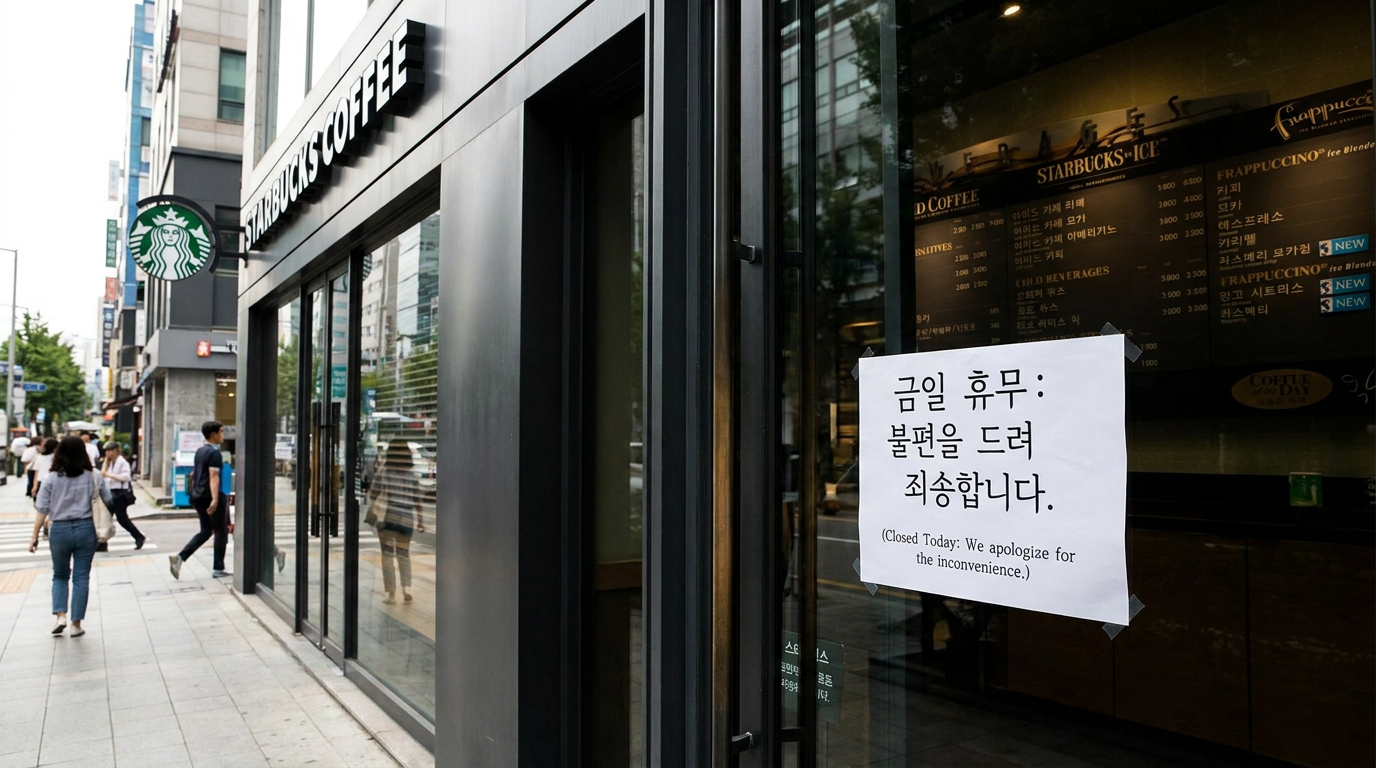
A disastrous promotional campaign evoking a 1980 pro-democracy massacre led to the firing of Starbucks Korea's CEO and the unprecedented half-day closure of 2,000 stores for mandatory history training.
By Factlen Editorial Team
- Pro-Democracy Advocates
- Views the campaign as a severe insult to the victims of the Gwangju Uprising and a symptom of corporate historical illiteracy.
- Corporate Management
- Views the incident as an unintentional procedural failure exacerbated by automated tools.
- Marketing & Localization Analysts
- Sees the crisis as a definitive warning about the dangers of using AI for copywriting without rigorous human oversight.
What's not represented
- · Front-line Starbucks Baristas
- · AI Tool Developers
Why this matters
As multinational brands rely increasingly on automated marketing tools and rapid-fire promotions, the Starbucks Korea incident serves as a stark warning about the financial and reputational costs of bypassing human cultural oversight.
Key points
- Starbucks Korea launched a 'Tank Day' promotion on the anniversary of the 1980 Gwangju Uprising, inadvertently evoking the military tanks used to crush pro-democracy protests.
- The campaign's AI-generated slogan echoed a notorious police cover-up of a student activist's torture and death in 1987.
- The cultural misstep triggered a massive consumer boycott, with customers smashing merchandise and deleting loyalty apps.
- Shinsegae Group fired Starbucks Korea CEO Son Jung-hyun on the day the campaign launched and issued a public apology.
- Over 2,000 Starbucks locations across South Korea closed for half a day to mandate historical awareness training for all employees.
On May 18, 2026, Starbucks Korea launched a seemingly routine online promotion designed to sell a new line of large-capacity reusable cups. Within hours, the marketing campaign triggered a nationwide consumer boycott, the immediate firing of the regional chief executive, and a highly publicized apology from a billionaire corporate chairman. The incident has since become a textbook example of the risks associated with automated marketing and the profound importance of cultural localization. The campaign, branded "Tank Day," offered steep discounts on "Tank" tumbler sets to highlight their spacious volume. However, the launch date coincided exactly with the 46th anniversary of the 1980 Gwangju Uprising, a deeply painful chapter in South Korean history when the military dictatorship deployed troops and tanks to violently suppress student-led pro-democracy demonstrations.[1][2][4][6]
The use of the word "tank" on this specific memorial day immediately evoked the brutal military crackdown, sparking outrage across the nation. Official figures report that 165 civilians were killed during the ten-day suppression, though victims' groups and historians have long maintained that the true death toll is significantly higher. For decades, the Gwangju Uprising has stood as a solemn catalyst for the democratization of South Korea, which finally held free elections in 1987. Launching a retail promotion that inadvertently referenced the very weapons used against civilians on the anniversary of their deaths was viewed not just as a mistake, but as a profound insult to the nation's democratic foundation.[1][2][4]
The cultural misstep was severely compounded by the campaign's promotional copy, which included the slogan "thwack it on the table" or "set it down on the table with a loud 'Tak!'". To international observers or automated translation tools, this might appear to be harmless onomatopoeia describing the satisfying sound of placing a heavy cup on a desk. In South Korea, however, the phrase echoed a notorious and highly sensitive police cover-up from 1987. During the height of the dictatorship era, a South Korean student activist named Park Jong-chul was tortured to death during a police interrogation.[1][4][6]
Authorities initially attempted to hide the murder from the public by claiming the student had simply died of shock because an interrogating officer had "hit the desk with a thwack." The phrase remains a deeply painful cultural trigger, synonymous with state violence and the suppression of truth. The revelation that a sophisticated global brand had inadvertently combined references to military tanks and the "thwack" cover-up on the anniversary of the Gwangju massacre left the public demanding answers. Shinsegae Group, the massive retail conglomerate that operates Starbucks in South Korea under a licensing agreement, was forced to explain how the campaign bypassed internal review.[1][2][6]

The mechanism of the failure reveals a critical vulnerability in modern multinational retail operations. Shinsegae Group disclosed that marketers had consulted an artificial intelligence tool for copywriting suggestions, which generated the offensive "thwack" slogan. The AI-generated copy and the "Tank Day" branding were then passed up the corporate ladder for approval. According to internal investigations, senior executives signed off on the campaign without properly reviewing the attached marketing materials. The e-commerce team was reportedly heavily focused on driving sales velocity, leaving the marketing strategy to be approved without the appropriate cultural scrutiny or human oversight that would have immediately flagged the historical sensitivities.[1][6]
The mechanism of the failure reveals a critical vulnerability in modern multinational retail operations.
The public reaction to the campaign was swift, visceral, and highly visible. Outraged customers filmed themselves smashing Starbucks-branded mugs and tumblers, posting the videos across social media platforms. Thousands of users deleted the company's loyalty apps and cashed out their prepaid balances in protest. Demonstrations erupted outside storefronts, and several government ministries announced they were cutting ties with the coffee chain. The controversy quickly reached the highest levels of government, with prominent South Korean political figures—including those attending Gwangju memorial ceremonies—publicly condemning the campaign. Politicians labeled the promotion a grotesque commercial exploitation that diminished the sacrifices of pro-democracy victims and insulted the nation's history.[1][3][4][5]
Facing an unprecedented public relations crisis, Shinsegae Group went into immediate damage control. On the very day the campaign launched, the conglomerate fired Starbucks Korea Chief Executive Officer Son Jung-hyun, holding him directly responsible for the oversight. The promotion was pulled from all platforms within hours, but the reputational damage had already triggered a sharp drop in nationwide sales. A week later, Shinsegae Group Chairman Chung Yong-jin held an emergency press conference to address the escalating boycott. Bowing deeply before a room full of cameras, the billionaire executive took full responsibility for the "inappropriate marketing" and pleaded with the public not to direct their anger at front-line baristas and store employees who had no role in the campaign.[1][2][5][6]
In a drastic move to rebuild public trust and ensure internal reform, Shinsegae announced an operational reset that had never been attempted in the brand's local history. The company declared that all 2,000-plus Starbucks locations across South Korea would close their doors at 3:00 p.m. on June 22. This half-day shutdown marked the first time the chain had closed all its outlets simultaneously since entering the South Korean market in 1999. The closure was not a symbolic pause, but a logistical necessity to mandate comprehensive retraining for the entire corporate and retail workforce.[2][3][5]

During the nationwide closure, every employee—from part-time baristas to the highest-ranking executives, including Chairman Chung Yong-jin—was required to undergo mandatory "historical awareness and social sensitivity" training. The curriculum was specifically designed to cover major events in contemporary Korean history, focusing heavily on the democratic uprisings and the ethical responsibilities of corporate marketing. Shinsegae stated that the shutdown was intended to demonstrate the absolute seriousness with which the conglomerate viewed the incident. By forcing executives to sit through the same historical lectures as entry-level staff, the company aimed to rebuild a corporate culture that respects the cultural weight of the nation's past, rather than viewing it merely as a backdrop for retail promotions.[1][2][3]
The financial toll of the operational reset is substantial, reflecting the tangible cost of cultural negligence. The half-day closure alone is estimated to cost Starbucks Korea approximately 2.1 billion won, or roughly 1.4 million dollars, in lost sales, according to data firm IGAWorks. This immediate revenue hit compounds the broader, unquantified losses driven by the ongoing consumer boycott and the destruction of brand loyalty. For a company that has historically occupied a safe, neutral space in South Korean daily life—serving as a ubiquitous hub for studying, working, and socializing—the sudden politicization of the brand represents a severe structural threat to its market dominance.[1][6]

The "Tank Day" incident highlights a growing tension in global marketing as multinational corporations increasingly lean on artificial intelligence for rapid content generation. AI tools are highly efficient at producing catchy slogans and optimizing e-commerce copy for volume, but they fundamentally lack historical context, emotional intelligence, and cultural memory. When these automated systems are paired with a corporate culture that prioritizes speed over scrutiny, the risk of catastrophic brand damage multiplies. The Starbucks Korea crisis serves as a definitive case study in modern localization, proving that human oversight cannot be bypassed in the pursuit of efficiency.[1][6]
Ultimately, the fallout from the May 18 promotion demonstrates that cultural context cannot be fully automated or treated as an afterthought. For global brands operating in regions with complex and painful modern histories, localization must go beyond simple translation to encompass a deep understanding of national trauma and social triggers. The unprecedented response by Shinsegae Group—sacrificing millions in revenue to mandate historical education—acknowledges that a single unvetted phrase can unravel decades of carefully built brand equity in a matter of hours. The incident stands as a stark warning that in the era of AI-assisted marketing, cultural sensitivity remains a uniquely human imperative.[1][2][6]
How we got here
May 15, 2026
Starbucks Korea e-commerce team finalizes the 'Tank Day' promotion using AI-generated copy.
May 18, 2026
The campaign launches on the anniversary of the Gwangju Uprising, sparking immediate boycotts; Starbucks Korea CEO is fired.
May 26, 2026
Shinsegae Group Chairman Chung Yong-jin holds an emergency press conference to publicly apologize.
June 22, 2026
Over 2,000 Starbucks locations across South Korea close for half a day to conduct mandatory history training.
Viewpoints in depth
Corporate Management
Argues the incident was an unintentional oversight caused by a failure in the internal review process and over-reliance on automated marketing tools.
Shinsegae Group and Starbucks global headquarters have framed the 'Tank Day' campaign as a catastrophic but entirely unintentional administrative failure. From this perspective, the crisis was born out of an e-commerce team prioritizing sales velocity and leaning too heavily on AI-generated copywriting without sufficient human review. Executives argue that the failure was procedural rather than ideological, pointing to the fact that senior managers approved the campaign without opening the attached marketing materials. Their unprecedented response—firing the CEO and closing 2,000 stores for retraining—is presented as proof of their commitment to correcting these systemic blind spots.
Pro-Democracy Advocates
Views the campaign as a severe insult to the victims of the Gwangju Uprising and a symptom of corporate historical illiteracy.
For activists, victims' families, and political figures, the campaign was not merely a procedural error but a grotesque display of corporate historical illiteracy. This camp argues that using the word 'tank' on the anniversary of a military massacre, combined with a slogan echoing a notorious police torture cover-up, demonstrates a profound disrespect for the foundational traumas of South Korean democracy. They view the incident as evidence that massive conglomerates have become detached from the cultural realities of the citizens they serve, treating painful national history as irrelevant to the pursuit of profit.
Marketing & Localization Analysts
Sees the crisis as a definitive warning about the dangers of using AI for copywriting without rigorous, culturally aware human oversight.
Industry analysts view the Starbucks Korea boycott as a watershed moment in the era of automated marketing. This perspective emphasizes that while artificial intelligence can rapidly generate catchy slogans and optimize campaigns for engagement, it fundamentally lacks cultural memory and emotional intelligence. Analysts argue that the crisis exposes the hidden costs of prioritizing efficiency over localization. They warn that as global brands increasingly deploy AI tools across diverse international markets, the need for rigorous, localized human oversight is more critical than ever to prevent automated systems from triggering deep-seated cultural traumas.
What we don't know
- Whether Starbucks Korea will fully recover its lost market share and brand loyalty following the boycott.
- The specific AI copywriting tool that generated the offensive 'thwack' slogan.
- If Shinsegae Group will implement new software guardrails to prevent AI from generating culturally insensitive copy in the future.
Key terms
- Gwangju Uprising
- A 1980 pro-democracy movement in South Korea that was violently suppressed by the military dictatorship.
- Park Jong-chul
- A South Korean student activist whose 1987 death by torture during police interrogation helped spark nationwide pro-democracy protests.
- Shinsegae Group
- A major South Korean retail conglomerate that operates Starbucks locations in the country under a licensing agreement.
- Localization
- The process of adapting a product, brand, or marketing campaign to the specific cultural and historical context of a target market.
Frequently asked
Why did Starbucks Korea close its stores?
The company closed over 2,000 locations for half a day to mandate 'historical awareness and social sensitivity' training for all employees following a highly offensive marketing campaign.
What was the 'Tank Day' controversy?
Starbucks launched a promotion for a 'Tank' tumbler on the anniversary of the 1980 Gwangju Uprising, inadvertently evoking the military tanks used to crush pro-democracy protests.
Did artificial intelligence play a role in the campaign?
Yes. Shinsegae Group revealed that marketers used an AI tool to generate the promotional slogan, which accidentally referenced a notorious 1987 police cover-up.
Was the CEO of Starbucks Korea fired?
Yes. Shinsegae Group fired Starbucks Korea CEO Son Jung-hyun on the same day the controversial campaign was launched.
Sources
Source coverage
6 outlets
3 viewpoints surfaced






[1]The GuardianPro-Democracy Advocates
Starbucks Korea CEO dismissed over ad evoking massacre of pro-democracy protesters
Read on The Guardian →[2]Al JazeeraMarketing & Localization Analysts
Coffee chain to hold 'historical awareness' training after backlash against marketing campaign
Read on Al Jazeera →[3]South China Morning PostCorporate Management
Starbucks' South Korean staff to receive history lesson after 'Tank Day' blunder
Read on South China Morning Post →[4]ThairathPro-Democracy Advocates
South Koreas Starbucks CEO Fired Over Tank Day Campaign Tied to Gwangju Massacre Anniversary
Read on Thairath →[5]ABC News AustraliaMarketing & Localization Analysts
Starbucks in South Korea will close all 2000 of its stores for half a day
Read on ABC News Australia →[6]Global NewsCorporate Management
Starbucks South Korea saw a significant slump in sales this week after it released an ad campaign evoking a deadly military crackdown
Read on Global News →

More in lifestyle
See all 6 stories →Cognitive Endurance
The 5-Minute Rule: New 19,000-Person Study Finds Hourly Movement Breaks Are the Optimal Balance for Productivity and Mood
6 sources

Digital Romance
The Algorithmic Matchmaker: How AI-Driven, Swipeless Dating is Displacing the $10 Billion App Industry
8 sources

Computational Gastronomy
The Science of AI-Designed Food: How Stanford's 'BurgerAI' is Inventing Personalized, Sustainable Recipes
7 sources

Home Electrification
The Electrification Mandate: How New Building Codes and Federal HVAC Rules Are Reshaping the American Home
7 sources

Every angle. Every day.
Get lifestyle stories with full source coverage and perspective breakdowns delivered to your inbox.