
Supreme Court Enters Final Week With Rulings Pending on Presidential Power and Birthright Citizenship
The justices are set to issue their final decisions of the term, including landmark cases that could redefine executive authority and the 14th Amendment's citizenship clause.
By Factlen Editorial Team
- Civil Rights & Immigration Advocates
- Argue that the 14th Amendment's text is absolute regarding birthright citizenship and warn against expanding unilateral executive power beyond congressional limits.
- Administration Supporters
- Argue that the president requires broad authority to secure the nation and that the 14th Amendment has been misinterpreted to grant citizenship to the children of undocumented immigrants.
- Legal Institutionalists
- Focus on the structural implications for the balance of power, analyzing how these rulings will alter the relationship between the executive and legislative branches.
What's not represented
- · Undocumented families directly affected by the potential citizenship ruling
- · Local election officials managing voter rolls amid shifting citizenship definitions
Why this matters
These impending decisions will legally define the boundaries of the president's ability to act unilaterally and could potentially strip automatic citizenship from millions of children born to undocumented immigrants, fundamentally altering American constitutional law and demographics.
Key points
- The Supreme Court has 14 cases left to decide before its summer recess begins in early July.
- A major pending case will determine the extent of the president's unilateral authority over domestic policy funding.
- Another landmark case challenges the long-held interpretation of the 14th Amendment regarding birthright citizenship.
- Security has been significantly increased around the Court ahead of the expected rulings and anticipated protests.
The United States Supreme Court enters the final week of its 2025-2026 term on Monday, with fourteen cases remaining on the docket. Among the pending decisions are two landmark constitutional disputes that could fundamentally reshape the balance of power in Washington and redefine the parameters of American citizenship. Chief Justice John Roberts is expected to lead the bench in handing down the remaining opinions over the next several days, concluding a term defined by high-stakes clashes between the executive branch and constitutional precedent.[1][3]
At the center of the legal storm is a major test of presidential authority. The Court is expected to rule on whether the White House possesses the unilateral executive power to bypass congressional appropriations for border security initiatives and mass deportation logistics. The administration has argued that emergency declarations grant the executive branch broad latitude to redirect federal funds when national security is at stake, a position that lower courts have deeply divided over during the appeals process.[2][7]
Legal analysts note that a broad ruling in favor of the administration would significantly expand the modern presidency, effectively shielding certain executive actions from legislative oversight and the traditional power of the purse. Conversely, a narrow ruling or a defeat could severely hamstring the administration's domestic agenda for the remainder of the term, forcing the White House to negotiate directly with a fractured Congress for enforcement funding.[4][8]

Equally consequential is the pending decision on birthright citizenship. The justices are weighing a direct challenge to the long-standing interpretation of the 14th Amendment, which has historically granted automatic United States citizenship to anyone born on American soil, regardless of their parents' immigration status. The case stems from executive actions aimed at halting the issuance of passports and Social Security numbers to children born domestically to undocumented parents.[3][6]
Equally consequential is the pending decision on birthright citizenship.
The administration's legal team has argued that the phrase "subject to the jurisdiction thereof" in the Citizenship Clause was never intended to apply to the children of undocumented immigrants or temporary foreign workers, asserting that foreign nationals remain subject to the political jurisdiction of their home countries. Civil rights groups and immigration advocates have warned that altering this interpretation would instantly render millions of future children stateless and upend over a century of established legal precedent dating back to the 1890s.[2][6]
The business community is also watching the docket closely, warning of secondary economic effects. Major agricultural, construction, and technology sectors have expressed concern that a sudden shift in citizenship rules could disrupt the long-term labor market and create massive compliance and verification burdens for employers nationwide. Industry groups have filed multiple amicus briefs urging the Court to consider the economic destabilization that could follow a sudden reversal of citizenship norms.[5]

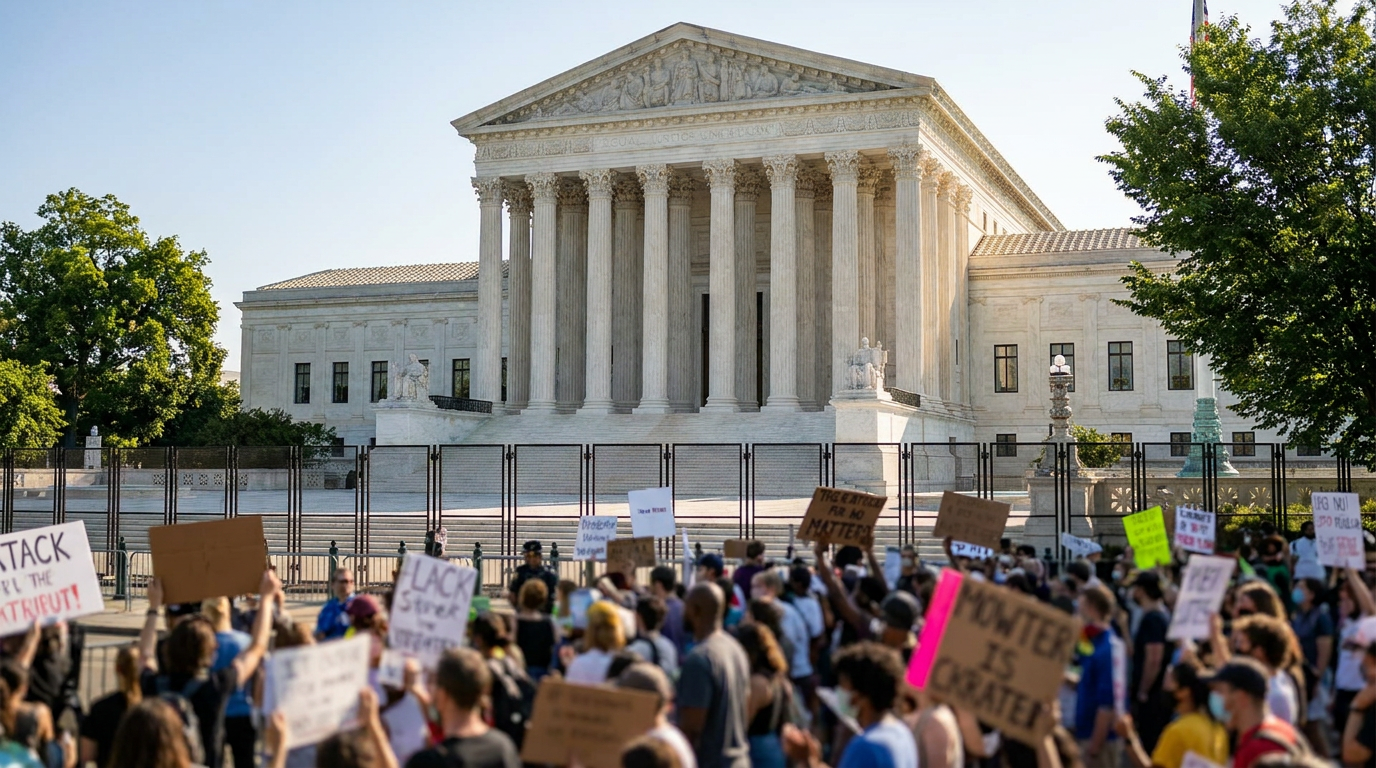
In anticipation of the rulings, security around the Supreme Court building has been heavily fortified. Non-scalable barricades have been erected along First Street, and the Capitol Police have increased their presence across the complex. Both supporters and opponents of the administration's policies have begun gathering on the surrounding lawns, preparing for what are expected to be massive, highly polarized demonstrations once the opinions are officially handed down.[1][7]
The Court traditionally issues its final opinions by the end of June or the first few days of July before recessing for the summer. The remaining decisions will be announced from the bench starting Tuesday morning, setting the stage for immediate political and legal fallout. With the midterm election cycle rapidly approaching, the outcomes of these cases will likely provide the central organizing principles for both major political parties heading into November.[4][8]
How we got here
1868
The 14th Amendment is ratified, establishing the Citizenship Clause to guarantee rights for formerly enslaved people.
1898
The Supreme Court rules in United States v. Wong Kim Ark, cementing birthright citizenship for children of foreign citizens born in the US.
Jan 2025
The administration issues new executive orders challenging the scope of birthright citizenship and redirecting federal funds.
Oct 2025
The Supreme Court agrees to hear the consolidated challenges to the administration's executive actions.
June 2026
The Court enters its final week of the term to issue the definitive rulings on these constitutional questions.
Viewpoints in depth
Executive Branch Advocates
Argue that the modern presidency requires broad authority to secure the nation and that the 14th Amendment has been historically misinterpreted.
Supporters of the administration's legal strategy argue that the executive branch must have the flexibility to redirect funds during national security emergencies without waiting for a gridlocked Congress. On the issue of citizenship, they maintain that the authors of the 14th Amendment included the phrase 'subject to the jurisdiction thereof' specifically to exclude the children of foreign nationals who owe allegiance to another sovereign power. They argue that correcting this interpretation is necessary to restore the original intent of the Constitution and disincentivize illegal immigration.
Constitutional Originalists & Civil Rights Groups
Argue that the 14th Amendment's text is absolute regarding birthright citizenship and warn against expanding unilateral executive power.
Civil rights advocates and many constitutional scholars argue that the 14th Amendment was explicitly written to guarantee citizenship to anyone born on US soil, pointing to over a century of legal precedent affirming this right. They warn that stripping birthright citizenship would create a permanent underclass of stateless residents. Furthermore, they argue that allowing the executive branch to bypass congressional appropriations violates the separation of powers, effectively granting the president the ability to legislate and fund initiatives by fiat.
Business & Labor Markets
Focused on the economic stability and workforce implications of altering citizenship and immigration enforcement rules.
Industry leaders and economic analysts are primarily concerned with the destabilizing effects these rulings could have on the US labor market. Major sectors that rely heavily on immigrant labor, such as agriculture and construction, warn that redefining citizenship could lead to massive workforce shortages and complex new compliance burdens for employers. They argue that sudden shifts in constitutional interpretations regarding citizenship create an unpredictable business environment that threatens long-term economic growth.
What we don't know
- Exactly which days the specific rulings will be released this week.
- How broadly or narrowly the justices will rule on the executive power question.
- Whether a ruling striking down birthright citizenship would apply retroactively or only to future births.
Key terms
- 14th Amendment
- A constitutional amendment ratified in 1868 that grants citizenship to 'all persons born or naturalized in the United States, and subject to the jurisdiction thereof.'
- Birthright Citizenship
- The legal right to citizenship for all children born in a country's territory, regardless of the immigration status of their parents.
- Executive Authority
- The power granted to the President under Article II of the Constitution to enforce laws, manage the federal government, and direct national security.
- Docket
- The official schedule of proceedings and pending cases waiting to be heard or decided by a court.
Frequently asked
When will the Supreme Court release these decisions?
The Court is expected to release its final decisions by the end of June or early July, with opinion days typically scheduled for Tuesday and Thursday mornings.
What happens if birthright citizenship is struck down?
If the Court rules in favor of the administration, children born in the US to undocumented immigrants would no longer automatically receive US citizenship, likely prompting immediate legislative battles over their legal status.
Can the President's executive actions be appealed further?
No. The Supreme Court is the highest court in the federal judiciary, and its rulings on constitutional matters are final unless overturned by a subsequent constitutional amendment or a future Supreme Court decision.
Sources
Source coverage
8 outlets
3 viewpoints surfaced








[1]ReutersLegal Institutionalists
Supreme Court braces for final week of term with executive power on the docket
Read on Reuters →[2]Fox NewsAdministration Supporters
SCOTUS to decide on birthright citizenship and presidential authority in historic final week
Read on Fox News →[3]The New York TimesCivil Rights & Immigration Advocates
In Final Week, Supreme Court Poised to Issue Landmark Rulings on 14th Amendment and Executive Power
Read on The New York Times →[4]SCOTUSblogLegal Institutionalists
Term limits: What to expect in the final days of the 2025-2026 Supreme Court term
Read on SCOTUSblog →[5]The Wall Street JournalAdministration Supporters
Markets Watch Closely as Supreme Court Prepares Rulings on Presidential Authority
Read on The Wall Street Journal →[6]NPRCivil Rights & Immigration Advocates
Millions wait as Supreme Court readies decisions on birthright citizenship and presidential powers
Read on NPR →[7]PoliticoLegal Institutionalists
The stakes for the White House as SCOTUS enters its final stretch
Read on Politico →[8]The Washington PostCivil Rights & Immigration Advocates
Supreme Court's final week could fundamentally alter the balance of power in Washington
Read on The Washington Post →
More in news politics
See all 6 stories →Election Integrity
FACT CHECK: State Audits and Think Tank Data Refute Claims of 'Rampant' Non-Citizen Voting
7 sources
AI Misinformation
FACT CHECK: Manipulated Audio Falsely Claims Vice President Vance Criticized Elon Musk
6 sources
Drug Policy
DEA Begins Formal Hearing on Rescheduling Marijuana to Schedule III
8 sources
Voter Trust
New Poll: Voter Confidence in Election Accuracy Plummets to Pre-2024 Levels Amid Integrity Rhetoric
8 sources

Every angle. Every day.
Get news politics stories with full source coverage and perspective breakdowns delivered to your inbox.