
Canada Opens 6.1% Tariff Quota for Chinese EVs, Triggering US Border Threats
Canada has broken with US trade policy by allowing 49,000 Chinese electric vehicles to enter annually at a sharply reduced 6.1% tariff. The move aims to lower EV prices and boost agricultural exports, but has sparked fierce pushback and border threats from Washington.
By Factlen Editorial Team
- Canadian Trade Strategy
- Leveraging limited market access to boost agricultural exports and force domestic EV manufacturing investments.
- US Protectionism
- Prioritizing the defense of the domestic auto industry and viewing the Canadian quota as a severe supply chain security risk.
- Consumer Access
- Emphasizing the urgent need for affordable, sub-$35,000 electric vehicles to accelerate adoption.
- Domestic Labor
- Warning that opening the door to Chinese imports threatens North American manufacturing jobs and union stability.
What's not represented
- · Chinese Automakers' Global Strategy
- · Canadian Agricultural Producers
Why this matters
This policy divergence shatters the unified North American auto market, giving Canadians access to affordable electric vehicles while leaving US buyers behind a 100% tariff wall. It also sets the stage for a high-stakes trade showdown that could disrupt cross-border supply chains and reshape where the next generation of cars is manufactured.
Key points
- Canada replaced its 100% tariff on Chinese EVs with a 6.1% rate for an annual quota of 49,000 vehicles.
- The agreement secured a massive reduction in Chinese retaliatory tariffs on Canadian agricultural exports, including canola.
- By 2030, more than half of the imported Chinese EVs must be priced under C$35,000 to target budget-conscious buyers.
- The policy requires Chinese automakers to establish local manufacturing or joint ventures in Canada within three years.
- US officials have threatened to block border infrastructure, fearing the quota creates a backdoor into the North American market.
For decades, the United States and Canada have operated as a single, highly integrated automotive market, moving in lockstep on regulations, safety standards, and trade barriers. When Washington erected a 100 percent tariff wall against Chinese electric vehicles to protect domestic manufacturing, Ottawa quickly followed suit. But in 2026, that unified front has fractured. Canada has officially opened a controlled gateway for Chinese automakers, creating a stark policy divergence at the 49th parallel and triggering a complex geopolitical standoff over the future of North American transportation.[1][3]
The shift stems from a landmark strategic partnership signed in January 2026 by Canadian Prime Minister Mark Carney and Chinese leadership in Beijing. Under the new framework, Canada is replacing its blanket 100 percent surtax with a managed tariff-rate quota. The policy allows up to 49,000 Chinese-built electric vehicles to enter the country annually subject only to a 6.1 percent most-favored-nation tariff.[1][3][6]
This 6.1 percent rate restores the baseline tariff levels that existed before the bilateral trade frictions of 2024. While the United States and the European Union have both deployed heavy tariffs to block the influx of low-cost Chinese EVs, Canada is betting that it can harness the benefits of affordable imports while using a strict volume cap to shield its domestic industry from being entirely overwhelmed.[3][6]
The 49,000-unit quota is designed as a controlled valve rather than an open floodgate. According to federal officials, this volume represents less than 3 percent of the Canadian new vehicle market, roughly matching the pre-tariff import levels seen in 2023 when vehicles like the Shanghai-built Tesla Model 3 flowed freely into the country. The cap is scheduled to gradually expand to 70,000 units over the next five years.[1][4]

For Canadian consumers, the policy is explicitly aimed at solving the EV affordability crisis. While buyers in Europe and Asia have access to capable electric vehicles priced well under $25,000, North Americans have largely been trapped in a premium market where the cheapest electric options often start north of $40,000. Chinese manufacturers, benefiting from massive scale and vertical integration of battery supply chains, have achieved cost structures that legacy Western automakers currently cannot match.[6]
To ensure the quota actually benefits budget-conscious buyers, the agreement includes a specific affordability mandate. By 2030, more than 50 percent of the vehicles imported under the 6.1 percent tariff must have an import price of less than C$35,000. This targets the exact entry-level segment that domestic automakers have struggled to serve profitably.[1][7]
However, the quota was not born solely out of a desire for cheaper cars; it was the linchpin of a massive agricultural trade swap. In exchange for opening its auto market, Canada secured a dramatic reduction in Chinese retaliatory tariffs on its agricultural exports. Beijing agreed to slash duties on Canadian canola seed from roughly 85 percent down to 15 percent, while also lifting restrictions on Canadian lobster and crab, unlocking billions of dollars for Canadian producers.[1][4][5]

However, the quota was not born solely out of a desire for cheaper cars; it was the linchpin of a massive agricultural trade swap.
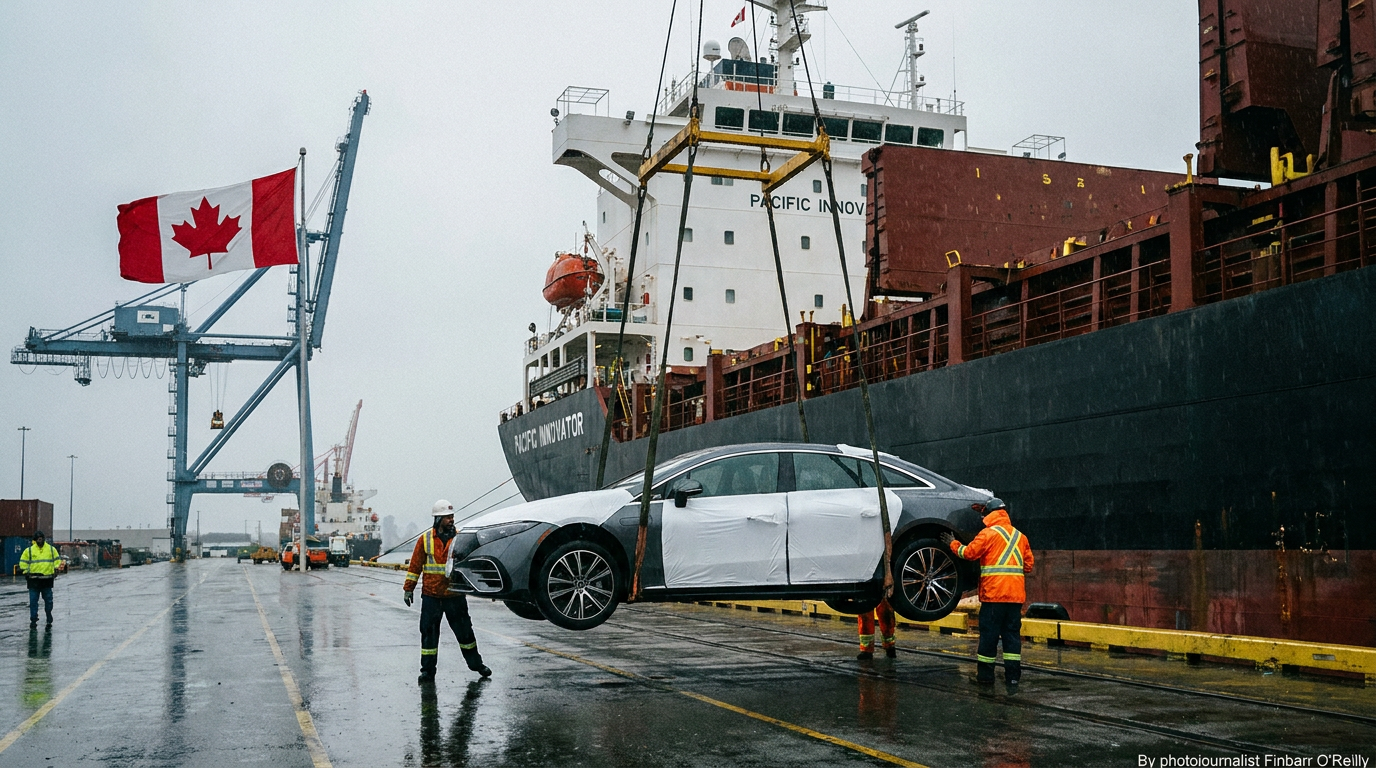
The first vehicles to utilize the new quota are already en route. In July 2026, Geely will ship its Lotus Eletre electric SUVs to Canada, marking the first Chinese-owned and Chinese-built models to reach retail buyers under the new framework. While the high-end Lotus is far from the budget EVs promised by the deal, it serves as the regulatory icebreaker, with mass-market brands like BYD and Chery actively working through Transport Canada certification for future rollouts.[4]
The arrival of Geely's vehicles in Montreal highlights the jarring contrast with US policy. Just days before the Lotus shipment was announced, the US Commerce Department effectively banned Geely's Polestar brand from the American market. Under the stringent Connected Vehicle Rule, the US is barring vehicles equipped with Chinese-developed software or hardware, pushing the effective barrier to entry past 125 percent and forcing Polestar to halt US sales by the 2027 model year.[4]
Washington has viewed Canada's quota with deep suspicion, fearing it creates a "backdoor" for Chinese technology to infiltrate the integrated North American supply chain. US trade officials and industry groups representing legacy automakers have warned that the agreement complicates long-term investment decisions and undermines the protective moat the US has attempted to build around its domestic battery sector.[2][7]
The tension has already spilled over into physical infrastructure. US politicians, including Michigan Senate candidate Mike Rogers, have urged the Trump administration to use the newly completed Gordie Howe International Bridge as leverage. The $4.7 billion span linking Ontario and Michigan recently saw its ribbon-cutting abruptly canceled, with US officials threatening to block the bridge's opening unless Ottawa offers concessions on the Chinese EV quota.[5]

Despite the political rhetoric, the fear of a literal backdoor—where consumers buy cheap Chinese EVs in Canada and drive them south—is largely unfounded. US customs regulations, the 100 percent Section 301 tariff, and the sweeping Connected Vehicle software bans make it virtually impossible to legally import, register, or operate a Canadian-bought Chinese EV in the United States.[4][5]
Behind the scenes, Canada's strategy is far more calculated than simply trading car market share for canola exports. Buried within the January framework is a clause designed to force industrial investment. The agreement requires Chinese automakers utilizing the quota to establish local manufacturing or joint ventures in Canada within three years of entry.[2][5]
Ottawa is effectively using the 49,000-unit quota as bait. By offering a taste of the lucrative North American market, the Canadian government hopes to compel giants like BYD or CATL to set up assembly plants and battery facilities on Canadian soil. The goal is to force technology transfer and build a domestic supply chain that relies on Canadian labor and resources, mimicking the joint-venture requirements China itself used to build its auto industry decades ago.[1][2][5]

This high-stakes gamble has faced fierce domestic opposition. Labor unions like Unifor and provincial leaders, including Ontario Premier Doug Ford, have warned that the quota risks accelerating job losses and surrendering critical leverage ahead of the mandatory 2026 review of the USMCA trade pact. They argue that inviting Chinese automakers in, even with a cap, threatens Canada's privileged access to the US market, which remains its largest auto export destination.[7][8]
Yet, public sentiment suggests a growing appetite for the experiment. Recent polling indicates that 53 percent of Canadians say a vehicle's Chinese origin would not negatively affect their buying decision, prioritizing affordability and technology over geopolitical origin. This stands in stark contrast to the US, where a majority of potential EV buyers express unfavorable views of Chinese brands.[8]
As the first shipments arrive at Canadian ports, the global auto industry is watching closely. Canada has positioned itself as a controlled testing ground, attempting to balance the urgent need for affordable climate solutions with the geopolitical realities of North American trade. Whether this quota system successfully incubates a new wave of domestic manufacturing, or simply triggers a punishing trade war with Washington, will define the next decade of the automotive transition.[1][5][7]
How we got here
August 2024
Canada aligns with the US, imposing a 100% tariff on Chinese-made electric vehicles.
January 2026
Prime Minister Mark Carney signs a trade deal in Beijing, replacing the 100% tariff with a 49,000-unit quota at 6.1%.
March 2026
China slashes retaliatory tariffs on Canadian canola seed from 85% to 15%.
June 2026
US officials threaten to block the opening of the Gordie Howe bridge in retaliation for the Canadian quota.
July 2026
The first Chinese-built EVs under the new quota, Geely's Lotus Eletre, arrive in Montreal.
Viewpoints in depth
Canadian Trade Strategy
Leveraging limited market access to boost agricultural exports and force domestic EV manufacturing investments.
Proponents of the quota view it as a pragmatic masterstroke. By capping imports at 49,000 units—less than 3 percent of the market—Canada protects its domestic industry from being flooded while simultaneously solving two massive economic problems. First, it reopened the lucrative Chinese market for Canadian canola and seafood. Second, it uses the quota as 'bait' to force Chinese automakers into joint ventures, aiming to extract technology transfers and compel companies like BYD to build factories on Canadian soil.
US Protectionism
Prioritizing the defense of the domestic auto industry and viewing the Canadian quota as a severe supply chain security risk.
From Washington's perspective, any crack in the North American tariff wall is a threat. US lawmakers and legacy automakers argue that Chinese EVs benefit from massive state subsidies, making fair competition impossible. Furthermore, they view the software and hardware in these vehicles as national security vulnerabilities. The US stance is that Canada's quota undermines the integrated USMCA supply chain, prompting threats to leverage border infrastructure like the Gordie Howe bridge to force Ottawa back into alignment.
Consumer Access
Emphasizing the urgent need for affordable, sub-$35,000 electric vehicles to accelerate adoption.
Consumer advocates and environmental groups point to a glaring affordability crisis in the North American EV market, where the cheapest models often exceed $40,000. They argue that 100 percent tariffs artificially inflate prices and slow the transition away from fossil fuels. For this camp, the Canadian quota is a necessary relief valve, providing budget-conscious buyers with access to the highly capable, low-cost EVs that are already dominating European and Asian markets.
What we don't know
- Whether Chinese automakers like BYD will actually commit to building multi-billion dollar manufacturing plants in Canada, or simply max out the import quota.
- How the Trump administration will formally retaliate during the upcoming 2026 USMCA trade pact review.
- Which specific mass-market Chinese EV models will be the first to successfully clear Transport Canada's certification process.
Key terms
- Tariff-Rate Quota (TRQ)
- A trade mechanism that allows a specific quantity of imported goods to enter at a lower tariff rate, while quantities above that limit face higher duties.
- Most-Favored-Nation (MFN) Tariff
- The standard, non-discriminatory tariff rate a country applies to imports from other WTO members, which is 6.1% for autos in Canada.
- Connected Vehicle Rule
- A US regulation banning vehicles equipped with specific software or hardware developed by foreign adversaries, effectively blocking Chinese EVs.
- Joint Venture (JV)
- A business arrangement where a foreign automaker partners with a domestic company to manufacture vehicles locally, a key goal of Canada's new policy.
Frequently asked
Can I buy a Chinese EV in Canada and register it in the US?
No. US customs rules, a 100% import tariff, and the Connected Vehicle Rule's ban on Chinese automotive software make it virtually impossible to legally import and register these vehicles in the United States.
Which Chinese electric vehicles are coming to Canada first?
The first models arriving in July 2026 are luxury Lotus Eletre SUVs, built by China's Geely. Mass-market brands like BYD are currently working through Transport Canada certification and are expected to follow.
Why did Canada lower the tariff from 100% to 6.1%?
The reduction was part of a strategic trade deal. In exchange for the EV quota, China drastically reduced its retaliatory tariffs on Canadian agricultural exports, unlocking billions for Canadian canola and seafood producers.
Will Chinese companies build car factories in Canada?
It is a core goal of the policy. The trade agreement includes clauses requiring Chinese automakers to establish local manufacturing or joint ventures in Canada within three years of utilizing the quota.
Sources
Source coverage
8 outlets
4 viewpoints surfaced







[1]ElectrekConsumer Access
Canada breaks with US, slashes 100% tariffs on Chinese EVs to 6%
Read on Electrek →[2]AutoblogUS Protectionism
Driving a Chinese Car From Canada or Mexico Into America Could Be Banned
Read on Autoblog →[3]Global China EVCanadian Trade Strategy
Canada cuts 100% import tariffs to 6.1% and will allow 49,000 Chinese EVs a year
Read on Global China EV →[4]EVXLCanadian Trade Strategy
Geely Ships Lotus Evs To Canada In July While The Us Bans Its Polestar Twin
Read on EVXL →[5]Eletric-Vehicles.comUS Protectionism
A Bridge Caught in a Trade Fight
Read on Eletric-Vehicles.com →[6]CarDogConsumer Access
The 100% surtax is replaced by 6.1% tariff for vehicles within the 49,000 annual quota
Read on CarDog →[7]CBT NewsDomestic Labor
Canada is moving forward with a limited electric vehicle trade agreement with China
Read on CBT News →Canadian consumers are significantly more open to purchasing Chinese-made EVs
Read on Eletric-Vehicles.com →
Every angle. Every day.
Get automotive stories with full source coverage and perspective breakdowns delivered to your inbox.