
Gravitational Waves Reveal First 'Fingerprints' of a Black Hole's Event Horizon, Probing the 'Point of No Return'
By isolating a faint 'direct wave' from the loudest black hole merger ever recorded, scientists have successfully extracted data from the immediate edge of an event horizon. The breakthrough offers a new way to test general relativity and search for quantum gravity.
By Factlen Editorial Team
- General Relativity Traditionalists
- Astrophysicists who view the direct wave detection as a triumphant confirmation of Einstein's predictions regarding frame dragging and horizon dynamics.
- Quantum Gravity Theorists
- Physicists looking to use these horizon-level signals to find quantum fluctuations that break classical relativity and reveal new physics.
- Observational Skeptics
- Researchers who urge caution, questioning whether the faint direct wave can be reliably separated from the dominant ringdown noise.
What's not represented
- · Alternative gravity theorists who propose black hole 'mimickers' (like gravastars or boson stars) that lack true event horizons.
Why this matters
The event horizon has long been considered an impenetrable boundary that hides the deepest secrets of physics. By learning to 'read' the gravitational waves emitted right at this edge, scientists can now directly test whether Einstein's theories hold up in the universe's most extreme environments, or if new quantum laws take over.
Key points
- Scientists have isolated a 'direct wave' from a black hole merger, providing the first observational fingerprints of an event horizon.
- The discovery was made using data from GW250114, the loudest gravitational wave signal ever recorded by the LIGO observatory.
- Unlike traditional 'ringdown' signals that originate from the light ring, the direct wave is emitted from the immediate vicinity of the horizon.
- The data confirms Einstein's predictions of 'frame dragging,' where a rotating black hole twists the fabric of spacetime.
- The breakthrough offers a new practical tool to search for quantum gravity and deviations from classical physics.
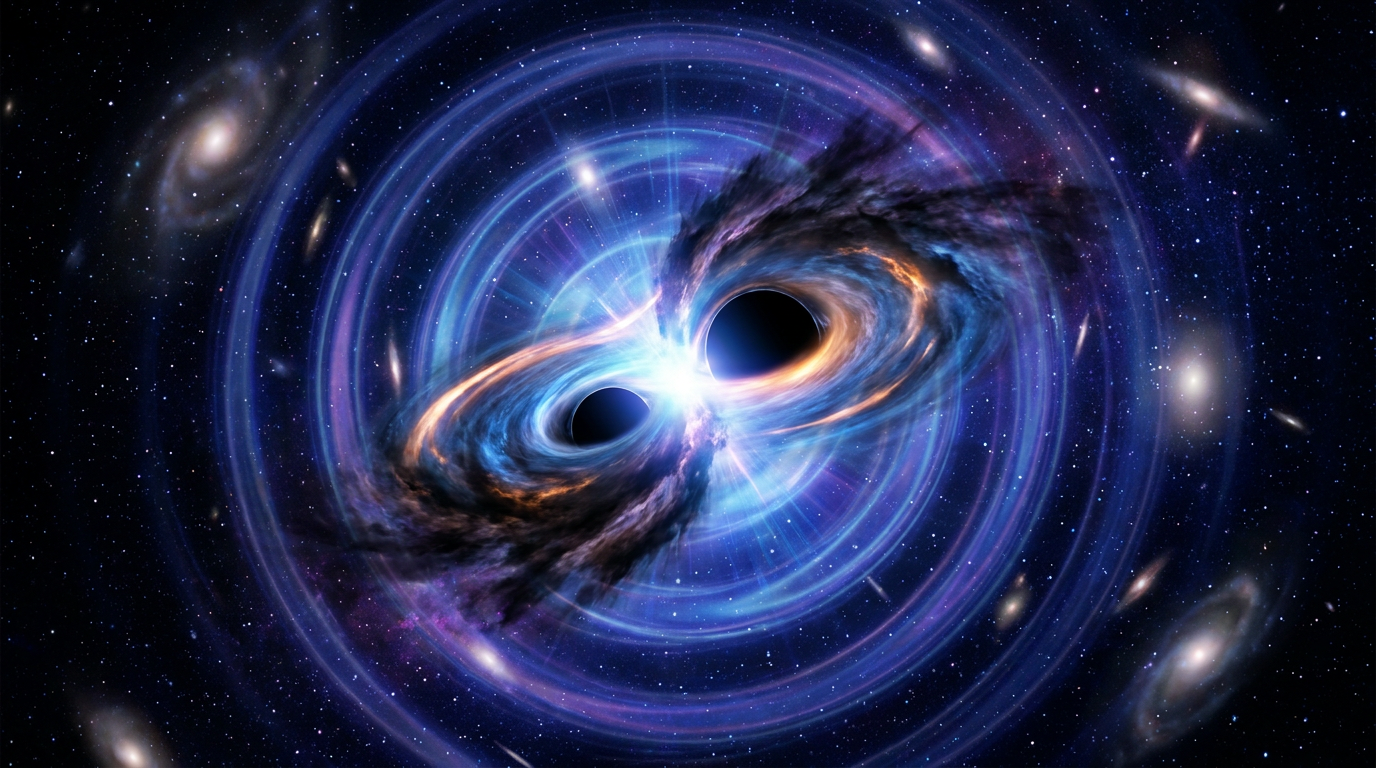
For decades, the event horizon of a black hole has stood as the ultimate cosmic veil. It is the infamous 'point of no return,' a boundary where gravity becomes so overwhelmingly powerful that nothing—not even light—can escape its grasp. Because no information can travel outward from beyond this threshold, astrophysicists have historically been forced to study black holes indirectly, observing the swirling accretion disks of superheated gas that orbit safely outside the abyss. But a landmark discovery published in the journal Nature has fundamentally altered that reality. By analyzing the most powerful gravitational wave signal ever recorded, an international team of researchers has successfully isolated the first direct 'fingerprints' of an event horizon, allowing humanity to probe the very edge of the universe's darkest phenomena.[1][2][3]
The breakthrough centers on an extraordinary cosmic collision designated GW250114, detected in January 2025 by the Laser Interferometer Gravitational-Wave Observatory (LIGO) in the United States. When two massive black holes—weighing roughly 33.6 and 32.2 times the mass of our sun—spiraled into one another billions of light-years away, they unleashed a cataclysmic storm of gravitational waves. These invisible ripples in the fabric of spacetime traveled across the universe at the speed of light before washing over Earth. According to the LIGO Scientific Collaboration, GW250114 was about three times louder than the very first gravitational wave detected a decade ago, boasting an unprecedented signal-to-noise ratio of 80. This extraordinary clarity provided researchers with an unusually pristine view of the merger's final, frantic moments.[1][4][5]

To understand why this detection is so revolutionary, it is necessary to break down how a black hole merger actually sounds to a gravitational wave observatory. The process unfolds in three distinct phases. First comes the 'inspiral,' a long, rising tone generated as the two black holes circle each other, drawing closer and spinning faster. Next is the 'merger,' the violent crescendo where the two masses finally touch and fuse into a single, highly distorted object. Finally, there is the 'ringdown.' Much like a struck bell vibrating before it settles into silence, the newly formed, lopsided black hole oscillates, emitting a fading chord of gravitational waves known as quasinormal modes until it reaches a smooth, spherical equilibrium.[2][8][9]
For years, physicists have relied on the ringdown phase to calculate the mass and spin of the newly formed black hole. However, a critical limitation has always haunted these measurements. As theoretical physicists pointed out as early as 2016, the quasinormal modes of the ringdown are not actually generated by the event horizon itself. Instead, they are primarily linked to the 'light ring'—a fragile, unstable orbit slightly further out where photons of light are trapped in circular paths by the black hole's gravity. Because the ringdown originates from the light ring, it cannot provide conclusive, direct proof of the event horizon's properties. It tells scientists what is happening near the black hole, but not exactly at the boundary.[2][8][9]
The new research led by Sizheng Ma at the Perimeter Institute for Theoretical Physics and Ling Sun at the Australian National University's OzGrav sought to bridge that exact gap. Their goal was to isolate a fleeting, hidden signal that occurs in the brief, chaotic stretch between the late inspiral and the familiar ringdown. Theoretical models had long predicted the existence of a 'direct wave'—a specific burst of gravitational energy emitted as the orbital motion of the two original black holes is suddenly dominated by the gravity of the newly formed single object. Unlike the ringdown, this direct wave is born in the immediate vicinity of the event horizon.[1][3][4]

Their goal was to isolate a fleeting, hidden signal that occurs in the brief, chaotic stretch between the late inspiral and the familiar ringdown.
Extracting this direct wave from the broader cacophony of the merger was a monumental data analysis challenge. As matter and energy get closer to the horizon of a rotating black hole, they are dragged into extremely rapid motion. At the same time, the signal they emit fades away incredibly quickly because the black hole's intense gravity redshifts and suppresses outgoing waves. Ma compared the final stage of the merger to a spoon vigorously stirring a glass of water. The resulting spacetime swirl creates ripples that carry information from the region immediately surrounding the event horizon, but observing them requires filtering out the overwhelming noise of the warped spacetime that surrounds the system.[1][3]
Thanks to the sheer volume of the GW250114 signal, the researchers were able to decipher this rapidly dimming swirl. The data they extracted provided striking evidence of 'frame dragging,' a phenomenon predicted by Albert Einstein's theory of general relativity. Frame dragging occurs when a massive, rotating object literally twists the fabric of spacetime around itself, much like a spinning top dragging a bedsheet along with its rotation. The direct wave carried the distinct signature of this twisting effect, confirming that the newly formed 62.7-solar-mass black hole was spinning rapidly, with a dimensionless spin parameter of 0.68.[1][4][6]

The ability to 'touch' the region around the horizon with gravitational data has sent ripples of excitement through the astrophysics community. Maximiliano Isi, a gravitational-wave astrophysicist at Columbia University, described the findings as a tantalizing glimpse into how space and time are woven together at a fundamental level. For decades, the event horizon has been the theoretical battleground where classical general relativity clashes with quantum mechanics. By observing the direct wave, scientists now have a practical tool to search for quantum fluctuations or deviations from Einstein's predictions, potentially unlocking new fundamental laws of physics.[2][6]
Despite the enthusiasm, the findings have also been met with rigorous scientific skepticism, a necessary component of any major physics breakthrough. Researchers like Sean McWilliams at West Virginia University have urged caution, questioning whether the specific gravitational wave frequencies analyzed by the team can be definitively separated from the broader, messy dynamics of the merger. The challenge lies in the fact that the direct wave is deeply tangled up with the subsequent quasinormal modes. Proving that the extracted signal is an uncontaminated fingerprint of the horizon, rather than an artifact of the data filtering process, will require corroboration from future merger events.[2][7]

The research team acknowledges these hurdles but remains confident in their methodology, pointing to the unprecedented 80-SNR clarity of GW250114 as the key that made the extraction possible. As next-generation gravitational wave observatories like the Cosmic Explorer and the Einstein Telescope come online in the 2030s, their vastly improved sensitivity will likely turn these rare, deafening mergers into routine detections. For now, the isolation of the direct wave stands as a monumental proof of concept. Humanity is no longer restricted to observing the shadows cast by black holes; we are finally learning to listen to the whispers of the abyss itself.[1][3][4]
How we got here
1915
Albert Einstein publishes the theory of general relativity, predicting the existence of gravitational waves.
2015
The LIGO observatory makes the first-ever direct detection of gravitational waves from merging black holes.
2016
Theoretical physicists publish papers warning that standard ringdown signals originate from the light ring, not the event horizon.
January 2025
LIGO detects GW250114, the loudest gravitational wave signal on record, providing unprecedented data clarity.
June 2026
Researchers publish findings in Nature detailing the successful extraction of the 'direct wave,' revealing the first fingerprints of the event horizon.
Viewpoints in depth
The Standard Model Consensus
Astrophysicists who view the direct wave detection as a triumphant confirmation of Einstein's predictions.
For researchers rooted in classical astrophysics, the isolation of the direct wave is a monumental victory for general relativity. The data extracted from GW250114 perfectly matches the mathematical models of frame dragging and horizon dynamics that Einstein's equations predicted over a century ago. By successfully reading the 'fingerprints' of the event horizon, this camp argues that we have definitively proven the existence of these boundaries exactly as theorized, closing a major observational gap in our understanding of the universe's most extreme environments.
The Quantum Gravity Hopefuls
Physicists looking to use these horizon-level signals to find quantum fluctuations that break classical relativity.
Theoretical physicists who focus on quantum mechanics view the event horizon not just as a boundary, but as a laboratory. Because general relativity and quantum mechanics fundamentally clash at the edge of a black hole, this camp hopes that future, even clearer direct wave detections will reveal 'echoes' or quantum fluctuations. If the event horizon behaves differently than classical physics predicts—perhaps acting more like a fuzzy quantum membrane—it would provide the first observational evidence needed to build a unified theory of quantum gravity.
The Observational Skeptics
Researchers who urge caution, questioning whether the faint direct wave can be reliably separated from the dominant ringdown noise.
Data analysis in gravitational wave astronomy is notoriously complex, and some astrophysicists remain unconvinced that the direct wave has been truly isolated. This camp points out that the direct wave is deeply entangled with the much louder quasinormal modes of the ringdown phase. They argue that the mathematical filtering required to extract the horizon's fingerprint might inadvertently create artifacts in the data. For these skeptics, while GW250114 is an extraordinary event, claiming a definitive observation of the event horizon requires corroboration from multiple future high-SNR mergers to rule out statistical noise.
What we don't know
- Whether the direct wave signal contains hidden quantum fluctuations that deviate from classical general relativity.
- If future gravitational wave detectors will be able to routinely isolate direct waves from quieter, more distant black hole mergers.
- How the exact geometry of the event horizon shifts during the chaotic micro-seconds of the merger before settling into equilibrium.
Key terms
- Event Horizon
- The theoretical boundary around a black hole from which no matter or radiation can escape.
- Gravitational Waves
- Ripples in spacetime propagating outward from accelerating massive objects, first predicted by Albert Einstein.
- Quasinormal Modes
- The fading, vibrating frequencies emitted by a newly formed black hole as it settles into a stable shape, often compared to a ringing bell.
- Light Ring
- An unstable orbital region just outside the event horizon where gravity is so strong that photons of light are forced to travel in circles.
- Frame Dragging
- A relativistic effect where a rotating mass drags the surrounding spacetime along with its rotation.
- Signal-to-Noise Ratio (SNR)
- A measure used in science and engineering that compares the level of a desired signal to the level of background noise.
Frequently asked
What is an event horizon?
The event horizon is the boundary around a black hole beyond which nothing, not even light, can escape its gravitational pull. It is often called the 'point of no return.'
What are gravitational waves?
Gravitational waves are invisible ripples in the fabric of spacetime caused by some of the most violent and energetic processes in the universe, such as colliding black holes.
Why is the GW250114 signal special?
Detected in January 2025, GW250114 is the loudest gravitational wave signal ever recorded, with a signal-to-noise ratio of 80. This extreme clarity allowed scientists to isolate faint signals that are usually lost in the noise.
What is 'frame dragging'?
Frame dragging is a phenomenon predicted by Einstein where a massive, rotating object (like a spinning black hole) twists the fabric of spacetime around itself as it turns.
Sources
Source coverage
9 outlets
3 viewpoints surfaced








[1]NatureGeneral Relativity Traditionalists
Observation of direct waves from a black hole event horizon
Read on Nature →[2]Factlen Editorial TeamQuantum Gravity Theorists
Synthesis by Factlen editorial team
Read on Factlen Editorial Team →[3]Perimeter Institute for Theoretical PhysicsGeneral Relativity Traditionalists
Researchers detect first 'fingerprints' of a black hole event horizon
Read on Perimeter Institute for Theoretical Physics →[4]OzGravGeneral Relativity Traditionalists
A louder crash, a closer look: GW250114 reveals horizon physics
Read on OzGrav →[5]LIGO Scientific CollaborationGeneral Relativity Traditionalists
GW250114: The loudest gravitational-wave signal to date
Read on LIGO Scientific Collaboration →[6]Columbia University AstrophysicsQuantum Gravity Theorists
Expert commentary on frame dragging and event horizon signatures
Read on Columbia University Astrophysics →[7]West Virginia University PhysicsObservational Skeptics
Skepticism remains on direct wave extraction from GW250114
Read on West Virginia University Physics →[8]Physical Review LettersObservational Skeptics
Is the Gravitational-Wave Ringdown a Probe of the Event Horizon?
Read on Physical Review Letters →[9]Max Planck Institute for Gravitational PhysicsObservational Skeptics
A black hole rings like a bell: Quasinormal modes in binary mergers
Read on Max Planck Institute for Gravitational Physics →

More in science
See all 5 stories →Neural Lineage
Fundamental 'Lineage Rule' Discovered for How Brain Cells Organize During Development
7 sources
Crop Yields
Landmark Study Quantifies Climate-Driven Food Crisis: Global Crop Yields to Fall 4.4% Per Degree of Warming
6 sources

Particle Physics
Construction Begins on Electron-Ion Collider to Create First 3D Map of the Proton's Interior
6 sources
Every angle. Every day.
Get science stories with full source coverage and perspective breakdowns delivered to your inbox.