
The First-Ever Tornado Code: How the New IBC Mandate is Rewriting Structural Engineering
For the first time in U.S. history, the 2024 International Building Code requires new schools, hospitals, and emergency facilities to be explicitly engineered to withstand tornado forces.
By Factlen Editorial Team
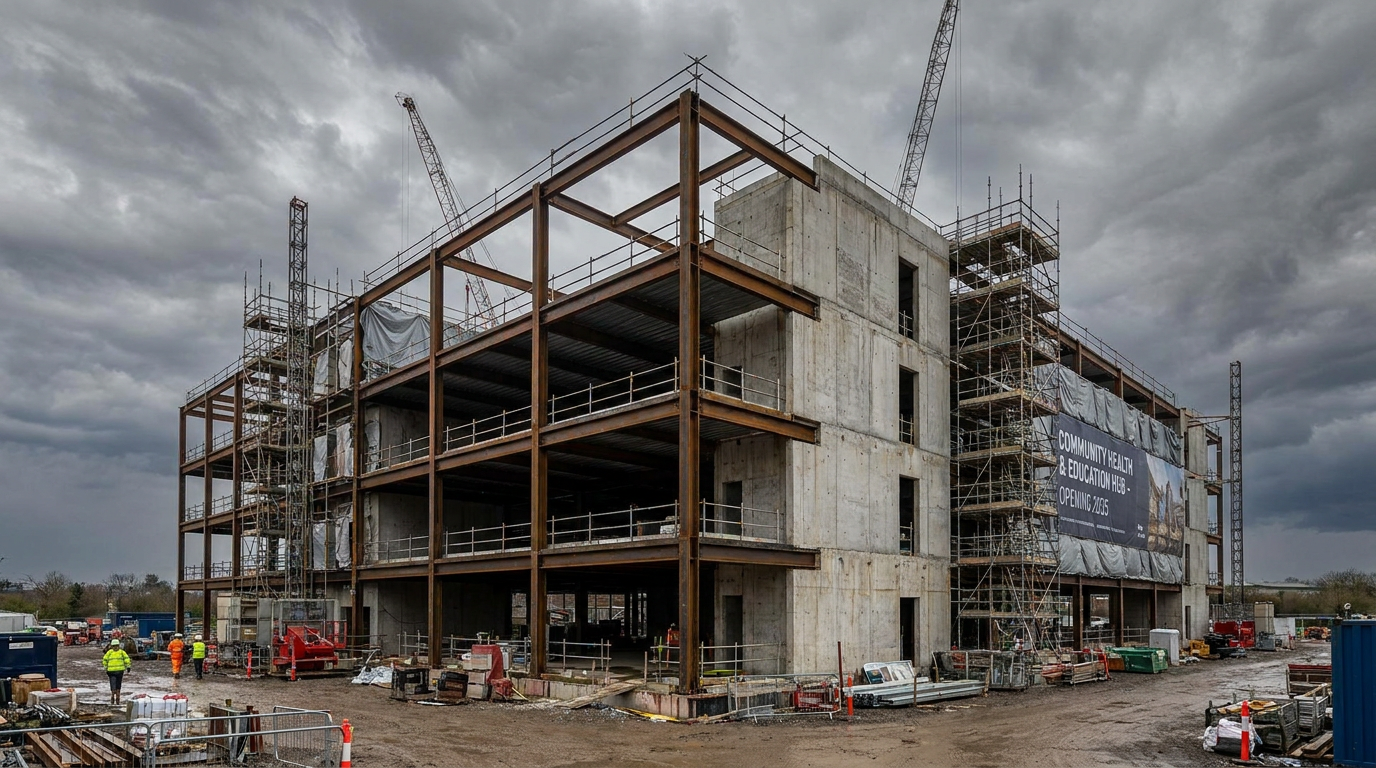
- Structural Engineers
- Prioritizing standardized, mathematically sound life-safety minimums for critical infrastructure.
- Municipal Planners
- Balancing the upfront costs of enhanced construction against long-term community resilience.
- Resilience Researchers
- Advocating for data-driven building codes that adapt to shifting extreme weather patterns.
What's not represented
- · Residential Homebuilders
- · Local Taxpayers
Why this matters
For the first time, the buildings communities rely on most during a disaster—hospitals, schools, and fire stations—must be mathematically engineered to survive a tornado. This quiet regulatory shift will save countless lives by ensuring that critical infrastructure remains standing when the sirens sound.
Key points
- The 2024 International Building Code introduces the first-ever mandatory tornado design requirements for critical infrastructure.
- The rules apply exclusively to Risk Category III and IV buildings, such as schools, hospitals, and emergency response centers.
- Engineers must now design for Atmospheric Pressure Change (APC), the vacuum effect that causes roofs to tear off during a vortex.
- The code targets EF0 to EF2 tornadoes, which account for 97% of all recorded tornadic events, rather than attempting to resist EF5 storms.
- While upfront construction costs will marginally increase, the mandate is expected to drastically reduce post-storm recovery expenses and save lives.
In May 2011, a massive EF5 tornado tore through Joplin, Missouri, killing 161 people and leveling schools, businesses, and a major medical center. In the aftermath, structural engineers and researchers from the National Institute of Standards and Technology (NIST) descended on the city to study the failures. They discovered a glaring blind spot in American infrastructure: none of the city's commercial buildings had been designed specifically to withstand tornadoes. For decades, the structural engineering community had treated tornadoes as anomalous, worst-case acts of nature that were simply too complex to design against. Buildings were engineered to resist the straight-line winds of hurricanes or severe thunderstorms, but the unique, twisting physics of a tornado vortex were entirely absent from the national building codes. The Joplin tragedy catalyzed a fundamental rethinking of how America builds in high-risk zones, launching a decade-long research initiative to quantify tornadic forces and translate them into actionable engineering standards.[1][5]
Fifteen years after Joplin, that research has officially become law in municipalities across the United States. The 2024 International Building Code (IBC)—the foundation for local building regulations across the country—is currently moving through its standard adoption cycle, taking effect in city councils and state legislatures throughout 2026. For the first time in U.S. history, the IBC includes explicit, mandatory tornado wind load design criteria. This represents a paradigm shift in structural engineering, fundamentally altering the blueprints for critical infrastructure. While the code does not mandate that every new structure become an impenetrable concrete bunker, it requires a calculated, proactive defense against the most common tornadic threats, ensuring that the buildings communities rely on most will remain standing.[3][6]
The engine driving this regulatory shift is a document known as ASCE 7-22, published by the American Society of Civil Engineers. Titled "Minimum Design Loads and Associated Criteria for Buildings and Other Structures," the 2022 edition introduced a brand-new section: Chapter 32, Tornado Loads. Prior to this addition, engineers designing a hospital in Tornado Alley would calculate the regional straight-line wind speeds—perhaps 115 miles per hour—and design the structural frame and roof connections to resist that specific lateral force. Chapter 32 introduces a secondary, parallel calculation. Engineers must now determine the site-specific tornado wind speed, calculate the unique aerodynamic pressures generated by a vortex, and compare those figures against the straight-line wind loads. The building must be constructed to resist whichever force is greater, effectively establishing a new baseline for structural resilience in the Midwest and South.[2][4]

Crucially, the new tornado mandate does not apply to every new construction project. The International Code Council deliberately targeted the regulations at structures where failure poses the greatest risk to human life and community recovery. The requirements apply exclusively to Risk Category III and Risk Category IV buildings. Risk Category III encompasses structures with high occupancy loads, such as schools, nursing homes, large theaters, and community assembly halls holding more than 250 people. Risk Category IV covers essential facilities that must remain operational during and immediately after a disaster, including hospitals, fire stations, police stations, and emergency response centers. By focusing on these critical assets, the code ensures that vulnerable populations are protected and that the civic infrastructure necessary for post-storm recovery survives the initial impact.[3][4]
The geographic application of the new code is equally targeted. The IBC defines a specific "tornado-prone region" where the Chapter 32 calculations are mandatory. This region is broadly defined as the entire United States east of the Continental Divide. However, the actual design wind speeds are highly localized, utilizing a massive geodatabase of historical tornado tracks and frequencies. A new Risk Category IV hospital built in Dallas, Texas, or Oklahoma City will face significantly higher tornado design wind speeds than a similar facility built in upstate New York or eastern Pennsylvania. If the localized tornado design wind speed falls below 60 miles per hour, the tornado load calculations are waived, as standard straight-line wind provisions will naturally provide sufficient structural capacity.[3]
The geographic application of the new code is equally targeted.
One of the most common misconceptions about the new mandate is that it attempts to make buildings "tornado-proof" against apocalyptic EF4 or EF5 storms. In reality, the engineering community took a highly pragmatic, data-driven approach. The ASCE 7-22 tornado speeds for Risk Category III and IV structures range from 60 to 138 miles per hour, which roughly corresponds to the wind speeds of EF0, EF1, and EF2 tornadoes on the Enhanced Fujita scale. While an EF5 tornado captures the headlines, historical data reveals that approximately 97 percent of all recorded tornadoes are rated EF2 or lower. By calibrating the code to resist these vastly more common events, engineers can drastically reduce the overall loss of life and property without imposing financially ruinous construction costs on local school boards and healthcare networks.[2][4]
Designing for a 130-mph tornado is fundamentally different from designing for a 130-mph hurricane, owing to the complex fluid dynamics of a rotating vortex. Straight-line winds hit a building laterally, creating positive pressure on the windward wall and negative pressure on the leeward wall and roof. A tornado, however, is a rapidly rotating column of air that subjects the building to rapidly shifting wind directions, extreme updrafts, and a phenomenon known as Atmospheric Pressure Change (APC). Because the air inside the tornado vortex is spinning so fast, the barometric pressure drops precipitously at the center of the funnel. When this low-pressure core passes over a sealed, climate-controlled building, the higher-pressure air trapped inside the structure violently expands outward, attempting to equalize with the storm.[2][6]

This Atmospheric Pressure Change is responsible for the explosive structural failures often seen in tornado footage, where roofs appear to pop off and walls blow outward. To counteract APC, the new code requires engineers to account for massive increases in uplift forces. In some scenarios, the combined effect of tornadic updrafts and internal pressurization can increase the uplift load on a roof by a factor of two or more compared to standard wind loads. To keep the roof attached, structural engineers must design a robust "continuous load path"—a heavily reinforced chain of connections tying the roof trusses to the walls, the walls to the foundation, and the foundation deep into the earth. Every bracket, anchor bolt, and weld must be upsized to handle the violent vertical pull of the vortex.[2][4]
The building envelope—the windows, doors, and exterior cladding—also faces heightened scrutiny under the new provisions. If a window shatters during a tornado, the wind rushes in, instantly pressurizing the interior and exacerbating the APC effect, often leading to immediate roof failure. To prevent this cascading collapse, essential facilities like hospitals in high-risk zones are increasingly required to utilize impact-resistant glazing or protective shutter systems. While schools are not strictly mandated by the base code to use impact-resistant glass, many districts are voluntarily adopting it to maintain the integrity of the building envelope. If standard glass is used, the engineer must assume the windows will fail and design the internal structure as a "partially enclosed" building, which requires even stronger internal connections to survive the resulting pressure spike.[1][6]

It is vital for community leaders and the public to understand the distinction between a building designed to the new IBC tornado loads and a dedicated "storm shelter." The Chapter 32 provisions are designed to prevent structural collapse and maintain the building's overall functionality during an EF2 event. They do not guarantee absolute life safety in an EF4 or EF5 monster. For absolute protection, facilities must still construct dedicated safe rooms or storm shelters that comply with a separate, much more stringent standard known as ICC 500. These shelters are designed to withstand 250-mph winds and the impact of a 15-pound wooden two-by-four traveling at 100 miles per hour. The new IBC mandate does not replace the need for ICC 500 shelters in schools; rather, it ensures the rest of the school doesn't collapse around the shelter during a moderate storm.[2][3]
The financial impact of the new mandate has been a subject of intense discussion among municipal planners and developers. Upgrading a facility to meet the Chapter 32 tornado loads does increase upfront construction costs, primarily due to the need for heavier steel connections, thicker roof decking, and enhanced glazing. However, engineering cost-benefit analyses indicate that the premium is relatively small—often representing less than a two percent increase in the total project budget. For a $50 million high school, the added cost of tornado resilience is a fraction of the cost of a new athletic stadium. In exchange, the community receives a structure that is vastly more likely to survive the region's most common severe weather events, protecting the lives inside and drastically reducing post-storm recovery and rebuilding expenses.[1][6]

As the 2024 IBC becomes the law of the land in 2026, the insurance industry is taking close note. Facilities built to the new ASCE 7-22 standards represent a significantly lower risk profile for catastrophic loss. Over time, this enhanced resilience is expected to translate into more favorable insurance premiums for school districts and healthcare systems, helping to offset the initial construction premium. Furthermore, the successful implementation of these codes for critical infrastructure is already sparking conversations about the future of residential construction. While single-family homes and apartment buildings are currently exempt from the tornado mandate, the engineering framework now exists. As the materials and hardware required for tornado resilience become standardized and cheaper, it is highly likely that future code cycles will begin extending these life-saving protections to the homes where Americans sleep.[6]
How we got here
May 2011
An EF5 tornado devastates Joplin, Missouri, prompting federal researchers to investigate the widespread failure of commercial buildings.
2014
NIST publishes its final technical investigation of the Joplin tornado, recommending the development of performance-based tornado design standards.
December 2021
The American Society of Civil Engineers publishes ASCE 7-22, introducing the first-ever chapter dedicated to calculating tornado loads.
Late 2023
The International Code Council officially adopts the ASCE 7-22 tornado provisions into the 2024 International Building Code (IBC).
2026
Local and state jurisdictions across the tornado-prone regions of the U.S. actively adopt and enforce the 2024 IBC, making the provisions law.
Viewpoints in depth
Structural Engineers & Code Officials
Prioritizing standardized, mathematically sound life-safety minimums for critical infrastructure.
For decades, the engineering community viewed tornadoes as anomalies too complex and powerful to codify. This camp views the ASCE 7-22 update as a monumental triumph of post-disaster research. By finally quantifying the fluid dynamics of a vortex—specifically Atmospheric Pressure Change—engineers can now apply standard mathematical formulas to tornado resilience. They emphasize that while the code doesn't guarantee a building will survive a direct hit from an EF5, establishing a baseline defense against the 97 percent of tornadoes that are EF2 or weaker is the most effective way to protect public safety at scale.
Municipal Planners & School Boards
Balancing the upfront costs of enhanced construction against long-term community resilience.
Local governments and educational districts are the entities actually paying for these structural upgrades. While they broadly support enhanced life safety, this camp is highly focused on the cost-benefit analysis of the new mandates. Upgrading a new high school to resist tornado loads requires heavier steel, specialized hardware, and expensive impact-resistant glazing, which can add millions to a project budget. However, planners increasingly view this premium as a necessary insurance policy. By investing slightly more upfront, they secure civic assets that will survive moderate storms, drastically reducing post-disaster recovery costs and ensuring that community shelters remain intact when they are needed most.
Resilience & Climate Researchers
Advocating for data-driven building codes that adapt to shifting extreme weather patterns.
Disaster researchers and meteorologists focus on the statistical reality of extreme weather. This camp points to the data gathered after the 2011 Joplin tornado, which proved that the vast majority of structural failures in a tornado's path are caused by moderate wind speeds on the outer edges of the vortex, not the extreme winds at the dead center. They argue that the new building codes represent a vital shift from reactive disaster response to proactive climate adaptation. Furthermore, as 'Tornado Alley' historically shifts eastward into more densely populated regions of the Southeast, researchers view these mandatory code updates as a critical defense mechanism for vulnerable, expanding communities.
What we don't know
- How quickly all 50 states will fully adopt and enforce the 2024 IBC without local amendments that weaken the tornado provisions.
- Whether future code cycles will eventually extend these mandatory tornado load requirements to Risk Category II structures, such as single-family homes.
Key terms
- ASCE 7-22
- The 2022 edition of the national engineering standard that defines the minimum structural loads—like wind, snow, and earthquakes—a building must be designed to withstand.
- Risk Category
- A building classification system ranging from I to IV that dictates how strictly a structure must be engineered, based on the risk to human life if it fails.
- Atmospheric Pressure Change (APC)
- The rapid drop in barometric pressure inside a tornado vortex, which causes the higher-pressure air inside a building to push violently outward and upward.
- Continuous Load Path
- An unbroken chain of structural connections—using steel brackets, bolts, and ties—that anchors a building's roof to its walls, and its walls to its foundation.
- ICC 500
- The strict national standard for designing and constructing dedicated storm shelters and safe rooms capable of surviving 250-mph EF5 tornadoes.
Frequently asked
Does the new code make schools and hospitals completely tornado-proof?
No. The code ensures the building can survive EF0 to EF2 tornadoes (up to 138 mph), which account for 97% of all tornadoes. For absolute protection against EF4 or EF5 storms, a dedicated ICC 500 storm shelter is still required.
Will this new mandate make building a single-family home more expensive?
Not currently. The tornado load requirements only apply to Risk Category III and IV structures, such as schools, hospitals, and large assembly halls. Standard residential homes (Risk Category II) are exempt.
Why did it take so long to add tornadoes to the building code?
For decades, tornadoes were considered too unpredictable and powerful to practically design against. It took years of post-disaster research, particularly following the 2011 Joplin tornado, to accurately quantify tornadic forces and prove that designing for moderate tornadoes was both possible and cost-effective.
Sources
Source coverage
6 outlets
3 viewpoints surfaced





[1]Engineering News-RecordMunicipal Planners
Tornado Resilience Added to International Building Code
Read on Engineering News-Record →[2]American Society of Civil EngineersStructural Engineers
ASCE 7-22 includes first-ever tornado provisions
Read on American Society of Civil Engineers →[3]International Code CouncilMunicipal Planners
2024 IBC Includes Tornado Wind Load Design Criteria
Read on International Code Council →[4]STRUCTURE MagazineStructural Engineers
Significant Structural Changes to the 2024 IBC: Environmental Loads
Read on STRUCTURE Magazine →[5]National Institute of Standards and TechnologyStructural Engineers
NIST Research Leads to First-Ever Tornado Building Codes
Read on National Institute of Standards and Technology →[6]Factlen Editorial TeamResilience Researchers
Synthesis by Factlen editorial team
Read on Factlen Editorial Team →
Every angle. Every day.
Get home stories with full source coverage and perspective breakdowns delivered to your inbox.