
Construction Begins on Electron-Ion Collider to Create First 3D Map of the Proton's Interior
The U.S. Department of Energy has officially broken ground on the $2.8 billion Electron-Ion Collider at Brookhaven National Laboratory, a next-generation facility designed to map the inner workings of the proton and solve the mystery of visible mass.
By Factlen Editorial Team
- Fundamental Physicists
- Focused on using the EIC to solve the deep theoretical mysteries of Quantum Chromodynamics, including the origin of mass and spin.
- Accelerator Engineers
- Focused on the unprecedented technical challenge of colliding highly polarized electron and ion beams at high luminosities.
- Applied Technologists
- Focused on how the extreme engineering requirements of the collider will drive downstream innovations in medical imaging and computing.
What's not represented
- · Local Long Island communities affected by the decade-long construction project.
- · Taxpayer advocates monitoring the $2.8 billion federal science investment.
Why this matters
By understanding how the strong nuclear force binds quarks and gluons, scientists hope to unlock new paradigms in fundamental physics, with downstream applications ranging from advanced medical imaging to novel materials and accelerator technologies.
Key points
- Construction has officially begun on the $2.8 billion Electron-Ion Collider at Brookhaven National Laboratory.
- The facility will collide polarized electrons with protons to create the first 3D tomographic maps of the proton's interior.
- Scientists aim to solve the mysteries of how quarks and gluons generate 99% of the universe's visible mass and the proton's spin.
- The project saves billions by reusing the 2.4-mile tunnel and infrastructure from the recently retired Relativistic Heavy Ion Collider.
- The EIC is a global effort involving over 1,500 physicists from 300 institutions, with first collisions expected in the early 2030s.
The landscape of fundamental physics is undergoing a seismic shift this month as construction officially begins on the Electron-Ion Collider (EIC) at Brookhaven National Laboratory in New York. Following the planned retirement of the Relativistic Heavy Ion Collider (RHIC) earlier this year, engineers and physicists have immediately pivoted to transforming the site into the world's most advanced nuclear physics research facility. This groundbreaking marks the transition from decades of theoretical planning and design into tangible steel, concrete, and superconducting wire. The EIC represents a generational leap in our ability to probe the subatomic realm, promising to illuminate the darkest corners of the atomic nucleus. By colliding highly energetic electrons with protons and heavier ions, the facility will serve as an unprecedented precision microscope, allowing scientists to peer inside the fundamental building blocks of matter without destroying them in the process.[1][6]
Backed by a $2.8 billion investment from the U.S. Department of Energy, the EIC is the highest-priority new construction project for the American nuclear physics community. The sheer scale of the endeavor reflects the profound nature of the questions it seeks to answer. While previous generations of particle accelerators, such as the Large Hadron Collider in Europe, have excelled at discovering new fundamental particles by smashing protons together at maximum energy, the EIC is designed for surgical precision. It will be the first collider in the world capable of colliding polarized electron beams with polarized proton and ion beams. This unique capability allows researchers to control the spin alignment of the colliding particles, a crucial requirement for mapping the internal dynamics of the proton. The resulting data will provide the first true three-dimensional tomographic images of the proton's interior, moving far beyond the simplistic textbook models of three static quarks.[1][2]
At the heart of the EIC's scientific mission is the quest to understand Quantum Chromodynamics (QCD), the theory that describes the strong nuclear force. The strong force is the most powerful of the four fundamental forces of nature, responsible for binding quarks together to form protons and neutrons, and ultimately holding atomic nuclei intact. Despite its central role in the existence of all visible matter, the strong force remains notoriously difficult to calculate and understand in dynamic environments. The EIC will act as a dedicated laboratory for QCD, allowing physicists to observe how quarks and the gluons that bind them interact in real-time. By systematically varying the energy and polarization of the collisions, researchers hope to map the distribution and movement of these particles within the nucleon, much like how a medical MRI scanner builds a 3D image of the human brain from a series of 2D slices.[1][5]

One of the most profound mysteries the EIC aims to solve is the origin of visible mass in the universe. When the Higgs boson was discovered in 2012, it completed the Standard Model of particle physics by explaining how fundamental particles like electrons and quarks acquire their mass. However, the mass of the three valence quarks inside a proton accounts for barely one percent of the proton's total mass. The remaining 99 percent does not come from the Higgs mechanism; rather, it emerges dynamically from the staggering binding energy of the strong force. According to Einstein's famous equation, E=mc², the immense energy of massless gluons pulling and stretching against the quarks manifests as the physical mass of the proton. The EIC will provide the first direct measurements of how this energy is distributed, effectively explaining how the universe generates the bulk of the mass we interact with every day.[4][6]
Equally perplexing is the decades-old "proton spin crisis," a puzzle that has confounded physicists since the late 1980s. Spin is a fundamental quantum property of particles, akin to intrinsic angular momentum, and it dictates how particles behave in magnetic fields—a property exploited daily in medical magnetic resonance imaging. For a long time, physicists assumed that the spin of a proton was simply the sum of the spins of its three constituent quarks. However, landmark experiments revealed that the quarks contribute only about 30 percent of the proton's total spin. The remaining 70 percent must come from the gluons and the orbital angular momentum of the particles swirling around inside the proton at near light-speed. Because the EIC can precisely control the polarization of both the electron and proton beams, it is uniquely equipped to measure these hidden contributions and finally balance the proton's angular momentum ledger.[1][6]
The methodology behind the EIC's precision relies on a technique known as deep inelastic scattering, but with a revolutionary 3D twist called parton tomography. In traditional colliders, smashing two protons together creates a messy spray of secondary particles, making it incredibly difficult to reconstruct the initial state of the interacting quarks and gluons. The EIC avoids this chaotic aftermath by using an electron as a clean, point-like probe. When the high-energy electron passes through the proton, it exchanges a virtual photon—a packet of electromagnetic energy—that interacts with a single quark. By carefully measuring the angle and energy of the scattered electron, physicists can deduce the exact position and momentum of the quark at the moment of impact. This delicate probing leaves the proton largely intact, allowing for a pristine reconstruction of its internal architecture.[6]

To capture these fleeting interactions, the EIC will rely on the ePIC detector, a massive, state-of-the-art instrument currently being designed by a global collaboration of scientists. The ePIC detector will completely surround the collision point, utilizing concentric layers of advanced tracking and calorimetry technologies to measure the trajectory, energy, and identity of every particle that emerges from the interaction. Building a detector capable of operating in the high-luminosity environment of the EIC requires pushing the boundaries of sensor technology. The collaboration is developing ultra-fast silicon pixel trackers, advanced particle identification systems using Cherenkov radiation, and high-resolution electromagnetic calorimeters. These systems must work in perfect concert, processing terabytes of data per second to isolate the rare scattering events that carry the most valuable information about the proton's structure.[1][5]
Building a detector capable of operating in the high-luminosity environment of the EIC requires pushing the boundaries of sensor technology.
Beyond the structure of individual protons, the EIC will also explore the behavior of gluons in larger atomic nuclei, searching for an exotic state of matter known as the Color Glass Condensate. Theoretical models of Quantum Chromodynamics suggest that as protons and nuclei are accelerated to higher energies, the number of gluons inside them rapidly multiplies. However, this unchecked proliferation cannot continue indefinitely. Physicists hypothesize that at extremely high densities, the gluons begin to recombine as fast as they split, reaching a saturated state. In this regime, the nucleus would appear as a solid wall of gluons—a Color Glass Condensate. By colliding electrons with heavy ions like gold or uranium, the EIC will create the exact conditions necessary to observe this gluon saturation, providing critical insights into the universal properties of matter at the most extreme densities.[1][6]
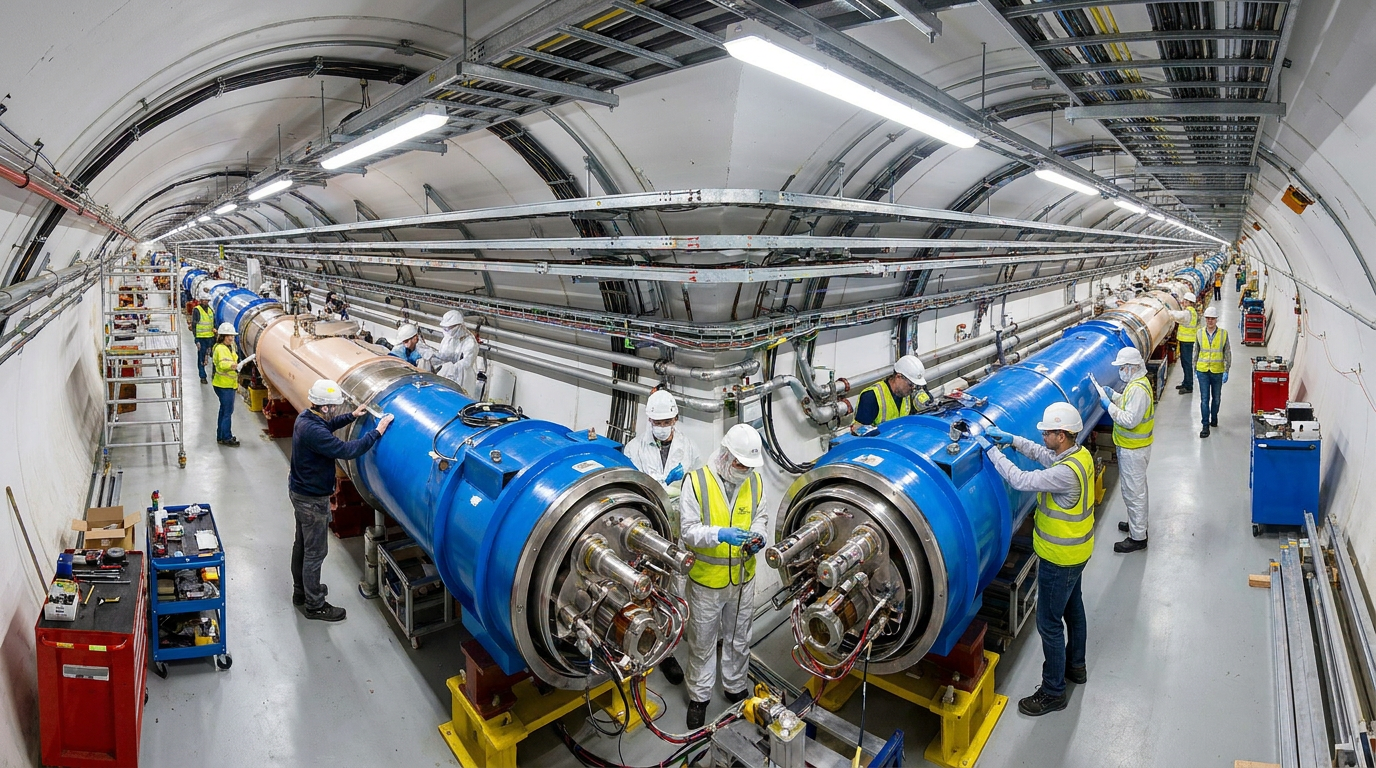
From an engineering perspective, the construction of the EIC is a masterclass in resource optimization and sustainable scientific infrastructure. Rather than digging a new tunnel and building a facility from scratch, the Department of Energy is heavily leveraging the existing infrastructure of the Relativistic Heavy Ion Collider. The EIC will reuse the 2.4-mile circular tunnel beneath the Long Island pine barrens, along with one of RHIC's superconducting ion rings, its pre-accelerator chain, and its massive cryogenic cooling systems. This strategic recycling reduces the overall cost of the project by billions of dollars and significantly accelerates the construction timeline. The primary new additions will be a high-intensity electron storage ring, a rapid-cycling synchrotron to inject the electrons, and the complex interaction regions where the two beams will be steered into head-on collisions.[1][5]

The realization of the EIC is far from a purely American endeavor; it is a testament to the highly collaborative nature of modern high-energy physics. The project has galvanized a global user community, with more than 1,500 physicists from nearly 300 laboratories and universities across 30 countries actively participating in the design and scientific planning. International partners are making substantial material and intellectual contributions to the facility. The United Kingdom's Science and Technology Facilities Council has committed significant funding to develop critical detector components, while France's CNRS and various institutions across Italy, Japan, and CERN are lending their expertise in accelerator physics and superconducting magnet design. This broad international consensus underscores the universal importance of the EIC's scientific mission and ensures that the facility will benefit from the world's best engineering talent.[1][4]
While the primary goal of the EIC is to answer fundamental questions about the nature of reality, the technological innovations required to build it will have profound downstream impacts on society. Historically, the demanding requirements of particle accelerators have driven breakthroughs in numerous applied fields. The development of high-field superconducting magnets for the EIC will directly translate to more powerful and compact MRI machines for medical diagnostics. The advanced particle tracking algorithms and ultra-fast silicon detectors designed for the ePIC experiment will find applications in national security, radiation monitoring, and non-destructive materials testing. Furthermore, the techniques developed to produce and control intense, highly polarized electron beams could revolutionize the production of medical isotopes used in targeted cancer therapies, demonstrating the tangible return on investment for fundamental science.[4][6]
The timeline for the EIC is ambitious but meticulously planned. With the formal start of construction this month, the project enters a phase of intensive civil engineering and component manufacturing. Over the next several years, industrial partners worldwide will deliver the thousands of specialized components required for the new electron ring, while teams at Brookhaven and Thomas Jefferson National Accelerator Facility assemble and test the superconducting radio-frequency cavities that will power the beams. The installation of the ePIC detector is scheduled to follow the completion of the accelerator rings. If the current schedule holds, the facility will achieve its first electron-ion collisions in the early 2030s, initiating a multi-decade research program that will systematically map the strong force across a vast range of energies and nuclear species.[4]

The economic and educational impacts of the EIC construction are already rippling through the regional and national economy. The project is creating thousands of highly skilled jobs in engineering, manufacturing, and construction, while driving investments in the local tech sector. More importantly, the EIC will serve as a premier training ground for the next generation of STEM professionals. Graduate students and postdoctoral researchers working on the EIC will gain invaluable experience in cutting-edge fields such as cryogenics, quantum computing, artificial intelligence, and big data analytics. The skills acquired while designing detectors and analyzing collision data are highly transferable, ensuring a steady pipeline of talent for the broader technology, finance, and national defense sectors long after the students have completed their physics degrees.[1][2]
The launch of the EIC construction also marks a strategic repositioning of the United States in the global landscape of particle physics. Following the closure of the Tevatron collider in 2011, the energy frontier of particle physics shifted to Europe with the operation of the Large Hadron Collider at CERN. By investing in the EIC, the United States is securing its leadership at the "luminosity and precision frontier." Rather than competing purely on collision energy, the EIC focuses on unprecedented collision rates and beam control, offering a complementary approach to the discoveries being made in Europe. This strategic divergence ensures that the global physics community has access to a diverse array of tools, each optimized to probe different aspects of the Standard Model and the forces that govern the universe.[1][2]
As the first shovels turn the earth at Brookhaven, the physics community stands on the precipice of a new era of understanding. The Electron-Ion Collider represents the culmination of decades of theoretical advancement and technological innovation, converging into a single machine capable of resolving the deepest mysteries of visible matter. By illuminating the chaotic, dynamic world of quarks and gluons, the EIC will finally explain how the mass and spin of the universe emerge from the void. It is a profound reminder that even after a century of quantum mechanics, the atomic nucleus still holds secrets waiting to be uncovered. When the first 3D maps of the proton are finally rendered in the next decade, they will not just rewrite the textbooks; they will fundamentally alter our comprehension of the fabric of reality itself.[4][6]
How we got here
2000
The Relativistic Heavy Ion Collider (RHIC) begins operations at Brookhaven, laying the groundwork for heavy ion physics.
2012
The discovery of the Higgs boson explains the mass of fundamental particles, but leaves the mass of the proton largely unexplained.
April 2024
The Department of Energy approves 'Critical Decision 3A', authorizing the purchase of long-lead components for the EIC.
Early 2026
RHIC completes its final scientific run and is officially retired to make way for the new facility.
June 2026
Construction officially begins on the Electron-Ion Collider.
Early 2030s
Projected timeline for the first electron-ion collisions and the start of the scientific program.
Viewpoints in depth
Fundamental Physicists
Focused on using the EIC to solve the deep theoretical mysteries of Quantum Chromodynamics, including the origin of mass and spin.
For theoretical and experimental physicists, the EIC represents the ultimate laboratory for Quantum Chromodynamics. While the equations governing the strong force have been known for decades, they are notoriously difficult to solve in the dynamic, highly populated environment inside a proton. Physicists argue that without the EIC's ability to precisely map the momentum and position of gluons, fundamental questions—such as how the universe generates 99% of its visible mass and where the proton gets its spin—will remain permanently unanswered. They view the facility not just as an incremental upgrade, but as a necessary paradigm shift from particle discovery to structural understanding.
Accelerator Engineers
Focused on the unprecedented technical challenge of colliding highly polarized electron and ion beams at high luminosities.
From the perspective of accelerator physicists and engineers, the EIC is a monumental technical hurdle. Colliding a beam of electrons with a beam of heavy ions, while maintaining the delicate spin polarization of both beams, has never been done before at this scale. Engineers must design novel rapid-cycling synchrotrons, ultra-precise superconducting magnets, and complex beam-cooling systems to ensure the particles collide with maximum efficiency. For this camp, the success of the EIC lies in proving that these advanced accelerator concepts can be reliably engineered, setting the stage for all future high-energy physics facilities.
Applied Technologists
Focused on how the extreme engineering requirements of the collider will drive downstream innovations in medical imaging and computing.
Technologists and industrial partners view the EIC through the lens of societal spin-offs. The extreme demands of the ePIC detector and the accelerator ring force engineers to invent new technologies that eventually trickle down to the commercial sector. This camp emphasizes that the high-field superconducting magnets developed for the collider will lead to more powerful and accessible MRI machines, while the ultra-fast silicon tracking sensors will revolutionize radiation detection and non-destructive testing. To them, the $2.8 billion investment is justified not just by fundamental physics, but by the inevitable technological dividends that will benefit medicine, computing, and national security.
What we don't know
- Whether the EIC will definitively observe the theorized Color Glass Condensate state of gluon saturation.
- Exactly how the orbital angular momentum of quarks and gluons will balance the final proton spin equation.
- What unexpected technological spin-offs will emerge from the novel detector systems being developed.
Key terms
- Quantum Chromodynamics (QCD)
- The theory in physics that describes the strong nuclear force and the interactions between quarks and gluons.
- Gluon
- A massless fundamental particle that acts as the exchange particle for the strong force, effectively 'gluing' quarks together.
- Spin
- A fundamental quantum property of particles that acts like intrinsic angular momentum, dictating how they interact with magnetic fields.
- Tomography
- A technique for displaying a representation of a cross section through a solid object, used here to build 3D maps of the proton.
- Luminosity
- In particle physics, a measure of how many particles are squeezed into a given space over time, determining the number of collisions.
Frequently asked
What is the Electron-Ion Collider?
The EIC is a next-generation particle accelerator being built in New York that will collide electrons with protons and atomic nuclei to map their internal structure.
Why do we need a new collider?
While previous colliders discovered new particles, the EIC is designed as a precision microscope to understand how known particles (quarks and gluons) interact to create mass and spin.
How much will the EIC cost?
The project is funded by the U.S. Department of Energy with an estimated cost of $2.8 billion, saving money by reusing an existing 2.4-mile tunnel.
When will the EIC be finished?
Construction began in mid-2026, and the facility is expected to achieve its first particle collisions in the early 2030s.
Sources
Source coverage
6 outlets
3 viewpoints surfaced






[1]Brookhaven National LaboratoryAccelerator Engineers
The Electron-Ion Collider: A new frontier in nuclear physics
Read on Brookhaven National Laboratory →[2]U.S. Department of EnergyAccelerator Engineers
Electron-Ion Collider Project Status and Construction
Read on U.S. Department of Energy →[3]CERNFundamental Physicists
The path to the Electron-Ion Collider
Read on CERN →[4]ePIC CollaborationFundamental Physicists
3D Imaging of Nucleons and the ePIC Detector
Read on ePIC Collaboration →[5]Science and Technology Facilities CouncilApplied Technologists
UK participation in the Electron-Ion Collider
Read on Science and Technology Facilities Council →[6]Factlen Editorial TeamApplied Technologists
Synthesis by Factlen editorial team
Read on Factlen Editorial Team →

More in science
See all 5 stories →Neural Lineage
Fundamental 'Lineage Rule' Discovered for How Brain Cells Organize During Development
7 sources
Crop Yields
Landmark Study Quantifies Climate-Driven Food Crisis: Global Crop Yields to Fall 4.4% Per Degree of Warming
6 sources

Deep-Sea Biology
Landmark Discovery Reveals Hidden Ecosystem of Worms and Bacteria Thriving Beneath Deep-Sea Hydrothermal Vents
8 sources
Every angle. Every day.
Get science stories with full source coverage and perspective breakdowns delivered to your inbox.