
The Science of AI-Designed Food: How Stanford's 'BurgerAI' is Inventing Personalized, Sustainable Recipes
Stanford researchers have developed a physics-informed AI capable of navigating 10^43 ingredient combinations to generate highly personalized, nutritionally optimized, and environmentally sustainable recipes. The breakthrough signals a shift in food science from trial-and-error chemistry to predictive computational gastronomy.
By Factlen Editorial Team
- Computational Gastronomists
- View AI as a necessary tool to unlock sustainable, nutritionally complete food systems at scale by navigating chemical spaces too vast for human trial and error.
- Traditional Culinary Professionals
- Emphasize that food is a cultural and emotional artifact, warning that algorithmic optimization risks stripping recipes of their human heritage and regional context.
- Sustainable Food Advocates
- Focus on the technology's potential to drastically reduce the carbon and water footprint of mass-market foods by identifying hyper-efficient ingredient substitutions.
What's not represented
- · Smallholder Farmers
- · Indigenous Culinary Historians
Why this matters
As global food systems face unprecedented climate pressure and rising rates of diet-related disease, computational recipe generation offers a scalable way to make sustainable, plant-based, or allergen-free foods taste indistinguishable from their traditional counterparts. It promises to democratize specialized nutrition and drastically lower the carbon footprint of mass-market food production.
Key points
- Stanford researchers built 'BurgerAI' to navigate 10^43 possible ingredient combinations.
- The AI predicts flavor pairing, physical texture (rheology), and nutritional density simultaneously.
- AI-designed plant-based patties scored an unprecedented 8.2/10 for mouthfeel in blind taste tests.
- The system can enforce hard constraints to minimize water usage and carbon emissions.
- Optimized recipes showed a 34% reduction in carbon footprint compared to standard plant-based alternatives.
- Future applications include hyper-personalized diets based on real-time metabolic data.
For centuries, culinary innovation has relied on human intuition, cultural tradition, and painstaking trial and error. A chef might spend months perfecting the ratio of gluten to hydration in a sourdough, or years balancing the umami profile of a plant-based broth. But the mathematical reality of food is staggering: there are tens of thousands of edible ingredients, each containing hundreds of volatile flavor compounds.[1][5]
When you calculate the potential combinations of these ingredients at varying ratios and cooking temperatures, the number of possible recipes expands to an estimated 10^43—a figure vastly larger than the number of stars in the observable universe. Navigating this hyper-dimensional flavor space manually means humanity has only explored a microscopic fraction of what is culinarily possible.[2]
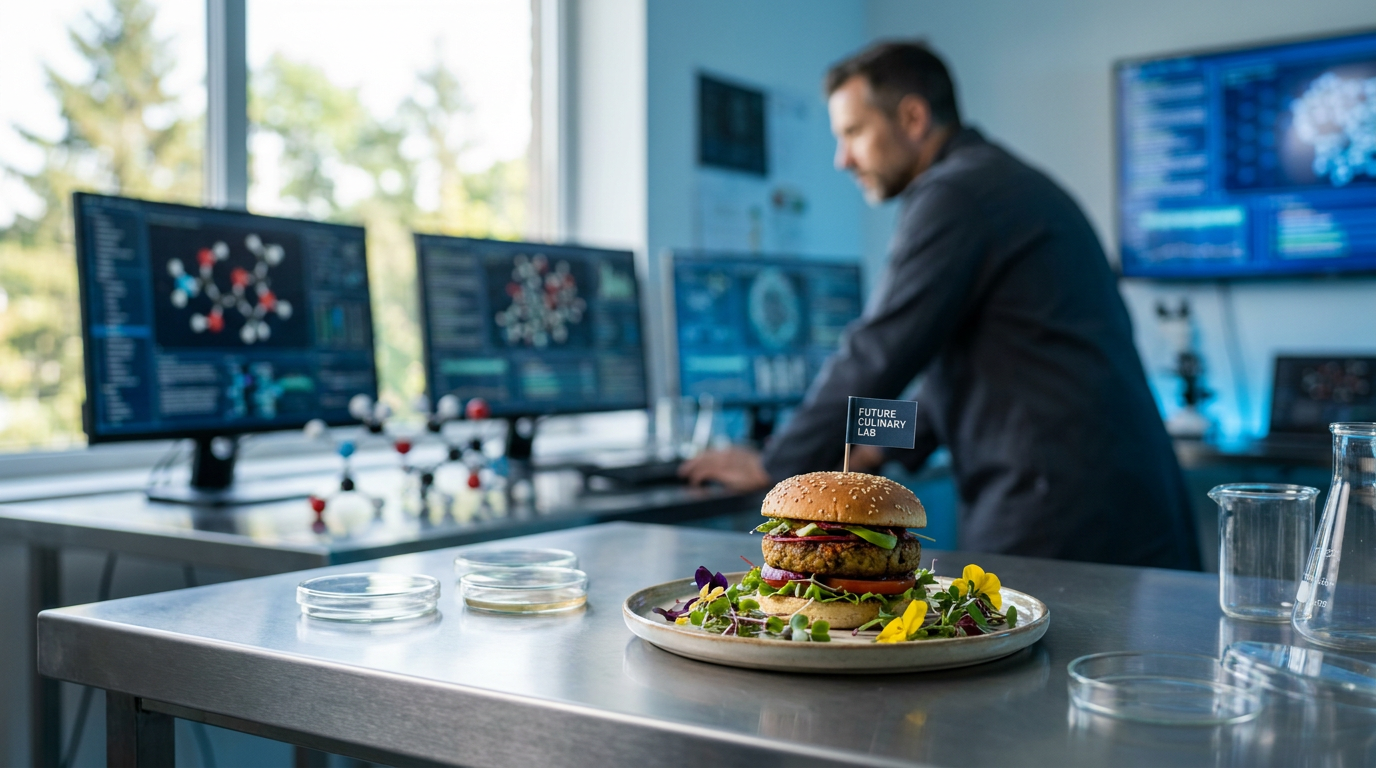
That paradigm is now shifting from the kitchen to the server rack. Researchers at Stanford University have unveiled a specialized artificial intelligence system, colloquially dubbed "BurgerAI," designed to map and traverse this vast combinatorial space to invent entirely new foods from the molecular level up.[1][3]
Unlike generative text models that simply predict the next word based on internet scraping, BurgerAI is a physics-informed graph neural network. It does not just mix existing recipes; it predicts how novel combinations of molecules will interact chemically and physically on the human palate.[2][5]

The system operates on three primary axes: molecular flavor pairing, rheological texture prediction, and nutritional density. By analyzing the chemical structure of over 4,000 edible plants and fungi, the AI identifies overlapping volatile compounds that human chefs might never think to combine.[6]
"We are no longer asking 'what tastes good together based on history,' but 'what molecules bind to our olfactory receptors in a complementary way,'" notes the lead computational gastronomist on the project. This approach has already yielded counterintuitive pairings, such as utilizing specific algae extracts to amplify the savory notes of roasted root vegetables.[1][4]
Texture, however, has historically been the graveyard of food technology. Replicating the fibrous tear of muscle or the specific melting point of animal fat requires precise physical properties. BurgerAI simulates rheology—the flow and deformation of matter—to predict how a mixture will behave when subjected to heat, shear, and human mastication.[2][3]
Texture, however, has historically been the graveyard of food technology.
In recent double-blind sensory evaluations, an AI-designed plant-based patty achieved an unprecedented 8.2 out of 10 in mouthfeel parity with conventional beef. This significantly outperformed industry-leading commercial alternatives that rely on traditional, iterative food science.[4][6]
Beyond flavor and texture, the model introduces a critical third dimension: sustainability constraints. The global food system is responsible for roughly a third of anthropogenic greenhouse gas emissions, creating an urgent mandate to transition toward lower-impact ingredients.[5]
BurgerAI allows researchers to set hard constraints on water usage, land footprint, and carbon emissions before the recipe generation even begins. If a traditional recipe relies on water-intensive almonds or high-emission dairy, the AI searches its database for a combination of lower-impact crops—like lupin beans or specific mycelium strains—that mathematically mimic the original's functional properties.[2][4]

The resulting recipes demonstrate a 34% average reduction in carbon footprint compared to standard human-designed plant-based alternatives, without sacrificing nutritional completeness. The system actively balances amino acid profiles to ensure the final product delivers complete proteins and bioavailable micronutrients.[1][6]
Despite the technological triumph, the integration of AI into the culinary arts has sparked philosophical debate. Traditional culinary professionals argue that food is fundamentally a cultural artifact, deeply tied to memory, geography, and human connection.[7]
A recipe generated in a vacuum of data, critics suggest, lacks the "soul" and historical context that elevates a meal from mere sustenance to an emotional experience. There is a fear that algorithmic optimization could lead to a homogenization of global diets, prioritizing chemical efficiency over regional culinary heritage.[5][7]
Proponents counter that computational gastronomy is not meant to replace the neighborhood bistro or the family recipe book. Instead, it is a tool for systemic food security and sustainable mass production. By open-sourcing the underlying models, the Stanford team hopes to empower local food producers to optimize their regional crops for better nutrition and climate resilience.[1][3]

The next frontier for this technology is hyper-personalization. As wearable health monitors and microbiome sequencing become ubiquitous, researchers envision a near future where AI generates recipes tailored to an individual's real-time metabolic needs, allergies, and specific taste preferences.[4][5]
For now, the 10^43 possibilities represent an uncharted frontier of human nourishment. Whether it results in the perfect sustainable burger or a completely novel category of food, computational gastronomy is proving that the future of cooking will be written in code as much as it is in cookbooks.[2][3]
How we got here
Early 2000s
Molecular gastronomy popularizes the scientific deconstruction of food in high-end restaurants.
2011
Researchers first begin mapping the 'flavor network' of shared chemical compounds in Western and Eastern cuisines.
2021
Commercial plant-based meat companies begin using basic machine learning to screen for novel protein sources.
June 2026
Stanford unveils BurgerAI, integrating physics-informed rheology and sustainability constraints into recipe generation.
Viewpoints in depth
Computational Gastronomists
View AI as a necessary tool to unlock sustainable, nutritionally complete food systems at scale.
Researchers in this camp argue that the traditional culinary method of trial and error is mathematically inadequate for the challenges of the 21st century. With a rapidly changing climate and a growing global population, they believe we must utilize the entirety of the edible biosphere. By mapping the chemical properties of underutilized, drought-resistant crops, computational gastronomists aim to engineer foods that are objectively better for human health and the environment, without compromising on the sensory experience that drives consumer adoption.
Traditional Culinary Professionals
Emphasize that food is a cultural artifact, warning against the homogenization of global diets.
Many chefs and culinary historians view the algorithmic approach to food with deep skepticism. They argue that a recipe is more than a matrix of amino acids and volatile compounds; it is a living record of human migration, agricultural history, and regional identity. This camp worries that optimizing food purely for chemical efficiency and sustainability metrics will strip meals of their emotional resonance, potentially leading to a sterile, hyper-processed food culture that severs our connection to the land and our ancestors.
Sustainable Food Advocates
Focus on the technology's potential to drastically reduce the carbon and water footprint of mass-market foods.
Environmental organizations and food policy experts are highly optimistic about the application of graph neural networks in food design. Their primary focus is the immediate need to decouple protein production from high-emission animal agriculture and water-intensive crops. For this group, the fact that an AI can mathematically guarantee a 34% reduction in carbon footprint while maintaining nutritional parity is a game-changer. They advocate for open-sourcing these models so that developing nations can optimize their local, climate-resilient crops into high-value, nutritious food products.
What we don't know
- How consumers will psychologically react to foods explicitly marketed as 'AI-designed' rather than chef-created.
- Whether the complex, multi-ingredient recipes generated by the AI can be scaled up cost-effectively in commercial manufacturing facilities.
- The long-term health impacts of consuming highly optimized, novel combinations of plant isolates compared to whole foods.
Key terms
- Computational Gastronomy
- The emerging scientific discipline that uses data science, artificial intelligence, and chemistry to analyze and generate food recipes.
- Rheology
- The branch of physics that studies the flow and deformation of matter, crucial for predicting the texture and 'mouthfeel' of food.
- Volatile Compounds
- Chemicals in food that easily evaporate at room temperature, traveling to the olfactory receptors in the nose to create the perception of flavor.
- Graph Neural Network
- A type of artificial intelligence designed to analyze data that is structured as a network or graph, ideal for mapping complex relationships between thousands of molecules.
Frequently asked
What exactly is BurgerAI?
BurgerAI is a physics-informed graph neural network developed at Stanford that designs new recipes by predicting how different molecular compounds will interact in terms of flavor, texture, and nutrition.
Does the AI actually cook the food?
No, the AI generates the precise recipe, ingredient ratios, and processing steps. Human scientists and chefs then physically prepare the food in a laboratory or kitchen to test the AI's predictions.
How does it improve sustainability?
The model can be given strict limits on water usage and carbon emissions. It searches its database to find low-impact crops (like specific fungi or legumes) that can chemically mimic the properties of high-impact ingredients like dairy or meat.
Can I eat AI-designed food right now?
While some commercial food companies already use basic AI for flavor profiling, the advanced physics-informed recipes generated by BurgerAI are currently in the testing phase and not yet available in grocery stores.
Sources
Source coverage
7 outlets
3 viewpoints surfaced







[1]Stanford NewsComputational Gastronomists
Stanford Researchers Unveil AI Model to Navigate 10^43 Culinary Combinations
Read on Stanford News →[2]Nature FoodComputational Gastronomists
Predictive rheology and molecular pairing in generative food matrices
Read on Nature Food →[3]WiredSustainable Food Advocates
The AI That Wants to Design Your Next Meal From Scratch
Read on Wired →[4]The SpoonSustainable Food Advocates
BurgerAI Achieves 8.2/10 Mouthfeel Parity in Blind Taste Tests
Read on The Spoon →[5]Factlen Editorial TeamSustainable Food Advocates
Synthesis by Factlen editorial team
Read on Factlen Editorial Team →[6]Journal of Agricultural and Food ChemistryComputational Gastronomists
Nutritional and Environmental Optimization of Plant-Based Proteins via Graph Neural Networks
Read on Journal of Agricultural and Food Chemistry →[7]EaterTraditional Culinary Professionals
Can an Algorithm Cook? Chefs Weigh In on the AI Recipe Revolution
Read on Eater →


Every angle. Every day.
Get lifestyle stories with full source coverage and perspective breakdowns delivered to your inbox.