
Copper Squeeze Threatens US AI Buildout as Geopolitical Risks and Supply Constraints Intensify
The rapid expansion of artificial intelligence data centers is colliding with a looming global copper shortage, threatening to delay U.S. infrastructure goals. As demand for power-dense AI facilities surges, complex permitting, declining ore grades, and China's dominance in smelting are creating a critical supply bottleneck.
By Factlen Editorial Team
- Market and Geopolitical Analysts
- Focuses on the structural deficit and price spikes, warning that tariffs could backfire by draining global supply.
- Hyperscalers and Tech Giants
- Prioritize speed-to-market and securing infrastructure at any cost to maintain AI leadership.
- Domestic Mining Industry
- Argues for streamlined permitting and tariffs to break reliance on foreign smelting and secure national security.
- Conservation and Indigenous Coalitions
- Opposes fast-tracking domestic mines that threaten sacred lands, ecosystems, or local water supplies.
What's not represented
- · Local municipalities facing sudden grid strain from new data centers
- · Downstream industries competing for the same copper supply
Why this matters
Copper is the irreplaceable backbone of the electrical infrastructure required to power artificial intelligence. If the U.S. cannot secure a reliable and scalable supply of this critical metal, the rapid deployment of AI technologies could stall, ceding technological and economic leadership to global rivals.
Key points
- AI data centers require significantly more copper than traditional facilities due to intense power and cooling demands.
- The U.S. faces a 29-year average permitting timeline for new copper mines, severely lagging behind global averages.
- China controls over 50% of global copper smelting capacity, creating a geopolitical vulnerability for the U.S. tech sector.
- Proposed U.S. tariffs on refined copper imports could drive prices to $15,000 per tonne by late 2026.
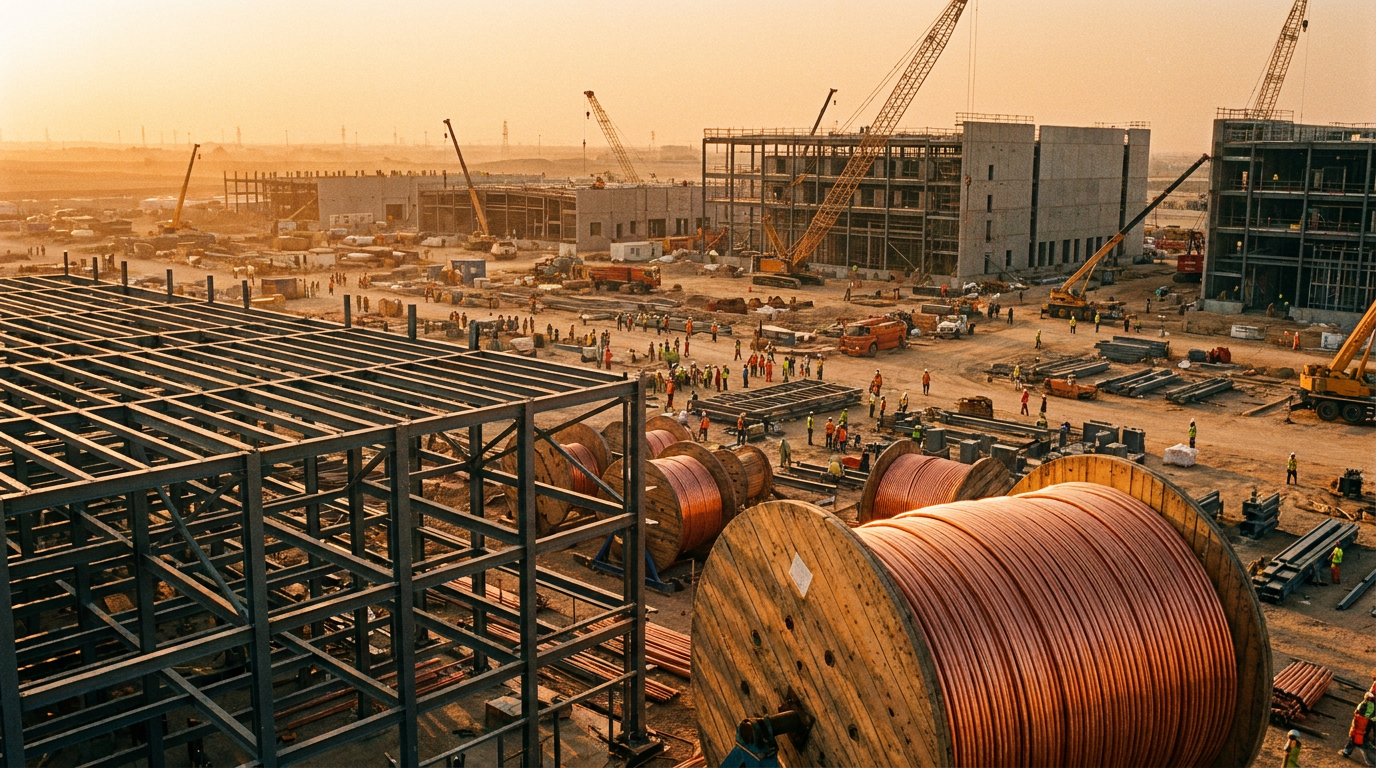
The accelerating race for artificial intelligence supremacy is colliding with a stubborn physical reality: a looming global shortage of copper. As technology giants pour billions into the infrastructure required to train and run next-generation AI models, the sheer material footprint of these facilities is straining global supply chains. Copper, a metal that has underpinned human industrialization for centuries, is now the critical bottleneck for the digital future. Without a massive expansion in copper availability, the ambitious buildout of U.S. data centers could face paralyzing delays, threatening American leadership in the global AI sector.[1][7]
The architecture of AI computing fundamentally alters the material requirements of a data center. Traditional server farms are relatively power-dense, but AI-ready facilities—powered by high-performance graphics processing units (GPUs)—operate on an entirely different scale. A conventional rack might draw 10 to 15 kilowatts of power, whereas an AI-ready rack demands 40 to 60 kilowatts. This four-to-six-fold increase in power density generates immense heat and requires significantly more robust electrical distribution systems, turning these facilities into massive copper sinks.[6][8]
Inside these hyperscale campuses, copper is the irreplaceable backbone of power delivery. The metal is heavily utilized in thick busbars, high-voltage cabling, and advanced liquid cooling systems necessary to manage the intense electrical loads and thermal output of AI training clusters. Unlike data transmission, where fiber optics have largely replaced metal wires, power delivery strictly requires copper's superior electrical and thermal conductivity. Aluminum, while cheaper and used in some broader grid applications, is simply too bulky and thermally inefficient to fit within the dense architecture of modern AI server racks.[6][8]
The numbers illustrate the scale of the challenge. Industry estimates indicate that AI data centers require roughly 27 to 33 tonnes of copper for every megawatt of installed capacity. Because modern hyperscale campuses are routinely designed in blocks of 50 to 150 megawatts, a single large-scale site can absorb between 1,500 and 2,500 tonnes of copper just for its internal systems. When accounting for the upstream grid reinforcements required to deliver that power, the total copper footprint of a single facility expands dramatically.[2][7]

This localized demand is part of a broader macroeconomic shift in energy consumption. S&P Global projects that data centers, which currently account for roughly 5% of total U.S. electricity demand, will consume up to 14% of the nation's power by 2030. Delivering this electricity requires a historic expansion of the electric grid, including new transmission lines, transformers, and substations—all of which are highly copper-intensive. The convergence of data center construction and grid expansion is creating a compounding call on copper that the current market is ill-equipped to handle.[1]
Meeting this surging demand is severely constrained by the realities of modern mining. Global copper producers are grappling with steadily declining ore grades, which have fallen by approximately 40% since 1991. To extract the same amount of refined metal, mining companies must now move and process significantly more earth, driving up capital expenditures and operational costs. Many legacy mines are reaching the end of their productive lifespans, forcing operators to either attempt costly deep-underground extensions or hunt for new deposits in increasingly remote locations.[2]
Even when new deposits are discovered, the timeline to bring them online is glacial. Globally, a typical copper mine takes 10 to 15 years to move from initial exploration to commercial production. In the United States, that timeline is even more protracted, averaging 29 to 31 years due to complex permitting processes, environmental reviews, and frequent litigation. This lag creates a severe mismatch between the rapid deployment schedules of tech companies—who measure progress in months—and the decades-long realities of heavy industrial mining.[4][8]

Even when new deposits are discovered, the timeline to bring them online is glacial.
Compounding the physical scarcity is a geopolitical chokepoint that has alarmed national security officials in Washington. While the U.S. possesses domestic copper reserves, it currently imports more than a third of its refined copper. The global supply chain is highly concentrated, with China controlling over 50% of global copper smelting and refining capacity. Beijing has spent the last decade aggressively acquiring overseas mines and processing facilities, giving it immense leverage over the refined metal essential for both AI infrastructure and modern defense systems.[3]
In response to this vulnerability, the U.S. government is weighing aggressive trade interventions. Following a Section 232 national security investigation, U.S. Commerce Secretary Howard Lutnick is reportedly preparing a recommendation for the White House to impose steep tariffs on refined copper imports. The proposed duties would start at 15% in early 2027 and escalate to 30% by 2028. The goal is to artificially raise the domestic price of copper to incentivize the construction of new U.S.-based smelting and refining facilities, thereby breaking reliance on foreign supply chains.[3]
However, market analysts warn that these tariffs could trigger severe short-term price shocks. Financial institutions like Citi and Goldman Sachs project that the combination of inelastic AI demand, constrained global supply, and new U.S. import duties could push copper prices to $14,000 or even $15,000 per metric ton by late 2026. Such a price spike would dramatically increase the capital expenditure required to build AI data centers, potentially forcing tech companies to scale back their infrastructure ambitions or pass the costs onto consumers.[3][6]

The global supply picture offers little relief. Production disruptions at major international sites, including the Grasberg mine in Indonesia and the Kamoa-Kakula project in the Democratic Republic of Congo, have repeatedly forced analysts to downgrade their near-term supply forecasts. In Latin America, which accounts for a massive share of global output, mining operations are increasingly hampered by severe droughts that limit the water necessary for processing ore, as well as growing political opposition from local communities demanding a larger share of mining revenues.[5]
Domestic efforts to boost production face similar headwinds. The Resolution Copper project in Arizona, which sits on one of the largest untapped deposits in North America, illustrates the friction between industrial strategy and environmental preservation. The deposit is located beneath land considered sacred by several Apache tribal groups. Despite billions of dollars in sunk costs and a recent Supreme Court ruling clearing a procedural hurdle, a federal appeals court froze the land-exchange process in late 2025, leaving the mine's future in legal limbo.[2][9]
Faced with these bottlenecks, the tech industry's largest players are taking aggressive steps to secure their infrastructure. Hyperscale developers are reportedly outbidding traditional utility companies for critical electrical components, such as heavy-duty transformers and switchgear, effectively hoarding the equipment necessary to power their campuses. This dynamic is creating friction between the tech sector and public utilities, as the rush to build AI data centers threatens to delay routine grid maintenance and upgrades for residential and commercial ratepayers.[2]

To mitigate the looming deficit, the industry is increasingly looking toward alternative supply streams, particularly recycling and urban mining. Companies are developing advanced techniques to reclaim copper from electronic waste, discarded appliances, and decommissioned infrastructure. While enhanced recycling is crucial and can significantly supplement primary mine output, analysts caution that it cannot single-handedly close the projected millions-of-tonnes supply gap expected by the 2030s. The sheer volume of new metal required for the energy transition and AI buildout necessitates new primary extraction.[2]
The AI copper squeeze represents a structural reset of the global commodities market. For decades, copper demand was closely tied to traditional macroeconomic indicators like housing starts and manufacturing output. Today, it is increasingly tethered to the exponential growth curve of artificial intelligence. As data centers evolve into the most critical infrastructure of the 21st century, their reliance on this ancient metal creates a permanent, high-volume floor for its valuation, fundamentally altering the economics of the mining sector.[6][7]
Ultimately, the race for AI supremacy will be dictated not just by software breakthroughs or silicon chip designs, but by the physical availability of raw materials. The United States possesses the technological edge in artificial intelligence, but maintaining that lead requires navigating a treacherous landscape of geological constraints, geopolitical rivalries, and domestic permitting battles. If the copper supply chain cannot scale to meet the ambitions of the tech sector, the AI revolution may find itself constrained by the very metal that powers it.[1][4]
How we got here
Nov 2022
ChatGPT launches, triggering an AI arms race that radically alters long-term data center power projections.
Feb 2025
The White House opens a Section 232 investigation into copper imports, citing national security risks.
Aug 2025
A federal appeals court freezes the land-exchange process for the Resolution Copper project in Arizona.
Jun 2026
U.S. Commerce Secretary Lutnick prepares a report recommending 15% to 30% tariffs on refined copper imports.
Viewpoints in depth
Hyperscalers and Tech Giants
Prioritize speed-to-market and securing infrastructure at any cost to maintain AI leadership.
For the world's largest technology companies, the race to build artificial intelligence models is an existential competition where delays are unacceptable. Developers view the copper shortage as a logistical hurdle to be cleared with capital, leading them to outbid traditional utilities for critical electrical components like transformers. Their primary concern is that permitting delays and supply chain bottlenecks will paralyze the U.S. AI buildout, allowing international rivals to close the technological gap.
Domestic Mining Industry
Argues for streamlined permitting and tariffs to break reliance on foreign smelting and secure national security.
Mining advocates argue that the U.S. possesses the geological reserves necessary to power the AI revolution but is hamstrung by a broken regulatory framework. With average permitting timelines stretching to nearly three decades, industry groups warn that the U.S. is functionally outsourcing its digital infrastructure to foreign nations. They support proposed tariffs on refined copper as a necessary, albeit painful, step to incentivize the construction of domestic smelting facilities and protect the supply chain from geopolitical leverage.
Market and Geopolitical Analysts
Focuses on the structural deficit and price spikes, warning that tariffs could backfire by draining global supply.
Financial analysts view the AI-driven copper squeeze as a structural reset of the commodities market, creating a permanent floor for high prices. However, they caution that aggressive trade interventions like tariffs could trigger severe short-term price shocks, potentially pushing copper to $15,000 per tonne. Geopolitical experts also warn that China's dominance over global smelting capacity gives Beijing a strategic chokepoint, complicating U.S. efforts to rapidly scale its digital infrastructure without triggering a broader trade war.
Conservation and Indigenous Coalitions
Opposes fast-tracking domestic mines that threaten sacred lands, ecosystems, or local water supplies.
Environmental and Indigenous groups argue that the urgency of the AI boom should not override ecological protections or tribal sovereignty. They point to projects like Resolution Copper in Arizona as examples of industrial overreach, where massive mining operations threaten sacred sites and fragile desert aquifers. These coalitions advocate for a heavier reliance on recycling, urban mining, and more efficient computing architectures rather than fast-tracking destructive primary extraction.
What we don't know
- Whether the proposed U.S. tariffs on refined copper will be implemented, and how global markets will react.
- If advanced recycling and urban mining technologies can scale quickly enough to meaningfully offset the primary supply deficit.
- How quickly alternative cooling technologies or more power-efficient AI chips might reduce the per-megawatt copper requirement.
Key terms
- Hyperscale Data Center
- Massive computing facilities designed to handle enormous data storage and AI training workloads, often drawing 50 to 150 megawatts of power.
- Busbar
- A metallic strip or bar, typically made of copper, that conducts and distributes high-voltage electricity within a data center's power system.
- Smelting
- The industrial process of extracting pure base metal from its raw mined ore using extreme heat and chemical reducing agents.
- Urban Mining
- The process of reclaiming and recycling raw materials, such as copper, from electronic waste and discarded infrastructure.
Frequently asked
Why does AI require more copper than traditional computing?
AI-ready server racks consume four to six times more power than conventional racks, requiring thicker copper busbars, advanced liquid cooling systems, and heavier high-voltage cabling to manage the intense electrical loads and heat.
Can tech companies substitute copper with other materials?
While fiber optics have replaced copper for some data transmission, power delivery strictly requires copper's superior electrical and thermal conductivity. Aluminum is sometimes used in broader grid applications but is too bulky and thermally inefficient for dense AI server racks.
Why is the U.S. considering tariffs on copper imports?
The U.S. imports over a third of its refined copper, and China controls more than 50% of global smelting capacity. Proposed tariffs aim to incentivize domestic refining and protect the AI supply chain from geopolitical leverage.
Sources
Source coverage
9 outlets
4 viewpoints surfaced









[1]S&P GlobalMarket and Geopolitical Analysts
Copper in the Age of AI
Read on S&P Global →[2]Tom's HardwareHyperscalers and Tech Giants
AI data-centre buildout pushes copper toward shortages
Read on Tom's Hardware →[3]South China Morning PostMarket and Geopolitical Analysts
US-China race to secure copper supply chain
Read on South China Morning Post →[4]Geopolitical MonitorDomestic Mining Industry
Copper Squeeze Threatens US AI Buildout
Read on Geopolitical Monitor →[5]The HinduMarket and Geopolitical Analysts
Economic Survey warns of global copper shortage
Read on The Hindu →[6]Skillings Mining ReviewHyperscalers and Tech Giants
The AI Copper Squeeze: A Structural Reset
Read on Skillings Mining Review →[7]Canadian Mining ReportMarket and Geopolitical Analysts
Frank Giustra warns the copper squeeze is bigger than markets expect
Read on Canadian Mining Report →[8]Copper Development AssociationDomestic Mining Industry
The U.S. Has What It Takes to Keep Pace in AI
Read on Copper Development Association →[9]EarthworksConservation and Indigenous Coalitions
Appeals Court Halts Resolution Copper Mine, Protecting Sacred Apache Land
Read on Earthworks →



Every angle. Every day.
Get news politics stories with full source coverage and perspective breakdowns delivered to your inbox.