
McCormick Acquires Unilever's Food Division in $44.8 Billion Deal to Create Global Flavor Powerhouse
Spice giant McCormick & Company has agreed to acquire Unilever's sprawling food division for $44.8 billion, marking one of the largest consumer packaged goods deals of the decade. The acquisition reshapes the global grocery landscape by combining McCormick's flavor dominance with Unilever's iconic condiment and bouillon brands.
By Factlen Editorial Team
- Corporate Strategists
- Focus on the financial synergies and Unilever's successful pivot to higher-margin categories.
- Marketing & Retail Analysts
- Emphasize the deal's impact on retail media networks and supermarket shelf dominance.
- Market Competition Watchdogs
- Warn about the dangers of CPG consolidation and its potential to drive up grocery prices.
What's not represented
- · Independent and challenger food brands competing for shelf space.
- · Everyday consumers facing potential price changes in the grocery aisle.
- · Agricultural suppliers and farmers who provide raw ingredients to both companies.
Why this matters
This $44.8 billion consolidation fundamentally alters the balance of power in the global grocery industry, giving McCormick unprecedented leverage in supermarket aisles and retail media networks. For consumers, it signals a shift toward unified "flavor and enhancement" portfolios that will dictate product innovation, pricing, and shelf space for the next decade.
Key points
- McCormick is acquiring Unilever's food division for $44.8 billion in cash and stock.
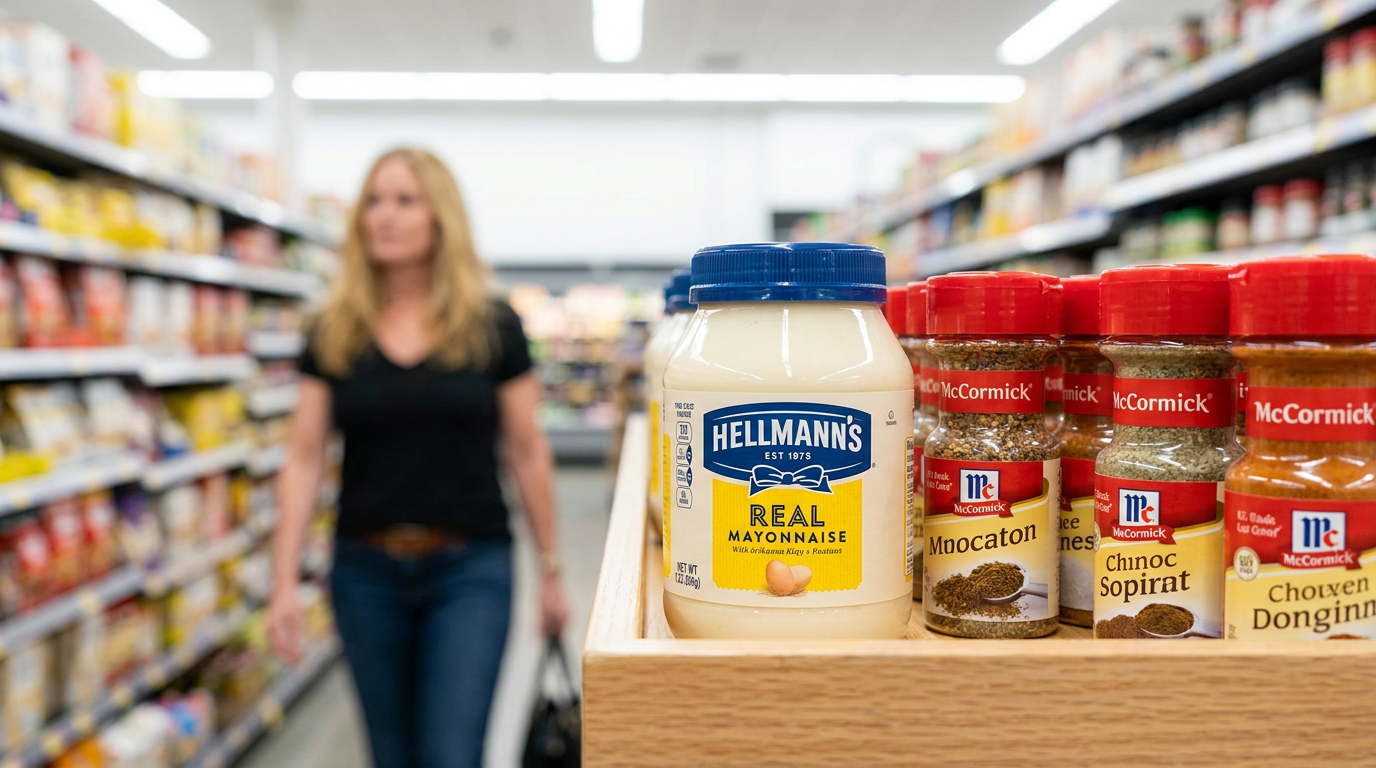
- The deal unites McCormick's spices with Unilever brands like Hellmann's and Knorr.
- Unilever is shedding the unit to focus entirely on its higher-margin health and beauty divisions.
- The combined entity will generate over $18.2 billion in annual food revenue across 140 countries.
- The merger is expected to face significant antitrust scrutiny in the US, UK, and EU.
McCormick & Company has agreed to acquire Unilever's global food division for $44.8 billion in an all-cash and stock transaction. The blockbuster deal, announced early Monday, unites McCormick's dominant spice and seasoning portfolio with Unilever's iconic condiment and culinary brands, including Hellmann's, Knorr, and Maille. The transaction represents one of the largest consumer packaged goods (CPG) acquisitions of the decade and fundamentally redraws the map of the modern grocery store.[1][2]
The acquisition creates an undisputed global powerhouse in the "flavor and food enhancement" category. By absorbing Unilever's food operations, McCormick will nearly triple its annual revenue, creating a combined entity generating over $18.2 billion in food sales across 140 countries. The move signals a massive doubling-down on the center aisles of the supermarket, an area that many legacy food conglomerates have recently viewed with skepticism amid the rise of fresh perimeter shopping.[3][4]
For Unilever, the divestiture marks the culmination of a years-long strategic pivot. Under intense pressure from activist investors to streamline its sprawling portfolio, the Anglo-Dutch conglomerate has increasingly focused its capital on its higher-margin health, beauty, and personal care divisions. The company had already spun off its tea business and ice cream divisions in recent years, leaving the core food unit as the final major hurdle in its corporate transformation.[2][8]

Financial analysts note that while Unilever's food division maintained a healthy 22% operating margin, it suffered from slower top-line growth compared to its prestige beauty and wellness brands. Offloading the food unit provides Unilever with a massive capital injection to pursue aggressive acquisitions in the dermatology and premium skincare sectors, effectively completing its transition away from its grocery roots.[4][8]
For McCormick, the strategic logic hinges on distribution synergies and retailer leverage. McCormick already commands premium shelf space in the spice aisle, while Unilever's Knorr and Hellmann's dominate the condiment and bouillon sections. Combining these sales forces gives McCormick unprecedented leverage when negotiating with mega-retailers like Walmart, Tesco, and Carrefour, ensuring their products cannot be easily delisted or squeezed on margins.[1][7]
For McCormick, the strategic logic hinges on distribution synergies and retailer leverage.
The deal also fundamentally rewrites the CPG marketing playbook, particularly in the booming sector of retail media networks. These networks—where brands pay supermarkets to advertise on their digital platforms and apps—have become the fastest-growing segment of digital advertising. By pooling their marketing budgets, the new McCormick-Unilever food entity will become one of the largest single buyers of retail media in the world.[6]
This scale allows the combined company to negotiate better placement on digital grocery storefronts. Marketing strategists point out that McCormick can now effectively bundle a consumer's search for a "chicken recipe" with Knorr bouillon, Hellmann's mayonnaise, and McCormick paprika in a single sponsored cart addition, creating a closed-loop ecosystem that smaller competitors cannot match.[6][7]

Beyond marketing, the acquisition promises significant supply chain consolidation. Both companies rely heavily on global agricultural supply chains for raw ingredients like mustard seed, garlic, and herbs. Integrating these procurement operations is expected to yield $900 million in annual cost synergies by 2029, providing a buffer against the volatile commodity pricing that has plagued the food industry in recent years.[1][5]
However, a transaction of this magnitude faces immediate and intense antitrust scrutiny. Regulators in the United States, the European Union, and the United Kingdom are expected to heavily scrutinize the deal's impact on grocery pricing and market concentration. The sheer scale of the combined entity raises questions about whether it will create a "category captain" monopoly that could stifle competition.[3][4]
While McCormick argues that spices and condiments are distinct categories with minimal direct overlap, antitrust advocates warn that the combined company's scale could allow it to bully retailers into unfavorable terms. Critics fear this dynamic could crowd out smaller, independent food brands and ultimately drive up prices for consumers during an era of already sticky food inflation.[4][8]

Despite regulatory hurdles, Wall Street reacted enthusiastically to the announcement. McCormick shares surged nearly 8% in pre-market trading as investors cheered the bold expansion. Unilever's stock also climbed 4% on relief that the long-rumored divestiture had finally materialized at a premium valuation, rewarding the company's commitment to its high-growth beauty strategy.[2][5]
The transaction is expected to close in the second half of 2027, pending regulatory approvals and shareholder votes. Until then, both companies will continue to operate independently, even as the broader CPG industry braces for a new era of mega-mergers sparked by this historic consolidation of the grocery aisle.[1][3]
How we got here
2017
Kraft Heinz makes a failed $143 billion takeover bid for Unilever, prompting Unilever to begin restructuring its portfolio.
2021
Unilever separates its tea business, eventually selling it to CVC Capital Partners for $5 billion.
2024
Activist investor Nelson Peltz joins Unilever's board, pushing for a sharper focus on high-margin beauty and personal care.
Late 2025
Rumors surface that Unilever is quietly shopping its remaining food division to private equity and strategic buyers.
June 29, 2026
McCormick officially announces the $44.8 billion acquisition of Unilever's food unit.
Viewpoints in depth
CPG Industry Analysts
View the deal as a necessary evolution for both companies to survive retail consolidation.
Analysts argue that as mega-retailers like Walmart and Amazon consolidate their power, CPG brands must scale up to maintain negotiating leverage. By combining two massive portfolios of "must-have" center-store items, McCormick ensures it cannot be easily delisted or squeezed on margins by powerful grocers. Furthermore, they view Unilever's exit as a masterstroke of timing, allowing the conglomerate to cash out of a slow-growth sector at a premium valuation.
Antitrust Advocates
Warn that the merger will reduce competition and increase grocery prices.
Consumer protection groups and antitrust scholars argue that even if the specific product lines (spices vs. mayonnaise) don't directly overlap, the sheer scale of the combined entity creates a "category captain" monopoly. They fear McCormick will use its dominance to dictate shelf placement, crowding out smaller, independent food brands and ultimately raising prices for shoppers who are already fatigued by years of food inflation.
Retail Media Strategists
See the acquisition as a masterclass in digital advertising consolidation.
Marketing experts point out that the future of grocery is digital cart-building. By owning the entire "flavor profile" of a meal—from the marinade to the finishing sauce—the new McCormick can dominate recipe-based advertising on platforms like Instacart and Kroger Precision Marketing. This creates a closed-loop ecosystem that competitors cannot match, effectively turning the combined company into a media powerhouse as much as a food manufacturer.
What we don't know
- Whether antitrust regulators in the US or Europe will force McCormick to divest specific overlapping brands to approve the deal.
- How Unilever plans to deploy the $44.8 billion windfall, though acquisitions in premium skincare are widely expected.
- How major grocers like Walmart and Tesco will react to negotiating with the newly supersized flavor conglomerate.
Key terms
- Center Store
- The interior aisles of a supermarket, typically housing shelf-stable, packaged, and non-perishable goods.
- Retail Media Network (RMN)
- Advertising platforms owned by retailers that allow brands to market directly to consumers near the point of purchase, often on digital grocery apps.
- Category Captain
- A leading brand manufacturer selected by a retailer to help manage and optimize a specific product category's shelf space and pricing.
- Consumer Packaged Goods (CPG)
- Products used daily by average consumers that require routine replacement, such as food, beverages, and household items.
Frequently asked
Will Hellmann's or Knorr change their recipes?
There are no announced plans to change product formulations; McCormick intends to maintain the brand identities and recipes of Unilever's iconic products.
Why is Unilever selling its food brands?
Unilever is pivoting to focus exclusively on its health, beauty, and personal care divisions, which offer higher profit margins and faster growth than traditional grocery items.
When will the deal be finalized?
The transaction is expected to close in the second half of 2027, pending regulatory approvals in multiple jurisdictions.
Sources
Source coverage
8 outlets
3 viewpoints surfaced








[1]The Wall Street JournalCorporate Strategists
McCormick Strikes $44.8 Billion Deal for Unilever's Food Unit
Read on The Wall Street Journal →[2]BloombergCorporate Strategists
Unilever Sheds Food Division in $44.8 Billion Sale to McCormick
Read on Bloomberg →[3]ReutersMarket Competition Watchdogs
McCormick to buy Unilever food business, creating global flavor giant
Read on Reuters →[4]Financial TimesCorporate Strategists
Unilever completes pivot to personal care with $44.8bn food exit
Read on Financial Times →[5]CNBCMarketing & Retail Analysts
McCormick shares surge on $44.8 billion Unilever food acquisition
Read on CNBC →[6]AdAgeMarketing & Retail Analysts
What McCormick's Unilever buyout means for CPG marketing and retail media
Read on AdAge →[7]Grocery DiveMarketing & Retail Analysts
McCormick-Unilever merger to reshape center-store grocery dynamics
Read on Grocery Dive →[8]The EconomistMarket Competition Watchdogs
The great grocery unbundling: Why Unilever sold its food empire
Read on The Economist →
Every angle. Every day.
Get business stories with full source coverage and perspective breakdowns delivered to your inbox.