
SpaceX Hands AI Startup Cursor a $60 Billion Lifeline, Reviving the 'Vibe Coding' Revolution
Written off after the rise of autonomous coding agents, the pioneer of visual AI coding has secured a massive investment from SpaceX to build industrial-grade software tools.
By Factlen Editorial Team
- Vibe-Coding Advocates
- Believe AI IDEs democratize software creation by allowing users to build via natural language.
- Agentic AI Proponents
- Argue that terminal-based, autonomous agents are the true future of software engineering.
- Industrial Scale Investors
- View AI coding as critical infrastructure for hardware and aerospace, justifying massive valuations.
- Economic & Security Realists
- Warn that the economic cost of AI errors in production code requires strict human oversight.
What's not represented
- · Traditional software engineers who prefer writing code manually without AI assistance.
- · Open-source advocates concerned about the centralization of coding tools within massive tech conglomerates.
Why this matters
The $60 billion valuation signals that AI coding assistants are evolving from consumer productivity tools into critical industrial infrastructure. For investors and engineers alike, it proves that highly specialized, human-in-the-loop AI will command massive premiums alongside fully autonomous agents.
Key points
- SpaceX has provided AI coding startup Cursor with a $60 billion lifeline, defying predictions of the company's demise.
- Cursor pioneered 'vibe coding,' allowing users to build software via plain-language prompts in a visual editor.
- The startup faced intense competition from Anthropic's Claude Code, an autonomous agent that operates in the terminal.
- SpaceX's investment highlights the need for human-in-the-loop AI tools in high-stakes industrial and aerospace environments.
- Economic data shows that while autonomous agents are efficient, visual oversight is critical when the cost of errors is high.
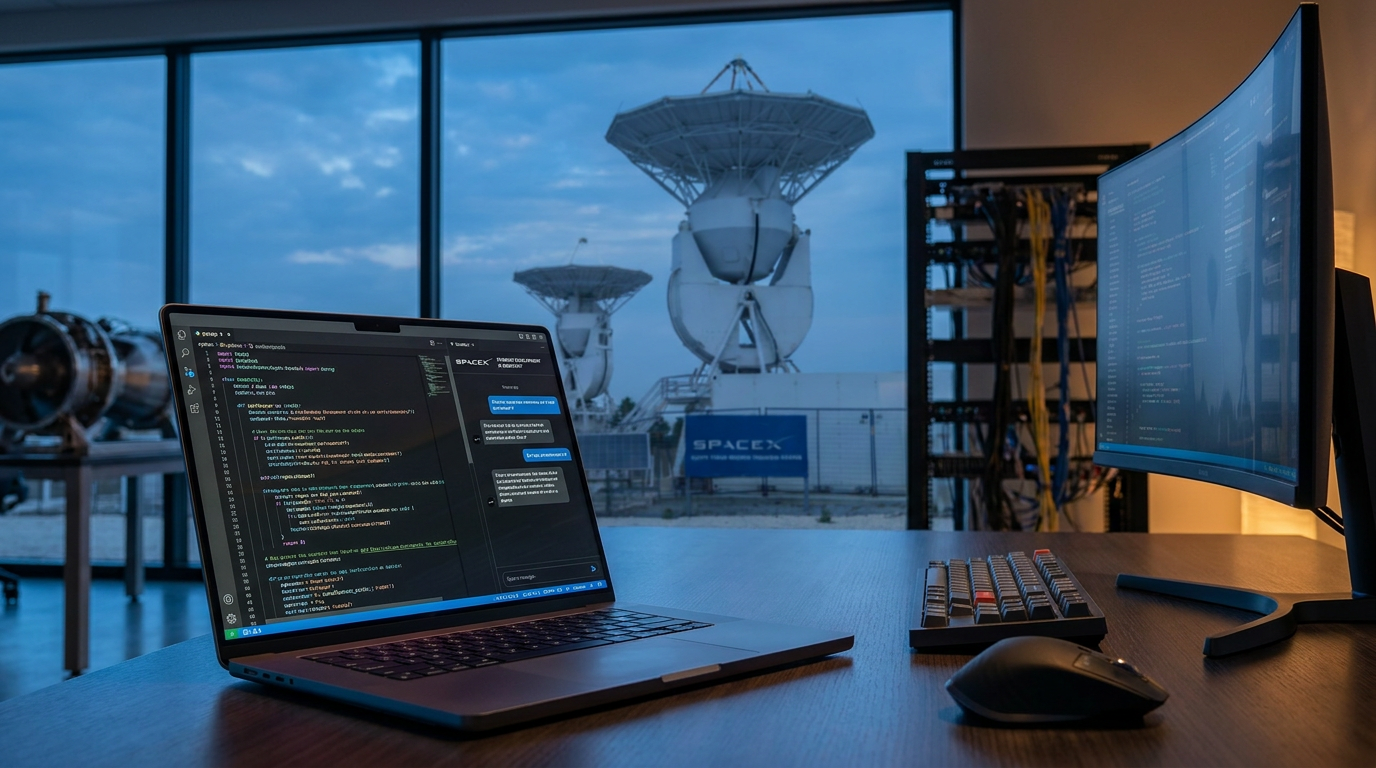
The technology sector loves a comeback story, but few expected the latest one to arrive via low Earth orbit. Just months after social media eulogized Cursor—the startup that pioneered the AI-assisted "vibe coding" movement—the company has secured a staggering $60 billion lifeline and strategic partnership from SpaceX.[1]
This massive injection of capital fundamentally reshapes the landscape of artificial intelligence in software engineering. It signals that the race to automate code generation is no longer just a battle between consumer software companies, but a critical infrastructure play for industrial and aerospace giants.[1][7]
To understand the magnitude of this deal, one must look at the rapid, almost violent evolution of how software is built. For decades, coding required a deep, syntactic mastery of specific programming languages. Then came the large language models, and the barrier to entry collapsed.[7]
In early 2025, the industry coalesced around a new paradigm affectionately dubbed "vibe coding." The concept was simple: a user describes what they want to build in plain English, and the AI handles the boilerplate, the syntax, and the structural heavy lifting.[4]

Cursor was the undisputed king of this era. Built as a customized fork of the popular VS Code editor, it brought the AI directly into the developer's visual workspace. Users didn't have to switch tabs to a chatbot; they could highlight a block of code and simply type, "make this run faster," watching the AI rewrite it in real-time.[6]
This approach democratized software creation, allowing designers, product managers, and hobbyists to spin up functional prototypes with unprecedented speed. But the underlying technology moved faster than anyone anticipated, and Cursor soon found itself outflanked by a new philosophy of automation.[4][6]
The disruptor was Anthropic, which released Claude Code—an "agentic" system that fundamentally altered the relationship between human and machine. Unlike Cursor, which waited for human prompts within a visual editor, Claude Code lived in the command-line terminal and operated autonomously.[2][3]
The disruptor was Anthropic, which released Claude Code—an "agentic" system that fundamentally altered the relationship between human and machine.
A developer could give Claude Code a high-level directive, and the agent would independently read the entire codebase, plan a multi-file approach, execute the changes, run tests, and iterate on its own failures. It wasn't just an autocomplete tool; it functioned as a tireless junior engineer.[3]
The adoption of agentic coding was explosive. Industry research showed that users were spending an average of 20 hours a week interacting with Claude Code. Over a seven-month period, the time developers spent fixing broken code dropped by nearly half, freeing them to focus on deploying software and analyzing data.[3]

Anthropic's rapid iteration—including the recent launch of Claude Design, which seamlessly syncs visual brand assets with terminal-based coding—made Cursor's visual IDE approach feel suddenly quaint to some Silicon Valley insiders. Social media quickly declared the vibe-coding era dead, superseded by the age of autonomous agents.[1][2]
But those obituaries missed a crucial economic reality: not all software is built for lightweight web applications, and not all code can be blindly trusted to an autonomous agent operating in the background.[7]
Recent economic evaluations of large language models reveal a stark threshold. While cheap, autonomous models are highly efficient for routine tasks, their value plummets when the cost of a mistake is high. In fields where a single error can cost millions of dollars—or human lives—the interactive, highly visible nature of Cursor's IDE becomes a critical safety feature.[5]
Enter SpaceX. The aerospace company operates in an environment where software reliability is literally a matter of life and death. Rockets, satellite constellations, and life-support systems require code that is rigorously audited, line by line, with a human firmly in the loop.[7]
By handing Cursor a $60 billion lifeline, SpaceX is securing a dedicated, highly integrated AI coding environment tailored for industrial scale. It is a massive bet that the future of hardware-integrated software requires the intuitive, visual interface of vibe coding, backed by immense computational power.[1][7]

The partnership provides Cursor with the capital and compute necessary to train specialized models that understand the complex physics, telemetry, and hardware constraints of aerospace engineering. It transforms a consumer-friendly coding tool into an industrial-grade weapon.[1][7]
The software engineering profession is now bifurcating. On one side, agentic tools will autonomously generate and manage the vast majority of web and enterprise applications. On the other, heavily capitalized, specialized environments like the new Cursor will empower engineers to build the critical systems that touch the physical world. The vibe-coding revolution isn't dead; it just put on a spacesuit.[2][3][7]
How we got here
2021
OpenAI debuts Codex, demonstrating the early potential of chat-to-code technology.
February 2025
The term 'vibe coding' is coined to describe building apps through plain-language prompts.
Late 2025
Anthropic launches Claude Code, shifting the industry toward autonomous, terminal-based agentic coding.
April 2026
Claude Design integrates visual assets into AI coding, further expanding Anthropic's dominance.
June 2026
SpaceX hands Cursor a $60 billion lifeline, reviving the vibe-coding pioneer for industrial use.
Viewpoints in depth
Vibe-Coding Advocates
Supporters of visual AI editors who believe coding should be a collaborative, accessible conversation.
This camp argues that the true power of AI in software development lies in democratizing the creation process. By integrating AI directly into a visual Integrated Development Environment (IDE) like Cursor, non-engineers—such as designers and product managers—can build functional software using natural language. They maintain that keeping the human in the loop visually prevents the "black box" problem of autonomous agents, ensuring the creator always understands how their application is structured.
Agentic AI Proponents
Technologists who argue that autonomous, terminal-based agents represent the ultimate future of software engineering.
Advocates for tools like Anthropic's Claude Code believe that requiring a human to prompt an AI line-by-line is an outdated bottleneck. They point to data showing massive efficiency gains when an AI agent is allowed to read an entire codebase, plan a multi-file migration, and execute tests autonomously. In their view, the future developer is more of a high-level manager directing a swarm of AI agents, rather than a typist reviewing code in a visual editor.
Industrial Scale Investors
Financial and aerospace stakeholders focused on the reliability and economic stakes of production code.
For industrial giants, the debate between visual editors and autonomous agents comes down to the cost of a mistake. While a bug in a web application might cause a temporary outage, a bug in aerospace telemetry can cost billions of dollars and human lives. This camp views the $60 billion valuation of Cursor as a necessary premium for a highly specialized, human-auditable AI environment that can handle the immense complexity of hardware-integrated software without sacrificing safety.
What we don't know
- The exact financial structure of the $60 billion lifeline, and how much of it consists of compute credits versus direct capital.
- How Cursor will adapt its consumer-friendly interface to handle the rigorous security and compliance standards of aerospace engineering.
- Whether Anthropic will attempt to build its own visual IDE to compete directly with Cursor's new industrial focus.
Key terms
- Vibe Coding
- A term coined in 2025 describing the process of building software by typing plain-language prompts and letting an AI handle the syntax and structure.
- Agentic AI
- Artificial intelligence systems that can autonomously plan, execute, and iterate on multi-step tasks across an entire project, rather than just answering single queries.
- IDE (Integrated Development Environment)
- A software application that provides comprehensive facilities to computer programmers for software development, such as VS Code or Cursor.
- Terminal
- A text-based command-line interface where developers type commands directly to the computer's operating system, bypassing graphical menus.
Frequently asked
What is the difference between Cursor and Claude Code?
Cursor is a visual code editor (IDE) that integrates AI directly into the workspace for interactive coding. Claude Code is an agentic tool that lives in the command-line terminal and can autonomously execute complex changes across multiple files.
Why did SpaceX invest $60 billion in Cursor?
Industrial giants like SpaceX require massive, rapid software iteration for aerospace hardware. Backing Cursor ensures they have a dedicated, highly integrated AI coding environment tailored to industrial scale where human oversight remains critical.
Does vibe coding mean human software engineers are obsolete?
No. While AI can handle routine coding and prototyping, human engineers are still required for system architecture, security auditing, and ensuring production-grade reliability where the cost of errors is high.
Sources
Source coverage
7 outlets
4 viewpoints surfaced







[1]MarketWatchIndustrial Scale Investors
Social media declared Cursor dead. Then SpaceX handed the AI startup a $60 billion lifeline.
Read on MarketWatch →[2]CNETAgentic AI Proponents
Anthropic Is Bringing Together AI Design and Coding in Claude
Read on CNET →[3]Anthropic ResearchAgentic AI Proponents
Agentic coding and persistent returns to expertise
Read on Anthropic Research →[4]MediumVibe-Coding Advocates
What I Learned Vibe-Coding My First Project in Cursor AI
Read on Medium →[5]arXivEconomic & Security Realists
Economic Evaluation of LLMs
Read on arXiv →[6]DEV CommunityVibe-Coding Advocates
Vibe Coding with Cursor AI: My First Hands-On Experience
Read on DEV Community →[7]Factlen Editorial TeamEconomic & Security Realists
Synthesis by Factlen editorial team
Read on Factlen Editorial Team →

More in finance
See all 5 stories →


Every angle. Every day.
Get finance stories with full source coverage and perspective breakdowns delivered to your inbox.