
Self-Driving Labs: How AI and Robotics are Automating Scientific Discovery
Autonomous laboratories are combining artificial intelligence, robotics, and closed-loop feedback to dramatically accelerate the discovery of new materials and drugs.
By Factlen Editorial Team
- Autonomous Lab Pioneers
- Advocate for fully closed-loop systems to accelerate fundamental scientific discovery.
- Commercial Implementers
- Focus on using autonomous labs to rapidly solve industrial and supply chain bottlenecks.
- Scientific Skeptics
- Emphasize the need for rigorous human validation to prevent AI systems from misinterpreting complex physical data.
What's not represented
- · Traditional manufacturing engineers
- · Laboratory technicians whose roles are changing
Why this matters
By removing the physical bottlenecks of manual experimentation, self-driving labs could reduce the time it takes to discover life-saving drugs and critical aerospace materials from decades to mere months. This acceleration promises to lower the cost of innovation and secure vulnerable supply chains.
Key points
- Self-driving laboratories combine AI, robotics, and automated testing to run continuous, closed-loop scientific experiments.
- These systems can dramatically accelerate discovery, with one startup producing 1,200 unique aerospace alloys in just six months.
- The technology is being applied to both materials science and early-stage drug discovery to reduce costs and bypass supply chain bottlenecks.
- Skeptics warn that automated sensors can misinterpret complex physical data, requiring rigorous human oversight to prevent false discoveries.
The bottleneck in modern scientific discovery is rarely a lack of ideas. It is the physical execution of experiments. For decades, the pace of innovation in materials science and drug development has been constrained by the manual realities of the laboratory: synthesizing compounds, pipetting liquids, waiting for reactions, and analyzing results. Now, a convergence of artificial intelligence, robotics, and advanced instrumentation is fundamentally altering that equation. The result is the "self-driving laboratory"—an autonomous system capable of designing, executing, and learning from experiments with minimal human intervention.[1][8]
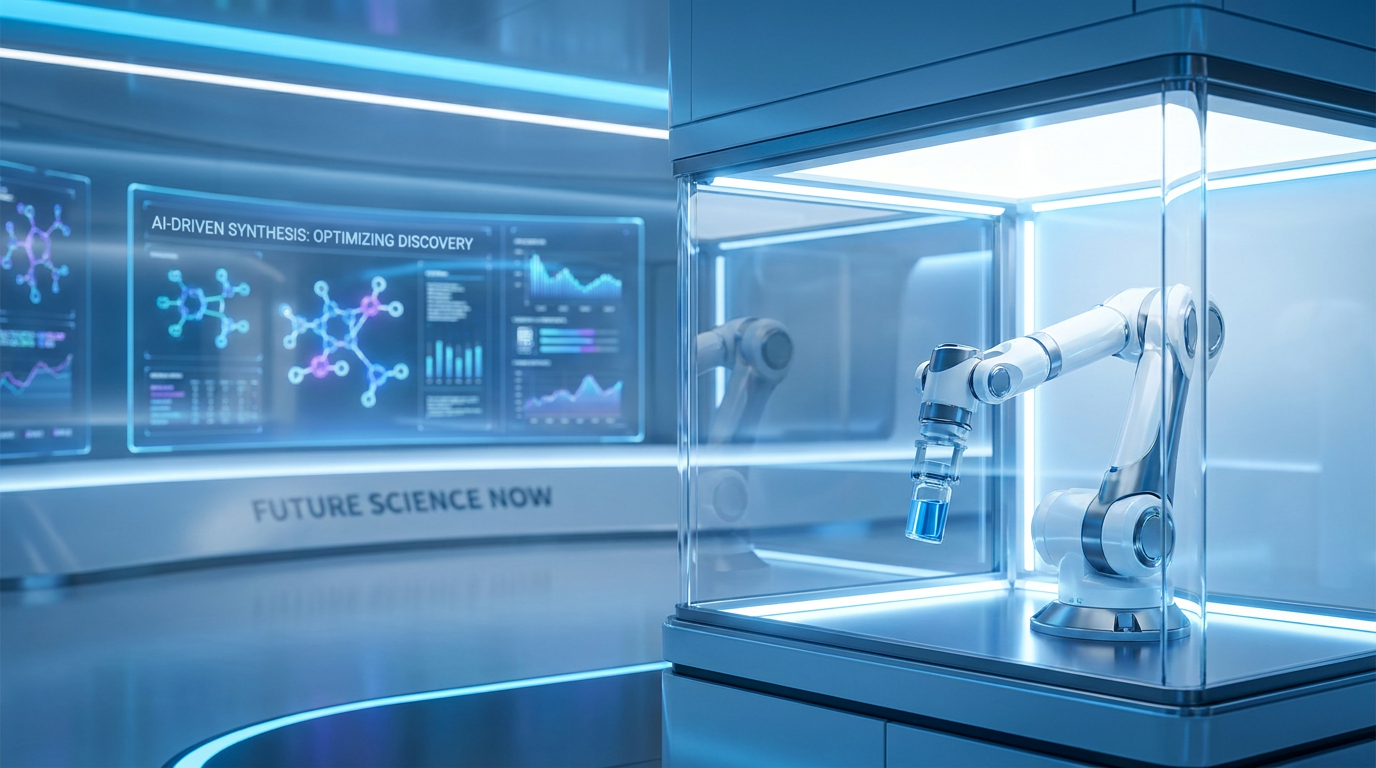
Unlike traditional high-throughput screening, which simply executes human-provided instructions at an accelerated rate, self-driving laboratories operate in a continuous, closed-loop cycle. In these systems, an AI model proposes a novel molecular structure or material composition based on a specific optimization goal. Robotic hardware then physically synthesizes the material, and automated characterization tools test its properties. Crucially, the results are immediately fed back into the machine learning algorithm, which updates its understanding of the chemical space and proposes a refined experiment for the next cycle.[3][8]
"This is the difference between hands-free driving and a Waymo," explained Joseph Krause, CEO of Radical AI, a startup leveraging autonomous labs for aerospace materials. While automated labs act as accelerators for human-directed research, a true self-driving lab runs entire research campaigns autonomously. It removes the human scientist from the rote mechanics of iterative trial and error, elevating their role to that of a system architect who defines the high-level goals and boundary conditions.[6]

The impact of this closed-loop autonomy is already being felt in materials science, a field historically defined by agonizingly slow trial-and-error processes. At the Department of Energy's Lawrence Berkeley National Laboratory, researchers have developed A-Lab, an autonomous facility that connects AI-driven computational screening with robotic synthesis. A-Lab draws on the Materials Project, an open-access database with over 650,000 registered users, to identify promising theoretical compounds before attempting to physically create them.[2]
The speed of these systems is unprecedented. Radical AI recently reported that its self-driving laboratory produced 1,200 unique alloys in just six months. Of those, 300 were completely novel materials that had never been reported in scientific literature. According to Krause, that level of throughput is roughly 25 times what a single PhD student could achieve in a year.[6]
This acceleration is not merely an academic exercise; it has profound geopolitical and economic stakes. For example, the aerospace industry relies heavily on hafnium, a critical element used in high-performance alloys for rocket engines and jet turbines. With hafnium prices surging fifteenfold over the past decade due to supply chain constraints, Radical AI utilized its autonomous lab to rapidly develop a novel alloy that eliminates the need for hafnium while matching the required performance specifications.[6]

Beyond materials science, self-driving labs are poised to reshape the pharmaceutical industry. Drug discovery is notoriously inefficient, often requiring over a decade and more than a billion dollars to bring a single therapeutic to market. At the University of Toronto's Acceleration Consortium, researchers are building autonomous workflows specifically designed to tackle the early stages of this pipeline.[5]
Beyond materials science, self-driving labs are poised to reshape the pharmaceutical industry.
Stuart R. Green, a staff scientist at the consortium, is developing closed-loop systems that connect chemical synthesis directly with biological evaluation. By delegating both the physical labor of running assays and the mental labor of compound selection to an automated system, researchers hope to drastically reduce the time and cost of hit-to-lead optimization. This efficiency could eventually allow pharmaceutical companies to pursue niche or complex biological targets that were previously deemed too economically risky to explore.[5][8]
As these systems mature, researchers are also addressing one of the primary criticisms of AI-driven science: the "black box" problem. Historically, machine learning models might identify a high-performing material without providing any insight into why it works. A recent study published in ACS Catalysis demonstrated a shift toward "gray-box" AI models.[7]
In this approach, the AI is explicitly designed to explore chemical space in a way that simultaneously uncovers the underlying chemical mechanisms. By applying this strategy to the conversion of propane into propylene—a crucial industrial process for manufacturing plastics—the autonomous system not only discovered a catalyst that outperformed current benchmarks but also elucidated the physical reasons for its superior performance. This interpretability is vital for building trust in AI-generated discoveries.[7][8]

Despite these rapid advancements, the transition to fully autonomous science is not without significant friction. The physical world is inherently messy, and translating digital predictions into physical reality remains a formidable challenge. "AI cannot one-shot a new material," Krause noted, contrasting materials science with the rapid breakthroughs seen in digital biology, where proteins can be neatly encoded in text strings. An alloy's performance depends on complex microstructures and processing histories that are difficult to capture in a purely digital model.[6]
This friction was highlighted by a recent controversy surrounding Berkeley's A-Lab. In late 2023, the A-Lab team published a paper claiming their autonomous system had successfully synthesized 41 novel inorganic compounds out of 58 attempts—a remarkable 71% success rate. However, an independent analysis by materials chemists Robert Palgrave and Leslie Schoop raised serious doubts about the findings.[4]
The critique, which found "systematic errors all the way through" the experimental analysis, argued that the AI system failed to properly account for compositional disorder—a phenomenon where atoms are arranged in an ordered pattern, but with inherent structural variations. The controversy underscores a critical vulnerability in self-driving labs: if the automated characterization tools misinterpret the physical data, the closed-loop system will confidently optimize toward false conclusions.[4][8]
Furthermore, discovering a material in a lab is only the first step. Scaling up production from a 500-gram laboratory sample to a 10-ton industrial ingot introduces entirely new variables that current autonomous systems cannot simulate or control. The pathway to commercialization will likely require deep partnerships between AI-driven discovery labs and traditional manufacturers who possess decades of intuitive, undocumented production expertise.[6][8]

To address these integration challenges, the U.S. Department of Energy recently launched FORUM-AI, a $10 million multi-institutional initiative led by Berkeley Lab. The project aims to build the first "full-stack, agentic AI system" for materials science, creating an open-source platform that standardizes how AI models interface with physical laboratory equipment across different research institutions.[2]
Ultimately, the rise of the self-driving laboratory represents a fundamental shift in the epistemology of science. The laboratory is transitioning from a collection of mechanical tools into a unified cyber-physical system capable of processing real-time feedback. While human scientists will no longer spend their days pipetting liquids or manually analyzing routine spectra, their expertise will be more critical than ever in defining the boundaries of exploration, ensuring the integrity of the data, and translating autonomous discoveries into real-world applications.[1][6][8]
How we got here
2009
The 'Adam' project demonstrates one of the first autonomous workflows in genomics.
2015
The 'Eve' system showcases autonomous capabilities in early-stage drug discovery.
Late 2023
Berkeley's A-Lab reports synthesizing 41 novel materials, sparking both excitement and scientific debate over data validation.
Early 2026
The U.S. Department of Energy launches the $10 million FORUM-AI initiative to build a standardized, agentic AI platform for materials science.
Viewpoints in depth
Autonomous Lab Pioneers
Researchers focused on scaling discovery and removing human bottlenecks.
Scientists at institutions like Oak Ridge and Berkeley Lab view autonomous systems as the only viable path to solving complex, multi-variable scientific challenges. They argue that human researchers are fundamentally limited by the speed of their hands and the cognitive limits of processing high-dimensional data. By building closed-loop systems, these pioneers aim to elevate scientists to 'system architects' who guide the AI, rather than technicians who execute rote tasks.
Commercial Implementers
Startups and industry players focused on applying SDLs to solve immediate supply chain and manufacturing bottlenecks.
For companies like Radical AI, the value of a self-driving lab isn't just academic discovery—it's rapid commercial deployment. These implementers focus on utilizing AI to bypass geopolitical supply chain constraints, such as the reliance on Chinese hafnium for aerospace alloys. They argue that the true test of an autonomous lab is its ability to produce materials that meet strict industrial performance specifications faster and cheaper than traditional R&D departments.
Scientific Skeptics
Chemists and materials scientists who urge caution regarding the reliability of AI-generated physical data.
Skeptics do not dismiss automation, but they strongly challenge the premise that AI can seamlessly interpret the messy realities of the physical world. Researchers like Robert Palgrave point out that automated characterization tools can easily misinterpret complex phenomena like compositional disorder. They argue that without rigorous human oversight and traditional validation, closed-loop systems risk rapidly optimizing toward false positives, creating a facade of discovery built on systematic errors.
What we don't know
- How effectively discoveries made at the gram-scale in autonomous labs can be scaled up to industrial manufacturing volumes.
- Whether 'gray-box' AI models can consistently provide accurate mechanistic explanations for highly complex biological interactions.
- How the scientific community will standardize data validation to prevent autonomous systems from optimizing toward false positives.
Key terms
- Self-Driving Lab (SDL)
- A fully autonomous laboratory that uses AI to design experiments, robotic hardware to execute them, and machine learning to analyze the results in a continuous loop.
- Closed-Loop Discovery
- A research process where the results of one experiment automatically inform the parameters of the next, without requiring human intervention.
- Gray-Box AI
- An artificial intelligence approach designed to reveal the underlying mechanisms of a result, rather than just outputting an answer without explanation.
- Compositional Disorder
- A phenomenon in materials science where atoms are arranged in an ordered pattern, but with inherent structural variations that can be difficult for automated sensors to interpret.
Frequently asked
What is a self-driving laboratory?
A self-driving lab is an autonomous research system that combines artificial intelligence, robotic hardware, and automated testing. The AI designs an experiment, the robots execute it, and the results are fed back into the AI to plan the next step without human intervention.
How is this different from standard lab automation?
Standard automation simply speeds up human-provided instructions, stopping when a batch is done. A self-driving lab operates in a 'closed loop,' actively learning from each experiment to independently decide what to test next.
Can AI instantly discover new materials?
No. Unlike digital biology where proteins can be modeled as text strings, physical materials are highly complex. AI cannot 'one-shot' a new alloy; it requires rapid, iterative physical testing in a self-driving lab to verify performance.
Will these labs replace human scientists?
No, but they will change their roles. Scientists will transition from performing manual lab work to acting as system architects—setting the high-level goals, defining the boundaries for the AI, and interpreting the final validated data.
Sources
Source coverage
8 outlets
3 viewpoints surfaced







[1]Oak Ridge National LaboratoryAutonomous Lab Pioneers
Autonomous Science: Labs of the Future
Read on Oak Ridge National Laboratory →[2]Lawrence Berkeley National LaboratoryAutonomous Lab Pioneers
Berkeley Lab Leads Effort to Build AI Assistant for Energy Materials Discovery
Read on Lawrence Berkeley National Laboratory →[3]ACS Central ScienceAutonomous Lab Pioneers
Accelerated Emergence of Self-Driving Laboratories for Accelerating Materials Discovery
Read on ACS Central Science →[4]Chemistry WorldScientific Skeptics
New analysis raises doubts over autonomous lab's materials 'discoveries'
Read on Chemistry World →[5]Drug Target ReviewAutonomous Lab Pioneers
How self-driving labs are changing drug development
Read on Drug Target Review →[6]Latent SpaceCommercial Implementers
Joseph Krause: AI Cannot One-Shot a New Material. Self-Driving Labs Can.
Read on Latent Space →AI-powered self-driving labs move beyond discovery to explain catalyst performance
Read on ACS Catalysis →[8]Factlen Editorial Team
Synthesis by Factlen editorial team
Read on Factlen Editorial Team →
More in ai
See all 6 stories →On-Device AI
The Rise of Small Language Models: How AI is Moving from the Cloud to Your Pocket
8 sources

AI Provenance
The Global Standardization of AI Watermarking: Evidence from 2026 Policy Implementation
7 sources

Medical AI
AI Medical Assistants Match or Surpass Human Doctors in Diagnostic Accuracy, Landmark Studies Show
6 sources

Oculomics
How AI Retinal Scans Are Predicting Heart Disease and Dementia
7 sources
Every angle. Every day.
Get ai stories with full source coverage and perspective breakdowns delivered to your inbox.