
How AI Retinal Scans Are Predicting Heart Disease and Dementia
Advancements in 'oculomics' are allowing artificial intelligence to detect early signs of cardiovascular and neurological diseases through non-invasive eye scans.
By Factlen Editorial Team
- Clinical Researchers
- Focus on discovering new retinal biomarkers and proving the physiological link between the eye and systemic diseases.
- AI Developers
- Prioritize scaling foundation models and 3D imaging to improve the predictive accuracy of diagnostic algorithms.
- Medical Regulators
- Emphasize the need for standardized imaging protocols, transparent AI reasoning, and rigorous clinical trials before widespread adoption.
What's not represented
- · Patient Privacy Advocates
- · Health Insurance Actuaries
Why this matters
By turning a routine eye exam into a whole-body health screening, this technology could democratize early disease detection, allowing patients to catch life-threatening conditions years before symptoms appear.
Key points
- Oculomics uses AI to analyze retinal scans, detecting systemic diseases long before clinical symptoms appear.
- The retina is the only place in the body where blood vessels and nerve tissue can be viewed directly without surgery.
- Recent AI models have successfully predicted cardiovascular disease risk with accuracy matching traditional blood-test scores.
- 3D imaging and massive foundation models are rapidly improving the AI's ability to spot Alzheimer's, Parkinson's, and kidney failure.
- Widespread clinical adoption still requires standardized imaging protocols and multi-center trials to verify real-world efficacy.
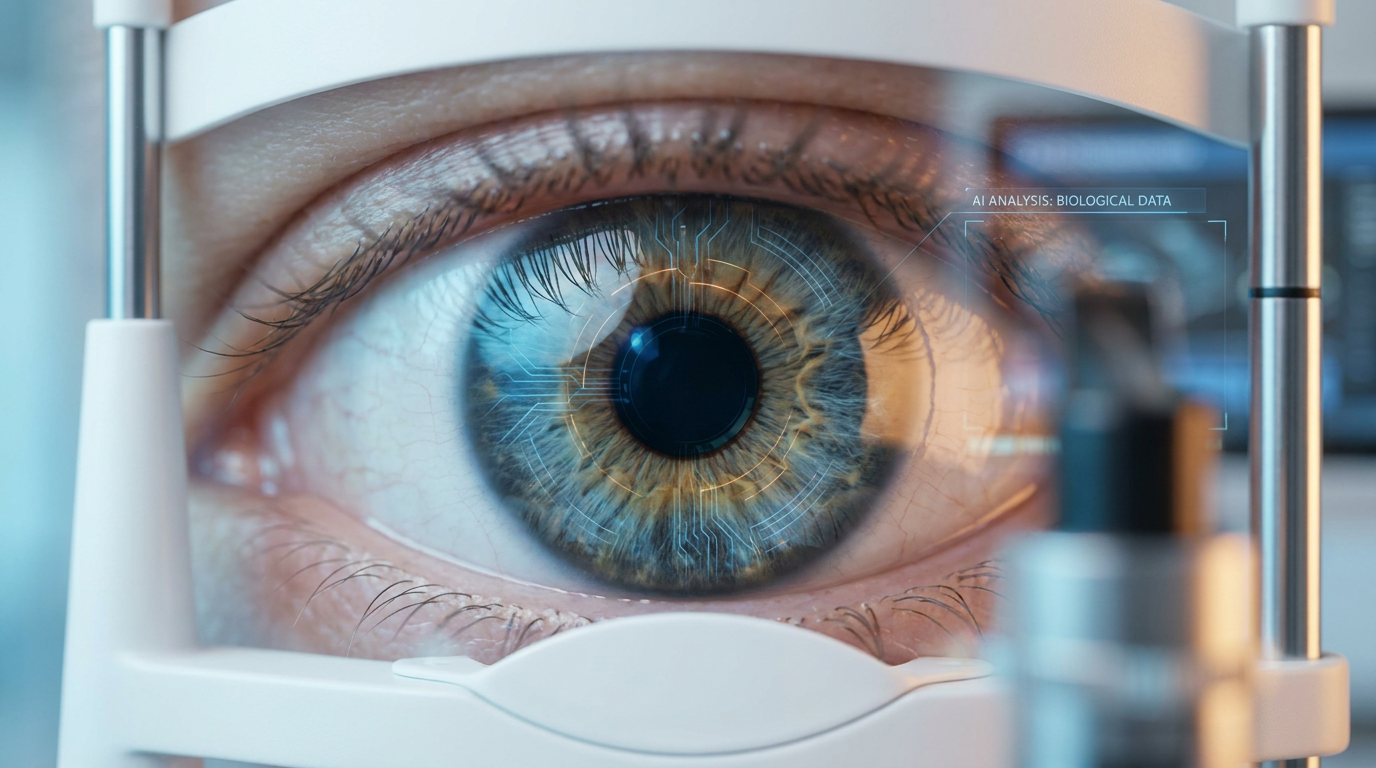
Imagine visiting your optometrist for a routine vision check and leaving with actionable intelligence about your cardiovascular system, cognitive health, or kidney function. This is the promise of oculomics, a rapidly accelerating medical discipline that uses the eye as a diagnostic window into the rest of the human body. By merging widely available imaging hardware with increasingly sophisticated neural networks, medicine is moving closer to a future where a simple, painless glance into the eye provides a comprehensive map of human health.[7]
The anatomical logic behind oculomics is straightforward but profound. The retina—a paper-thin layer of neural tissue lining the back of the eye—is the only place in the human body where blood vessels and central nervous system tissue can be directly visualized without invasive surgery. When systemic diseases begin to take root, they often leave microscopic signatures in this vascular network long before clinical symptoms appear elsewhere.[5]
For decades, these subtle physiological changes were largely invisible to human clinicians. However, the integration of high-resolution optical coherence tomography (OCT) and artificial intelligence has transformed retinal imaging from a localized diagnostic tool into a whole-body screening platform. Deep learning algorithms can now detect patterns in retinal microvasculature that strongly correlate with life-threatening conditions.[4][5]
The evidence for cardiovascular prediction is particularly robust. A landmark March 2026 study published in Nature Biomedical Engineering demonstrated that deep learning models can predict cardiovascular disease risk directly from standard retinal photographs. The artificial intelligence achieved an area under the curve (AUC) of 0.72 to 0.74, effectively matching the accuracy of traditional, blood-test-reliant risk scoring systems.[1]

This cardiovascular link was further validated by a June 2026 study from the University of Manchester. Researchers utilized comprehensive health data from 68,000 UK Biobank volunteers to develop an AI tool called Ret-AAE. By analyzing both 3D OCT scans and standard color fundus photographs, the system successfully linked the physical appearance of the eye to the future risk of heart failure, high blood pressure, and heart attacks.[2]
Beyond the heart, retinal scans are proving highly effective at identifying early-stage neurodegenerative diseases. Because the retina shares an embryological origin with the brain, it serves as a direct, physical extension of the central nervous system. This anatomical continuity makes the eye an ideal, non-invasive biomarker for tracking cognitive decline.[5]
Beyond the heart, retinal scans are proving highly effective at identifying early-stage neurodegenerative diseases.
Researchers at Duke University provided foundational proof-of-concept by training convolutional neural networks to identify Alzheimer's disease. The AI detected a decreased density in the capillary network around the center of the macula in patients with Alzheimer's, successfully differentiating them from cognitively healthy individuals. The recent Manchester study also confirmed that 3D OCT scans carry strong predictive signals for Parkinson's disease and broader dementia.[2][3]
The technology driving these discoveries is advancing rapidly, with 3D modeling and foundation models pushing the next leap in accuracy. Early oculomics models relied exclusively on 2D images, but the field is now shifting to three-dimensional spatial analysis. In June 2026, researchers at Washington University in St. Louis and Genentech unveiled OCTCube-M, an experimental AI system built specifically to analyze 3D retinal scans.[4]

To train the OCTCube-M system, the research team utilized more than 26,000 3D OCT images, which translated to a staggering 1.62 million individual retinal slices. By analyzing the retina in all three dimensions—where diseases often extend around the fovea—the model proved capable of predicting outcomes far beyond the eye, including stroke and kidney failure.[4]
Simultaneously, the medical field is benefiting from the rise of specialized foundation models. Systems like RETFound have been trained on up to 1.6 million unlabelled retinal images using self-supervised learning techniques. By learning the universal visual language of retinal structures before being fine-tuned for specific diseases, these models require vastly less labeled data to achieve high accuracy on new diagnostic tasks.[5][6]
The clinical implications for primary care are substantial. Rather than waiting for patients to develop severe symptoms that warrant a specialist referral, primary care providers equipped with standard fundus cameras and AI software can perform real-time systemic triage. Retrospective data from the Wilmer Eye Institute suggests that AI-assisted screening in primary care settings can significantly increase appropriate specialist referrals, particularly among historically underserved populations.[4]

Despite these breakthroughs, the transition from the laboratory to routine clinical practice carries transparent uncertainties. The primary hurdle is the heterogeneity of imaging protocols; different clinics use different cameras with varying resolutions and lighting conditions, which can confuse AI models trained on pristine, standardized datasets.[5]
Furthermore, medical ethicists and regulators are grappling with the "black box" nature of these superhuman algorithms. When an artificial intelligence predicts cardiovascular disease from a retinal photo—a task no human doctor can replicate—it becomes exceedingly difficult to verify the model's reasoning or establish legal accountability for false positives.[7]
Finally, while the predictive correlations are strong, prospective, multi-center randomized trials are still required to prove that early detection via oculomics actually improves long-term patient survival rates. Until these longitudinal studies are completed, AI retinal scans will serve as a powerful supplementary triage tool rather than a standalone diagnostic definitive.[5]
How we got here
Dec 2020
Duke University researchers demonstrate that machine learning can identify Alzheimer's disease by analyzing retinal capillary density.
2023
The release of RETFound, one of the first major AI foundation models trained on over 1.6 million retinal images.
Mar 2026
A landmark study in Nature Biomedical Engineering proves AI can predict cardiovascular disease risk from retinal images with high accuracy.
Jun 2026
The University of Manchester unveils Ret-AAE, linking eye appearance to heart failure and Parkinson's using data from 68,000 patients.
Jun 2026
Researchers introduce OCTCube-M, an advanced AI system trained on 3D retinal scans to predict stroke and kidney failure.
Viewpoints in depth
Clinical Researchers' view
The eye is an untapped reservoir of systemic health data.
Medical researchers view the retina as the ultimate non-invasive diagnostic window. Because it is the only place in the body where the microvascular network and central nervous system tissue are exposed, they argue it provides a real-time snapshot of vascular and neurological health. Their primary goal is to map specific retinal changes—like capillary thinning or vessel tortuosity—to specific systemic diseases, proving that these biomarkers are biologically sound and not just statistical artifacts.
AI Developers' view
Data scale and 3D modeling will solve current diagnostic limitations.
For computer scientists and AI engineers, oculomics is fundamentally a data problem. They argue that early 2D models missed crucial spatial context, which is why the field is rapidly shifting toward 3D Optical Coherence Tomography (OCT) and massive foundation models like RETFound. By pre-training algorithms on millions of unlabelled retinal scans, developers believe they can create highly adaptable AI systems that require minimal fine-tuning to detect entirely new diseases, pushing the boundaries of what machines can see.
Medical Regulators' view
Superhuman AI requires new frameworks for accountability and validation.
Regulators and medical ethicists urge caution regarding the 'black box' nature of deep learning. When an AI predicts heart disease from a retinal scan using patterns invisible to human doctors, it becomes nearly impossible to audit the model's reasoning. Regulators argue that before these tools can be deployed universally, the industry must standardize imaging hardware across clinics and conduct massive, multi-center randomized trials to ensure the AI does not generate harmful false positives or exhibit bias against specific demographics.
What we don't know
- Whether early detection of systemic diseases via retinal scans will definitively translate to improved long-term patient survival rates.
- How to perfectly standardize AI performance across the wide variety of commercial retinal cameras used in different clinics.
- The exact legal and ethical frameworks for accountability when a 'black box' AI makes a superhuman diagnostic prediction that a human doctor cannot verify.
Key terms
- Oculomics
- The study of using ophthalmic biomarkers, typically from retinal imaging, to identify and predict systemic diseases.
- Optical Coherence Tomography (OCT)
- A non-invasive imaging test that uses light waves to take cross-section pictures of the retina, allowing doctors to see each of its distinctive layers.
- Foundation Model
- A large-scale artificial intelligence model trained on a vast quantity of unlabelled data, which can then be adapted to a wide range of specific medical tasks.
- Area Under the Curve (AUC)
- A statistical metric used to evaluate how well a diagnostic test or AI model can distinguish between patients with a disease and those without it.
- Macula
- The small, specialized central area of the retina responsible for sharp, detailed central vision.
Frequently asked
What is oculomics?
Oculomics is the medical science of analyzing the structure and function of the eye—particularly the retina—to identify biomarkers of systemic diseases like heart disease and dementia.
How can an eye scan detect heart disease?
The retina contains a dense network of blood vessels. AI can detect microscopic changes in these vessels, such as thinning or stiffness, which serve as early warning signs for cardiovascular issues.
Is this technology currently available at my eye doctor?
While standard retinal cameras are widely available, the specific AI diagnostic software for systemic diseases is still largely in the clinical trial phase and not yet standard practice.
Does the AI replace human doctors?
No. The AI is designed to act as a triage tool, flagging high-risk patients during routine eye exams so they can be referred to specialists for definitive testing and treatment.
Sources
Source coverage
7 outlets
3 viewpoints surfaced







[1]Nature Biomedical EngineeringClinical Researchers
Deep learning prediction of cardiovascular disease risk from retinal images
Read on Nature Biomedical Engineering →[2]The University of ManchesterClinical Researchers
AI eye scans could detect heart and brain disease
Read on The University of Manchester →[3]Duke UniversityClinical Researchers
AI Predicts Alzheimer's Disease from Retinal Imaging
Read on Duke University →[4]AI in Eye CareAI Developers
AI May Speed Retinal Disease Diagnosis
Read on AI in Eye Care →[5]arXivAI Developers
Foundation Models in Oculomics: A Systematic Review
Read on arXiv →[6]The BMJAI Developers
Enhanced computer vision with foundation models in ophthalmology
Read on The BMJ →[7]Factlen Editorial TeamMedical Regulators
Synthesis by Factlen editorial team
Read on Factlen Editorial Team →

More in ai
See all 6 stories →Open-Weight Models
Open-Weight AI Models Surpass Proprietary Giants in Landmark June Releases
7 sources

Game Development
How Generative AI is Empowering Solo Developers to Build AAA-Scale Worlds
7 sources

Medical AI
Oxford Researchers Unveil AI System That Predicts Cancer Gene Activity From Cell Images
4 sources
On-Device AI
The Rise of Small Language Models: How AI is Moving from the Cloud to Your Pocket
8 sources

Every angle. Every day.
Get ai stories with full source coverage and perspective breakdowns delivered to your inbox.