
How Generative AI is Empowering Solo Developers to Build AAA-Scale Worlds
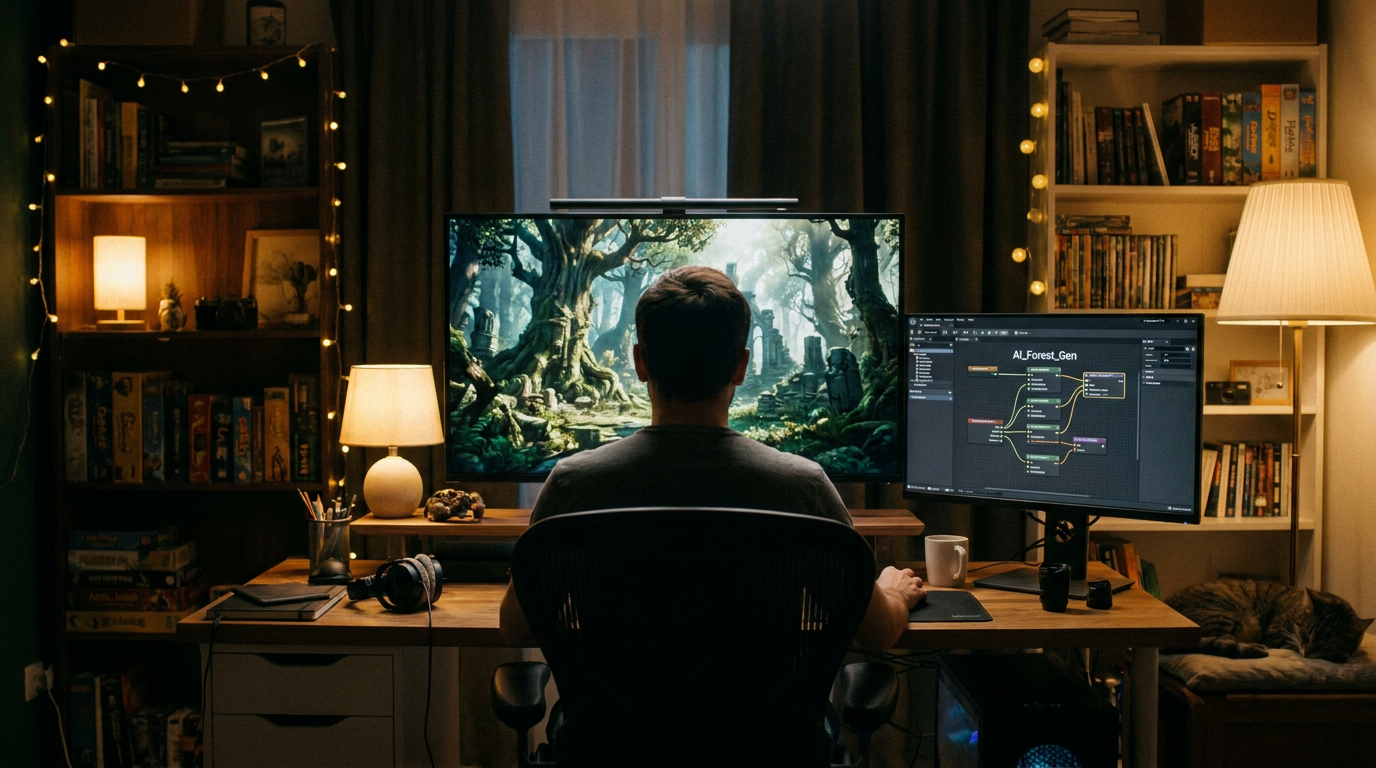
New AI tools for 3D modeling, coding, and dynamic NPCs are dismantling the traditional resource barriers of game development, allowing small indie teams to create massive, immersive experiences.
By Factlen Editorial Team
- Indie Developers
- View AI as a democratizing force that removes financial and technical barriers, allowing them to build ambitious games without a publisher.
- AI Tool Creators
- Focus on building seamless, in-engine pipelines that automate tedious technical work like retopology and rigging.
- Traditional Game Artists
- Emphasize the necessity of human oversight for style cohesion and raise ethical concerns regarding the training data used for AI models.
What's not represented
- · AAA Studio Executives
- · Game Quality Assurance (QA) Testers
Why this matters
For decades, the scope of a video game was strictly limited by the size of its studio's budget and art department. By automating the most labor-intensive parts of development, AI is democratizing world-building, paving the way for a renaissance of highly personalized, niche games that major publishers would never risk funding.
Key points
- Generative AI tools are allowing solo developers to create AA-quality games by automating labor-intensive tasks.
- Platforms like Meshy and Tripo can generate, texture, and rig 3D models from text prompts in minutes.
- LLM-powered NPCs are replacing static dialogue trees, enabling dynamic, unscripted interactions with players.
- AI acts as a co-pilot rather than a replacement, requiring human developers to direct the vision and clean up outputs.
- The democratization of game development is expected to lead to a surge in highly personalized, niche indie games.
Five years ago, shipping a solo video game meant months of grinding work or making heavy compromises on quality and scope. You either had a massive team and a multi-million dollar budget, or you had serious limitations on what you could build. Most talented developers with brilliant ideas never made it past the concept phase, not because they lacked talent, but because they lacked the sheer manpower required to model, texture, animate, and code a virtual world. [1] Today, that equation has completely changed. The barrier to entry for game development has shifted from resources to pure imagination. [7][1][7]
The rise of generative AI has quietly handed solo developers and small indie studios a superpower that no one in the industry fully anticipated. What was once a prohibitive barrier has become a bridge. Roles that traditionally required dedicated specialists—3D artists, composers, writers, and animators—can now be handled or significantly accelerated by AI tools accessible to anyone with a laptop. [1] The results are already showing up on digital storefronts, with indie titles built by one or two people boasting production quality that would have been impossible without a full studio just a few years ago. [1, 7][1][7]
Crucially, this technological shift is not about AI replacing the game developer. Instead, it elevates the solo creator to the role of a director. [6] The AI does not know what makes a game fun, how to balance a combat encounter, or how to pace a narrative. It simply acts as an ultra-fast assistant that builds the raw materials. The developer is still the visionary who must assemble these generated pieces into a cohesive, engaging experience. [7] By automating the tedious manual labor, creators can spend their energy on design, polish, and gameplay mechanics. [6][6][7]
The most significant bottleneck in modern game development has always been 3D asset creation. Building a single prop—like a fantasy sword or a sci-fi control panel—traditionally requires hours of manual modeling, UV unwrapping, and texturing in software like Blender or Maya. [2] When a game requires thousands of these unique assets to populate a world, the time investment becomes insurmountable for a solo developer. [7] Generative AI has attacked this bottleneck directly, reducing the asset creation phase by up to 50 percent for many indie teams. [2][2][7]

Platforms like Meshy, Tripo, and 3D AI Studio now allow developers to generate detailed 3D models from simple text prompts or reference images in a matter of seconds. [2, 5] A developer can type "ancient glowing runestone covered in moss," and the AI will output a fully formed 3D mesh. While the initial output isn't always flawless, it provides a massive head start. Instead of staring at a blank canvas, the developer is refining and polishing a model that already has the correct proportions and visual language. [2][2][5]
However, generating a 3D shape is only the first step. For an asset to be truly "game-ready," it needs proper texturing and topology. Modern AI tools now automatically generate Physically Based Rendering (PBR) textures, ensuring that the asset reacts realistically to in-game lighting, shadows, and reflections. [2] Furthermore, the best platforms include a crucial "retopology" step, which cleans up the messy, high-polygon output of the AI into a streamlined, efficient mesh that won't crash a game engine. [2, 5][2][5]
Once a character model is generated, it needs to move. Traditionally, this required a highly technical process called rigging—building a digital skeleton inside the model and manually painting "weights" to dictate how the 3D mesh bends at the joints. [7] Today, AI tools feature auto-rigging capabilities that analyze the geometry of a generated character and instantly apply a functional skeleton. [2, 3] Developers can then seamlessly apply hundreds of pre-made animations, turning a static text prompt into a running, jumping, and attacking hero in under five minutes. [2][2][3][7]
[7] Today, AI tools feature auto-rigging capabilities that analyze the geometry of a generated character and instantly apply a functional skeleton.
This automation extends to 2D games as well. While generic AI art generators often struggle with the specific requirements of game sprites, specialized tools like PixelLab have emerged to fill the gap. [3] These platforms generate usable, cohesive sprite sheets and tilemaps, allowing solo developers to create sprawling 2D levels and fully animated retro characters without needing to draw every single frame of a walk cycle by hand. [3][3]

Beyond visuals, AI is fundamentally changing how players interact with game worlds, particularly through the evolution of Non-Player Characters (NPCs). For decades, video games have relied on scripted, stilted dialogue trees. [4] A player approaches an NPC, clicks through a handful of pre-written text options, and receives a predictable response. This system, while functional, often breaks immersion and limits the player's ability to truly roleplay or experiment within the game's narrative. [4, 7][4][7]
By integrating Large Language Models (LLMs) directly into game engines, platforms like Inworld AI and Artificial Agency are giving NPCs the ability to think, remember, and improvise. [4] Developers can assign an NPC a specific personality, backstory, and set of motivations, acting more like a theater director than a scriptwriter. [4] When a player speaks to the NPC—either through text or voice—the character generates a unique, context-aware response in real-time, completely unscripted. [4][4]
This technology is already powering innovative indie titles. In the multiplayer game "Retail Mage," players run a magical furniture store and interact with AI-driven customers. [4] Because the NPCs are not bound by a script, players can come up with wildly creative solutions to problems—like deconstructing a chair for parts or writing a custom note to a shopper—and the AI characters will react realistically to these unprogrammed actions. [4] It creates a level of emergent gameplay that was previously impossible. [7][4][7]
On the technical side, AI is also assisting with the actual programming of the game. Writing code for complex game logic, inventory systems, or enemy pathfinding can be daunting for artists or designers who lack a formal computer science background. [7] AI code assistants like GitHub Copilot and in-engine agents like Summer Engine (built for the Godot engine) act as pair programmers, suggesting logic, fixing syntax errors, and writing boilerplate code on the fly. [5, 6][5][6][7]

Despite these massive leaps, the concept of a fully automated, "one-click" game remains a myth. The reality of AI game development in 2026 is that it requires a heavy human touch. [5] Raw AI outputs, whether 3D models or code snippets, often contain subtle flaws. A generated mesh might have a broken collision shape that allows players to walk through walls, or an AI-written script might introduce a memory leak that slows the game down. [5, 6][5][6]
Maintaining a cohesive art style is another major challenge. If a developer generates a sci-fi character in one tool and a futuristic vehicle in another, the two assets might clash visually when placed in the same scene. [6] Successful indie developers use AI for rapid iteration and prototyping, but they rely on their own artistic eye to unify the textures, adjust the lighting, and ensure the entire game feels like it belongs in a single, handcrafted universe. [6, 7][6][7]
The rapid adoption of these tools has also sparked intense ethical and legal debates within the industry. A recent Game Developers Conference report found that 31 percent of developers are already using generative AI, with indie studios leading the charge. [4] However, many traditional artists express valid concerns about how the foundational AI models were trained, often pointing to the unauthorized scraping of copyrighted artwork. [4, 7] In response, the industry is slowly shifting toward platforms that offer commercially safe, ethically sourced generation. [7][4][7]

Ultimately, the integration of AI into game development is leveling a playing field that has been tilted toward massive corporations for decades. AAA studios will undoubtedly use these tools to make their blockbusters even bigger, but the most profound impact will be felt at the indie level. [7] We are entering an era where a single person with a unique vision can build a sprawling, reactive, and visually stunning game without needing a publisher's funding. [1, 7][1][7]
This democratization of world-building means players can expect a surge of highly personalized, experimental, and niche games that traditional studios would never risk greenlighting. [7] The barrier to entry has been permanently lowered. For the next generation of game creators, the question is no longer whether they have the budget to build their dream game, but whether their imagination is vast enough to fill it. [1, 7][1][7]
How we got here
Pre-2023
Indie game development is heavily bottlenecked by the need for dedicated 3D artists, animators, and writers.
2023-2024
Early text-to-3D models emerge but struggle with topology and game-engine compatibility.
2025
Platforms introduce auto-rigging and retopology, making AI-generated assets viable for actual game production.
2026
In-engine AI assistants and LLM-powered NPCs become standard tools for indie developers, drastically reducing production times.
Viewpoints in depth
Indie Developers
View AI as a democratizing force that removes financial and technical barriers.
For solo creators and small teams, the primary value of AI is empowerment. Historically, a developer with a brilliant idea for a sprawling role-playing game would have to abandon the project because they couldn't afford a team of 3D modelers and animators. By utilizing generative AI to handle the heavy lifting of asset creation and boilerplate coding, these developers can punch far above their weight class, focusing their limited time on gameplay mechanics and creative direction rather than manual labor.
AI Tool Creators
Focus on building seamless, in-engine pipelines that automate tedious technical work.
The companies building these platforms argue that AI's true potential lies in pipeline integration. Rather than forcing developers to bounce between multiple external websites to generate, clean, and rig a model, tool creators are building plugins directly into engines like Unity and Godot. Their goal is to make the transition from a text prompt to a fully animated, game-ready asset as frictionless as possible, effectively acting as an automated technical art department.
Traditional Game Artists
Emphasize the necessity of human oversight for style cohesion and raise ethical concerns.
Veteran game artists point out that while AI can generate impressive standalone assets, it struggles to maintain a cohesive art direction across an entire game. They argue that raw AI outputs still require significant human cleanup to fix broken topology and collision meshes. Furthermore, many artists remain deeply concerned about the ethical implications of the technology, noting that the foundational models powering these tools were often trained on copyrighted artwork without the original creators' consent or compensation.
What we don't know
- How digital storefronts like Steam will handle the influx of games built entirely with AI assets.
- Whether copyright law will evolve to protect the specific art styles of human creators from being replicated by AI tools.
- How players will react long-term to LLM-powered NPCs, and whether the novelty of unscripted dialogue will wear off.
Key terms
- Procedural Content Generation (PCG)
- The algorithmic creation of game data, such as levels or textures, rather than manual design.
- PBR Textures
- Physically Based Rendering; textures that react to in-game lighting exactly as materials would in the real world.
- Retopology
- The process of simplifying a 3D model's polygon mesh so it runs smoothly in a game engine without losing visual detail.
- Auto-rigging
- Automatically applying a digital skeleton to a 3D model so it can be animated to walk, run, or attack.
- Behavior Trees
- A programming structure used to design complex, branching decision-making logic for non-player characters.
Frequently asked
Can AI build an entire video game for me?
No. While AI can generate individual assets, write code snippets, and power NPC dialogue, a human developer is still required to assemble the pieces, design the gameplay loop, and ensure it is actually fun to play.
Are AI-generated 3D models ready to drop straight into a game?
Rarely. Most raw AI outputs require a process called retopology to reduce their polygon count, as well as manual adjustments to ensure they have proper collision physics and match the game's art style.
How do AI NPCs differ from traditional video game characters?
Traditional NPCs rely on pre-written dialogue trees and scripted paths. AI NPCs use large language models to understand player input, remember past interactions, and improvise responses in real-time.
What game engines support these new AI tools?
Major engines like Unity, Unreal Engine, and Godot all feature native AI plugins or dedicated in-engine assistants that integrate directly into the developer's workflow.
Sources
Source coverage
7 outlets
3 viewpoints surfaced







[1]TechVerniaIndie Developers
What AI Has Changed, Layer by Layer in Game Dev
Read on TechVernia →[2]3D AI StudioAI Tool Creators
Best AI Game Asset Generators in 2026
Read on 3D AI Studio →[3]Gamedev AI HubIndie Developers
Best AI Tools for Indie Game Developers (2026)
Read on Gamedev AI Hub →[4]The IndependentTraditional Game Artists
How generative AI is changing video game NPCs
Read on The Independent →[5]Summer EngineAI Tool Creators
Best AI Tools for Game Development in 2026
Read on Summer Engine →[6]Teach AI ToolsAI Tool Creators
Core Categories of AI Game Development Tools 2026
Read on Teach AI Tools →[7]Factlen Editorial TeamTraditional Game Artists
Synthesis by Factlen editorial team
Read on Factlen Editorial Team →

More in ai
See all 7 stories →Bioacoustics
How AI is Decoding the Hidden Languages of Earth's Animals
6 sources

Open-Source AI
Open-Source AI Hits Frontier Milestone as New Models Democratize Local Computing
7 sources

On-Device AI
How Small Language Models Are Moving AI From the Cloud to Your Pocket
7 sources

Enterprise AI
The Economics of Small Language Models: Why Enterprise AI is Downsizing in 2026
9 sources

Every angle. Every day.
Get ai stories with full source coverage and perspective breakdowns delivered to your inbox.