
Open-Weight AI Models Surpass Proprietary Giants in Landmark June Releases
A wave of open-weight AI models released in June 2026 has matched or exceeded the performance of proprietary systems on key software engineering benchmarks. The releases mark a turning point in AI accessibility, allowing developers to run frontier-tier models locally.
By Factlen Editorial Team

- Open-Source Developers
- Advocates for decentralized AI emphasize the freedom to build without API restrictions.
- Enterprise Architects
- Corporate IT leaders prioritize licensing compliance and data security.
- Global AI Researchers
- Academics and analysts focus on the geopolitical equalization of AI capabilities.
What's not represented
- · Hardware Manufacturers
- · Cloud Service Providers
Why this matters
By democratizing access to frontier-level artificial intelligence, this wave of open-weight models allows startups, researchers, and enterprise teams to build highly secure, custom AI agents on their own hardware. This dramatically lowers the barrier to entry for advanced software development and breaks the dependency on costly, cloud-based APIs.
Key points
- MiniMax M3 launched on June 1, scoring 59.0% on SWE-Bench Pro to beat several proprietary models.
- Kimi K2.7 Code and GLM-5.2 followed rapidly, pushing the boundaries of token efficiency and context size.
- The U.S.-China AI performance gap has effectively closed, according to Stanford's 2026 AI Index.
- New consumer AI hardware allows developers to run these massive models locally, ensuring data privacy.
- Permissive licensing options like Nemotron 3 Ultra are accelerating enterprise adoption of open models.
The artificial intelligence landscape crossed a historic threshold in June 2026 as a rapid succession of open-weight model releases matched—and in some cases surpassed—the capabilities of the industry's most powerful proprietary systems. Led by a wave of highly efficient architectures from global research labs, the developer community is witnessing a monumental shift away from standard dense transformer configurations. Instead of relying exclusively on costly, cloud-based APIs from major tech giants, developers now have access to frontier-tier models that can be downloaded, modified, and deployed entirely within their own infrastructure.[1][4]
The catalyst for this summer's open-source surge was the June 1 launch of MiniMax M3. Billed as the first open-weight model to combine advanced software engineering capabilities with native multi-modal computer use, M3 introduced a massive one-million-token context window. Built entirely on the novel MiniMax Sparse Attention (MSA) architecture, the model is designed to process dense streams of video and image inputs while directly interacting with operating system interfaces, effectively allowing it to see and operate a computer much like a human user.[1][2]
Benchmark evaluations for MiniMax M3 immediately sent ripples through the AI community. The model registered a 59.0% score on SWE-Bench Pro, a rigorous evaluation framework that tests an AI's ability to solve real-world GitHub issues. This score edged past several premium closed-source offerings, including GPT-5.5 and Gemini 3.1 Pro. By achieving this milestone, MiniMax M3 proved that open-weight models could not only compete in general knowledge tasks but also dominate in complex, agentic software engineering.[1][2][3]

The momentum only accelerated as the month progressed. On June 12, Moonshot AI released Kimi K2.7 Code, a highly token-efficient model built on a one-trillion-parameter Mixture-of-Experts (MoE) architecture. By activating just 32 billion parameters per token, K2.7 Code delivers roughly 30% fewer reasoning tokens than its predecessor while scoring higher on internal coding benchmarks and leading the pack on tool-use accuracy.[3]
Just one day later, Z.ai unveiled GLM-5.2, inheriting a 744-billion-parameter architecture and introducing two new thinking-effort levels for complex reasoning tasks. Like MiniMax M3, GLM-5.2 features a one-million-token context window, making it capable of ingesting massive codebases or entire libraries of documentation in a single prompt.[3]
Just one day later, Z.ai unveiled GLM-5.2, inheriting a 744-billion-parameter architecture and introducing two new thinking-effort levels for complex reasoning tasks.
This rapid cadence of releases underscores a broader geopolitical and technological trend highlighted in Stanford University's 2026 AI Index Report. The report noted that the performance gap between U.S. and Chinese AI models has effectively closed, with models from both regions trading the lead multiple times since early 2025. The proliferation of top-tier open models from labs like DeepSeek, Qwen, and MiniMax demonstrates that the open-model movement is now a truly global phenomenon, democratizing access to cutting-edge technology.[2][6]

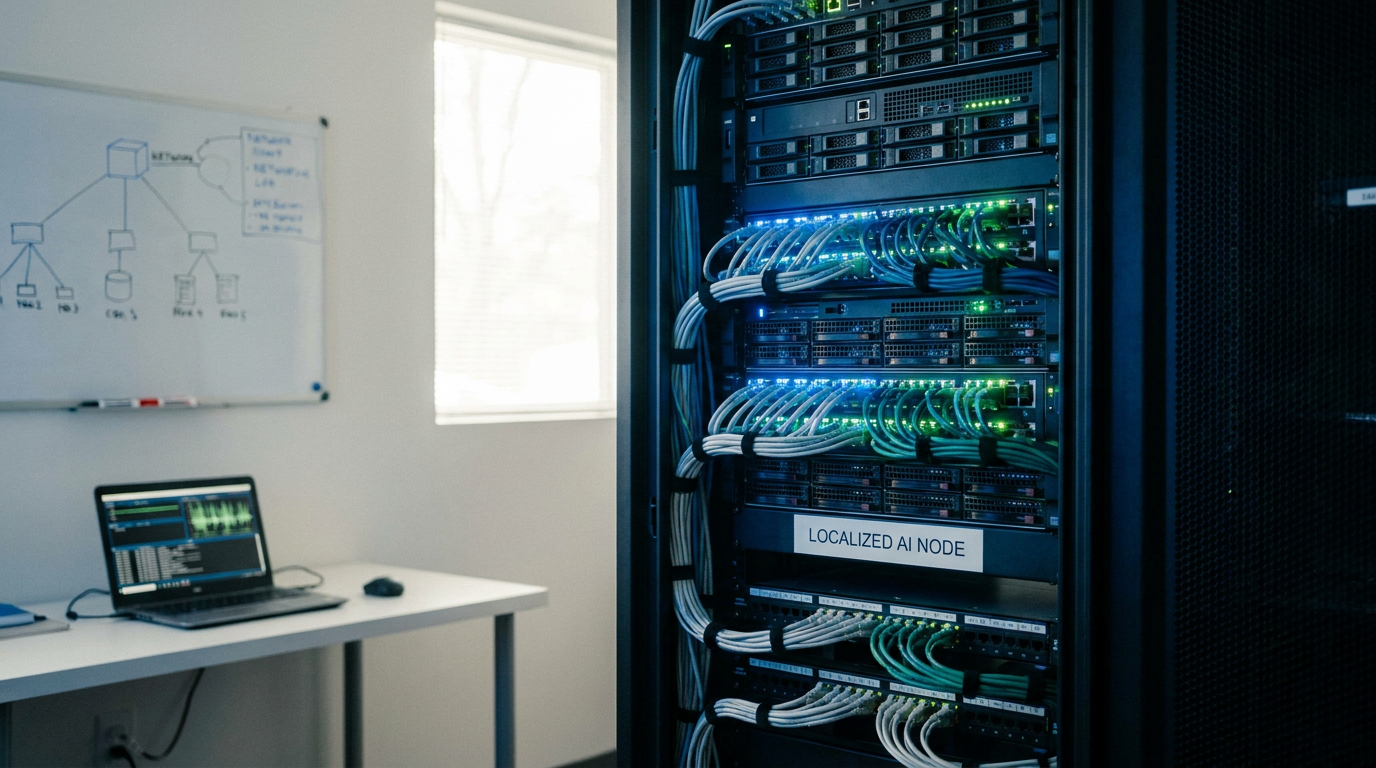
Software advances alone, however, do not fully explain the current shift toward localized AI; hardware has evolved to meet the moment. The recent launch of consumer-grade AI accelerators, such as the NVIDIA RTX Spark Superchip, has brought unprecedented compute power directly to workstation laptops. Combining CPU and GPU capabilities with up to 128 gigabytes of unified memory, these systems allow developers to run massive open-weight models locally, ensuring complete data privacy and zero API latency.[1]
As enterprise adoption of these models accelerates, licensing has become a critical differentiator. While many of the new models utilize Modified MIT licenses that include commercial thresholds or attribution requirements, alternatives like NVIDIA's Nemotron 3 Ultra offer fully permissive terms. Released in early June, the 550-billion-parameter Nemotron 3 Ultra allows commercial use with no user count or revenue thresholds, providing a compliance-friendly option for large enterprise teams.[3][5]

The industry has also matured in how it categorizes these releases. The Open Source Initiative's recently formalized Open Source AI Definition (OSAID) helps distinguish between fully open-source models—where training data and pipelines are public—and open-weight models, which release only the final neural network weights. While models like MiniMax M3 and Llama 4 fall into the latter category, their open weights are more than sufficient to fuel the current explosion of local AI development.[5]
Looking ahead, the AI ecosystem is rapidly migrating toward architectural diversification and localized execution networks. By utilizing frameworks that integrate open-weight models with local hardware, developers are building highly secure, context-aware systems that operate independently of major cloud providers. This decentralization of AI capabilities promises to accelerate innovation, lower costs, and put frontier-level intelligence into the hands of anyone with a capable computer.[1][4]
Despite the open-source surge, proprietary labs continue to push the absolute boundaries of artificial intelligence. In early June, Anthropic released Claude Fable 5, its most capable publicly available model, alongside a restricted version for trusted partners. However, as open-weight models consistently match the performance of these proprietary giants on specialized tasks like coding, the premium once commanded by closed APIs is facing unprecedented downward pressure.[4][7]
How we got here
Early 2025
U.S. and Chinese AI models begin trading the lead in global performance benchmarks.
April 2025
Meta releases the Llama 4 generation, introducing native multimodality to the open-weight ecosystem.
June 1, 2026
MiniMax M3 launches, becoming the first open-weight model to combine frontier coding with a 1-million-token context.
June 4, 2026
NVIDIA releases Nemotron 3 Ultra, offering a massive 550-billion-parameter model under a fully permissive commercial license.
June 12, 2026
Moonshot AI releases Kimi K2.7 Code, setting new standards for token efficiency in coding tasks.
June 13, 2026
Z.ai unveils GLM-5.2, featuring a 744-billion-parameter architecture and a 1-million-token context window.
Viewpoints in depth
Open-Source Developers
Advocates for decentralized AI emphasize the freedom to build without API restrictions.
For the developer community, the June 2026 releases represent liberation from cloud dependency. By running models like MiniMax M3 locally, developers eliminate API latency, avoid subscription costs, and ensure absolute data privacy. This camp argues that open-weight models are essential for fostering grassroots innovation, allowing startups to build custom, agentic workflows that would be prohibitively expensive to run on proprietary systems.
Enterprise Architects
Corporate IT leaders prioritize licensing compliance and data security.
Enterprise teams view the open-weight boom through the lens of risk and compliance. While they are eager to deploy models internally to protect proprietary company data, they remain cautious about the Modified MIT licenses used by some international labs. For this group, fully permissive models like NVIDIA's Nemotron 3 Ultra are the true breakthroughs, offering a legally clear path to integrating frontier-level AI into commercial products without triggering revenue-sharing thresholds.
Global AI Researchers
Academics and analysts focus on the geopolitical equalization of AI capabilities.
Researchers tracking the global AI race note that the traditional dominance of a few Silicon Valley labs has fractured. As highlighted by Stanford's AI Index, the rapid iteration of models from international teams proves that algorithmic breakthroughs are no longer geographically constrained. This camp views the proliferation of open-weight models as a net positive for global science, providing researchers worldwide with the tools needed to accelerate discoveries in medicine, physics, and climate science.
What we don't know
- How major cloud providers will adjust their pricing models in response to the availability of frontier-tier open-weight models.
- Whether the rapid pace of open-source AI development will prompt new regulatory frameworks for locally deployed models.
Key terms
- Open-weight
- AI models that release their trained parameters to the public, allowing anyone to run them, though the training data is kept private.
- SWE-Bench Pro
- A rigorous evaluation framework that tests an AI model's ability to solve real-world software engineering issues from GitHub.
- Mixture-of-Experts (MoE)
- An AI architecture that divides a model into specialized sub-networks, activating only the necessary experts for a given prompt to save computing power.
- Context window
- The maximum amount of text, code, or data an AI model can process and remember in a single interaction.
- Sparse Attention Mechanism
- A highly efficient way for AI models to process massive amounts of data, such as video or million-token documents, without running out of memory.
Frequently asked
What is an open-weight AI model?
An open-weight model is one where the final, trained neural network (the weights) is freely available to download and run, even though the original training data remains private.
Can I run these new models on a standard laptop?
While the largest models require specialized hardware, new consumer AI accelerators like the RTX Spark Superchip allow high-end workstation laptops to run these models locally.
How does MiniMax M3 compare to proprietary models?
On specific software engineering benchmarks like SWE-Bench Pro, MiniMax M3 has scored 59.0%, slightly outperforming proprietary models like GPT-5.5 in coding tasks.
Are these models free to use commercially?
It depends on the license. Some use a Modified MIT license with user or revenue thresholds, while others, like Nemotron 3 Ultra, are fully permissive for commercial use.
Sources
Source coverage
7 outlets
3 viewpoints surfaced





[1]DevFlokersOpen-Source Developers
Open-Source AI Projects, New Model Releases & Research Papers: June 2026 Roundup
Read on DevFlokers →[2]Kilo AIOpen-Source Developers
The best open-source coding models in 2026
Read on Kilo AI →[3]BuildFastWithAIEnterprise Architects
What is the best open-source AI model in June 2026?
Read on BuildFastWithAI →[4]LLM StatsGlobal AI Researchers
The Pace of AI Development
Read on LLM Stats →[5]Thunder ComputeEnterprise Architects
Open source large language models have closed the gap
Read on Thunder Compute →[6]Stanford HAIGlobal AI Researchers
2026 AI Index Report
Read on Stanford HAI →[7]IBMGlobal AI Researchers
Anthropic launches most powerful AI model yet, with new safety guardrails
Read on IBM →

More in ai
See all 5 stories →

Every angle. Every day.
Get ai stories with full source coverage and perspective breakdowns delivered to your inbox.