
OLED vs. Mini-LED in 2026: Which Premium TV Technology Actually Wins?
With OLED panels hitting 4,500 nits and Mini-LEDs adopting pure RGB backlights, the 2026 television market offers the most competitive flagship displays in history. Here is how to choose the right panel for your living room.
By Factlen Editorial Team
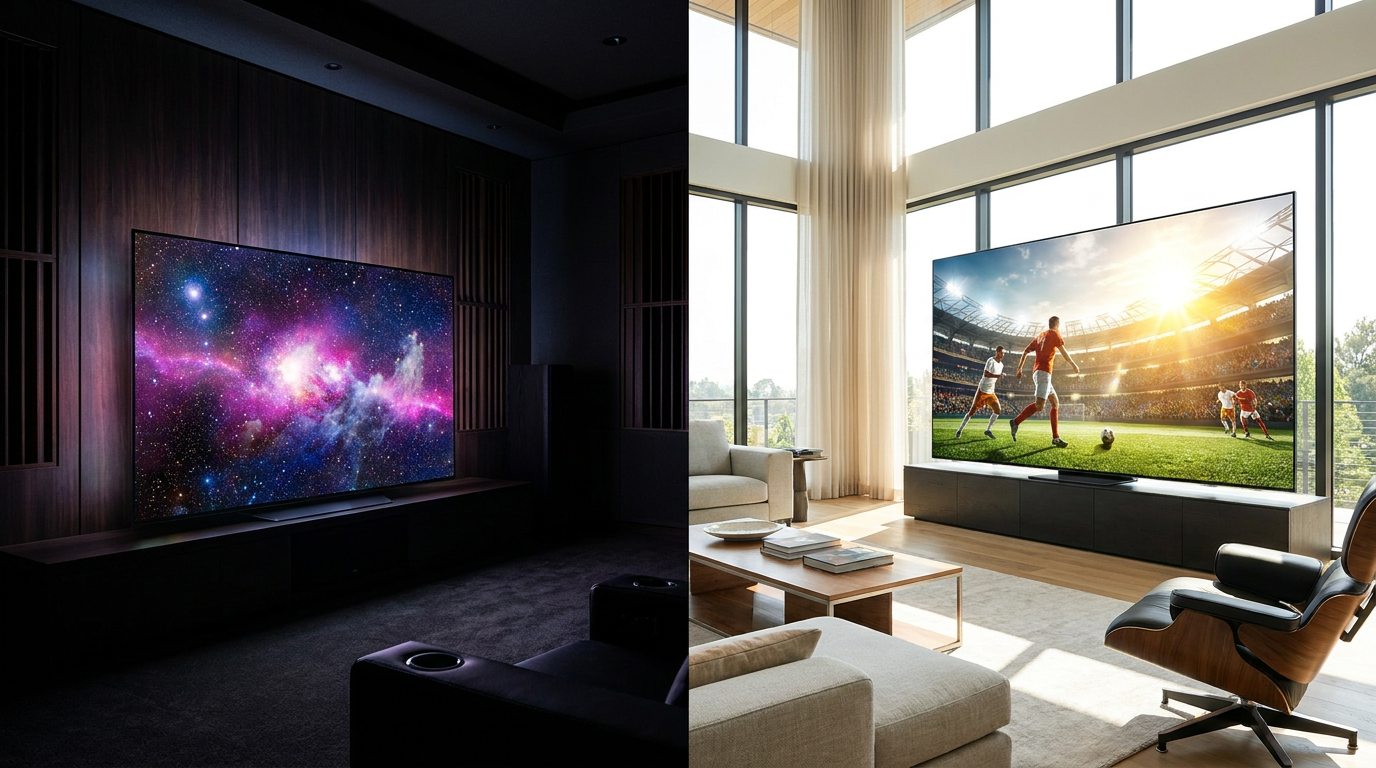
- Cinematic Purists
- Value perfect blacks, infinite contrast, and pixel-level precision for dark-room movie viewing.
- Bright-Room Enthusiasts
- Value raw brightness, glare reduction, and vibrant colors in sunlit environments.
- Value & Scale Maximizers
- Prioritize massive screen sizes (85 inches and above) and cost-effectiveness without sacrificing premium features.
What's not represented
- · Budget-conscious buyers seeking sub-$500 models
- · Commercial display installers
Why this matters
A flagship television is a decade-long investment for most households. Understanding the exact trade-offs between OLED and Mini-LED ensures you don't spend thousands of dollars on a screen that fights against your living room's natural lighting.
Key points
- OLED technology remains the undisputed champion for dark rooms, offering perfect blacks and infinite contrast.
- 2026 OLED panels utilize Tandem and QD-OLED tech to hit 4,500 nits in small highlights, though full-screen brightness remains limited.
- Mini-LED TVs now use pure RGB backlights, drastically improving color accuracy and reducing the 'blooming' halo effect.
- Mini-LED is the superior choice for bright, sunlit rooms and offers massive screen sizes (up to 115 inches) at much lower prices than OLED.
The television market in 2026 has reached a spectacular inflection point. For the past decade, the buying advice for premium displays was relatively simple: purchase an OLED for dark rooms and cinematic perfection, or buy an LED for bright rooms and budget constraints. But a wave of technological breakthroughs has completely blurred those lines, turning the flagship TV segment into a fierce, high-stakes arms race. Consumers are no longer choosing between a 'good' and 'bad' technology; they are choosing between two distinct flavors of visual perfection, each armed with new innovations designed to eliminate their historical weaknesses.
On one side, OLED technology has shattered its historical brightness limits. Panel manufacturers have introduced Tandem OLED architectures—which stack multiple light-emitting layers to multiply output—and refined Quantum Dot (QD-OLED) materials that push peak luminance to astonishing new heights. On the other side, Mini-LED has evolved beyond its traditional blue-light-and-phosphor roots. The latest premium models are adopting pure RGB backlights, utilizing dedicated red, green, and blue diodes. This architectural shift drastically improves color accuracy, enhances off-angle viewing, and nearly eliminates the dreaded 'blooming' effect that plagued earlier backlit televisions.[3][4][5][7]
Choosing between the two is no longer a matter of simply picking the 'best' picture quality, because both technologies now deliver reference-level visuals that would have seemed impossible just three years ago. Instead, the decision hinges entirely on your viewing environment, your screen-size ambitions, and your tolerance for specific visual trade-offs. To make the right investment, buyers need to look past the marketing acronyms and understand exactly how these panels perform in real-world living rooms, rather than on a perfectly calibrated showroom floor.

**The Case For OLED:** The fundamental advantage of Organic Light-Emitting Diode (OLED) technology remains unchanged—every single pixel generates its own light and can turn off completely independently of its neighbors. This delivers infinite contrast, perfect, inky blacks, and a level of three-dimensional depth that backlit televisions simply cannot replicate. In 2026, the addition of Tandem OLED and Micro Lens Array (MLA) technology has supercharged this formula, allowing the panels to drive significantly more light toward the viewer without increasing the risk of panel degradation or permanent image retention.
**The Case Against OLED:** Despite these massive leaps, OLED still cannot match the full-screen brightness of a premium Mini-LED. While small highlights like a flashlight or a star in a night sky can now reach blinding levels, the television must aggressively dim the entire panel when displaying a bright, full-screen image—like a hockey rink or a snow-covered landscape—to prevent overheating. Furthermore, OLED panels become exponentially more expensive once you cross the 83-inch threshold, making truly massive home theater setups prohibitively costly for most consumers.
**The Evidence for OLED:** Independent testing by display analysts and tech publications confirms that 2026 flagship models are hitting peak highlight brightnesses between 3,000 and 4,500 nits in small, localized windows. However, their full-screen sustained brightness still hovers around 300 to 450 nits. Reviewers consistently note that in a light-controlled room, the pixel-level precision of QD-OLED provides the most accurate and vibrant color volume available on the consumer market, rendering HDR movies exactly as the director intended without any light bleeding into the cinematic black bars.[1][2]

However, their full-screen sustained brightness still hovers around 300 to 450 nits.
**OLED Fits Well When:** Your primary viewing happens in the evening, you have dimmable lighting, or you are building a dedicated home theater environment. It is the undisputed champion for cinematic movie watching, high-end console gaming, and seating arrangements where viewers are spread out at wide angles across the room. **OLED Does Not Fit When:** Your living room features floor-to-ceiling windows, you watch predominantly daytime sports with static score bugs, or you want a 100-inch screen without taking out a second mortgage to finance the purchase.
**The Case For Mini-LED:** Mini-LED televisions utilize thousands of microscopic light-emitting diodes grouped into localized dimming zones behind an LCD panel. The 2026 breakthrough is 'RGB Mini-LED' (branded variously as True RGB or SQD-Mini LED), which replaces standard white or blue backlights with dedicated red, green, and blue diodes. This allows for retina-searing brightness, massive color volume, and complete immunity to permanent image retention or 'burn-in.' It also allows manufacturers to scale the panels to massive sizes with relative ease.
**The Case Against Mini-LED:** Because Mini-LEDs rely on dimming zones rather than individual pixels, they cannot perfectly isolate light down to the microscopic level. When a bright object appears on a pitch-black background—such as white subtitles on a letterboxed movie or a bright moon in a dark sky—some light inevitably bleeds into the surrounding dark areas, creating a halo effect known as 'blooming.' Additionally, the picture quality, contrast, and color saturation often degrade if you sit too far off-center from the screen.

**The Evidence for Mini-LED:** Data from 2026 showcases by major manufacturers reveal that premium Mini-LEDs are achieving peak brightness levels of 2,500 to an astonishing 10,000 nits, with full-screen brightness easily sustaining over 1,000 nits. Tech publications report that the new RGB backlighting algorithms have reduced blooming to near-imperceptible levels in standard viewing, though it can still be spotted in extreme torture-test scenes in pitch-black rooms. The sheer punch of the image in a brightly lit room is universally praised as unmatched.[4][5][6]
**Mini-LED Fits Well When:** You have a sun-drenched living room, you frequently host daytime sports watch parties, or you leave news channels with static tickers running all day. It is also the only realistic choice if you want a truly massive display; 98-inch, 100-inch, and even 115-inch Mini-LEDs are now readily available at prices that dramatically undercut their OLED equivalents. **Mini-LED Does Not Fit When:** You are a cinematic purist who watches sci-fi or horror films in total darkness and cannot tolerate even a hint of subtitle blooming.
For gamers, the battle between the two technologies is incredibly tight and depends heavily on the types of games you play. OLED panels offer near-instantaneous response times (often under 1 millisecond), resulting in zero motion blur during fast-paced competitive shooters or racing games. However, Mini-LEDs counter with raw HDR impact, making the sun glare in an open-world RPG feel genuinely blinding and immersive. Both technologies now routinely support 144Hz to 165Hz refresh rates, Variable Refresh Rate (VRR), and multiple HDMI 2.1 ports for next-generation consoles and high-end PCs.
Ultimately, the deciding factor for many 2026 buyers will be the price-to-size ratio. If your budget is capped and you are aiming for a standard 55-inch or 65-inch display, OLED and Mini-LED are fiercely competitive in price, making the decision purely about lighting and viewing habits. But as you scale up to 85 inches and beyond, the manufacturing yields for OLED panels drop, sending prices skyrocketing. In the ultra-large format category, Mini-LED offers an unbeatable combination of cinematic scale and premium performance without the astronomical premium.[8]

The era of compromising on picture quality is officially over. If you want the absolute pinnacle of contrast, perfect black levels, and pixel-perfect precision for movie night, OLED remains the undisputed king of the dark room. If you need a television that can overpower the afternoon sun, deliver massive cinematic scale, and run all day without a single thought about image retention, the new generation of RGB Mini-LED is the ultimate champion of the modern, multi-use living room. Either way, consumers have never had better options.
How we got here
2013
The first consumer OLED televisions launch, establishing a new benchmark for perfect black levels.
2021
Mini-LED technology goes mainstream, offering a brighter alternative to traditional LED LCDs.
2023
Micro Lens Array (MLA) and QD-OLED technologies are introduced, significantly boosting OLED brightness.
2025
The first RGB Mini-LED prototypes are showcased, promising to eliminate color crosstalk and blooming.
Jan 2026
Manufacturers unveil 4,500-nit OLEDs and 10,000-nit RGB Mini-LEDs at CES, setting a new standard for flagship displays.
Viewpoints in depth
Cinematic Purists
Advocates for OLED technology who prioritize perfect contrast and director-intended accuracy.
For home theater enthusiasts and cinematic purists, the television is a canvas that must perfectly replicate the director's vision. This camp argues that raw brightness is secondary to contrast and pixel-level control. Because OLED panels can turn off individual pixels, they deliver a three-dimensional depth to dark scenes that backlit TVs simply cannot match. To a purist, even the slightest hint of blooming around a subtitle or a starfield breaks the immersion, making OLED the only acceptable choice for critical viewing.
Bright-Room Enthusiasts
Advocates for Mini-LED technology who prioritize raw brightness and glare reduction in everyday living spaces.
This perspective reflects the reality of modern, open-concept homes with abundant natural light. Bright-room enthusiasts argue that perfect black levels are irrelevant if the screen is too dim to overpower the glare from a nearby window. They champion the new generation of RGB Mini-LEDs because these panels can sustain massive full-screen brightness, making daytime sports, news, and gaming vibrant and easily visible without needing to draw the blackout curtains.
Value & Scale Maximizers
Buyers who prioritize massive screen sizes and cost-effectiveness over microscopic pixel perfection.
As the demand for 85-inch, 98-inch, and even 115-inch displays grows, this camp focuses on the price-to-size ratio. They argue that the immersive impact of a massive screen far outweighs the subtle contrast advantages of an OLED. Because OLED manufacturing yields drop precipitously at ultra-large sizes, Mini-LED has become the undisputed champion for buyers who want a true home cinema scale without paying the astronomical premium associated with massive organic panels.
What we don't know
- How the long-term durability of the new Tandem OLED architectures will hold up after 5+ years of heavy use.
- Whether the manufacturing costs of 83-inch+ OLED panels will ever drop enough to compete with ultra-large Mini-LEDs.
Key terms
- Tandem OLED
- An architecture that stacks multiple light-emitting layers on top of each other to increase brightness and extend the lifespan of the panel.
- RGB Mini-LED
- A backlighting system that uses dedicated red, green, and blue diodes instead of standard blue LEDs with a color filter, resulting in purer colors and higher brightness.
- Blooming
- A visual artifact on backlit TVs where light from a bright object bleeds into adjacent dark areas, creating a halo effect.
- Micro Lens Array (MLA)
- A microscopic layer of lenses placed over an OLED panel to focus scattered light toward the viewer, significantly boosting perceived brightness.
- QD-OLED
- Quantum Dot OLED; a hybrid technology that uses a blue OLED light source passed through a quantum dot layer to produce incredibly vibrant and pure colors.
Frequently asked
Does OLED still suffer from burn-in?
While the risk is never zero, 2026 OLEDs use advanced heat sinks, pixel-shifting algorithms, and Tandem architectures to drastically reduce the likelihood of permanent image retention under normal viewing conditions.
What is blooming on a Mini-LED TV?
Blooming is a halo effect that occurs when a bright object is displayed on a dark background. Because the backlight dimming zones are larger than individual pixels, some light bleeds into the surrounding dark areas.
Which TV is better for PS5 and Xbox gaming?
Both are excellent, but they serve different needs. OLED offers near-instant response times for competitive gaming, while Mini-LED provides blinding HDR highlights for immersive, open-world titles.
Why are OLED TVs so expensive at larger sizes?
Manufacturing large, flawless sheets of organic light-emitting material is incredibly difficult. As the screen size increases past 83 inches, the yield rate drops, making the panels significantly more expensive to produce than LCD-based Mini-LEDs.
Sources
Source coverage
8 outlets
3 viewpoints surfaced








[1]RtingsCinematic Purists
OLED vs Mini LED TVs
Read on Rtings →[2]What Hi-Fi?Cinematic Purists
MLA vs QD-OLED: which is better?
Read on What Hi-Fi? →[3]PC GamerBright-Room Enthusiasts
OLED brightness improvements 2026 TVs
Read on PC Gamer →[4]EngadgetBright-Room Enthusiasts
Sony teases its next-gen 'True RGB' Mini LED TV technology
Read on Engadget →[5]Hisense USAValue & Scale Maximizers
116UXS and the Four-Color RGB Revolution
Read on Hisense USA →[6]T3Bright-Room Enthusiasts
Hisense's RGB MiniLED TVs have to be seen to be believed
Read on T3 →[7]Data Wire SolutionsCinematic Purists
Tandem OLED vs QD-OLED vs Mini-LED
Read on Data Wire Solutions →[8]Factlen Editorial TeamValue & Scale Maximizers
Synthesis by Factlen editorial team
Read on Factlen Editorial Team →

Every angle. Every day.
Get shopping stories with full source coverage and perspective breakdowns delivered to your inbox.